
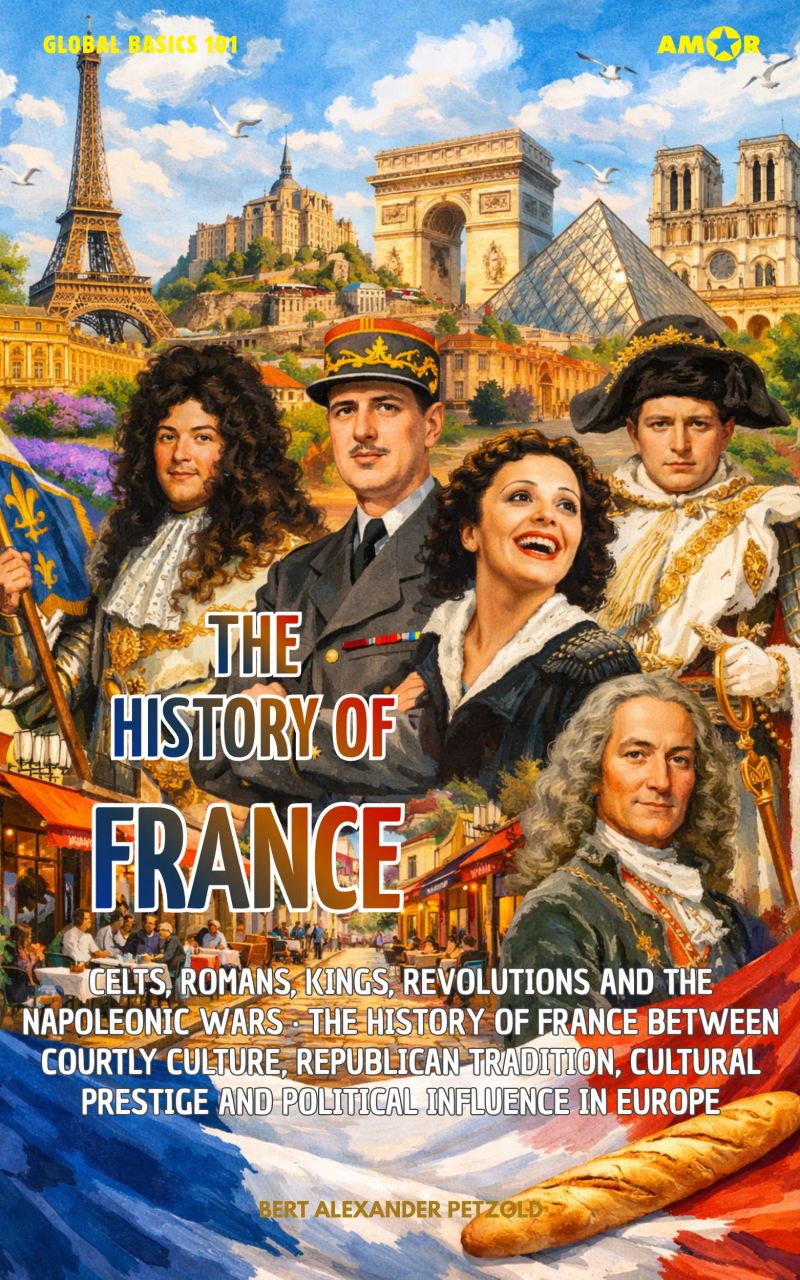
The History of France
Celts, Romans, kings, revolutions and the Napoleonic Wars · The history of France between courtly culture, republican tradition, cultural prestige and political influence in EuropeBy Bert Alexander Petzold


Length4h 50m
About this audiobook
Why did France become a country that shaped Europe’s history, politics and culture over the centuries more profoundly than almost any other nation? This book presents France as the cultural visionary of the new Europe and leads straight into a history full of upheavals, power struggles, ideas and moments of artistic brilliance. Anyone wishing to understand Europe will discover here the developments that made France an intellectual and political key power.
Bert Alexander Petzold invites the reader on a fact-rich, accessible, entertaining and clearly structured journey through time. From Gaul, conquered by the Romans in the first century BC and incorporated into their empire, to the upheavals following the end of the Roman Empire, a broad historical arc unfolds from which the later nation of France emerged. It quickly becomes clear that this country lay not only geographically at the heart of Europe, but also became one of the driving forces of European history.
In the Middle Ages, the Frankish Empire under Charlemagne shaped a legacy of enormous consequence. After the division of his empire, dynasties such as the Capetians, the Valois and the Bourbons influenced further developments. The Hundred Years’ War turned France in the fourteenth and fifteenth centuries into a central stage for the struggle for power and supremacy in Europe. History therefore appears here not as a mere sequence of dates, but as a living process in which statehood, identity and the European order were reshaped.
With the French Renaissance began a great flowering of art, literature and science under rulers such as Francis I and Henry IV. At the same time, religious conflicts between Catholics and Protestants shook the country. In the seventeenth century, France rose under Louis XIV to become a major political and cultural power. Versailles became the symbol of absolutist rule, while the centralisation of power and a succession of wars made visible France’s claim to supremacy in Europe.
A turning point of world-historical significance came with the French Revolution of 1789. The overthrow of the monarchy, the abolition of feudal rule and the Declaration of the Rights of Man and of the Citizen transformed both France and, far beyond its borders, political thought in Europe. Napoleon Bonaparte was followed by an era of ascent, expansion and profound upheaval. The nineteenth century, too, appears in this book as an age of economic modernisation and imperial violence, in which France forcibly conquered colonies in Africa, Asia and Oceania.
The twentieth century led France through the catastrophes of two world wars, through occupation, liberation, decolonisation and reconstruction. In the second half of the century, the country became a founding member of the European Union. To this day, Paris stands for the radiance of French art, literature, music, film and architecture. Bert Alexander Petzold combines historical precision with vivid presentation and makes this book a valuable read for all who wish to understand France in its full depth. The book is ideally suited to preparing for examinations leading to higher education entrance qualifications and for study at university.
Anyone wishing to understand France not merely as a travel destination but as one of the shaping forces of Europe will find here a well-founded, compelling and horizon-expanding account. Secure this book and discover France as a land of kings, revolutions, ideas and the arts, as the cultural visionary of the new Europe and as an indispensable key to understanding European history.
Audiobook details
GenreHistory
Length4 hrs 50 mins
Narrated byListen with 1,000+ voices
FormateBook with Audio
Publish dateMar 20, 2026
LanguageEnglish
Table of contents
1The History of France
2Celts, Romans, kings, revolutions and the Napoleonic Wars · The history of France between courtly culture, republican tradition, cultural prestige and political influence in Europe: Celts, Romans, kings, revolutions and the Napoleonic Wars · The history of France between courtly culture, republican tradition, cultural prestige and political influence in Europe
3Chapter 1. Early Settlements and Gallic Culture (circa 1000 BC to the 1st century BC)
4Chapter 2. Ancient Romans and Gauls (52 BC to AD 476)
5Chapter 3. Frankish Gaul in the Early Middle Ages and the West Frankish Kingdom (476–996)
Show all chaptersShow less
6Chapter 4. Feudalism in the Middle Ages, the Crusades and the Hundred Years’ War (987–1453)
7Chapter 5. Renaissance, Religious Wars and Absolute Monarchy (1498–1661)
8Chapter 6. Absolutism, Louis XIV and the Rise to Great Power Status (1643–1783)
9Chapter 7. Causes, Course and Consequences of the French Revolution (1789–1799)
10Chapter 8. The First French Empire under Napoleon Bonaparte (1804–1815)
11Chapter 9. Restoration, Napoleon III and the Second French Empire (1815–1870)
12Chapter 10. The Third Republic, the First World War and the Beginning of the 20th Century (1870–1940)
13Chapter 11. Occupation and the ‘Résistance’ in the Second World War (1939–1945)
14Chapter 13. The Fifth Republic, de Gaulle, d’Estaing and Mitterrand (1958–1995)
15Chapter 14. Student Protests and Acts of Terror (1968–1990)
16Chapter 15. France in Transition, Chirac, Sarkozy, Hollande and Macron (1995 to 2025)
17Chapter 16. The Economy and Climate Protection in France (1990 to the present)
18Chapter 17. Literature, Theatre, Opera, Art, Cinema, Music and Sport (18th century to the present)
19Chapter 18. Cultural Support, Education, Religion and Society (2000 to the present)
20Chapter 19. Summary
21Chapter 20. Timeline
22Chapter 21. Author’s Biography

Die Geschichte BrasiliensBert Alexander Petzold2h 44m$3

The History of the United Kingdom of Great Britain and Northern Ireland (UK)Bert Alexander Petzold3h 57m$3

The History of the United States of AmericaBert Alexander Petzold2h 59m$3

The History of ChinaBert Alexander Petzold2h 34m$3

Sigmund Freud, Neurologist and PsychologistBert Alexander Petzold2h 31m$3

The History of GermanyBert Alexander Petzold2h 58m$3

Die Geschichte DeutschlandsBert Alexander Petzold3h 1m$3

Die Geschichte IndiensBert Alexander Petzold4h 38m$3

Die Geschichte PalästinasBert Alexander Petzold3h 37m$3

Die Geschichte SpaniensBert Alexander Petzold5h 17m$3

The Physicist Albert EinsteinBert Alexander Petzold2h 4m$3

Die Geschichte ItaliensBert Alexander Petzold6h 18m$3

Die Geschichte FrankreichsBert Alexander Petzold5h 10m$3

Die Geschichte der SchweizBert Alexander Petzold3h 25m$3

Die Geschichte des Vereinigten Königreichs Großbritannien und Nordirland (UK)Bert Alexander Petzold4h 20m$3

Der Komponist Wolfgang Amadeus MozartBert Alexander Petzold2h$3

Die Geschichte IsraelsBert Alexander Petzold2h 29m$3

Die Geschichte der Vereinigten Staaten von Amerika (USA)Bert Alexander Petzold3h 9m$3

Der Komponist Joseph HaydnBert Alexander Petzold1h 44m$3

A Brief History of IntelligenceMax S. Bennett12h 18m4.6 (6.6K)$29 · $0.00

The Gulag Archipelago Volume 3Aleksandr I. Solzhenitsyn21h 56m4.7 (8.9K)$46 · $0.00

Pearl of Great PriceJoseph Smith3h 8m4.7 (7.2K)$1.20 · $0.00

The Happiest Man on EarthEddie Jaku3h 48m4.6 (178K)$7 · $0.00

MotherlandJulia Ioffe17h 52m4.7 (2.5K)$40 · $0.00

Where Cowards Go to DieBenjamin Sledge8h 42m4.7 (351)$20 · $0.00

RevolutionariesSanjeev Sanyal11h 23m4.6 (2.6K)$29 · $0.00

We Crossed a Bridge and It TrembledWendy Pearlman6h4.6 (5.2K)$24 · $0.00

Unbroken Bonds of BattleJohnny Joey Jones8h 31m4.6 (2.6K)$8 · $0.00

The Daughter of AuschwitzTova Friedman, Malcolm Brabant7h 54m4.6 (16.7K)$26 · $0.00

Lily's PromiseLily Ebert, Dov Forman8h 54m4.6 (16.1K)$29 · $0.00

On Democracies and Death CultsDouglas Murray10h 38m4.6 (6.5K)$29 · $0.00

Across the RiverKent Babb11h 40m4.6 (927)$29 · $0.00

Balcony Over Jerusalem: A Middle East Memoir - Israel, Palestine and BeyondJohn Lyons12h 37m4.6 (1.4K)$33 · $0.00

BeyondStephen Walker15h 39m4.6 (3.2K)$33 · $0.00

Kings and PawnsHoward Bryant10h 9m4.6 (678)$29 · $0.00

No EscapeNury Turkel9h 30m4.6 (809)$28 · $0.00

Jubal Stone: U.S. Marshal: Blood Trail To Hell: A Western Adventure NovelCasey Nash3h 42m4.6 (3.2K)$18 · $0.00

Fall and RiseMitchell Zuckoff17h 23m4.6 (9.8K)$40 · $0.00

The SurvivorJosef Lewkowicz, Michael Calvin9h 22m4.6 (2.5K)$29 · $0.00