
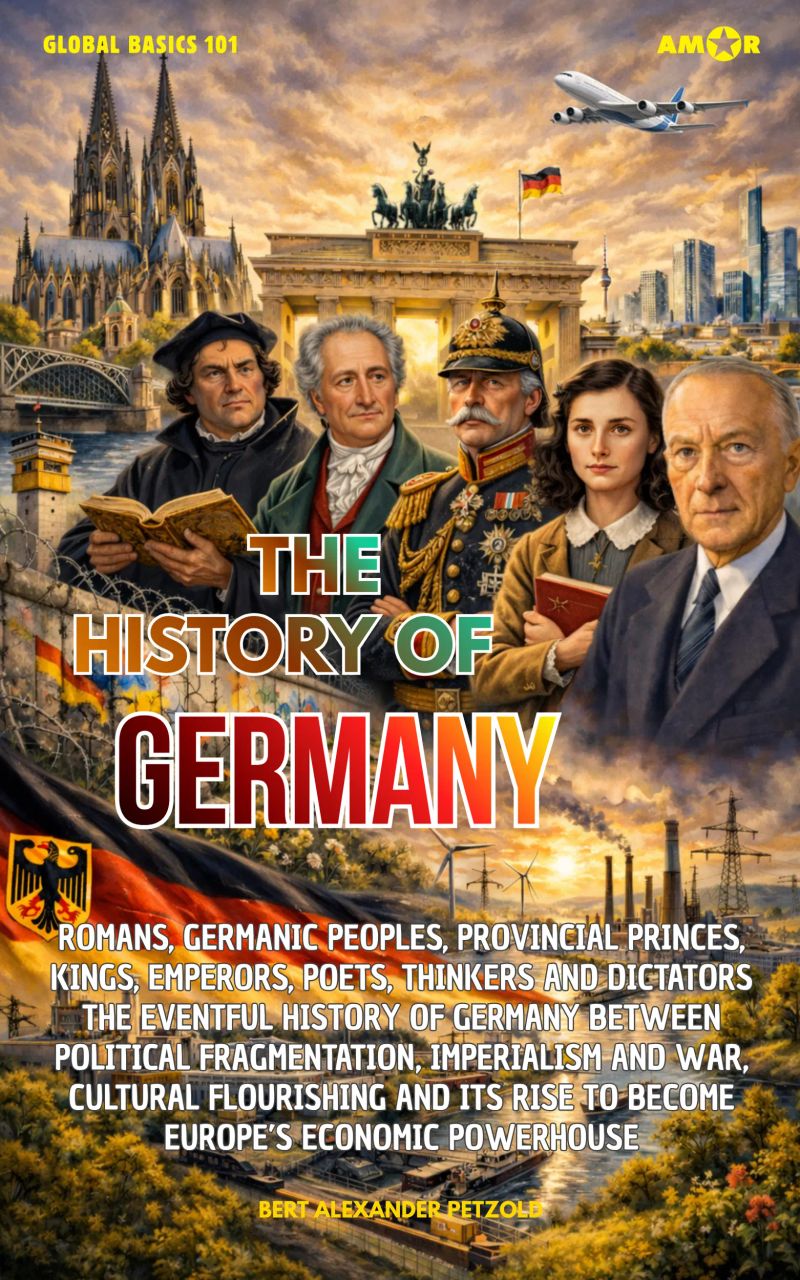
The History of Germany
Romans, Germanic peoples, provincial princes, kings, emperors, poets, thinkers and dictators · The eventful history of Germany between political fragmentation, imperialism and war, cultural flourishing and its rise to become Europe’s economic powerhouseBy Bert Alexander Petzold

Length2h 57m
About this audiobook
How did a region full of principalities, wars and contradictions become the country that still shapes Europe today? Anyone who wants to understand Germany, its ruptures, its periods of ascent and its capacity for transformation, will find in this book far more than a mere overview. ‘The History of Germany’ is a fact rich journey through time that explains, in a clear, accessible and engaging way, how a modern state and ultimately an export powerhouse emerged out of political fragmentation, upheaval and catastrophe.
The early beginning of this development is already compelling. In the Teutoburg Forest, regional resistance becomes a founding myth of German history. The uprising of the Germanic tribes under Hermann the Cheruscan, also known as Arminius, against the Romans, the collapse of the empire in the third century and the turmoil of the Migration Period appear here not as distant schoolbook knowledge, but as the dramatic opening of a long historical movement. With Charlemagne, a new order emerges around the year 800. The Christian Church shapes the empire, monasteries become centres of learning, towns grow, guilds gain influence and, with the ‘Holy Roman Empire of the German Nation’, a framework comes into being that would shape medieval life for centuries.
The book is equally impressive in the way it traces the eras in which ideas and conflicts reshaped Germany. Martin Luther’s translation of the Bible turns language, faith and thought into forces of change. The Thirty Years’ War devastates vast areas and profoundly transforms the political order of the German lands. New centres of power then emerge. Under Frederick the Great, Prussia rises to the status of a great power, the old order is shaken after the Napoleonic Wars and the German Confederation marks the beginning of a new chapter. When Wilhelm I founded the German Empire in 1871, many earlier developments culminated in a political new beginning under the first Imperial Chancellor, Otto von Bismarck.
The book is especially strong where it makes Germany’s twentieth century history comprehensible. The First World War, the burdens of the Weimar Republic, the global economic crisis, unemployment and political chaos become recognisable as the prehistory of a catastrophe that reached its climax in the National Socialist dictatorship and the Second World War unleashed by Adolf Hitler. What follows is division, the founding of the Federal Republic and the GDR, the economic miracle in the West, the construction of the Berlin Wall in 1961 and its peaceful fall in 1989. With the reunification of Germany under Helmut Kohl, Berlin’s new status as capital, the introduction of the euro and Germany’s path to international strength, the account reaches right up to the present day.
Bert Alexander Petzold combines historical precision with a reader friendly style that places complex developments in context, makes the larger patterns visible and never loses sight of the decisive dates, figures and turning points. Precisely for that reason, this book is not only a gripping introduction to the history of Germany, but also a reliable working tool for anyone seeking sound knowledge. It is ideally suited to preparing for examinations leading to university entrance qualifications and for study at university.
Anyone who truly wants to understand Germany’s path from the early Germanic tribes through the Reformation, the founding of the Reich, dictatorship, division and reunification to the present day will find in this volume an approach that is as informed as it is motivating. Secure this well founded work of non fiction now and discover Germany as a historical space full of conflicts, ideas and renewal, a development that explains our present better than many debates do.
Audiobook details
GenreHistory
Length2 hrs 57 mins
Narrated byListen with 1,000+ voices
FormateBook with Audio
Publish dateMar 19, 2026
LanguageEnglish
Table of contents
1The History of Germany
2Romans, Germanic peoples, provincial princes, kings, emperors, poets, thinkers and dictators · The eventful history of Germany between political fragmentation, imperialism and war, cultural flourishing and its rise to become Europe’s economic powerhouse: Romans, Germanic peoples, provincial princes, kings, emperors, poets, thinkers and dictators · The eventful history of Germany between political fragmentation, imperialism and war, cultural flourishing and its rise to become Europe’s economic powerhouse
3Chapter 1. Prehistory, How It All Began (18,000 BC to 500 BC)
4Chapter 2. Antiquity (500 BC to AD 500)
5Chapter 3. Early Middle Ages (500–1024)
Show all chaptersShow less
6Chapter 4. The Middle Ages (1024–1500)
7Chapter 5. Early Modern Period and the Reformation (1517–1648)
8Chapter 6. The Thirty Years’ War (1618–1648)
9Chapter 7. The Rise of Prussia and the Reordering of Europe (1648–1815)
10Chapter 8. German Confederation and the German Revolution of 1848 (1815–1848)
11Chapter 9. Waves of Emigration (1749–1912)
12Chapter 10. The German Empire and Colonialism (1871–1918)
13Chapter 11. Weimar Republic (1919–1933)
14Chapter 12. The Third Reich (1933–1945)
15Chapter 13. Divided Germany in the Cold War (1945–1990)
16Chapter 14. The Reunified Federal Republic of Germany (1990 to the present)
17Chapter 15. Summary
18Chapter 16. Timeline
19Chapter 17. Author’s Biography

Die Geschichte BrasiliensBert Alexander Petzold2h 44m$3

The History of the United Kingdom of Great Britain and Northern Ireland (UK)Bert Alexander Petzold3h 57m$3

The History of the United States of AmericaBert Alexander Petzold2h 59m$3

The History of FranceBert Alexander Petzold4h 51m$3

The History of ChinaBert Alexander Petzold2h 34m$3

Sigmund Freud, Neurologist and PsychologistBert Alexander Petzold2h 31m$3

Die Geschichte DeutschlandsBert Alexander Petzold3h 1m$3

Die Geschichte IndiensBert Alexander Petzold4h 38m$3

Die Geschichte PalästinasBert Alexander Petzold3h 37m$3

Die Geschichte SpaniensBert Alexander Petzold5h 17m$3

The Physicist Albert EinsteinBert Alexander Petzold2h 4m$3

Die Geschichte ItaliensBert Alexander Petzold6h 18m$3

Die Geschichte FrankreichsBert Alexander Petzold5h 10m$3

Die Geschichte der SchweizBert Alexander Petzold3h 25m$3

Die Geschichte des Vereinigten Königreichs Großbritannien und Nordirland (UK)Bert Alexander Petzold4h 20m$3

Der Komponist Wolfgang Amadeus MozartBert Alexander Petzold2h$3

Die Geschichte IsraelsBert Alexander Petzold2h 29m$3

Die Geschichte der Vereinigten Staaten von Amerika (USA)Bert Alexander Petzold3h 9m$3

Der Komponist Joseph HaydnBert Alexander Petzold1h 44m$3

A Brief History of IntelligenceMax S. Bennett12h 18m4.6 (6.6K)$29 · $0.00

The Gulag Archipelago Volume 3Aleksandr I. Solzhenitsyn21h 56m4.7 (8.9K)$46 · $0.00

Pearl of Great PriceJoseph Smith3h 8m4.7 (7.2K)$1.20 · $0.00

The Happiest Man on EarthEddie Jaku3h 48m4.6 (178K)$7 · $0.00

MotherlandJulia Ioffe17h 52m4.7 (2.5K)$40 · $0.00

Where Cowards Go to DieBenjamin Sledge8h 42m4.7 (351)$20 · $0.00

RevolutionariesSanjeev Sanyal11h 23m4.6 (2.6K)$29 · $0.00

We Crossed a Bridge and It TrembledWendy Pearlman6h4.6 (5.2K)$24 · $0.00

Unbroken Bonds of BattleJohnny Joey Jones8h 31m4.6 (2.6K)$8 · $0.00

The Daughter of AuschwitzTova Friedman, Malcolm Brabant7h 54m4.6 (16.7K)$26 · $0.00

Lily's PromiseLily Ebert, Dov Forman8h 54m4.6 (16.1K)$29 · $0.00

On Democracies and Death CultsDouglas Murray10h 38m4.6 (6.5K)$29 · $0.00

Across the RiverKent Babb11h 40m4.6 (927)$29 · $0.00

Balcony Over Jerusalem: A Middle East Memoir - Israel, Palestine and BeyondJohn Lyons12h 37m4.6 (1.4K)$33 · $0.00

BeyondStephen Walker15h 39m4.6 (3.2K)$33 · $0.00

Kings and PawnsHoward Bryant10h 9m4.6 (678)$29 · $0.00

No EscapeNury Turkel9h 30m4.6 (809)$28 · $0.00

Jubal Stone: U.S. Marshal: Blood Trail To Hell: A Western Adventure NovelCasey Nash3h 42m4.6 (3.2K)$18 · $0.00

Fall and RiseMitchell Zuckoff17h 23m4.6 (9.8K)$40 · $0.00

The SurvivorJosef Lewkowicz, Michael Calvin9h 22m4.6 (2.5K)$29 · $0.00
You may also like

The Indian War of 1864 (Annotated)Eugene Fitch Ware16h 42m4.3 (647)$0.99 · $0.00

An Apache Campaign In The Sierra MadreJohn Gregory Bourke2h 20m4.1 (330)$1 · $0.00
The Invasion of Europe by the Barbarians (Annotated)J. B. Bury8h 41m4.0 (697)$2 · $0.00
The NegroW. E. B. Du Bois6h 20m4.3 (477)$2.30

History of the American Civil War (Annotated)James Ford Rhodes16h4.1 (875)$2 · $0.00

The Paradox of JamestownChristopher Collier, James Lincoln Collier1h 43m4.1 (476)$15

The Most Momentous Stories from the History of Unated StatesHenrietta Elizabeth Marshall20h 22m4.2 (2.7K)$1.99 · $0.00

The History of the Peloponnesian WarThucydides22h 10m4.2 (54.2K)$2.30

The Cape and the Kaffirs: A Diary of Five Years' Residence in KaffirlandMrs. Ward11h 2m$2 · $0.00

History of ScotlandMargaret MacArthur4h 33m3.1 (12)$2 · $0.00

The Great Boer WarArthur Conan Doyle24h 17m3.5 (308)$0.60 · $0.00

Vermont: A Study of IndependenceRowland Evans Robinson10h 33m3.8 (10)$1 · $0.00

The Incredible Tales of Ohio (Illustrated Edition)William Dean Howells9h 10m$1.99 · $0.00

Pontiac and the Indian Wars: 3 Classic Essential BooksKirk Munroe, Francis Parkman, Edson Leone Whitney, F. M. Perry36h 14m$0.99 · $0.00

The Lipan Apache: Defiant People of the Texas BorderlandsMarcus T. Calloway4h 14m$6

Pilgrims and PuritansChristopher Collier, James Lincoln Collier1h 57m3.9 (570)$15

The SikhsJohn James Hood Gordon4h 19m3.9 (32)$1 · $0.00

The Ultimate Western CollectionMark Twain, James Fenimore Cooper, Max Brand, James Oliver Curwood, B. M. Bower, Zane Grey, Jackson Gregory, Jack London, William MacLeod Raine, William Patterson White, Rex Beach, Emerson Hough, Will Lillibridge, Andy Adams, Bret Harte, Owen Wister, Washington Irving, Willa Cather, O. Henry, Grace Livingston Hill, Charles King, Charles Alden Seltzer, Stephen Crane, Dane Coolidge, Marah Ellis Ryan, Francis William Sullivan, Frederic Homer Balch, Frederic Remington, Robert W. Chambers, Forrestine C. Hooker, James B. Hendryx, Frank H. Spearman, J. Allan Dunn, Ann S. Stephens, Robert E. Howard, Clarence E. Mulford, R.M. Ballantyne, Charles Siringo, Isabel E. Ostrander, Frederic Logan Paxson1014h 52m4.3 (135)$1 · $0.00

Scotland, Independence, and the Medieval British IslesSantiago Machain5h 11m$21 · $0.00

The Five Indian Nations of CanadaCadwallader Colden7h 17m4.0 (94)$1.99 · $0.00