
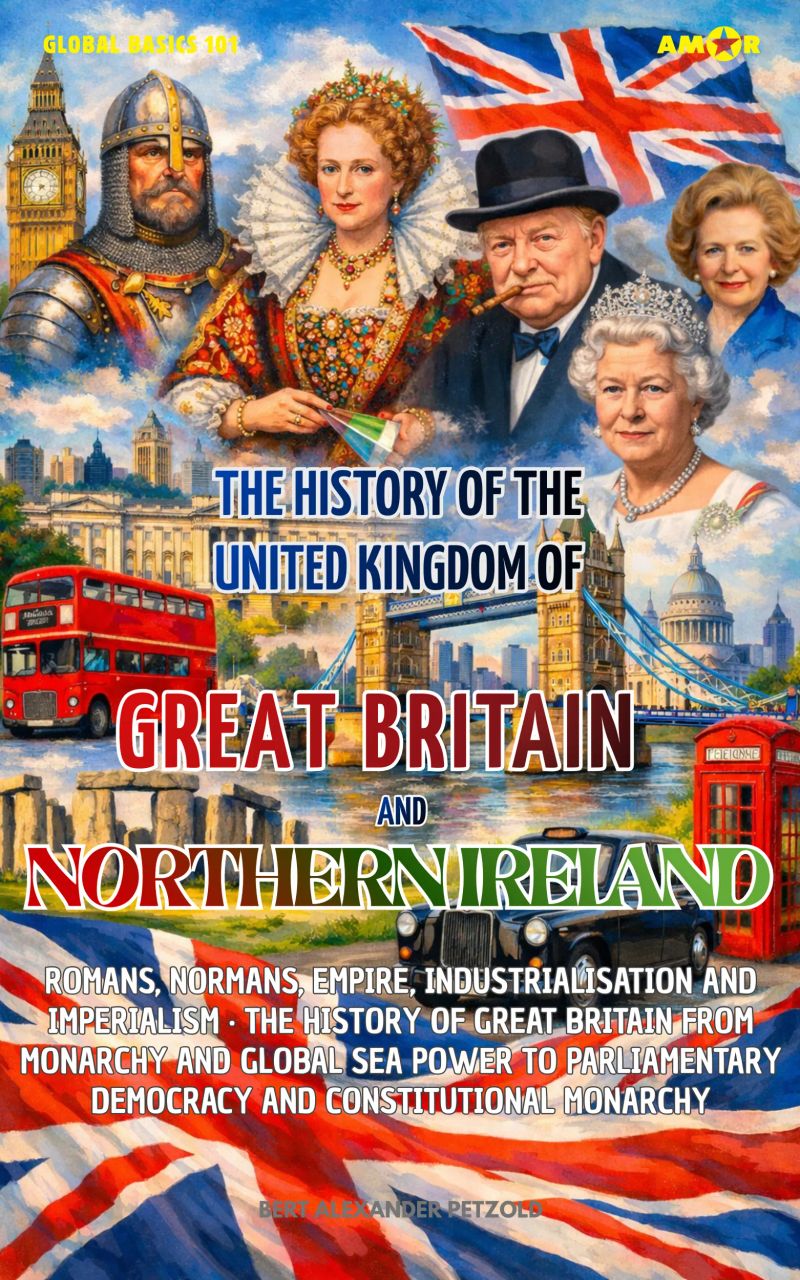
The History of the United Kingdom of Great Britain and Northern Ireland (UK)
Romans, Normans, empire, industrialisation and imperialism · The history of Great Britain from monarchy and global sea power to parliamentary democracy and constitutional monarchyBy Bert Alexander Petzold


Length3h 56m
About this audiobook
How could an island on the edge of Europe give rise to the power that, through kings, Parliament, empire and industrialisation, shaped the world for centuries? Anyone wishing to understand Great Britain, its political upheavals and its global influence, will find in this book far more than a mere chronicle. ‘The History of the United Kingdom of Great Britain and Northern Ireland (UK)’ is a fact-rich, clearly structured and compelling account of a nation whose rise, crises and transformations continue to resonate to the present day.
From the Celtic origins of Britain, the Roman conquest in AD 43 and the nearly four-hundred-year rule of the Romans, there emerged a historical landscape that had to be reorganised after their withdrawal in the fifth century. Angles, Saxons and Jutes struggled for supremacy until the Norman Conquest of 1066 under William the Conqueror marked a turning point that permanently changed England.
The book is equally compelling in its portrayal of the Middle Ages as a period of political consolidation. Magna Carta of 1215 appears as an early limitation of royal power and as the foundation of the development from which the modern parliamentary system emerged. Under the Tudors, especially Henry VIII and Elizabeth I, the country experienced religious conflict, the Reformation and at the same time a cultural flourishing that still echoes today as the Elizabethan Age.
The seventeenth century brought severe upheavals. The English Civil War from 1642 to 1651 curtailed the power of the monarch and prepared the way for constitutional monarchy. With the Glorious Revolution of 1688 and the Bill of Rights, Parliament was further strengthened, allowing the political tradition that was to shape Great Britain enduringly to take form.
In the eighteenth century, Great Britain grew into one of the world’s leading colonial powers. The British Empire gained influence, while the Industrial Revolution fundamentally transformed economy and society. In the nineteenth century, this development reached its height under Queen Victoria. The Empire extended across a quarter of the earth’s land surface, while the abolition of slavery in 1833 and the introduction of universal suffrage in 1884 marked important stages on the road to modernity.
With great clarity, the book guides the reader through the twentieth century. The First World War marked the beginning of the decline of imperialism, while the Second World War brought Great Britain to the brink of defeat before it reasserted itself with the help of the Allies. In this struggle, Winston Churchill became a symbolic figure of resistance to Hitler. After 1945, decolonisation, the Commonwealth of Nations and social upheavals transformed the country profoundly.
Into the twenty-first century, Great Britain remains an important political and cultural actor. Brexit and withdrawal from the European Union in 2020 mark a new turning point, the consequences of which are still felt today. Bert Alexander Petzold combines historical precision with a vivid and highly readable style that organises connections and makes turning points easy to understand. The book is ideally suited to preparing for examinations leading to higher education entrance qualifications and for study at university.
Anyone wishing to understand the history of England, Scotland, Wales and Northern Ireland not merely through catchwords but in its full depth will find in this volume an informed introduction. Secure your copy of ‘The History of the United Kingdom of Great Britain and Northern Ireland (UK)’ now and discover a work of non-fiction that brings together political intrigue, military conflict, cultural achievements and consequences of world-historical significance.
Audiobook details
GenreHistory
Length3 hrs 56 mins
Narrated byListen with 1,000+ voices
FormateBook with Audio
Publish dateMar 20, 2026
LanguageEnglish
Table of contents
1The History of the United Kingdom of Great Britain and Northern Ireland (UK)
2Romans, Normans, empire, industrialisation and imperialism · The history of Great Britain from monarchy and global sea power to parliamentary democracy and constitutional monarchy: Romans, Normans, empire, industrialisation and imperialism · The history of Great Britain from monarchy and global sea power to parliamentary democracy and constitutional monarchy
3Chapter 1. Prehistory to the Roman Conquest (10,000 BC to 100 BC)
4Chapter 2. The Roman Occupation of Britain (55 BC to AD 410)
5Chapter 3. Anglo Saxons and Vikings, England in the Early Middle Ages (473–1065)
Show all chaptersShow less
6Chapter 4. The Norman Conquest and Its Consequences (1066–1200)
7Chapter 5. Magna Carta, the Hundred Years’ War and the Wars of the Roses (1215–1362)
8Chapter 6. King Henry VII, Religious Conflict and the Tudor Age (1485–1558)
9Chapter 7. Queen Elizabeth I, Culture and Conflict (1558–1603)
10Chapter 8. King James I, Parliament and the Glorious Revolution (1603–1701)
11Chapter 9. The British Empire and the American War of Independence (1702–1783)
12Chapter 10. The Industrial Revolution and Social Change (1789–1833)
13Chapter 11. Queen Victoria I, Culture and Society (1837–1901)
14Chapter 12. British Colonialism and Its Consequences (17th century to the present)
15Chapter 13. The First World War, Irish Independence, Appeasement Policy (1901–1940)
16Chapter 14. Britain’s Role in the Second World War (1940–1945)
17Chapter 15. The Post Colonial Era and Multiculturalism (1945–1997)
18Chapter 16. The Royal Family of Windsor, Personalities and Scandals (1917 to the present)
19Chapter 17. Globalisation, Political Change and Brexit (1997 to the present)
20Chapter 18. Population and Economic Development (1945 to the present)
21Chapter 19. Literature, Music, Popular Culture and Football (1960 to the present)
22Chapter 20. Summary
23Chapter 21. Timeline
24Chapter 22. Author’s Biography

Die Geschichte BrasiliensBert Alexander Petzold2h 44m$3
The History of the United States of AmericaBert Alexander Petzold2h 59m$3

The History of FranceBert Alexander Petzold4h 51m$3
The History of ChinaBert Alexander Petzold2h 34m$3

Sigmund Freud, Neurologist and PsychologistBert Alexander Petzold2h 31m$3

The History of GermanyBert Alexander Petzold2h 58m$3

Die Geschichte DeutschlandsBert Alexander Petzold3h 1m$3

Die Geschichte IndiensBert Alexander Petzold4h 38m$3

Die Geschichte PalästinasBert Alexander Petzold3h 37m$3

Die Geschichte SpaniensBert Alexander Petzold5h 17m$3
The Physicist Albert EinsteinBert Alexander Petzold2h 4m$3

Die Geschichte FrankreichsBert Alexander Petzold5h 10m$3
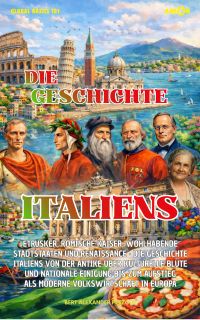
Die Geschichte ItaliensBert Alexander Petzold6h 18m$3

Die Geschichte der SchweizBert Alexander Petzold3h 25m$3

Die Geschichte des Vereinigten Königreichs Großbritannien und Nordirland (UK)Bert Alexander Petzold4h 20m$3

Der Komponist Wolfgang Amadeus MozartBert Alexander Petzold2h$3

Die Geschichte IsraelsBert Alexander Petzold2h 29m$3

Die Geschichte der Vereinigten Staaten von Amerika (USA)Bert Alexander Petzold3h 9m$3

Der Komponist Joseph HaydnBert Alexander Petzold1h 44m$3

A Brief History of IntelligenceMax S. Bennett12h 18m4.6 (6.6K)$29 · $0.00
The Gulag Archipelago Volume 3Aleksandr I. Solzhenitsyn21h 56m4.7 (8.9K)$46 · $0.00

Pearl of Great PriceJoseph Smith3h 8m4.7 (7.2K)$1.20 · $0.00

The Happiest Man on EarthEddie Jaku3h 48m4.6 (178K)$7 · $0.00
MotherlandJulia Ioffe17h 52m4.7 (2.5K)$40 · $0.00

Where Cowards Go to DieBenjamin Sledge8h 42m4.7 (351)$20 · $0.00

RevolutionariesSanjeev Sanyal11h 23m4.6 (2.6K)$29 · $0.00

We Crossed a Bridge and It TrembledWendy Pearlman6h4.6 (5.2K)$24 · $0.00

Unbroken Bonds of BattleJohnny Joey Jones8h 31m4.6 (2.6K)$8 · $0.00

The Daughter of AuschwitzTova Friedman, Malcolm Brabant7h 54m4.6 (16.7K)$26 · $0.00
Lily's PromiseLily Ebert, Dov Forman8h 54m4.6 (16.1K)$29 · $0.00

On Democracies and Death CultsDouglas Murray10h 38m4.6 (6.5K)$29 · $0.00

Across the RiverKent Babb11h 40m4.6 (927)$29 · $0.00

Balcony Over Jerusalem: A Middle East Memoir - Israel, Palestine and BeyondJohn Lyons12h 37m4.6 (1.4K)$33 · $0.00

BeyondStephen Walker15h 39m4.6 (3.2K)$33 · $0.00
Kings and PawnsHoward Bryant10h 9m4.6 (678)$29 · $0.00

No EscapeNury Turkel9h 30m4.6 (809)$28 · $0.00

Jubal Stone: U.S. Marshal: Blood Trail To Hell: A Western Adventure NovelCasey Nash3h 42m4.6 (3.2K)$18 · $0.00

Fall and RiseMitchell Zuckoff17h 23m4.6 (9.8K)$40 · $0.00

The SurvivorJosef Lewkowicz, Michael Calvin9h 22m4.6 (2.5K)$29 · $0.00