
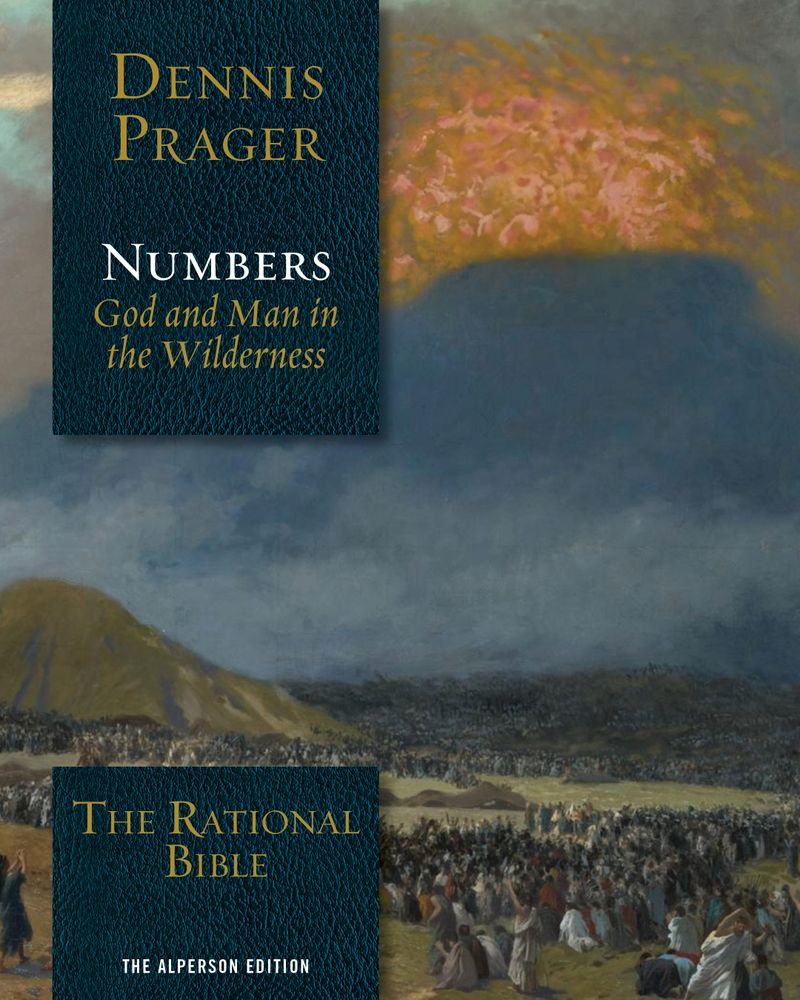
The Rational Bible: Numbers
God and Man in the WildernessBy Prager, Dennis


Length14h 38m
About this audiobook
If you think the Bible is irrelevant, irrational, or even, at times, immoral—and you have an open mind—The Rational Bible will change your mind and influence your outlook on life. You will come to understand why the Bible and especially its first five books, the Torah, are the most influential books ever written. Equally important, you will understand how they apply to your life. The Rational Bible, Dennis Prager's commentary and explanation of these five books—rooted in his expertise in biblical Hebrew and its grammar—is widely considered the most important modern Bible commentary. Read the thousands of reviews on Amazon—written by people of many faiths and of no faith—and you will appreciate why this is so. The Book of Numbers—"In the Wilderness" in the original Hebrew—is the fourth book of the Bible. Among the many compelling issues addressed in this volume are the following: • Doubting God. • What produces faith—miracles or effort? And if effort, what efforts work? • Arguing with God. • Ingratitude as a source of evil. • Why only men could be priests. • Why the conscience is not morally reliable. • Is fanaticism ever justified? • Is there luck in life, or is everything determined by God's will? The title of this five-volume commentary is The Rational Bible because its approach is entirely reason-based. The reader is never asked to accept anything on faith alone. In Dennis Prager's words, "If something I write is not rational, I have not done my job." Few people alive today have influenced as many people as has Dennis Prager. In the words of the website, Powerline, "Dennis Prager is probably the foremost public intellectual of our time." Read The Rational Bible and you will understand why.
Audiobook details
Rating★★★★★ 4.7 (227)
Includes Goodreads, Amazon, LibraryThing
GenreSpirituality and Religion
Length14 hrs 38 mins
Narrated byListen with 1,000+ voices
FormateBook with Audio
Publish dateNov 19, 2024
LanguageEnglish
Table of contents
1Why This Commentary?
2Who Is This Torah Commentary For?
3To Jewish Readers:
4To Christian Readers:
5To Non-Religious Readers:
Show all chaptersShow less
6The Torah Is Not Man-Made
7Man-Made or God-Made: Why It Matters
8How Was the Torah Transmitted?
9Reason, Torah, and God
10Why Read The Rational Bible?
11Why Exodus Was Volume 1
12BC or BCE?
13God as “He”
14How to Read This Commentary
15PREFACE
16Introduction to the Book of Numbers
17The Antiquity of the Names
18ESSAY: The Problem of the Number of Israelites in the Torah
19Why the Levite Tribe Was Not Counted in the Census
20CHAPTER 2: The Ten Commandments Were at the Center of Israel’s Life—Physically and Religiously
21CHAPTER 3
22Aaron’s Descendants—and the Other Levites—Are Israel’s Priests, Just as Israel Is to Be the Nations’ Priests
23The Tasks of Three Levite clans: Gershon, Kohath, Merari
24The Gershon Clan: Responsible for Maintaining the Tabernacle
25The Kohath Clan: Responsible for the Ark, Table, Lampstand, Altars, Etc.
26The Merarite Clan: Responsible for the Tabernacle’s Planks, Bars, Posts, Sockets, Etc.
27Death to Those Who Encroach on the Sanctuary
28Another Proof of the Solution of the Census Numbers Problem
29Priests, Levites, and Their Descendants
30Duties of the Kohathites (through Verse 20)
31What the Colors Signified
32ESSAY: The Importance of Sacred Objects
33Duties of the Gershonites
34Duties of the Merarites
35CHAPTER 5
36Purity and Impurity
37The Emphasis on Life
38Sins against People
39ESSAY: Guilt
40A Strange Ritual which Protected Wives and Marriages
41The Meaning of the Sotah Ritual
42CHAPTER 6
43ESSAY: The Nazirite
44The First Abstention
45The Second Abstention
46The Third Abstention
47When a Nazirite’s Vows Are Inadvertently Broken
48When the Nazirite Period Ends (Verses 13–21)
49ESSAY: The Torah’s Negative View of Asceticism
50The Famous Priestly Blessing
More from Prager, Dennis

31 Decrees of Blessing for Your LifePatricia King2h 38m4.8 (1.4K)$10 · $0.00

Loved BabySarah Philpott4h 51m4.8 (1.4K)$10 · $0.00

The QuranAllah23h 7m4.7 (136.1K)$1 · $0.00

The Secret of the RosaryLouis de Montfort6h 1m4.7 (16K)$2 · $0.00

The Holy Qur-an: Text, Translation and CommentaryAbdullah Yusuf Ali22h 16m4.7 (133K)$1 · $0.00

All of Grace (Annotated)Charles Spurgeon5h 1m4.7 (1.3K)$0.99 · $0.00

Steps to ChristEllen G. White3h 12m4.7 (13.8K)$2 · $0.00

The Doctrine and Selected CovenantsJoseph Smith13h 53m4.7 (10.4K)$1.99 · $0.00

Sinners in the Hands of an Angry God & Other Sermons (Annotated)Jonathan Edwards7h 51m4.7 (1.5K)$2 · $0.00

Swayam Ki AwaazPrem Rawat8h 34m4.7 (1.1K)$26 · $0.00

Behind the BadgeAdam Davis10h 18m4.7 (2.7K)$10 · $0.00

The New Human Revolution, vol. 1Daisaku Ikeda7h 46m4.7 (669)$12 · $0.00

You Are Worth ItKyle Carpenter, Don Yaeger8h 53m4.7 (4.8K)$29 · $0.00

Praying GraceDavid A. Holland3h 2m4.7 (658)$10 · $0.00

Evidence Not SeenDarlene Deibler Rose11h 11m4.6 (11.9K)$29 · $0.00

The Christ KeyChad Bird, Chad Bird7h 33m4.7 (592)$17.40 · $0.00

He and IGabrielle Bossis10h 12m4.7 (554)$17 · $0.00

Your Body Already KnowsNidhi Pandya Bhanshali9h 7m4.7 (360)$16 · $0.00

The Complete WorksFlorence Scovel Shinn7h 59m4.6 (6.6K)$2 · $0.00

Driven by EternityJohn Bevere3h 50m4.6 (3.2K)$10 · $0.00
You may also like
The Symbolism of FreemasonsAlbert Gallatin Mackey12h 37m3.9 (1.2K)$1.99 · $0.00
Shiva to ShankaraDevdutt Pattanaik3h 41m4.2 (628)$18 · $0.00

The Bible With and Without JesusAmy-Jill Levine, Marc Zvi Brettler14h 32m4.3 (1.3K)$33 · $0.00
The ExodusRichard Elliott Friedman5h 51m4.2 (2K)$17

The Lost Keys of FreemasonryManly P. Hall2h 31m4.3 (2.6K)$2 · $0.00

Five Stages of Greek Religion (Annotated)Gilbert Murray8h 35m4.2 (317)$2 · $0.00

The Everlasting Man (Annotated)G. K. Chesterton12h 33m4.3 (17.7K)$1.99 · $0.00

The Builders: History of FreemasonsJoseph Fort Newton8h 18m4.1 (965)$1.99 · $0.00

The Symbolism of FreemasonryAlbert Gallatin Mackey12h 20m4.0 (1.3K)$2 · $0.00

The God Who Is ThereD. A. Carson10h 2m4.4 (2.9K)$17

Japanese MythologyF. Hadland Davis12h 25m4.0 (1.8K)$1.99 · $0.00

Sadhana, The Realisation of LifeRabindranath Tagore3h 51m4.3 (2.5K)$3.50 · $0.00

The Lives and Opinions of Eminent Philosophers (Annotated)Diogenes Laertius21h 28m4.1 (801)$2 · $0.00

Living with the DevilStephen Batchelor6h 20m4.2 (1.3K)$20 · $0.00

TalmudVarious Authors185h 19m4.4 (3.1K)$1 · $0.00

The Creed of Half JapanArthur Lloyd10h 20m$21 · $0.00

Sculpture 120 illustrationsVictoria Charles1h4.0 (17)$15 · $0.00

IconsNikodim Pavlovich Kondakov9h 7m$18 · $0.00
The Idea of ProgressJ.B. Bury8h 29m4.0 (218)$9 · $0.00

The Ancient Egyptian Doctrine of the Immortality of the SoulAlfred Wiedemann33m$2 · $0.00