
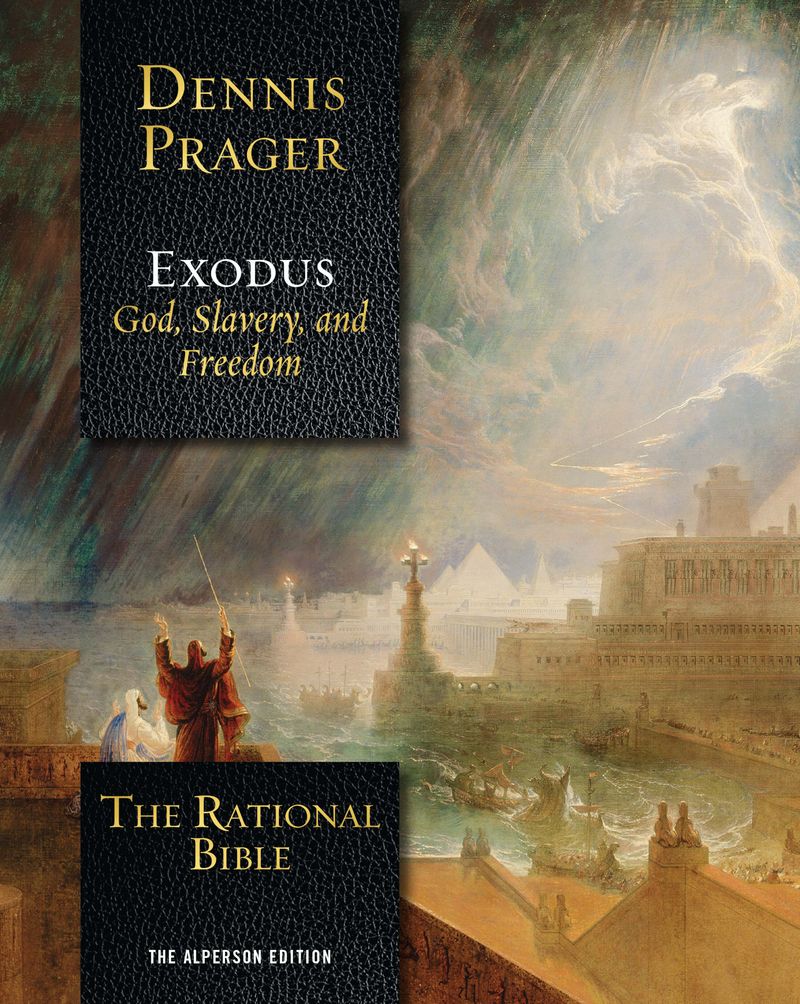


Length14h 54m
About this audiobook
NATIONAL BESTSELLER "Dennis Prager has put together one of the most stunning commentaries in modern times on the most profound document in human history. It's a must-read that every person, religious and non-religious, should buy and peruse every night before bed. It'll make you think harder, pray more ardently, and understand your civilization better." — Ben Shapiro, host of "The Ben Shapiro Show" "Dennis Prager's commentary on Exodus will rank among the greatest modern Torah commentaries. That is how important I think it is. And I am clearly not alone... It might well be on its way to becoming the most widely read Torah commentary of our time—and by non-Jews as well as by Jews." — Rabbi Joseph Telushkin, bestselling author of Jewish Literacy Why do so many people think the Bible, the most influential book in world history, is outdated? Why do our friends and neighbors – and sometimes we ourselves – dismiss the Bible as irrelevant, irrational, immoral, or all of these things? This explanation of the Book of Exodus, the second book of the Bible, will demonstrate that the Bible is not only powerfully relevant to today's issues, but completely consistent with rational thought. Do you think the Bible permitted the trans-Atlantic slave trade? You won't after reading this book. Do you struggle to love your parents? If you do, you need this book. Do you doubt the existence of God because belief in God is "irrational?" This book will give you reason after reason to rethink your doubts. The title of this commentary is, "The Rational Bible" because its approach is entirely reason-based. The reader is never asked to accept anything on faith alone. As Prager says, "If something I write does not make rational sense, I have not done my job." The Rational Bible is the fruit of Dennis Prager's forty years of teaching the Bible to people of every faith, and no faith. On virtually every page, you will discover how the text relates to the contemporary world and to your life. His goal: to change your mind – and then change your life.
Audiobook details
Rating★★★★★ 4.7 (6.2K)
Includes Amazon, Goodreads, StoryGraph, LibraryThing
GenreSpirituality and Religion
Length14 hrs 54 mins
Narrated byListen with 1,000+ voices
FormateBook with Audio
Publish dateApr 2, 2018
LanguageEnglish
Table of contents
1Why This Commentary?
2Who Is This Torah Commentary For?
3To Jewish Readers
4To Christian Readers
5To Non-Religious Readers
Show all chaptersShow less
6The Torah Is Not Man-Made
7Man-Made or God-Made: Why It Matters
8How Was the Torah Transmitted?
9Reason, Torah, and God
10Why Read This Commentary?
11Did the Exodus Happen?
12A Few Details
13Why Exodus Is Volume 1
14BC or BCE?
15God as “He”
16On How to Read This Commentary
17The Use of Post-Biblical Jewish Sources
18Preface
19The Story Thus Far
20Chapter 1
21Essay: The Jews: A Second Creation
22The Jews: God’s Third Attempt to Create a Moral World
23Why Didn’t God Give the Ten Commandments to the First Human Beings?
24Why Do People Think There Are So Many Jews in the World?
25The Indispensable Importance of Remembering
26The Individual and Massive Evil
27The Guilt of the Egyptian People
28Were the Midwives Who Disobeyed Pharaoh Egyptians or Hebrews? I
29The Torah Gives the Midwives’ Names, But Not the Pharaoh’s
30Essay: The Moral Significance of Fearing God
31Were the Midwives Who Disobeyed the Pharaoh Egyptians or Hebrews? II
32When Lying Is Moral
33Essay: Moral Absolutes, Moral Relativism, and Situational Ethics
34More on the Midwives: Egyptian or Hebrew? III
35Chapter 2
36The Preeminent Role of Women in Moses’s life—and in the Torah
37There Is No Miracle in Moses’s Birth
38Why Moses Was Saved In the Same Type of Vessel Noah Was Saved In
39The Daughter of the Israelites’ Killer Saves the Man Who Will Save the Israelites
40Our Mother Is the Woman, and Our Father Is the Man, Who Raises Us
41Why Moses Will Be Chosen to Lead Is Already Apparent
42God Apparently Strongly Approved of Moses’s Act of Homicide
43Moses’s Three Responses to Injustice
44If God Intervened During the Exodus, Why Didn’t He Intervene at Other Times?
45Chapter 3
46Essay: Belief in God is a Choice—and Why to Make It
47The Only Sovereign States that Have Ever Existed in Canaan were Jewish States
48God’s Name Is a Verb—“To Be”
49Chapter 4
50Moses’s Third Objection
More from Prager, Dennis

31 Decrees of Blessing for Your LifePatricia King2h 38m4.8 (1.4K)$10 · $0.00

Loved BabySarah Philpott4h 51m4.8 (1.4K)$10 · $0.00

The QuranAllah23h 7m4.7 (136.1K)$1 · $0.00

The Secret of the RosaryLouis de Montfort6h 1m4.7 (16K)$2 · $0.00

The Holy Qur-an: Text, Translation and CommentaryAbdullah Yusuf Ali22h 16m4.7 (133K)$1 · $0.00

All of Grace (Annotated)Charles Spurgeon5h 1m4.7 (1.3K)$0.99 · $0.00

Steps to ChristEllen G. White3h 12m4.7 (13.8K)$2 · $0.00
The Doctrine and Selected CovenantsJoseph Smith13h 53m4.7 (10.4K)$1.99 · $0.00

Sinners in the Hands of an Angry God & Other Sermons (Annotated)Jonathan Edwards7h 51m4.7 (1.5K)$2 · $0.00

Swayam Ki AwaazPrem Rawat8h 34m4.7 (1.1K)$26 · $0.00

Behind the BadgeAdam Davis10h 18m4.7 (2.7K)$10 · $0.00

The New Human Revolution, vol. 1Daisaku Ikeda7h 46m4.7 (669)$12 · $0.00

You Are Worth ItKyle Carpenter, Don Yaeger8h 53m4.7 (4.8K)$29 · $0.00
Praying GraceDavid A. Holland3h 2m4.7 (658)$10 · $0.00
Evidence Not SeenDarlene Deibler Rose11h 11m4.6 (11.9K)$29 · $0.00

The Christ KeyChad Bird, Chad Bird7h 33m4.7 (592)$17.40 · $0.00
He and IGabrielle Bossis10h 12m4.7 (554)$17 · $0.00

Your Body Already KnowsNidhi Pandya Bhanshali9h 7m4.7 (360)$16 · $0.00

The Complete WorksFlorence Scovel Shinn7h 59m4.6 (6.6K)$2 · $0.00
Driven by EternityJohn Bevere3h 50m4.6 (3.2K)$10 · $0.00
You may also like
The Aquarian Gospel of Jesus the ChristLevi H. Dowling14h 31m4.3 (997)$0.99 · $0.00

The Life of St. Teresa of Jesus, of the Order of Our Lady of CarmelOf Avila Saint Teresa18h 23m4.3 (5.4K)$2 · $0.00
PaulN. T. Wright15h 23m4.4 (10.2K)$33 · $0.00
Sketches from the Life of PaulEllen Gould White11h 32m4.6 (341)$1 · $0.00
Book of I TimothyUnknown Author19m4.7 (953)$8
The Good ShepherdKenneth E. Bailey10h 5m4.5 (1.3K)$20
STREAMS OF LIVING WATERRichard J. Foster3h 2m4.4 (5.2K)$18 · $0.00
TPT The Book of Genesis—Part 1Brian Simmons4h 27m4.8 (1.2K)$10 · $0.00

AbrahamBruce Feiler5h 50m3.8 (4.2K)$24 · $0.00

New Testament - Easy NavigationWorld English Bible19h 35m4.6 (1.3K)$1.30 · $0.00
The Gospel of Luke: NASB 2020New American Standard Bible2h 41m4.9 (272)$15
Institutes of the Christian ReligionJohn Calvin66h 40m4.5 (16.2K)$30
The Aquarian Gospel of Jesus ChristLevi H. Dowling14h 30m4.3 (1.8K)$2 · $0.00
George Whitefield: A Biography, with special reference to his labors in America (Annotated)Joseph Belcher15h 17m4.4 (16)$2 · $0.00
Expositions of Holy Scripture: St. John Chapters I to XIVAlexander Maclaren25h 7m4.5 (22)$1 · $0.00
Operating in the Power of God’s GraceRobert Henderson6h 32m4.4 (186)$17 · $0.00

Real Life with MARYKelsey Gillespy3h 41m$11 · $0.00
TPT The Book of LukeBrian Simmons4h 45m4.8 (246)$10 · $0.00

The Love Of Books The Philobiblon Of Richard De BuryRichard De Bury2h 25m3.9 (591)Free
Ascolta, IsraeleCamillo Maccise4h 45m$11 · $0.00