
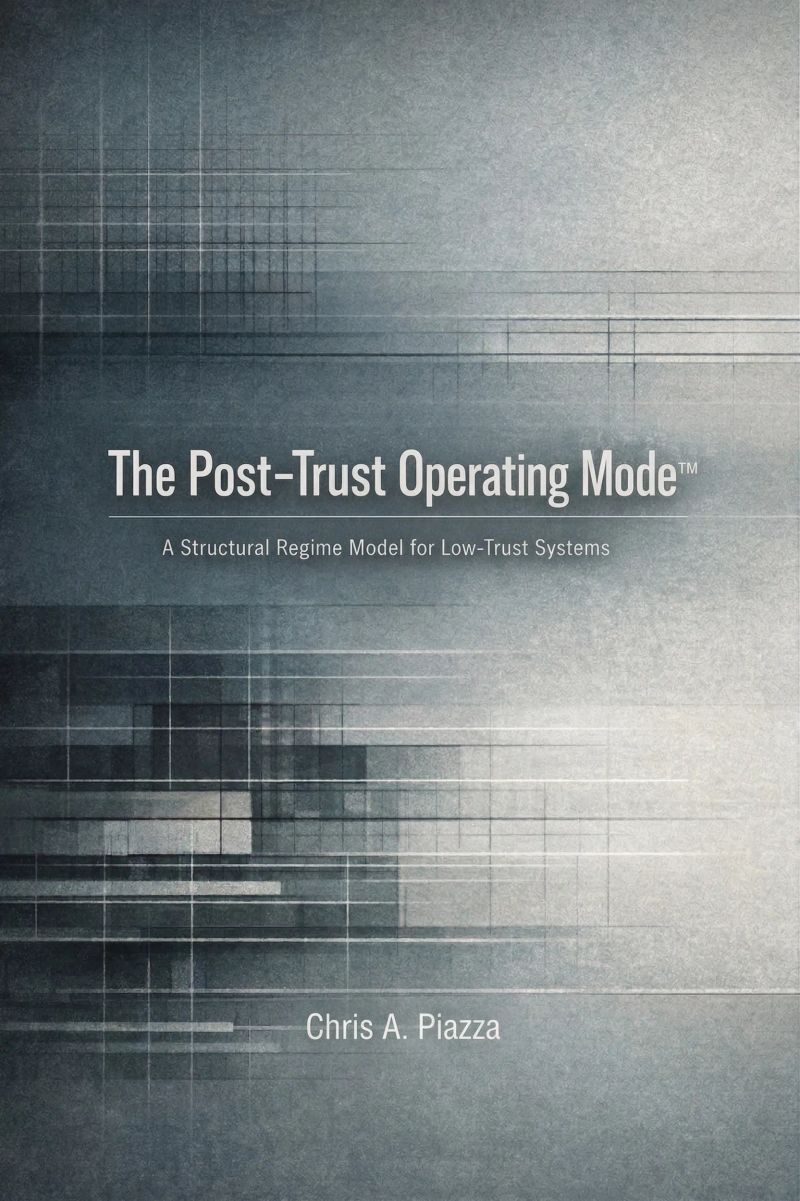
The Post-Trust Operating Mode
A Structural Regime Model for Low-Trust SystemsBy Chris A. Piazza | Antherra™


Length1h 55m
About this audiobook
You stop expecting your institution to listen, yet it still demands your compliance. Once trust falls below the threshold where people follow willingly, systems shift into a post-trust mode: enforcement hardens, reform stalls, and exhaustion spreads while the machinery appears intact. This IP invites you to notice where in your own world legitimacy has quietly evaporated but the structures keep grinding on.
Audiobook details
GenreEducation and Learning, Politics and Government
Length1 hr 55 mins
Narrated byListen with 1,000+ voices
FormateBook with Audio
Publish dateMar 2, 2025
LanguageEnglish
Table of contents
1Introduction
2Why This / Why Now (Plain English)
3How to Use This (Usage Protocol)
4The Post-Trust Operating Mode (PTOM)
51. System Definition (Structural, Not Metaphorical)
Show all chaptersShow less
62. Why This System Is Load-Bearing
73. Core Mechanics
84. Failure Modes
95. Thresholds & Non-Reversibility
106. Interaction With Other Systems
117. Signal vs Noise Dynamics
128. The “If Agreement Were Durable” Lens
139. Misinterpretations & Resistance
1410. Use Cases (Pre- and Post-Collapse)
15Final Check (Explicit)
16Module A: Objective Function & Structural Invariants
17A.0 System Role
18A.1 Invariant: Functional Continuity
19A.2 Invariant: Predictive Legibility
20A.3 Invariant: Bounded Coercion Load
21A.4 Invariant: Human Capacity Preservation
22A.5 Invariant: Error Absorption Capacity
23A.6 Invariant: Incentive Coherence
24A.7 Invariant: Reversibility Margin
25A.8 Invariant: Cross-Temporal Stability
26A.9 Boundary Conditions (Explicit Non-Goals)
27Module A — Lock Test
28Module B: The Constraint Map Under Post-Trust Conditions
29B.0 System Role
30B.1 Constraint Class: Enforcement Capacity
31B.2 Constraint Class: Coordination Bandwidth
32B.3 Constraint Class: Incentive Horizon
33B.4 Constraint Class: Information Integrity
34B.5 Constraint Class: Legitimacy Substitution Limit
35B.6 Constraint Class: Human Attention & Energy
36B.7 Constraint Class: Reversibility Ceiling
37B.8 Cross-Constraint Interactions (Critical)
38B.9 Constraint Misdiagnosis Pattern
39Module B — Lock Test
40Module C: The Viability Ladder Under Post-Trust Conditions
41C.0 System Role
42C.1 Phase I — Functional Stabilization
43C.1 — Lock Test
44C.2 Phase II — Coercion Load Reduction
45C.2 — Lock Test
46C.3 Phase III — Legibility Reconstruction
47C.3 — Lock Test
48C.4 Phase IV — Voluntary Coordination Re-Entry
49C.4 — Lock Test
50C.5 Phase V — Conditional Complexity Scaling

Heavenly KingdomChris A. Piazza | Antherra™1h 26m$4.99

Circuit: ExhaleChris A. Piazza | Antherra™1h 33m$4.99

Cultural TariffsChris A. Piazza | Antherra™1h 14m$4.99

CatchmentChris A. Piazza | Antherra™1h 24m$4.99

Nanny StateChris A. Piazza | Antherra™1h 12m$4.99

The ViaChris A. Piazza | Antherra™1h 20m$4.99

LoggedChris A. Piazza | Antherra™37m$4.99
DeaccessionChris A. Piazza | Antherra™48m$4.99

RemandChris A. Piazza | Antherra™37m$4.99

Color Me DrunkChris A. Piazza | Antherra™45m$4.99

StemsChris A. Piazza | Antherra™1h 18m$4.99

15 Buried InventionsChris A. Piazza | Antherra™1h$4.99

The Civilization That Could BeChris A. Piazza | Antherra™46m$4.99

Chain of CustodyChris A. Piazza | Antherra™42m$4.99

TitrationChris A. Piazza | Antherra™49m$4.99
CompactChris A. Piazza | Antherra™1h 48m$4.99
Discount RateChris A. Piazza | Antherra™1h 24m$4.99

The Long Vacancy, Volume IIIChris A. Piazza | Antherra™1h 19m$4.99

The Long Vacancy, Volume IIChris A. Piazza | Antherra™1h 6m$4.99

The Long Vacancy, Volume IChris A. Piazza | Antherra™1h 3m$4.99
A Brief History of IntelligenceMax S. Bennett12h 18m4.6 (6.6K)$29 · $0.00

HomeschooledStefan Merrill Block7h 10m3.6 (18.5K)$28 · $0.00

How We ThinkJohn Dewey7h 6m4.0 (1.1K)Free

EducationEllen G. White9h 41m4.6 (1.5K)$2 · $0.00

Parents and Children (Annotated)Charlotte Mason9h 23m4.6 (988)$2 · $0.00

Children Under FireJohn Woodrow Cox10h 17m4.5 (1.6K)$29 · $0.00

The State Must ProvideAdam Harris7h 15m4.5 (775)$24 · $0.00

The Call of the Wild and FreeAinsley Arment9h 7m4.4 (21.2K)$29 · $0.00
The Freelance WayRobert Vlach19h 48m4.5 (528)$40 · $0.00

Race to the BottomLuke Rosiak9h 20m4.5 (600)$29 · $0.00

They Came for the SchoolsMike Hixenbaugh9h 5m4.5 (2.6K)$8 · $0.00

Find Me UnafraidKennedy Odede, Jessica Posner11h 11m4.5 (2.7K)$29 · $0.00

Asking for ItKate Harding8h 55m4.4 (5.3K)$20 · $0.00
Defining Moments in Black HistoryDick Gregory7h 37m4.4 (6K)$26 · $0.00

The Emerald Tablets of Thoth the AtlanteanMaurice Doreal3h 4m4.4 (8.8K)$6 · $0.00

Learning AmericaLuma Mufleh6h 37m4.4 (564)$24 · $0.00
Math-ishJo Boaler7h 21m4.4 (588)$24 · $0.00
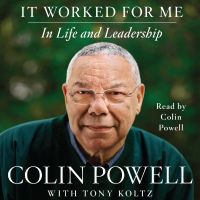
It Worked For MeColin Powell7h 42m4.3 (9.8K)$26 · $0.00

Little SoldiersLenora Chu11h 30m4.3 (3.1K)$29 · $0.00

Financial FeministTori Dunlap8h 3m4.2 (22.2K)$8 · $0.00

KrantikariSanjeev Sanyal11h 44m4.6 (1.3K)$16 · $0.00

Unbroken Bonds of BattleJohnny Joey Jones8h 31m4.6 (2.6K)$8 · $0.00

On Democracies and Death CultsDouglas Murray10h 38m4.6 (6.5K)$29 · $0.00

Balcony Over Jerusalem: A Middle East Memoir - Israel, Palestine and BeyondJohn Lyons12h 37m4.6 (1.4K)$33 · $0.00

RiggedMollie Hemingway12h 48m4.6 (4.2K)$23 · $0.00

SledgehammerDavid Friedman8h 21m4.7 (589)$26 · $0.00

Citizenship in a Republic (Annotated)Theodore Roosevelt2h 44m4.6 (1.4K)$2 · $0.00

No EscapeNury Turkel9h 30m4.6 (809)$28 · $0.00

Always FaithfulThomas Schueman, Zainullah Zaki12h 12m4.6 (977)$29 · $0.00

UnthinkableJamie Raskin15h 8m4.5 (9.3K)$8 · $0.00

My Fourth Time, We DrownedSally Hayden13h 59m4.6 (2.9K)$23 · $0.00

A Revolution of Common SenseScott Jennings9h 29m4.6 (528)$29 · $0.00

Statement From the Dock at the Rivonia TrialNelson Mandela2h 18m4.6 (1.3K)$1 · $0.00

Lessons from the EdgeMarie Yovanovitch17h 11m4.5 (5.9K)$40 · $0.00

To Rescue the American SpiritBret Baier10h 12m4.5 (2.7K)$8 · $0.00

StonewalledSharyl Attkisson15h 19m4.5 (4.3K)$33 · $0.00
The World According to Orwell: 1984 & Animal FarmGeorge Orwell15h 42m4.6 (1.1K)$1 · $0.00
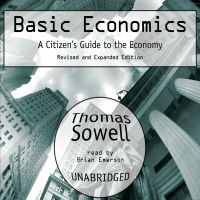
Basic EconomicsThomas Sowell18h 32m4.5 (29.3K)$28 · $0.00

To Rescue the RepublicBret Baier, Catherine Whitney11h 42m4.5 (8.6K)$29 · $0.00

Modern WarriorsPete Hegseth7h 10m4.5 (4.7K)$24 · $0.00
You may also like
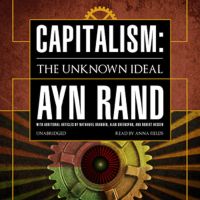
CapitalismAyn Rand14h 16m4.0 (5.2K)$25 · $0.00

Federalist & Anti-Federalist Papers - Complete EditionAlexander Hamilton, James Madison, John Jay, Samuel Bryan, Patrick Henry22h 20m4.3 (3K)$1 · $0.00

The Elements of Law, Natural and Politic (Annotated)Thomas Hobbes8h 6m4.0 (553)$2 · $0.00
How the Other Half BanksMehrsa Baradaran9h 35m4.2 (961)$20 · $0.00

LEVIATHAN (Complete Edition)Thomas Hobbes23h 43m3.9 (69.8K)$2 · $0.00

The War on Small BusinessCarol Roth9h 24m4.4 (411)$29 · $0.00

The Gulag Archipelago 1918-1956Aleksandr I. Solzhenitsyn21h 54m4.5 (44.1K)$46 · $0.00
The History of the Peloponnesian War (Annotated)Thucydides24h 3m4.6 (1.1K)$2 · $0.00

AzadiArundhati Roy6h 15m4.2 (5.1K)$17 · $0.00

The Secret Life of GroceriesBenjamin Lorr8h 57m4.1 (21.2K)$20

The Federalist Papers & Anti-Federalist Papers: Complete Edition of the Pivotal Constitution DebateAlexander Hamilton, James Madison, John Jay, Patrick Henry, Samuel Bryan22h 14m4.4 (7.7K)$2 · $0.00

The Gulag Archipelago Volume 3Aleksandr I. Solzhenitsyn21h 56m4.7 (8.9K)$46 · $0.00

The Gulag Archipelago Volume 1Aleksandr I. Solzhenitsyn25h 56m4.5 (25.1K)$8 · $0.00

One Day in the Life of Ivan DenisovichAleksandr Solzhenitsyn5h 6m4.1 (160.7K)$14

The Gulag Archipelago Volume 2Aleksandr I. Solzhenitsyn27h 31m4.6 (6K)$53 · $0.00

Virtue BombsChristian Toto6h 12m4.3 (150)$17 · $0.00

Thomas Hobbes: The Philosopher of OrderSaraban K. K. 1h 5m5.0 (9) Only with Ultra
Boom BustFred Harrison6h 42m$6 · $0.00
The Practice and Theory of Bolshevism (Annotated)Bertrand Russell5h 59m4.4 (122)$2 · $0.00
The Political Works of Thomas Hobbes (4 Books in One Edition)Thomas Hobbes48h 14m$2 · $0.00