
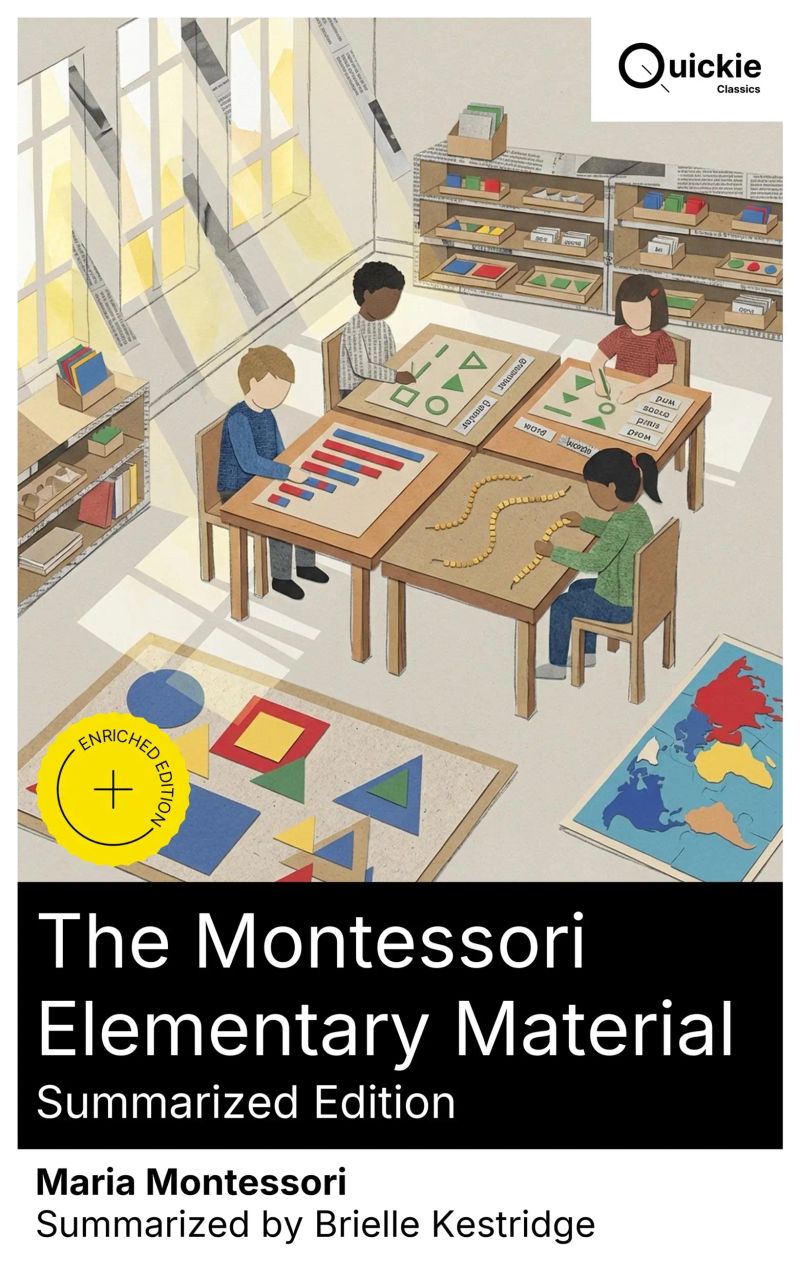
The Montessori Elementary Material (Summarized Edition)
Enriched edition. Montessori Methods and Materials for Self-Directed, Hands-On Learning in a Prepared ClassroomBy Maria Montessori


Length3h 52m
About this audiobook
The Montessori Elementary Material distills Maria Montessori's scientific pedagogy into a lucid manual for the elementary years. Organized by discipline—arithmetic, geometry, grammar, geography, and music—it details the didactic apparatus, the sequence of presentations, and the designed progression from concrete manipulation to abstraction. Montessori's style is exacting yet observant, pairing concise procedures with theoretical notes on control of error, isolation of difficulty, and the prepared environment. Composed within the ferment of early twentieth-century progressive education, the book distinguishes itself by standardizing child-centered discovery through replicable materials and carefully staged exercises, many accompanied by plates. A physician and anthropologist, Montessori brought laboratory rigor to pedagogy. Her early work with children with disabilities and her leadership at Rome's first Casa dei Bambini convinced her that attention, order, and autonomy could be elicited by materials engineered for self-correction. International classroom experiments and lectures informed the elementary extensions gathered here, where literacy, numeracy, and geometry are treated as engines of reasoning rather than recitation. Educators, researchers, and historically minded parents will value this landmark for both its clarity and its utility. Read it to design environments that cultivate initiative, precision, and sustained intellectual independence.
Quickie Classics summarizes timeless works with precision, preserving the author's voice and keeping the prose clear, fast, and readable—distilled, never diluted. Enriched Edition extras: Introduction · Synopsis · Historical Context · Author Biography · Brief Analysis · 4 Reflection Q&As · Editorial Footnotes.
Audiobook details
Rating★★★★ 4.3 (168)
Includes Goodreads
GenreEducation and Learning
Length3 hrs 52 mins
Narrated byListen with 1,000+ voices
FormateBook with Audio
Publish dateJan 10, 2026
LanguageEnglish
Table of contents
1Introduction
2Introduction
3Synopsis
4Historical Context
5Author Biography
Show all chaptersShow less
6The Montessori Elementary Material (pt. 1)
7The Montessori Elementary Material (pt. 2)
8Analysis
9Reflection
More from Maria Montessori

KinderrechteMaria Montessori1h 15m$18 · $0.00

Maria Montessori spricht zu ElternMaria Montessori1h 56m4.4 (573)$18 · $0.00

Das KindMaria Montessori1h 17m4.4 (130)$18 · $0.00

The Montessori Elementary Material (Annotated)Maria Montessori13h 10m$2 · $0.00

Dr. Montessori's Own HandbookMaria Montessori3h 33m4.3 (1.3K)$1 · $0.00

Die Montessori-MethodeMaria Montessori13h 14m4.1 (12.4K)$3 · $0.00

Dr. Montessori's Own HandbookMaria Montessori2h 42m4.3 (1.3K)$10 · $0.00

A Brief History of IntelligenceMax S. Bennett12h 18m4.6 (6.6K)$29 · $0.00

HomeschooledStefan Merrill Block7h 10m3.6 (18.5K)$28 · $0.00

Parents and Children (Annotated)Charlotte Mason9h 23m4.6 (988)$2 · $0.00

Children Under FireJohn Woodrow Cox10h 17m4.5 (1.6K)$29 · $0.00

The State Must ProvideAdam Harris7h 15m4.5 (775)$24 · $0.00

The Call of the Wild and FreeAinsley Arment9h 7m4.4 (21.2K)$29 · $0.00

The Freelance WayRobert Vlach19h 48m4.5 (528)$40 · $0.00

Race to the BottomLuke Rosiak9h 20m4.5 (600)$29 · $0.00

They Came for the SchoolsMike Hixenbaugh9h 5m4.5 (2.6K)$8 · $0.00

Find Me UnafraidKennedy Odede, Jessica Posner11h 11m4.5 (2.7K)$29 · $0.00

Asking for ItKate Harding8h 55m4.4 (5.3K)$20 · $0.00

Defining Moments in Black HistoryDick Gregory7h 37m4.4 (6K)$26 · $0.00

The Emerald Tablets of Thoth the AtlanteanMaurice Doreal3h 4m4.4 (8.8K)$6 · $0.00

Learning AmericaLuma Mufleh6h 37m4.4 (564)$24 · $0.00
Math-ishJo Boaler7h 21m4.4 (588)$24 · $0.00

It Worked For MeColin Powell7h 42m4.3 (9.8K)$26 · $0.00

Little SoldiersLenora Chu11h 30m4.3 (3.1K)$29 · $0.00

Financial FeministTori Dunlap8h 3m4.2 (22.2K)$8 · $0.00

Grammar-land; Or, Grammar in Fun for the Children of Schoolroom-shireM. L. Nesbitt2h 36m4.4 (487)$1 · $0.00

DarkwaterWilliam Edward Burghardt Du Bois6h 40m4.3 (1.4K)$11 · $0.00
You may also like

The Law of Mind in actionFenwicke L. Holmes5h 42m4.4 (297)$2.90 · $0.00

A Practical Guide to Self-Hypnosis (Annotated)Melvin Powers3h 57m4.4 (1.1K)$2 · $0.00
Mere ChristianityC. S. Lewis46m4.4 (546.2K)$17

You've Got ThisMichaela Dunbar4h 25m4.3 (382)$20 · $0.00

The Wisdom Of LifeArthur Schopenhauer4h 3m4.2 (20.2K)$2.30 · $0.00

A Buddhist BibleDwight Goddard7h 59m4.0 (663)$2 · $0.00

Sexual IntelligenceMarty Klein7h 36m3.9 (2.2K)$26 · $0.00
The Book of Daily BrilliancePamela Puja Kirpalani3h 16m$16 · $0.00

The Illustrated Self-Instructor in Phrenology and PhysiologyO. S. Fowler, L. N. Fowler6h 17m2.9 (11)$2 · $0.00

Strong MindDanniel Silva3h 31m$1.80 · $0.00

The Bad Bitch Business BibleLisa Carmen Wang7h 12m4.2 (159)$24 · $0.00

SocializingOliver M. Hayes4h 39m$4.10 · $0.00

LEARNING TO RESPECT YOURSELF AND OTHERSDave Uwaifo1h 54m$11

CrankyPhuc Tran7m4.0 (415)$3 · $0.00

Ojai 1973 Public Meetings USAJ. Krishnamurti5h 43m$13 · $0.00

PERSONAL POWER (All 12 Volumes)William Walker Atkinson50h 43m3.9 (144)$2 · $0.00
The Secret Of Mastering DetachmentDaniel Hartmann8h 19m$14 · $0.00
The Art of Understanding PeopleLaura Sthephane2h 1m$5.30 · $0.00

Steel FocusSara Melo2h 57m$1.80 · $0.00

Reprogram Your Brain in 21 DaysSara Melo2h 10m$1.80 · $0.00