
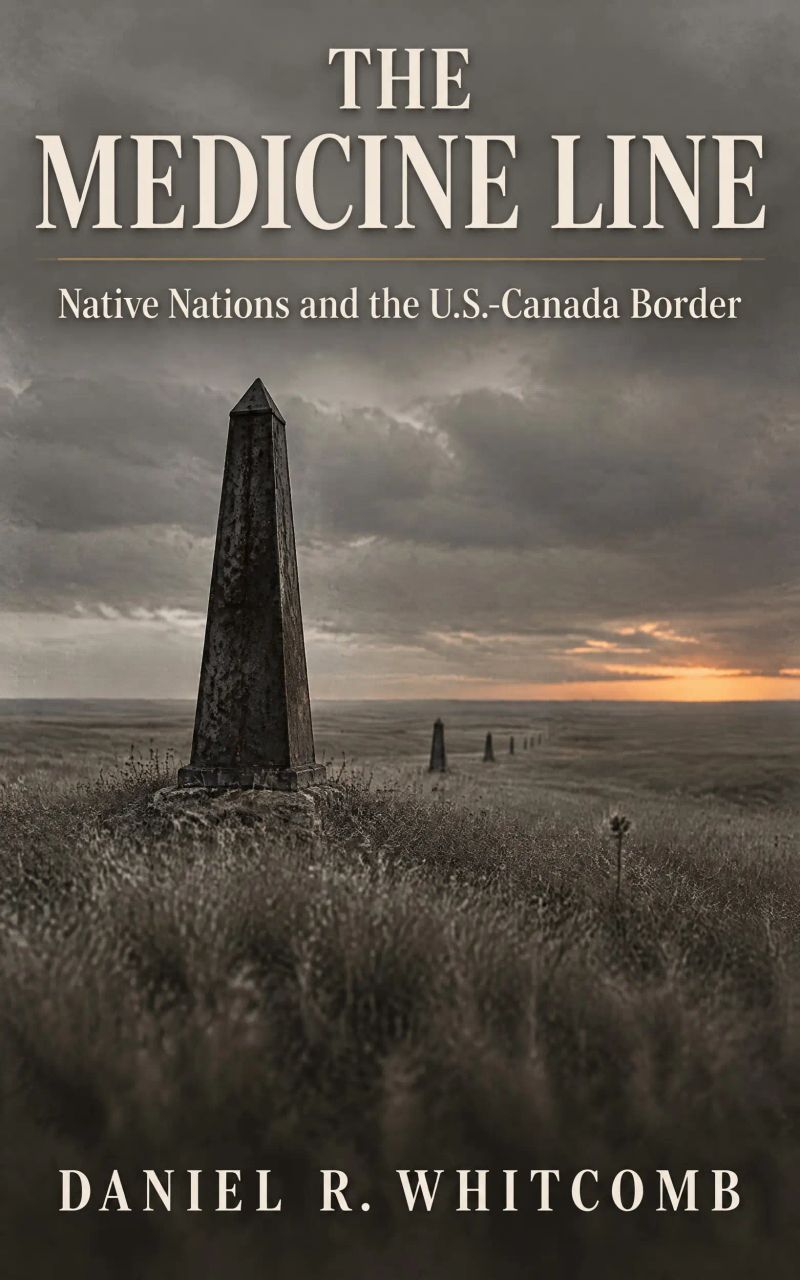
The Medicine Line: Native Nations and the U.S.-Canada Border
By Daniel R. Whitcomb


Length4h 51m
About this audiobook
No Haudenosaunee, Anishinaabe or Wabanaki delegate sat at the table in Paris on September 3, 1783, when American and British diplomats ended a war by drawing a boundary through the middle of their world. It ran through the Great Lakes to the Lake of the Woods and then due west toward a Mississippi that did not lie where the negotiators' map put it. Later treaties carried it west along the forty-ninth parallel, to the Rockies in 1818 and the Pacific in 1846, through fur-trade country the gold rushes would soon overrun, and across the hunting grounds of the Blackfoot, Cree, Nakoda and Métis, who went on crossing it as they always had.
In 1877 Sitting Bull and several thousand Lakota crossed it too, fleeing the army that had hunted them since the Little Bighorn, and made camp at Wood Mountain under the eyes of the North-West Mounted Police. The soldiers behind them stopped at a line they could not see. Plains peoples had a name for a boundary like that. They called it the Medicine Line.
By then the line had begun to harden. Wolf hunters had massacred Nakoda families in the Cypress Hills in 1873, bringing the Mounted Police west. As the buffalo failed, the border became a ration line; eight Cree and Nakoda men were hanged at Battleford in 1885, after the North-West Resistance; and in 1924 the United States created the Border Patrol. What does a people do when two foreign governments run their frontier straight through its homeland?
Audiobook details
GenreHistory
Length4 hrs 51 mins
Narrated byListen with 1,000+ voices
FormateBook with Audio
Publish dateSep 18, 2026
LanguageEnglish
Table of contents
1Chapter 1: A Line Through the Middle of the World
2Chapter 2: The 49th Parallel and the Fur Trade
3Chapter 3: The Drawing of the Oregon Line
4Chapter 4: The 49th Parallel and the Gold Rushes
5Chapter 5: The Cypress Hills Massacre, 1873
Show all chaptersShow less
6Chapter 6: Sitting Bull at Wood Mountain
7Chapter 7: The Metis and the Northern Plains
8Chapter 8: The North-West Mounted Police and the Border
9Chapter 9: The Buffalo Robe and the Ration Line
10Chapter 10: Border-Crossing Nations
11Chapter 11: The Border Hardens, 1885-1910
12Chapter 12: The Border Patrol and the Closing of the Line
13About the Author
More from Daniel R. Whitcomb
The Last of the Buffalo: Plains Ecology and the War for the GrasslandsDaniel R. Whitcomb4h 34m$6

The School on the Prairie: Carlisle and the War on Native ChildhoodDaniel R. Whitcomb4h 46m$6

The Great Law of Peace: The Iroquois Confederacy and the Making of the NortheastDaniel R. Whitcomb4h 12m$6
Crazy Horse and the End of Lakota FreedomDaniel R. Whitcomb4h 32m$6

The Long Hunter and the Shawnee Towns: Simon Kenton's Kentucky WarDaniel R. Whitcomb4h 45m$6
Sand Creek: The Colorado War, 1851-1865Daniel R. Whitcomb3h 48m4.3 (12)$6

The Yakama War and the Puget Sound War: Kamiakin, Leschi, and the Fight for the NorthwestDaniel R. Whitcomb3h 42m4.5 (10)$6

The Makah: Whaling, Treaties, and the Fight for the SeaDaniel R. Whitcomb4h 19m$6

The Pawnee: Earth Lodges, the Stars, and the ScoutsDaniel R. Whitcomb4h 2m$6

Seven Cargoes: How Corn, Horses, and Disease Remade Native AmericaDaniel R. Whitcomb5h 20m$6
Powder River: Red Cloud's War and the Fight for the Bighorn CountryDaniel R. Whitcomb4h 19m4.3 (22)$6
Fallen Timbers: Little Turtle, St. Clair, and the Fight for OhioDaniel R. Whitcomb5h 6m4.3 (21)$6

The Black Hawk War: The Last War East of the MississippiDaniel R. Whitcomb4h 6m$6

A Brief History of IntelligenceMax S. Bennett12h 18m4.6 (6.6K)$29 · $0.00

The Happiest Man on EarthEddie Jaku3h 48m4.6 (178K)$7 · $0.00

MotherlandJulia Ioffe17h 52m4.7 (2.5K)$40 · $0.00

Where Cowards Go to DieBenjamin Sledge8h 42m4.7 (351)$20 · $0.00

RevolutionariesSanjeev Sanyal11h 23m4.6 (2.6K)$29 · $0.00

We Crossed a Bridge and It TrembledWendy Pearlman6h4.6 (5.2K)$24 · $0.00

Unbroken Bonds of BattleJohnny Joey Jones8h 31m4.6 (2.6K)$8 · $0.00

The Daughter of AuschwitzTova Friedman, Malcolm Brabant7h 54m4.6 (16.7K)$26 · $0.00

Lily's PromiseLily Ebert, Dov Forman8h 54m4.6 (16.1K)$29 · $0.00

On Democracies and Death CultsDouglas Murray10h 38m4.6 (6.5K)$29 · $0.00

Across the RiverKent Babb11h 40m4.6 (927)$29 · $0.00

Balcony Over Jerusalem: A Middle East Memoir - Israel, Palestine and BeyondJohn Lyons12h 37m4.6 (1.4K)$33 · $0.00

BeyondStephen Walker15h 39m4.6 (3.2K)$33 · $0.00
Kings and PawnsHoward Bryant10h 9m4.6 (678)$29 · $0.00

No EscapeNury Turkel9h 30m4.6 (809)$28 · $0.00
Jubal Stone: U.S. Marshal: Blood Trail To Hell: A Western Adventure NovelCasey Nash3h 42m4.6 (3.2K)$18 · $0.00

Fall and RiseMitchell Zuckoff17h 23m4.6 (9.8K)$40 · $0.00
The SurvivorJosef Lewkowicz, Michael Calvin9h 22m4.6 (2.5K)$29 · $0.00

Always FaithfulThomas Schueman, Zainullah Zaki12h 12m4.6 (977)$29 · $0.00

The State of Society in France Before the Revolution of 1789 (Annotated)Alexis de Tocqueville17h 25m4.6 (1.2K)$2 · $0.00
You may also like
The Tuscarora WarDavid La Vere9h 53m4.1 (335)$20
The Invasion of Europe by the Barbarians (Annotated)J. B. Bury8h 41m4.0 (697)$2 · $0.00
Bury My Heart at Wounded KneeDee Brown14h 21m4.4 (139.5K)$25
An Apache Campaign In The Sierra MadreJohn Gregory Bourke2h 20m4.1 (330)$1 · $0.00
Of Plymouth Plantation (Complete Edition) (Annotated)William Bradford18h 14m3.9 (4.3K)$2 · $0.00
On the Border with Crook (Summarized Edition)John Gregory Bourke5h4.3 (849)$2
Australia: A History - How an ancient land became a great democracyTony Abbott14h 26m4.4 (289)$33 · $0.00
Homage to CataloniaGeorge Orwell8h 40m4.2 (105.1K)$1.20 · $0.00

UnleashedBoris Johnson25h 41m4.1 (4.2K)$53 · $0.00
Chicago and the Old Northwest, 1673-1835Milo Milton Quaife19h 24m$1 · $0.00
The Yosemite and the Ahwahneechee: People of the ValleyDaniel R. Corbin3h 50m$6
THE LAST STANDWilliam Hartshorne Stone6h 4m$8
The Yamasee War: Carolina, the Indian Slave Trade, and the Uprising That Nearly Ended a ColonyMarcus Fulton Reilly3h 37m$6

The Settler and the SavageR. M. Ballantyne10h 17m$2.30
THE LAST AMERICAN FRONTIER (Annotated)Frederic L. Paxson11h 25m3.8 (36)$2 · $0.00
The Last American Frontier (Summarized Edition)Frederic L. Paxson4h 12m$2
Three Years on the Plains: Observations of Indians, 1867-1870Edmund B. Tuttle4h 5m3.9 (18)$2 · $0.00
History of Tasmania (Annotated)John West34h 14m4.2 (38)$2 · $0.00
The History of American Indian in the Period of ReconstructionAnnie Heloise Abel8h 14m4.0 (11)$1.99 · $0.00

Ninety Million Acres: The Dawes Act and the Theft of Indian LandDaniel R. Whitfield4h 47m$6