
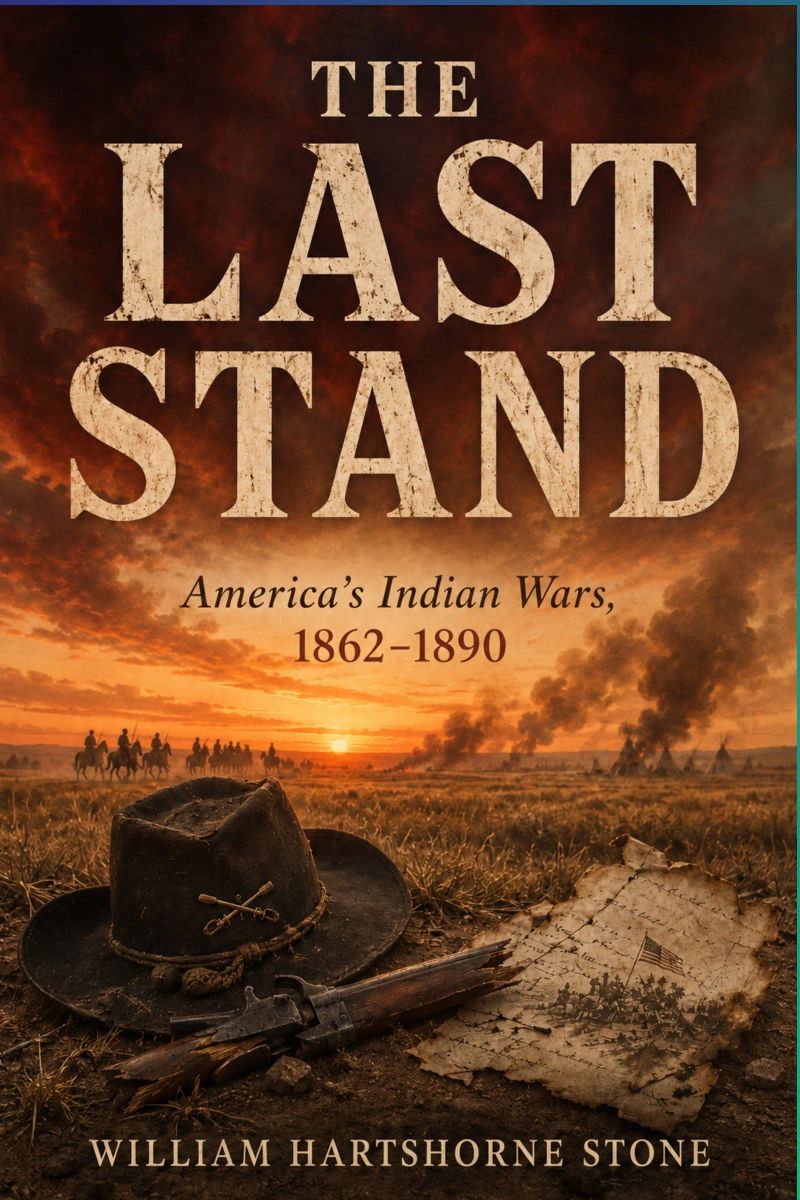
THE LAST STAND
America's Indian Wars, 1862–1890By William Hartshorne Stone


Length6h 4m
About this audiobook
American Indian Wars history — Little Bighorn, Wounded Knee, the complete narrative history of America's conquest of the West, 1862-1890: Sitting Bull, Crazy Horse, Geronimo, Chief Joseph.
In the winter of 1889-1890, a Lakota elder stood on the frozen ground of the former Great Sioux Reservation and watched government surveyors drive iron stakes into the earth. The stakes were dividing what remained — 9 million acres, excised from 22 million the Treaty of Fort Laramie had guaranteed in 1868, opened to white homesteaders under the Sioux Act. Red Cloud, by then an old man, said flatly: "I was not consulted." The surveyors worked methodically across the plains. The lines went into the ground.
This is the history of how those lines got drawn. Historian William Hartshorne Stone traces the full arc from the Dakota War of 1862 — when 38 men were hanged simultaneously at Mankato, the largest mass execution in American history — through the Apache Wars and the Great Sioux War, to Wounded Knee on December 29, 1890, where four Hotchkiss guns fired 500 shells in under an hour into a crowd that included women and children. General Miles called it "a cruel and unnecessary massacre." The government awarded twenty Medals of Honor to the soldiers who participated.
Inside this Indian Wars history:
• The Dakota War and the Mankato hangings — Andrew Myrick tells the starving Dakota they can eat grass; his body is found with his mouth stuffed with it; 38 men hanged December 26, 1862 — the largest mass execution in American history (Chapter 1)
• Sand Creek and the logic of atrocity — Black Kettle surrenders under an American flag; Colonel Chivington's Colorado militia kills 200, mostly women and children; the men are never prosecuted (Chapter 2)
• Little Bighorn, June 25, 1876 — how the Black Hills gold rush broke the Fort Laramie Treaty and drove the Lakota to their greatest military victory, and their final catastrophe (Chapters 9-11)
• Sitting Bull, Crazy Horse, and Geronimo — the last free men: their strategies, their surrenders, and what the government did with them after they stopped fighting (Chapters 12, 14)
• The boarding schools — Captain Pratt's formula at Carlisle: "Kill the Indian in him, and save the man"; 186 children in Carlisle's cemetery; Jim Thorpe wins two Olympic gold medals and dies in a California trailer (Chapter 19)
• The Dawes Act and ninety million acres lost — how Senator Dawes's sincere belief in private property transferred 65 percent of the 1887 Native land base to non-Native hands in forty-seven years (Chapter 18)
• Wounded Knee and its aftermath — Lost Bird, two months old, found alive under her mother's body; the Medals of Honor awarded and never rescinded; L. Frank Baum's editorial calling for "total annihilation" five days later (Chapter 16)
The Indian Wars are not ancient history. The 22 million acres of the Great Sioux Reservation, the 90 million acres lost to allotment, the Carlisle children buried under names not their own — these are the foundations on which the contemporary West was built. Understanding them is not optional for anyone who wants to understand America.
For readers of Dee Brown's BURY MY HEART AT WOUNDED KNEE and David Grann's KILLERS OF THE FLOWER MOON.
Audiobook details
GenreHistory, Psychology
Length6 hrs 4 mins
Narrated byListen with 1,000+ voices
FormateBook with Audio
Publish dateJun 2, 2026
LanguageEnglish
Table of contents
1Introduction
2Prologue: A Continent Contested
3PART ONE: THE EASTERN PLAINS (1862–1868)
4Chapter 1: The Dakota War — Minnesota's War of 1862
5Chapter 2: Sand Creek — Colorado's Atrocity
Show all chaptersShow less
6Chapter 3: Red Cloud's War — The Army's Greatest Defeat
7Chapter 4: The Medicine Lodge Treaties — Peace That Could Not Hold
8PART TWO: THE SOUTHERN PLAINS WARS (1868–1875)
9Chapter 5: Custer on the Washita — The Winter Campaign of 1868
10Chapter 6: The Comanche Empire — Lords of the Southern Plains
11Chapter 7: The Red River War — The Destruction of Southern Plains Resistance
12Chapter 8: Quanah Parker — From War Chief to Political Leader
13PART THREE: THE GREAT SIOUX WAR (1873–1877)
14Chapter 9: The Black Hills — Gold and the Breaking of the Treaty
15Chapter 10: Little Bighorn — June 25, 1876
16Chapter 11: After Little Bighorn — The Destruction of Sioux Resistance
17Chapter 12: Sitting Bull and Crazy Horse — The Last Free Men
18PART FOUR: THE WESTERN WARS (1877–1886)
19Chapter 13: The Nez Perce War — Chief Joseph's Fighting Retreat
20Chapter 14: The Apache Wars — Geronimo's Long Resistance
21Chapter 15: The Ghost Dance — A People's Last Hope
22Chapter 16: Wounded Knee — The Massacre That Ended an Era
23PART FIVE: CONFINEMENT AND DESTRUCTION (1870–1900)
24Chapter 17: The Reservation System — Confinement and Cultural Assault
25Chapter 18: The Dawes Act — Allotment and the Loss of the Land
26Chapter 19: The Boarding Schools — Assimilation by Force
27Chapter 20: The Collapse of the Buffalo — Ecological and Cultural Catastrophe
28PART SIX: LEGACIES (1890–PRESENT)
29Chapter 21: Native Americans in the Twentieth Century — Survival and Resistance
30Chapter 22: The Legal Legacy — Treaties, Courts, and Native Rights
31Chapter 23: How the Indian Wars Shaped America — Myth, Memory, and Monument
32Chapter 24: Reckoning — What the Indian Wars Mean Today
33Epilogue: The Long Aftermath
34Acknowledgments
35Selected Bibliography
36About the Author
More from William Hartshorne Stone

A Brief History of IntelligenceMax S. Bennett12h 18m4.6 (6.6K)$29 · $0.00

The Gulag Archipelago Volume 3Aleksandr I. Solzhenitsyn21h 56m4.7 (8.9K)$46 · $0.00

Pearl of Great PriceJoseph Smith3h 8m4.7 (7.2K)$1.20 · $0.00

The Happiest Man on EarthEddie Jaku3h 48m4.6 (178K)$7 · $0.00

MotherlandJulia Ioffe17h 52m4.7 (2.5K)$40 · $0.00

Where Cowards Go to DieBenjamin Sledge8h 42m4.7 (351)$20 · $0.00

RevolutionariesSanjeev Sanyal11h 23m4.6 (2.6K)$29 · $0.00

We Crossed a Bridge and It TrembledWendy Pearlman6h4.6 (5.2K)$24 · $0.00

Unbroken Bonds of BattleJohnny Joey Jones8h 31m4.6 (2.6K)$8 · $0.00

The Daughter of AuschwitzTova Friedman, Malcolm Brabant7h 54m4.6 (16.7K)$26 · $0.00

Lily's PromiseLily Ebert, Dov Forman8h 54m4.6 (16.1K)$29 · $0.00

On Democracies and Death CultsDouglas Murray10h 38m4.6 (6.5K)$29 · $0.00

Across the RiverKent Babb11h 40m4.6 (927)$29 · $0.00

Balcony Over Jerusalem: A Middle East Memoir - Israel, Palestine and BeyondJohn Lyons12h 37m4.6 (1.4K)$33 · $0.00

BeyondStephen Walker15h 39m4.6 (3.2K)$33 · $0.00
Kings and PawnsHoward Bryant10h 9m4.6 (678)$29 · $0.00

No EscapeNury Turkel9h 30m4.6 (809)$28 · $0.00
Jubal Stone: U.S. Marshal: Blood Trail To Hell: A Western Adventure NovelCasey Nash3h 42m4.6 (3.2K)$18 · $0.00

Fall and RiseMitchell Zuckoff17h 23m4.6 (9.8K)$40 · $0.00
The SurvivorJosef Lewkowicz, Michael Calvin9h 22m4.6 (2.5K)$29 · $0.00
What to Make of a LifeJim Collins13h 31m4.4 (794)$33 · $0.00

Black AF HistoryMichael Harriot15h 43m4.7 (14.6K)$33 · $0.00

Bad Fat Black GirlSesali Bowen6h 32m4.7 (2.8K)$24 · $0.00

Invisible StormJason Kander6h 48m4.7 (3.2K)$24 · $0.00

I Am The StormJanice Dean9h4.6 (1.5K)$8 · $0.00
On Democracies and Death CultsDouglas Murray10h 38m4.6 (6.5K)$29 · $0.00

TerraformPropaganda5h 39m4.7 (594)$24 · $0.00

Southern Horrors: Lynch Law in All Its Phases (Annotated)Ida B. Wells-Barnett2h 44m4.6 (1.3K)$2 · $0.00

Hour of the HeartIrvin D. Yalom, Benjamin Yalom8h 19m4.6 (2.3K)$26 · $0.00

Braving the TruthRachel Held Evans11h 31m4.7 (359)$29 · $0.00
Level UpRob Dial7h 42m4.6 (3.3K)$26 · $0.00

As a JewSarah Hurwitz8h 36m4.6 (1.2K)$26 · $0.00
Saint Joan (Annotated)George Bernard Shaw6h 20m4.6 (1.2K)$1.20 · $0.00

Burn the HaystackJennie Young, PhD9h 30m4.6 (543)$29 · $0.00

Woman and the New Race (Annotated)Margaret Sanger6h 30m4.6 (1K)$1.99 · $0.00

Good InsideBecky Kennedy9h 55m4.5 (59.3K)$29 · $0.00
The Mis-Education of the NegroCarter Godwin Woodson5h 4m4.5 (29.4K)$1.20 · $0.00

Du Bois: EssaysW.E.B. Du Bois6h 22m4.6 (1.5K)$1 · $0.00

The North American Indian (Illustrated Edition)Edward S. Curtis, Frederick Webb Hodge5h 59m4.6 (1.4K)$2 · $0.00

Valley of the BirdtailAndrew Stobo Sniderman, Douglas Sanderson10h 1m4.6 (2.4K)$29 · $0.00
You may also like

O Jerusalem!Larry Collins, Dominique Lapierre23h 42m4.4 (7.7K)$30
The Invasion of Europe by the Barbarians (Annotated)J. B. Bury8h 41m4.0 (697)$2 · $0.00
The Jewish WarsFlavius Josephus28h 18m4.2 (7K)$2 · $0.00
Bury My Heart at Wounded KneeDee Brown14h 21m4.4 (139.5K)$25

Cursed VictoryAhron Bregman13h 15m4.4 (296)$23
Six Days of WarMichael B. Oren17h 54m4.4 (15.5K)$32

A Diary from DixieMary Chesnut14h 27m3.9 (1.4K)$10 · $0.00
Autobiography of Ma-ka-tai-me-she-kia-kiak, or Black HawkSauk chief Black Hawk5h 9m3.9 (2K)$1.99 · $0.00
The Underground RailroadWilliam Still, Sarah Bradford, Laura S. Haviland64h 41m4.4 (322)$1.99 · $0.00

History of the American Civil War (Annotated)James Ford Rhodes16h4.1 (875)$2 · $0.00

Life Among the Piutes: The First Autobiography of a Native American WomanSarah Winnemucca Hopkins9h4.1 (1.1K)$1 · $0.00
The American Indians in the Civil WarAnnie Heloise Abel14h 52m4.2 (31)$1.99 · $0.00

The American Indian as Participant in the Civil WarAnnie Heloise Abel13h 3m3.6 (15)$2 · $0.00

The History of American Indian in the Period of ReconstructionAnnie Heloise Abel8h 14m4.0 (11)$1.99 · $0.00

The Yamasee War: Carolina, the Indian Slave Trade, and the Uprising That Nearly Ended a ColonyMarcus Fulton Reilly3h 37m$6

Paris under the CommuneJohn Leighton14h 53m$2 · $0.00

The History of the Black Hawk War & Autobiography of the Sauk Leader, the Great Black Hawk (Annotated)Black Hawk, Charles M. Scanlan9h 7m$2 · $0.00

The Medicine Line: Native Nations and the U.S.-Canada BorderDaniel R. Whitcomb4h 52m$6
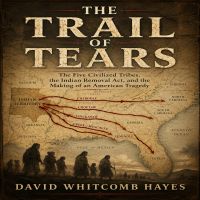
THE TRAIL OF TEARSDavid Whitcomb Hayes5h 22m$10 · $0.00
The History of Slaveholding IndiansAnnie Heloise Abel37h 20m4.4 (14)$1.99 · $0.00