
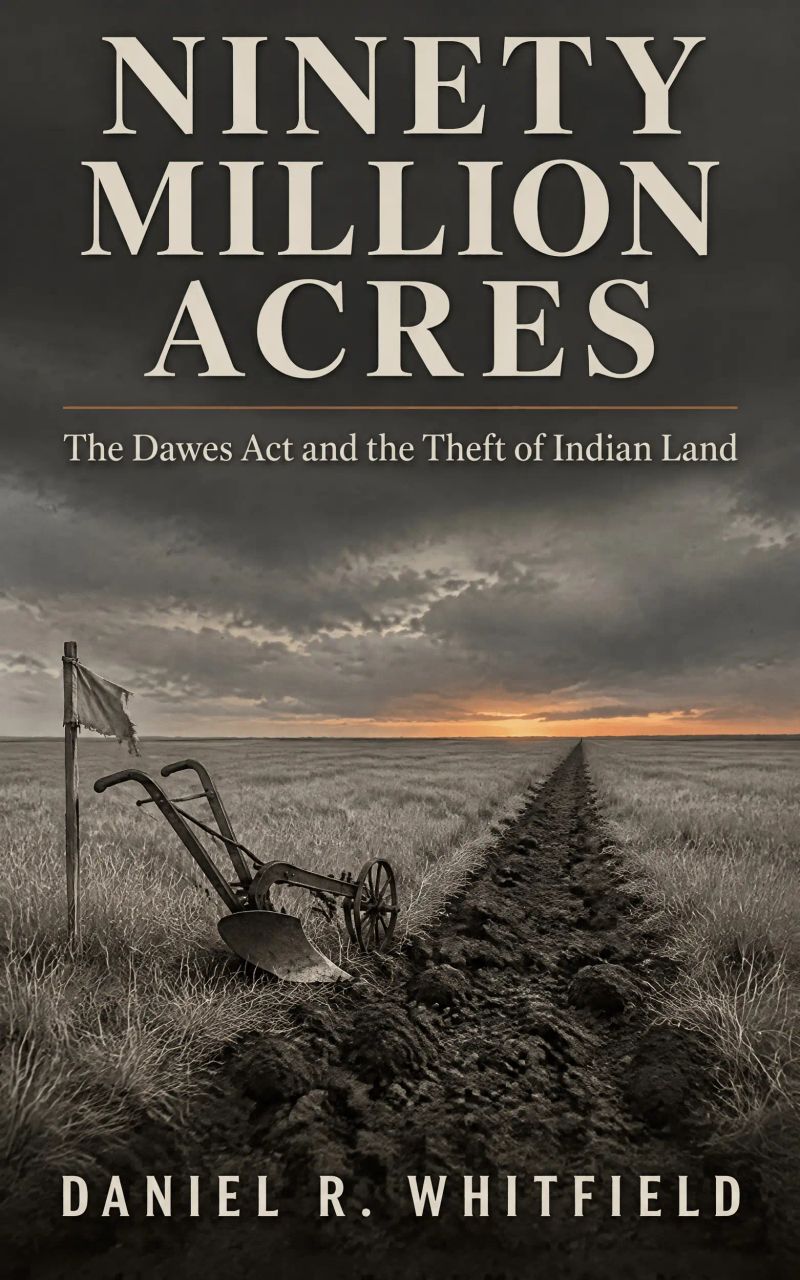
Ninety Million Acres: The Dawes Act and the Theft of Indian Land
By Daniel R. Whitfield


Length4h 47m
About this audiobook
The treaty the Lakota signed at Fort Laramie in 1868 set aside a reservation "for the absolute and undisturbed use and occupation" of their people. Its twelfth article went further: no part of that land could be given up without the consent of three-fourths of the adult men, not a bare majority and not the signature of one agreeable chief. Red Cloud would not sign at all until the Army's forts on the Bozeman Trail had been abandoned and burned.
Nineteen years later Senator Henry Dawes of Massachusetts, a man who believed himself the Indians' friend, saw his General Allotment Act become law. It carved reservations into individual plots, up to 160 acres for the head of a family, and opened the "surplus" to white settlement.
On the ground the law meant land rushes, guardians who drained the estates of Native minors, blood-quantum rolls that decided who counted as Indian on paper, and oil that made some allotments a target for fraud. Reformers and the Meriam Report of 1928 exposed the damage, and in 1934 the Indian Reorganization Act finally stopped the carving. By then the land held by Native nations had fallen from about 138 million acres to about 48 million.
The three-fourths clause outlived nearly everyone who signed it. In 1980 it stood behind a Supreme Court judgment over the Black Hills, and the Lakota, offered the money, would not take it.
Audiobook details
GenreHistory
Length4 hrs 47 mins
Narrated byListen with 1,000+ voices
FormateBook with Audio
Publish dateSep 19, 2026
LanguageEnglish
Table of contents
1Chapter 1: The Reservation as a Holding Pen
2Chapter 2: The Senator Who Believed Himself a Friend
3Chapter 3: 160 Acres and a Promise
4Chapter 4: The Great Land Rush
5Chapter 5: The Guardians and the Guardianship Fraud
Show all chaptersShow less
6Chapter 6: Blood Quantum and the Paper Indian
7Chapter 7: Oil Under the Allotment
8Chapter 8: The Reformers Awake
9Chapter 9: The Meriam Report
10Chapter 10: The Depression and the End of Allotment
11Chapter 11: 1934: The Indian Reorganization Act
12Chapter 12: What the Land Remembers
13About the Author
More from Daniel R. Whitfield

Jim Thorpe: The Greatest Athlete and the Fight for His MedalsDaniel R. Whitfield4h 19m$6

The Osage Empire Before OilDaniel R. Whitfield4h 38m$6

The World They Made: Native America in 1491Daniel R. Whitfield4h 24m$6

The Prophet and the Confederacy: Tenskwatawa, Tippecanoe, and the War for Native PowerDaniel R. Whitfield4h 17m$6

Ely Parker: The Seneca Engineer Who Wrote the Surrender at AppomattoxDaniel R. Whitfield3h 27m$6

The Chickasaw Wars: The Nation That Never SurrenderedDaniel R. Whitfield3h 55m$6

The Marshall Trilogy: How Three Supreme Court Cases Built Tribal SovereigntyDaniel R. Whitfield4h 42m$6

The Kiowa and the Southern Plains: Horse Trade, Sun Dance, and the Long Road to ReservationDaniel R. Whitfield4h 50m$6

A Brief History of IntelligenceMax S. Bennett12h 18m4.6 (6.6K)$29 · $0.00

The Happiest Man on EarthEddie Jaku3h 48m4.6 (178K)$7 · $0.00

MotherlandJulia Ioffe17h 52m4.7 (2.5K)$40 · $0.00

Where Cowards Go to DieBenjamin Sledge8h 42m4.7 (351)$20 · $0.00

RevolutionariesSanjeev Sanyal11h 23m4.6 (2.6K)$29 · $0.00

We Crossed a Bridge and It TrembledWendy Pearlman6h4.6 (5.2K)$24 · $0.00

Unbroken Bonds of BattleJohnny Joey Jones8h 31m4.6 (2.6K)$8 · $0.00

The Daughter of AuschwitzTova Friedman, Malcolm Brabant7h 54m4.6 (16.7K)$26 · $0.00

Lily's PromiseLily Ebert, Dov Forman8h 54m4.6 (16.1K)$29 · $0.00

On Democracies and Death CultsDouglas Murray10h 38m4.6 (6.5K)$29 · $0.00

Across the RiverKent Babb11h 40m4.6 (927)$29 · $0.00

Balcony Over Jerusalem: A Middle East Memoir - Israel, Palestine and BeyondJohn Lyons12h 37m4.6 (1.4K)$33 · $0.00

BeyondStephen Walker15h 39m4.6 (3.2K)$33 · $0.00
Kings and PawnsHoward Bryant10h 9m4.6 (678)$29 · $0.00

No EscapeNury Turkel9h 30m4.6 (809)$28 · $0.00

Jubal Stone: U.S. Marshal: Blood Trail To Hell: A Western Adventure NovelCasey Nash3h 42m4.6 (3.2K)$18 · $0.00

Fall and RiseMitchell Zuckoff17h 23m4.6 (9.8K)$40 · $0.00
The SurvivorJosef Lewkowicz, Michael Calvin9h 22m4.6 (2.5K)$29 · $0.00

Always FaithfulThomas Schueman, Zainullah Zaki12h 12m4.6 (977)$29 · $0.00

The State of Society in France Before the Revolution of 1789 (Annotated)Alexis de Tocqueville17h 25m4.6 (1.2K)$2 · $0.00
You may also like
By the Fire We CarryRebecca Nagle8h 15m4.5 (5.5K)$26 · $0.00

Autobiography of Ma-ka-tai-me-she-kia-kiak, or Black HawkSauk chief Black Hawk5h 9m3.9 (2K)$0.99 · $0.00

The Tuscarora WarDavid La Vere9h 53m4.1 (335)$20
Bury My Heart at Wounded KneeDee Brown14h 21m4.4 (139.5K)$25

The VortexScott Carney, Jason Miklian15h 26m4.4 (1K)$33 · $0.00

Geronimo's Story of His Life (Illustrated Edition)Geronimo5h 21m4.2 (7K)$1.99 · $0.00

O Jerusalem!Larry Collins, Dominique Lapierre23h 42m4.4 (7.7K)$30
It Wasn’t about SlaverySamuel W. Mitcham Jr.6h 21m4.4 (1.7K)$17

In the Midst of Civilized EuropeJeffrey Veidlinger14h 45m4.4 (444)$33 · $0.00

The Yamasee War: Carolina, the Indian Slave Trade, and the Uprising That Nearly Ended a ColonyMarcus Fulton Reilly3h 37m$6

The Yosemite and the Ahwahneechee: People of the ValleyDaniel R. Corbin3h 50m$6

The Lava Beds: The Modoc War of 1872-1873Daniel Whitcomb4h 16m4.6 (12)$6

The Medicine Line: Native Nations and the U.S.-Canada BorderDaniel R. Whitcomb4h 52m$6

THE LAST STANDWilliam Hartshorne Stone6h 4m$8

The History of American Indian in the Period of ReconstructionAnnie Heloise Abel8h 14m4.0 (11)$1.99 · $0.00

History of the Black Hawk WarBlack Hawk, Charles M. Scanlan8h 55m$2 · $0.00

Iron RoadPatrick Donnelly Frost5h 24m$10 · $0.00

Sand Creek: The Colorado War, 1851-1865Daniel R. Whitcomb3h 48m4.3 (12)$6

The American Indian Under ReconstructionAnnie Heloise Abel7h 19m4.0 (11)$1 · $0.00

Famous Indian ChiefsCharles H. L. Johnston10h 17m3.9 (34)$0.99 · $0.00