
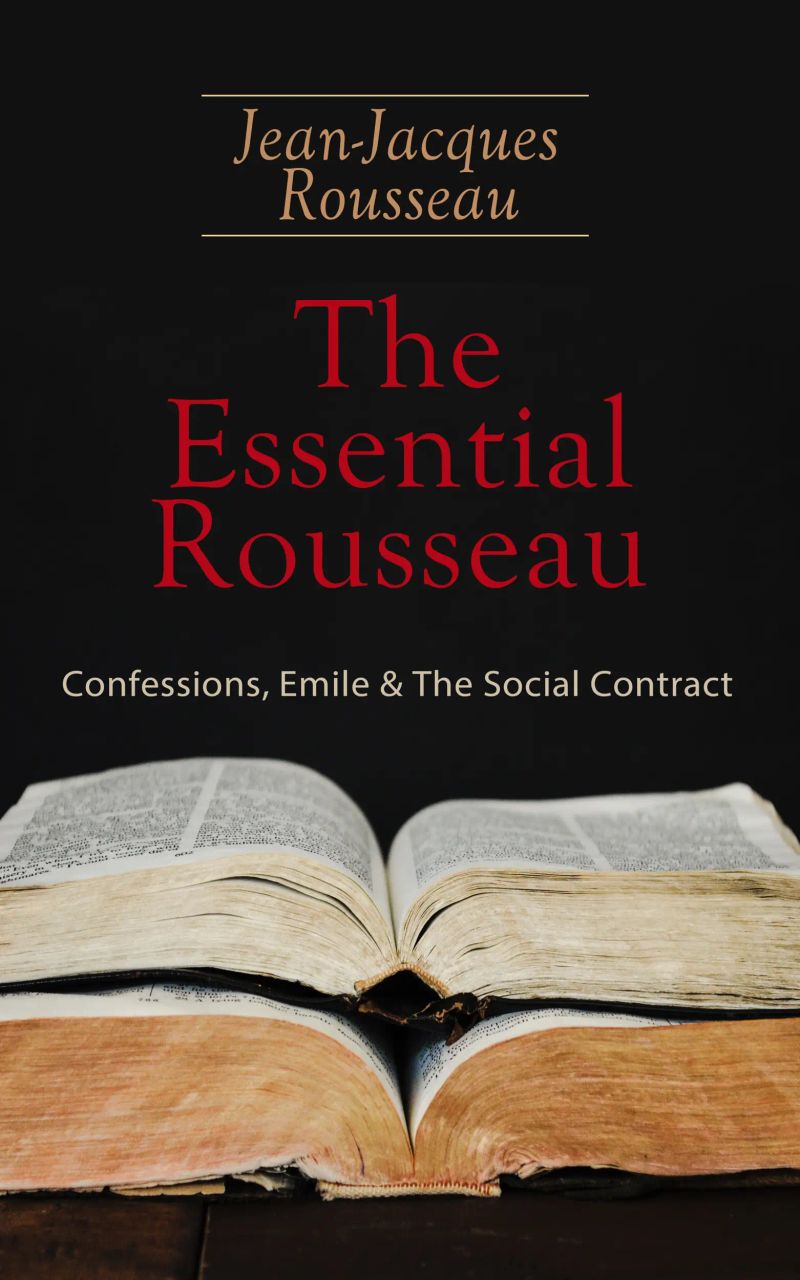
The Essential Rousseau: Confessions, Emile & The Social Contract
By Jean-Jacques Rousseau


Length61h 35m
About this audiobook
This meticulously edited Rousseau collection is formatted for your eReader with a functional and detailed table of contents:
"Emile, or On Education" or "Émile, or Treatise on Education" is a treatise on the nature of education and on the nature of man. Jean-Jacques Rousseau considered it to be the "best and most important" of all his writings. Emile is scarcely a detailed parenting guide but it does contain some specific advice on raising children. It is regarded by some as the first philosophy of education in Western culture to have a serious claim to completeness, as well as being one of the first Bildungsroman novels.
"The Social Contract," originally published as On the Social Contract; or, Principles of Political Rights by Rousseau, is a 1762 book in which Rousseau theorized about the best way to establish a political community in the face of the problems of commercial society, which he had already identified in his Discourse on Inequality (1754). The Social Contract helped inspire political reforms or revolutions in Europe, especially in France
"Confessions" is an autobiographical book which covers the first fifty-three years of Rousseau's life, up to 1765. It was completed in 1769, but not published until 1782, four years after Rousseau's death, even though Rousseau did read excerpts of his manuscript publicly at various salons and other meeting places. He wrote of his own life mainly in terms of his worldly experiences and personal feelings.
Audiobook details
GenrePhilosophy
Length61 hrs 35 mins
Narrated byListen with 1,000+ voices
FormateBook with Audio
Publish dateMay 1, 2018
LanguageEnglish
Table of contents
1Introduction by S.W. Orson
43Book II
2Book I.
44Chapter I. That Sovereignty is Inalienable
3Book II.
45Chapter II. That Sovereignty is Indivisible
4Book III.
46Chapter III. Whether the General Will is Fallible
5Book IV.
47Chapter IV. The Limits of the Sovereign Power
Show all chaptersShow less
6Book V.
48Chapter V. The Right of Life and Death
7Book VI.
49Chapter VI. Law
8Book VII. (pt. 1)
50Chapter VII. The Legislator
9Book VII. (pt. 2)
51Chapter VIII. The People
10Book VIII.
52Chapter IX. The People (continued)
11Book IX. (pt. 1)
53Chapter X. The People (continued)
12Book IX. (pt. 2)
54Chapter XI. The Various Systems of Legislation
13Book X.
55Chapter XII. The Division of the Laws
14Book XI.
56Book III
15Book XII. (pt. 1)
57Chapter I. Government in General
16Book XII. (pt. 2)
58Chapter II. The Constituent Principle in the Various Forms of Government
17Author's Preface
59Chapter III. The Division of Governments
18Book I
60Chapter IV. Democracy
19Book II (pt. 1)
61Chapter V. Aristocracy
20Book II (pt. 2)
62Chapter VI. Monarchy
21Book II (pt. 3)
63Chapter VII. Mixed Governments
22Book III (pt. 1)
64Chapter VIII. That All Forms of Government Do Not Suit All Countries
23Book III (pt. 2)
65Chapter IX. The Marks of a Good Government
24Book IV (pt. 1)
66Chapter X. The Abuse of Government and Its Tendency to Degenerate
25Book IV (pt. 2)
67Chapter XI. The Death of the Body Politic
26Book IV (pt. 3)
68Chapter XII. How the Sovereign Authority Maintains Itself
27Book IV (pt. 4)
69Chapter XIII. The Same (continued)
28Book V (pt. 1)
70Chapter XIV. The Same (continued)
29Book V (pt. 2)
71Chapter XV. Deputies or Representatives
30Book V (pt. 3)
72Chapter XVI. That the Institution of Government is Not a Contract
31Introduction
73Chapter XVII. The Institution of Government
32Foreword
74Chapter XVIII. How to Check the Usurpations of Government
33Book I
75Book IV
34Chapter I. Subject of the First Book
76Chapter I. That the General Will is Indestructible
35Chapter II. The First Societies
77Chapter II. Voting
36Chapter III. The Right of the Strongest
78Chapter III. Elections
37Chapter IV. Slavery
79Chapter IV. The Roman Comitia
38Chapter V. That We Must Always Go Back to a First Convention
80Chapter V. The Tribunate
39Chapter VI. The Social Compact
81Chapter VI. The Dictatorship
40Chapter VII. The Sovereign
82Chapter VII. The Censorship
41Chapter VIII. The Civil State
83Chapter VIII. Civil Religion
42Chapter IX. Real Property
84Chapter IX. Conclusion

The Social Contract & EmileJean-Jacques Rousseau33h 43m$2 · $0.00

Emile, or On EducationJean-Jacques Rousseau26h 3m$1 · $0.00
Émile eli KasvatuksestaJean-Jacques Rousseau28h 13m$2 · $0.00

A Discourse Upon the Origin and the Foundation of the Inequality Among MankindJean-Jacques Rousseau2h 50m$2 · $0.00

The Essential Writings of Jean-Jacques RousseauJean-Jacques Rousseau82h 35m$2 · $0.00

Emile & ConfessionsJean-Jacques Rousseau54h 57m$2 · $0.00
Emile, Confessions & The Social Contract (3 Books in One Edition)Jean-Jacques Rousseau62h 46m$1 · $0.00

Emile oder über die ErziehungJean-Jacques Rousseau31h 57m$2 · $0.00
Yhteiskuntasopimuksesta, eli, Valtio-oikeuden johtavat aatteetJean-Jacques Rousseau4h 36m$1 · $0.00

The French Revolution and NapoleonJean-Jacques Rousseau, Alexis de Tocqueville, Montesquieu, Charles Downer Hazen62h 54m$2 · $0.00

The Essential Writings of Jean-Jacques RousseauJean-Jacques Rousseau82h 35m$2 · $0.00

El contrato socialJean-Jacques Rousseau6h 2m$2 · $0.00
The Greatest Works of Jean-Jacques RousseauJean-Jacques Rousseau68h 49m$2 · $0.00

Emile, or On EducationJean-Jacques Rousseau26h 3m$2 · $0.00

Die größten Bildungsromane der WeltliteraturJean-Jacques Rousseau, Johann Wolfgang von Goethe, Charlotte Brontë, Stendhal, Charles Dickens, Christoph Martin Wieland, Robert Musil, Fjodor Michailowitsch Dostojewski, Jack London, Gottfried Keller, Voltaire, Daniel Defoe, Gustave Flaubert, Alessandro Manzoni, Frances Hodgson Burnett, Mark Twain, Henry Fielding, John Cleland, Lou Andreas-Salomé, Adalbert Stifter, Emile Zola, Waldemar Bonsels, Rudyard Kipling, Laurence Sterne, Selma Lagerlöf, Paul Scheerbart, Andre Gide, D. H. Lawrence, Charles-Louis Philippe603h 4m$2 · $0.00
CROWD PSYCHOLOGY: Understanding the Phenomenon and Its Causes (10 Books in One Volume)Jean-Jacques Rousseau, Gustave Le Bon, Sigmund Freud, Charles Mackay, Wilfred Trotter, Everett Dean Martin, Walter Lippmann, Gerald Stanley Lee, William McDougall122h 56m$2 · $0.00
The Collected Works of Jean-Jacques RousseauJean-Jacques Rousseau82h 35m$2 · $0.00
The Social Contract & EmileJean-Jacques Rousseau32h 41m$2 · $0.00

Julia, o La nueva HeloísaJean-Jacques Rousseau30h 7m$2 · $0.00

Confessions (Unabridged)Jean-Jacques Rousseau30h 25m$2 · $0.00
The Collected Works of Friedrich NietzscheFriedrich Nietzsche92h$2 · $0.00
The Practicing StoicWard Farnsworth9h 56m$20
Moral Letters to LuciliusLucius Annaeus Seneca25h 38m$2 · $0.00
THE THREE CRITIQUES: The Critique of Pure Reason, The Critique of Practical Reason & The Critique of JudgmentImmanuel Kant46h 10m$1 · $0.00

The Complete Essays of MontaigneMichel de Montaigne45h 30m$2 · $0.00

The Origin of OthersToni Morrison2h 25m$20
The LawFrédéric Bastiat2h 7m$10

IlluminationsWalter Benjamin10h 12m$20 · $0.00

Tâo Teh KingLaozi2h 38m$2 · $0.00

Buddhist Boot CampTimber Hawkeye2h 39m$18 · $0.00
The DhammapadaFriedrich Max Müller1h 30m$15

Change Your MindRJ Spina7h 5m$17

SUMMA THEOLOGICAThomas Aquinas282h 57m$1 · $0.00

The Meditations of the Emperor Marcus Aurelius AntoninusEmperor of Rome Marcus Aurelius6h 24m$1 · $0.00
Crime and PunishmentFyodor Dostoevsky23h 11m$12 · $0.00

MeditationsMarcus Aurelius5h 54m$1 · $0.00

Tao Te ChingLao Tzu1h 25m$2 · $0.00

Tao Te ChingStephen Mitchell, Lao Tzu1h 42m$16 · $0.00
Everyday DharmaSuneel Gupta5h 2m$20 · $0.00

Dr. Martin Luther King Jr. on LoveMartin Luther King10h 2m$29 · $0.00
You may also like

The Confession of a Child of the CenturyAlfred de Musset7h 44m$1 · $0.00

BoyhoodLeo Tolstoy3h 8m$2.30
Life of John KeatsWilliam Michael Rossetti5h 8m$2 · $0.00

People in Glass HousesTanya Levin10h 32m$20
Life of John SterlingThomas Carlyle7h 40m$2 · $0.00

Portrait of the Artist as a Young ManJames Joyce9h 19m$2.30

JAMES JOYCE Premium Collection: Ulysses, A Portrait of the Artist as a Young Man, Dubliners, Chamber Music & ExilesJames Joyce53h 5m$1 · $0.00
Emile, Confessions & The Social Contract (3 Books in One Edition)Jean-Jacques Rousseau62h 46m$1 · $0.00
The ConfessionsJean-Jacques Rousseau30h 1m$30

DUBLINERS (Modern Classics Series)James Joyce7h 26m$2 · $0.00

The New MachiavelliH.G. Wells16h 37m$15 · $0.00

Stop-TimeFrank Conroy11h 22m$20 · $0.00
Heidegger in 90 MinutesPaul Strathern1h 28m$7

Jimmy NeurosisJames Oseland9h 55m$29 · $0.00

Sinister Street (Vol. 1&2)Compton MacKenzie39h 22m$2 · $0.00

Karl LagerfeldAlfons Kaiser14h 59m$23 · $0.00

The Magic Mountain (Summarized Edition)Thomas Mann8h 9m$2

TimestampMarcus Granderson2h 6m$15

Enter HelenBrooke Hauser11h 30m$29 · $0.00

George Washington's Rules of CivilityMoncure Daniel Conway, George Washington3h 37m$2 · $0.00