
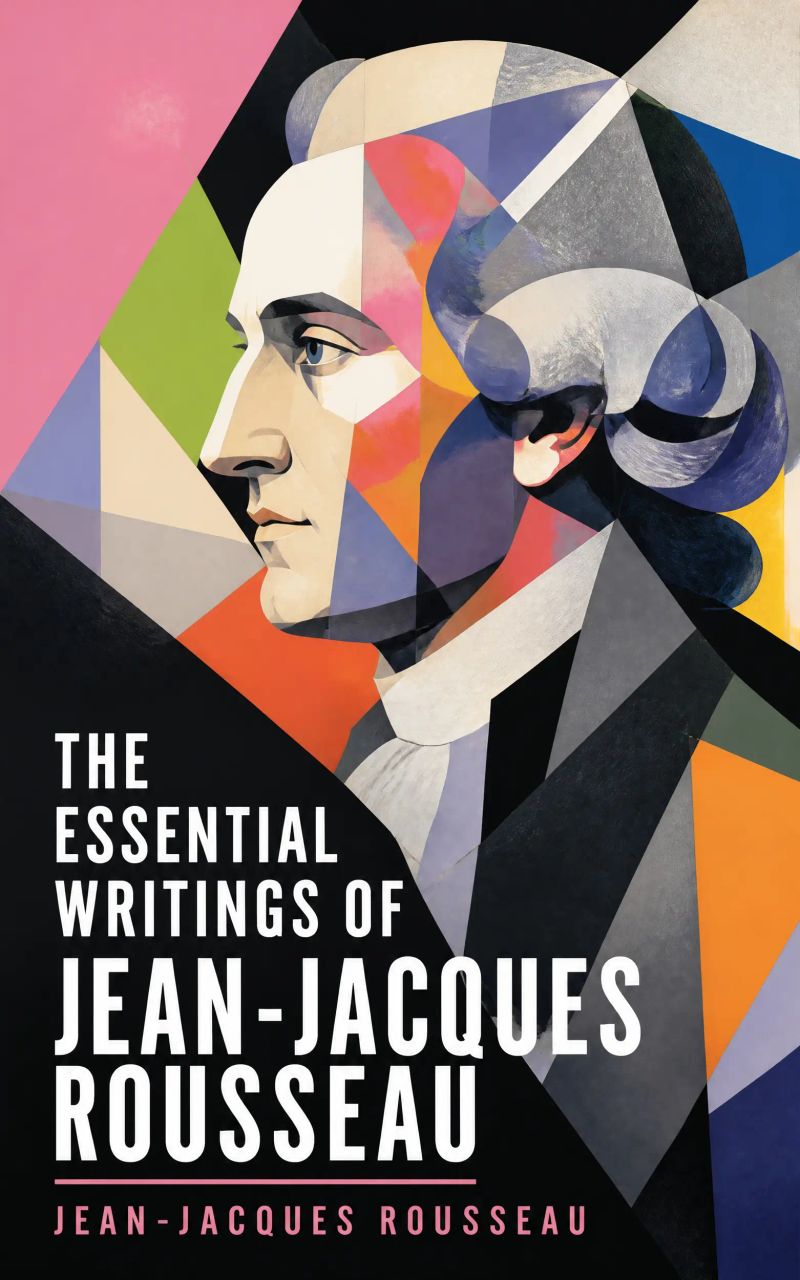
The Essential Writings of Jean-Jacques Rousseau
Nature, Freedom, Inequality, and the Foundations of Modern DemocracyBy Jean-Jacques Rousseau


Length82h 44m
About this audiobook
The Essential Writings of Jean-Jacques Rousseau presents a representative selection from the works that established him as one of modernity's most searching and controversial thinkers. Across political philosophy, moral psychology, educational theory, autobiography, and literary reflection, Rousseau interrogates the costs of civilization, the origins of inequality, the conditions of legitimate political authority, and the formation of an authentic self. His prose moves between rigorous argument, rhetorical provocation, lyrical introspection, and imaginative narrative; this stylistic range reflects the tension between Enlightenment reason and the Romantic valorization of feeling and nature. Read together, these writings reveal a sustained inquiry into freedom, dependence, self-love, and the possibility of recovering human wholeness within society. Born in Geneva in 1712, Rousseau emerged from the intellectual ferment of the eighteenth-century Enlightenment while resisting its confidence in progress, refinement, and purely rational improvement. His experiences of social marginality, religious uncertainty, musical ambition, and dependence on powerful patrons informed his distrust of artificial hierarchy and his intense concern with authenticity. The controversies surrounding his political, educational, and religious ideas—and his often persecuted public identity—deepened the autobiographical urgency of his writing. His influence extends from the French Revolution and democratic theory to Romantic literature and modern reflections on education and subjectivity. This volume is especially valuable for readers seeking to understand the conceptual origins of modern democracy, critiques of social inequality, and the enduring conflict between individual freedom and communal obligation. It offers an accessible yet intellectually substantial entry into Rousseau's thought, while preserving the contradictions that make him so compelling. Students, scholars, and general readers alike will find here a foundational encounter with a writer whose questions remain central to political, ethical, and cultural life.
Audiobook details
Rating★★★★ 4.2 (1.8K)
Includes Goodreads, Amazon, LibraryThing, StoryGraph
GenrePhilosophy
Length82 hrs 44 mins
Narrated byListen with 1,000+ voices
FormateBook with Audio
Publish dateDec 20, 2023
LanguageEnglish
Table of contents
1KARL MARX Ultimate Collection (Annotated)
2The Essential Writings of Jean-Jacques Rousseau
3Novels
4Emile, or On Education
5Author's Preface
Show all chaptersShow less
6Book I
7Book II (pt. 1)
8Book II (pt. 2)
9Book II (pt. 3)
10Book III (pt. 1)
11Book III (pt. 2)
12Book IV (pt. 1)
13Book IV (pt. 2)
14Book IV (pt. 3)
15Book IV (pt. 4)
16Book V (pt. 1)
17Book V (pt. 2)
18Book V (pt. 3)
19New Heloise (An Excerpt)
20I. "The Course of True Love"
21II. The Separation
22III. The Philosophic Husband
23IV. The Veil
24Political Writings
25Introduction
26Foreword
27Book I
28Chapter I. Subject of the First Book
29Chapter II. The First Societies
30Chapter III. The Right of the Strongest
31Chapter IV. Slavery
32Chapter V. That We Must Always Go Back to a First Convention
33Chapter VI. The Social Compact
34Chapter VII. The Sovereign
35Chapter VIII. The Civil State
36Chapter IX. Real Property
37Book II
38Chapter I. That Sovereignty is Inalienable
39Chapter II. That Sovereignty is Indivisible
40Chapter III. Whether the General Will is Fallible
41Chapter IV. The Limits of the Sovereign Power
42Chapter V. The Right of Life and Death
43Chapter VI. Law
44Chapter VII. The Legislator
45Chapter VIII. The People
46Chapter IX. The People (continued)
47Chapter X. The People (continued)
48Chapter XI. The Various Systems of Legislation
49Chapter XII. The Division of the Laws
50Book III
50 citations de RousseauJean-Jacques Rousseau10m$3 · $0.00
Emile oder über die Erziehung (Band 1&2)Jean-Jacques Rousseau35h 47m4.1 (17K)$1 · $0.00
Discourse on Inequality & The Social ContractJean-Jacques Rousseau14h 41m4.1 (3.7K)$1.99 · $0.00
Confessions & EmileJean-Jacques Rousseau55h 9m$1.99 · $0.00
The Social Contract & ConfessionsJean-Jacques Rousseau36h 51m4.0 (2.2K)$1.99 · $0.00
Emile & The Social ContractJean-Jacques Rousseau33h 55m4.1 (1.6K)$1.99 · $0.00
The Essential Writings of Jean-Jacques RousseauJean-Jacques Rousseau85h 11m3.8 (71)$1.99 · $0.00
EMILEJean-Jacques Rousseau26h 16m4.0 (19.3K)$1.99 · $0.00

Émile, ou De l'éducationJean-Jacques Rousseau27h 44m4.0 (18.8K)$0.99 · $0.00

Yhteiskuntasopimuksesta, eli, Valtio-oikeuden johtavat aatteetJean-Jacques Rousseau4h 45m3.8 (63.4K)$0.99 · $0.00
El contrato socialJean-Jacques Rousseau4h 50m4.0 (72.9K)$0.99 · $0.00
Die größten Philosophen der Aufklärung (Kommentiert)Jean-Jacques Rousseau, Voltaire, Denis Diderot, David Hume, Johann Gottfried Herder, John Locke, Thomas Hobbes, Benjamin Franklin, Francis Bacon, Immanuel Kant, Montesquieu, Baruch Spinoza, Isaac Newton, Freiherr von Gottfried Wilhelm Leibniz, René Descartes294h 4m4.2 (11)$2.50 · $0.00

Dirección Financiera: Inversión Y Financiación Vol I Decisiones De InversiónJean-Jacques Rousseau18h 12m$23 · $0.00
The Complete Works (Annotated)Jean-Jacques Rousseau70h 7m$2 · $0.00
Confessions & The Social Contract (Annotated)Jean-Jacques Rousseau36h 49m4.6 (12)$2 · $0.00
Confessions (Annotated)Jean-Jacques Rousseau30h 27m4.0 (28.9K)$2 · $0.00
Discourse on the Origin of Inequality (Annotated)Jean-Jacques Rousseau4h 36m4.2 (40.4K)$2 · $0.00

Emile oder über die Erziehung (Kommentiert)Jean-Jacques Rousseau38h 10m4.5 (12)$2 · $0.00
The Social Contract (Annotated)Jean-Jacques Rousseau8h 19m3.7 (169)$2 · $0.00
The Social Contract & EmileJean-Jacques Rousseau33h 43m3.8 (59.7K)$2 · $0.00
The Art of LivingThich Nhat Hanh5h 1m4.5 (14.2K)$24 · $0.00
Moral Letters to LuciliusLucius Annaeus Seneca24h 26m4.5 (71.7K)$0.99 · $0.00
Lessons in TruthH. Emilie Cady3h 50m4.5 (2.4K)$20 · $0.00
Letters from a StoicSeneca6h 5m4.4 (80.4K)$6 · $0.00
The Discourses of EpictetusP. E. MATHESOM12h 47m4.4 (17.7K)$1.20 · $0.00
IlluminationsWalter Benjamin10h 12m4.4 (16.2K)$20 · $0.00
That Bird Has My WingsJarvis Jay Masters9h 49m4.4 (13.7K)$29 · $0.00

Tâo Teh KingLaozi2h 34m4.4 (230.9K)$2 · $0.00
SymposiumPlato3h 26m4.4 (97.9K)$1.20 · $0.00

Buddhist Boot CampTimber Hawkeye2h 39m4.4 (8.4K)$18 · $0.00
Enchiridion & The Discourses of Epictetus (Annotated)Arrian Epictetus18h 9m4.4 (3.5K)$2 · $0.00
The Meditations of the Emperor Marcus Aurelius AntoninusEmperor of Rome Marcus Aurelius5h 41m4.4 (1.8M)$1 · $0.00
Crime and PunishmentFyodor Dostoevsky23h 11m4.4 (1.3M)$12 · $0.00
MeditationsMarcus Aurelius5h 52m4.4 (433.7K)$1 · $0.00
Everyday DharmaSuneel Gupta5h 2m4.5 (761)$20 · $0.00
The Joyful Wisdom ("La Gaya Scienza")Friedrich Wilhelm Nietzsche11h 37m4.4 (26.6K)$1 · $0.00
The Art of LivingEpictetus, Sharon Lebell3h 16m4.4 (50.1K)$18 · $0.00
MeditationsEmperor Of Rome Marcus Aurelius7h 23m4.3 (477.5K)$1.20 · $0.00
The Imitation of ChristThomas à Kempis6h 27m4.3 (84.6K)$21 · $0.00

Sadhana: the realisation of lifeRabindranath Tagore3h 49m4.4 (8.6K)$6 · $0.00
You may also like
Songs of Innocence and of ExperienceWilliam Blake1h 43m4.2 (58.6K)$2 · $0.00

Dress CodeVéronique Hyland9h 21m4.4 (1K)$29 · $0.00
The Complete Works of Oscar Wilde (Annotated)Oscar Wilde126h 19m4.6 (2.7K)$2 · $0.00

A Room of One's Own & Three GuineasVirginia Woolf12h 51m4.3 (8.5K)$1 · $0.00
A PORTRAIT OF THE ARTIST AS A YOUNG MAN (Awakening of Stephen Dedalus) (Annotated)James Joyce11h 13m3.8 (197.1K)$0.99 · $0.00
All Things ConsideredG. K. Chesterton6h 15m4.0 (988)$2.30
Such, Such Were the Joys and Other EssaysGeorge Orwell12h 24m4.2 (1.6K)$23

The Ego and His OwnMax Stirner16h 36m4.2 (5.9K)$2 · $0.00
So FetchJennifer Keishin Armstrong8h 6m3.6 (1.5K)$26 · $0.00
The Complete Satires & Essays of Mark TwainMark Twain24h 14m4.4 (1.1K)$1.99 · $0.00
Domination and the Arts of ResistanceJames C. Scott10h 44m4.2 (819)$25
Off with Her HeadEleanor Herman10h 58m4.0 (3.5K)$29 · $0.00
The Greatest Works of George Orwell (Annotated)George Orwell78h 12m4.5 (7.5K)$1.99 · $0.00
The White FeatherP. G. Wodehouse5h 2m3.7 (1.6K)$7.40
Three Plays (Annotated)Zora Neale Hurston1h 46m$2 · $0.00

Literary Fables of YriarteTomás de Iriarte2h 18m3.9 (11)$2 · $0.00
The Complete Works of Thorstein Veblen: Economics Books, Business Essays & Political ArticlesThorstein Veblen120h 34m4.1 (13)$1.99 · $0.00
A Miscellany of MenG. K. Chesterton5h 32m4.0 (495)$2.30
The Instruction of Ptah-Hotep and the Instruction of Ke'Gemni (Annotated)Ptahhotep, Kagemna1h 14m4.0 (367)$0.99 · $0.00
The Lighter Side of School LifeIan Hay4h 38m3.8 (12)$2.30