
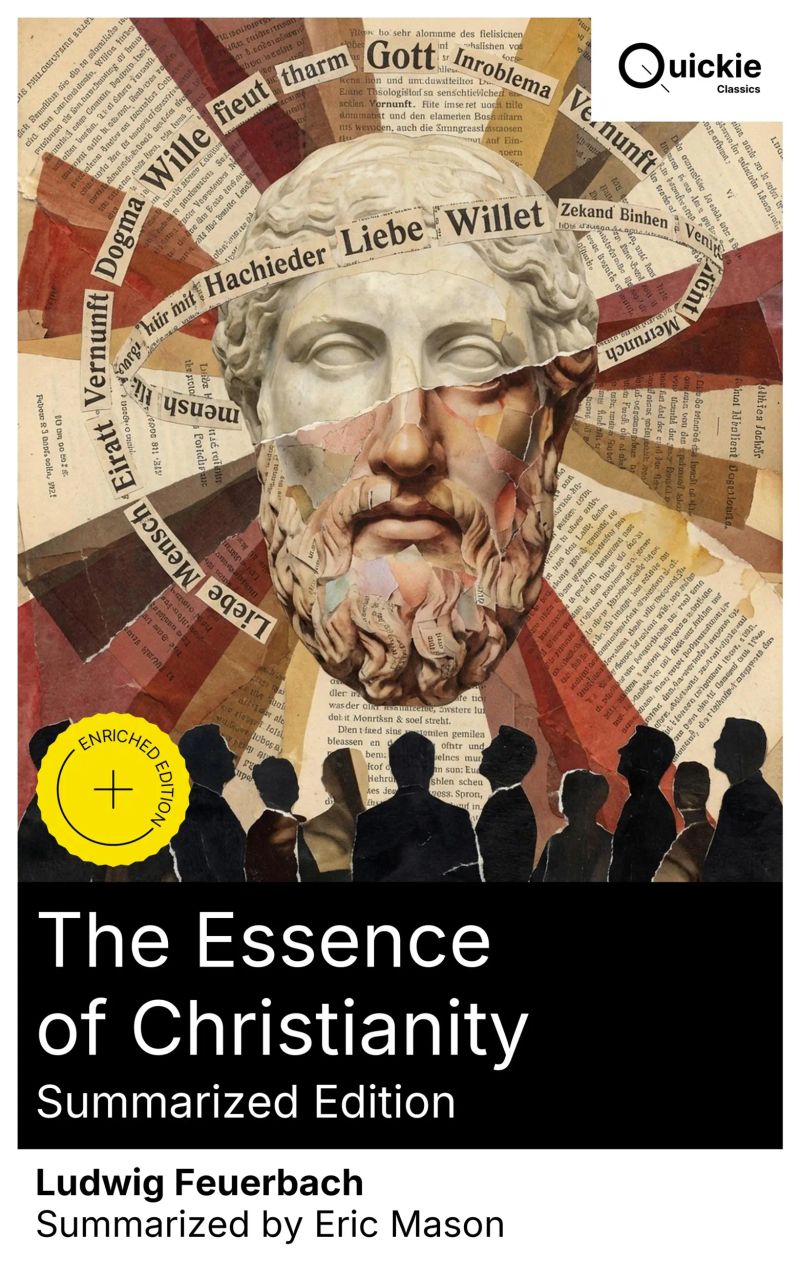
The Essence of Christianity (Summarized Edition)
Enriched edition. A Philosophical Critique of Theology: God as the Projection of Human Nature and the Anthropological Essence of ReligionBy Ludwig Feuerbach


Length3h 57m
About this audiobook
In The Essence of Christianity (1841), Feuerbach argues that theology is anthropology: the predicates of God are idealized projections of human powers. With lucid, unsentimental prose and a tactic of inverting subject and predicate, he dissects divine attributes and doctrines—Trinity, Incarnation, Eucharist—to show how love, reason, and will are alienated from their human source. Situated in post-Hegelian debates, he replaces speculative idealism with sensuous humanism grounded in feeling and communal need. Ludwig Feuerbach (1804–1872), a German philosopher trained in theology and a onetime student of Hegel, turned to independent scholarship after heterodox writings foreclosed an academic post. Working among the Young Hegelians and shaped by Enlightenment rationalism and Protestant culture, he redirected philosophy from metaphysics to anthropology, guided by historical criticism and a conviction that sensuous life and ordinary affect are the proper starting points of thought. Students of philosophy of religion, theology, and cultural theory will find this classic both clarifying and provocative. Read it for crystalline arguments, humane emphasis on love and reason, and a powerful genealogy of belief that prefigures later critiques while remaining accessible and bracing.
Quickie Classics summarizes timeless works with precision, preserving the author's voice and keeping the prose clear, fast, and readable—distilled, never diluted. Enriched Edition extras: Introduction · Synopsis · Historical Context · Brief Analysis · 4 Reflection Q&As · Editorial Footnotes.
Audiobook details
GenrePhilosophy
Length3 hrs 57 mins
Narrated byListen with 1,000+ voices
FormateBook with Audio
Publish dateJan 10, 2026
LanguageEnglish
Table of contents
1Introduction
2Introduction
3Synopsis
4Historical Context
5The Essence of Christianity (pt. 1)
Show all chaptersShow less
6The Essence of Christianity (pt. 2)
7Analysis
8Reflection
More from Ludwig Feuerbach

Moral Letters to LuciliusLucius Annaeus Seneca24h 26m4.5 (71.7K)$0.99 · $0.00

Lessons in TruthH. Emilie Cady3h 50m4.5 (2.4K)$20 · $0.00
The Discourses of EpictetusP. E. MATHESOM12h 47m4.4 (17.7K)$1.20 · $0.00

IlluminationsWalter Benjamin10h 12m4.4 (16.2K)$20 · $0.00
That Bird Has My WingsJarvis Jay Masters9h 49m4.4 (13.7K)$29 · $0.00

Tâo Teh KingLaozi2h 34m4.4 (230.9K)$2 · $0.00
SymposiumPlato3h 26m4.4 (97.9K)$1.20 · $0.00

Buddhist Boot CampTimber Hawkeye2h 39m4.4 (8.4K)$18 · $0.00
Enchiridion & The Discourses of Epictetus (Annotated)Arrian Epictetus18h 9m4.4 (3.5K)$2 · $0.00

The Meditations of the Emperor Marcus Aurelius AntoninusEmperor of Rome Marcus Aurelius5h 41m4.4 (1.8M)$1 · $0.00
Crime and PunishmentFyodor Dostoevsky23h 11m4.4 (1.3M)$12 · $0.00

MeditationsMarcus Aurelius5h 52m4.4 (433.7K)$1 · $0.00

Everyday DharmaSuneel Gupta5h 2m4.5 (761)$20 · $0.00

The Joyful Wisdom ("La Gaya Scienza")Friedrich Wilhelm Nietzsche11h 37m4.4 (26.6K)$1 · $0.00
The Art of LivingEpictetus, Sharon Lebell3h 16m4.4 (50.1K)$18 · $0.00
MeditationsEmperor Of Rome Marcus Aurelius7h 23m4.3 (477.5K)$1.20 · $0.00

The Imitation of ChristThomas à Kempis6h 27m4.3 (84.6K)$21 · $0.00

Sadhana: the realisation of lifeRabindranath Tagore3h 49m4.4 (8.6K)$6 · $0.00
SapiensYuval Noah Harari15h 18m4.3 (1.4M) · 1253$33 · $0.00

You BelongSebene Selassie8h 35m4.4 (2.7K)$26 · $0.00
You may also like
The Essence of ChristianityLudwig Feuerbach14h 20m3.9 (2.2K)$12 · $0.00

Beyond Good and EvilFRIEDRICH NIETZSCHE7h 12m4.2 (149.7K)$3.50 · $0.00

MERE CHRISTIANITY (Including The Case for Christianity, Christian Behaviour and Beyond Personality)C. S. Lewis6h 45m4.4 (527.6K)$1 · $0.00
A Treatise Concerning the Principles of Human KnowledgeGeorge Berkeley3h 52m3.9 (3.7K)$1.20 · $0.00
The Critique of Practical ReasonImmanuel Kant6h 51m4.1 (14.3K)$2.30

The Will to Believe, and Other Essays in Popular PhilosophyWilliam James8h 48m4.2 (4.6K)$2 · $0.00
Is Atheism Dead?Eric Metaxas16h 48m4.5 (3.1K)$25
The Existence and Attributes of GodStephen Charnock69h 27m4.7 (2.5K)$2.99 · $0.00

Beyond Good and EvilFriedrich Nietzsche7h 5m4.2 (155.1K)$1.20 · $0.00

The Atheist's MassHonoré de Balzac44m3.9 (2.3K)$2 · $0.00
God in the WhirlwindDavid F. Wells9h 31m4.4 (467)$20 · $0.00

On the Genealogy of MoralsFriedrich Nietzsche6h 11m4.3 (76.5K)$1.20 · $0.00

Ethics (Complete Edition)Baruch Spinoza9h 53m4.2 (27K)$1 · $0.00

God and the StateMikhail Bakunin4h 17m4.1 (7.1K)$1 · $0.00
The Critique of Practical ReasonImmanuel Kant8h 28m4.1 (13.8K)$1.99 · $0.00
The Varieties of Religious ExperienceWilliam James16h 58m4.1 (23.5K)$1.20 · $0.00

Rationalism (Annotated)J. M. Robertson2h 44m$1.99 · $0.00
Know the Truth: A Critique on the Hamiltonian Theory of LimitationJesse Henry Jones5h 39m$2 · $0.00

I don't know, do you?Marilla M. Ricker2h 43m$1 · $0.00
30 Millennia of Erotic ArtHans-Jürgen Döpp, Joe A. Thomas, Victoria Charles, Klaus H. Carl10h 8m4.4 (11)$18 · $0.00