
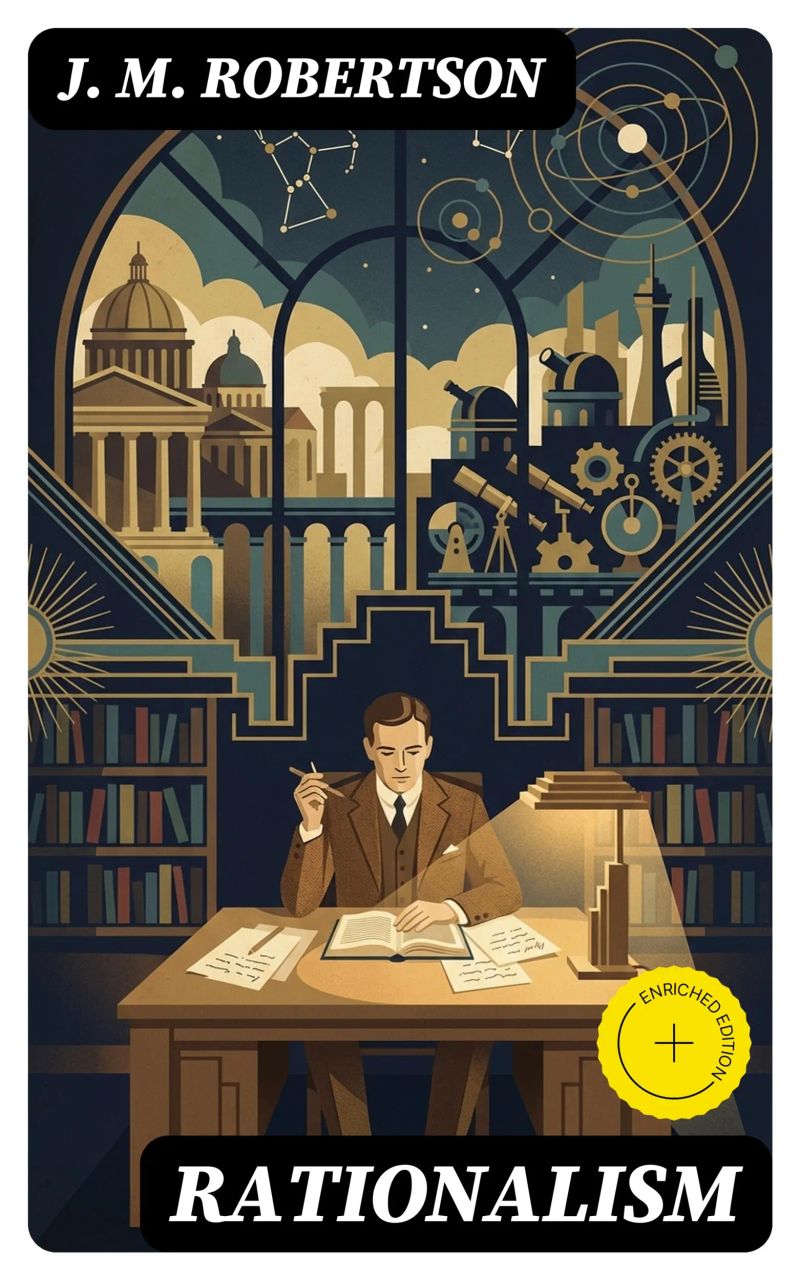
Rationalism (Annotated)
Enriched Edition. Reason, Belief, and the Search for Knowledge from Enlightenment Thought to Scientific InquiryBy J. M. Robertson


Length2h 43m
About this audiobook
In *Rationalism*, J. M. Robertson presents a vigorous historical and critical account of the intellectual movement that places reason, evidence, and independent inquiry above ecclesiastical authority and inherited dogma. Rather than treating rationalism as a merely abstract philosophy, he traces its development through religious controversy, scientific advance, biblical criticism, and changing conceptions of morality. The book combines lucid exposition with the polemical energy of the freethought tradition, bringing historical scholarship and philosophical analysis to bear on the claims of supernatural religion. Its method reflects the late Victorian and early twentieth-century culture of secular criticism, in which the authority of tradition was increasingly tested against comparative history, scientific knowledge, and the ideals of intellectual freedom. Robertson (1856–1933) was a Scottish journalist, literary critic, political writer, and prominent advocate of rationalism and freethought. His wide-ranging studies of Christianity, mythology, literature, and social reform equipped him to connect philosophical questions with the historical forces that shape belief. Writing in an age marked by Darwinism, higher biblical criticism, and debates over secular ethics, he regarded rational inquiry not simply as skepticism but as a constructive discipline for public and private life. *Rationalism* thus condenses the central commitments that informed his broader career: hostility to dogmatic authority, confidence in historical investigation, and faith in the emancipatory power of reason. This book will reward readers interested in the history of secular thought, the intellectual origins of modern religious criticism, and the relationship between reason and social progress. Its arguments remain valuable both as a substantial statement of early modern rationalist thought and as a document of the period's debates over science, religion, and moral autonomy. Readers should approach it as both a work of interpretation and a historically situated intellectual intervention—one whose clarity, breadth, and argumentative confidence continue to provoke reflection.
This enriched edition has been carefully crafted to add value to your reading experience.
- A succinct Introduction situates the work's timeless appeal and themes.
- The Synopsis outlines the central plot, highlighting key developments without spoiling critical twists.
- A detailed Historical Context immerses you in the era's events and influences that shaped the writing.
- A thorough Analysis dissects symbols, motifs, and character arcs to unearth underlying meanings.
- Reflection questions prompt you to engage personally with the work's messages, connecting them to modern life.
- Hand‐picked Memorable Quotes shine a spotlight on moments of literary brilliance.
- Interactive footnotes clarify unusual references, historical allusions, and archaic phrases for an effortless, more informed read.
Audiobook details
GenrePhilosophy
Length2 hrs 43 mins
Narrated byListen with 1,000+ voices
FormateBook with Audio
Publish dateAug 1, 2022
LanguageEnglish
Table of contents
1Rationalism (Annotated)
9§ 5. THE SKEPTICAL RELIGIOUS CHALLENGE
2Introduction
10§ 6. THE MEANING OF REASON
3Synopsis
11§ 7. THE TEST OF TRUTH
4Historical Context
12§ 8. ULTIMATE PROBLEMS
5§ 1. THE TERM
13§ 9. IDEALS
Show all chaptersShow less
6§ 2. THE PRACTICAL POSITION
14Analysis
7§ 3. THE RELIGIOUS CHALLENGE
15Reflection
8§ 4. THE PHILOSOPHICAL CHALLENGE
16Memorable Quotes
More from J. M. Robertson
The Jesus Problem: A Restatement of the Myth TheoryJ. M. Robertson10h 44m$1 · $0.00
RationalismJ. M. Robertson2h 42m$1 · $0.00

The Evolution of StatesJ. M. Robertson18h 54m$2 · $0.00

A Short History of ChristianityJ. M. Robertson15h 5m$1 · $0.00

The Historical Jesus: A Survey of PositionsJ. M. Robertson6h 12m$2 · $0.00

Lessons in TruthH. Emilie Cady3h 50m4.5 (2.4K)$20 · $0.00
Letters from a StoicSeneca6h 5m4.4 (80.4K)$6 · $0.00
The Discourses of EpictetusP. E. MATHESOM12h 47m4.4 (17.7K)$1.20 · $0.00

IlluminationsWalter Benjamin10h 12m4.4 (16.2K)$20 · $0.00

That Bird Has My WingsJarvis Jay Masters9h 49m4.4 (13.7K)$29 · $0.00

Tâo Teh KingLaozi2h 34m4.4 (230.9K)$2 · $0.00
SymposiumPlato3h 26m4.4 (97.9K)$1.20 · $0.00

Buddhist Boot CampTimber Hawkeye2h 39m4.4 (8.4K)$18 · $0.00
Enchiridion & The Discourses of Epictetus (Annotated)Arrian Epictetus18h 9m4.4 (3.5K)$2 · $0.00

The Meditations of the Emperor Marcus Aurelius AntoninusEmperor of Rome Marcus Aurelius5h 41m4.4 (1.8M)$1 · $0.00

Crime and PunishmentFyodor Dostoevsky23h 11m4.4 (1.3M)$12 · $0.00

MeditationsMarcus Aurelius5h 52m4.4 (433.7K)$1 · $0.00
Everyday DharmaSuneel Gupta5h 2m4.5 (761)$20 · $0.00

The Joyful Wisdom ("La Gaya Scienza")Friedrich Wilhelm Nietzsche11h 37m4.4 (26.6K)$1 · $0.00
The Art of LivingEpictetus, Sharon Lebell3h 16m4.4 (50.1K)$18 · $0.00
MeditationsEmperor Of Rome Marcus Aurelius7h 23m4.3 (477.5K)$1.20 · $0.00

The Imitation of ChristThomas à Kempis6h 27m4.3 (84.6K)$21 · $0.00

Sadhana: the realisation of lifeRabindranath Tagore3h 49m4.4 (8.6K)$6 · $0.00
SapiensYuval Noah Harari15h 18m4.3 (1.4M) · 1330$33 · $0.00

You BelongSebene Selassie8h 35m4.4 (2.7K)$26 · $0.00
You may also like
MiraclesC. S. Lewis6h 31m4.2 (25.8K)$14
Is Atheism Dead?Eric Metaxas16h 48m4.5 (3.1K)$25
A Treatise Concerning the Principles of Human KnowledgeGeorge Berkeley3h 52m3.9 (3.7K)$1.20 · $0.00

The Existence and Attributes of GodStephen Charnock69h 27m4.7 (2.5K)$2.99 · $0.00
The Critique of Practical ReasonImmanuel Kant6h 51m4.1 (14.3K)$2.30

The Will to Believe, and Other Essays in Popular PhilosophyWilliam James8h 48m4.2 (4.6K)$2 · $0.00

Beyond Good and EvilFRIEDRICH NIETZSCHE7h 12m4.2 (149.7K)$3.50 · $0.00

The Essence of ChristianityLudwig Feuerbach14h 20m3.9 (2.2K)$12 · $0.00

An Apology for the True Christian DivinityRobert Barclay24h 3m4.3 (401)$2 · $0.00
The Courage to Be ProtestantDavid Wells9h 49m4.3 (1.8K)$20 · $0.00
God in the WhirlwindDavid F. Wells9h 31m4.4 (467)$20 · $0.00

MERE CHRISTIANITY (Including The Case for Christianity, Christian Behaviour and Beyond Personality)C. S. Lewis6h 45m4.4 (527.6K)$1 · $0.00

The Varieties of Religious ExperienceWilliam James16h 58m4.1 (23.5K)$1.20 · $0.00

The Problem of PainC. S. Lewis3h 58m4.3 (135.8K)$12

On the Genealogy of MoralsFriedrich Nietzsche6h 11m4.3 (76.5K)$1.20 · $0.00
Summa Theologica, Part I-II (Pars Prima Secundae)Saint Aquinas Thomas54h 47m4.4 (620)$2 · $0.00
Letters to MalcolmC. S. Lewis3h 25m4.3 (12.4K)$12
A Pluralistic UniverseWilliam James9h 50m4.2 (410)$2 · $0.00

Letters to Malcolm: Chiefly on PrayerC. S. Lewis3h 35m4.3 (10.3K)$1 · $0.00

The Scientific Basis of Morals, and Other EssaysWilliam Kingdon Clifford4h 48m$2 · $0.00