
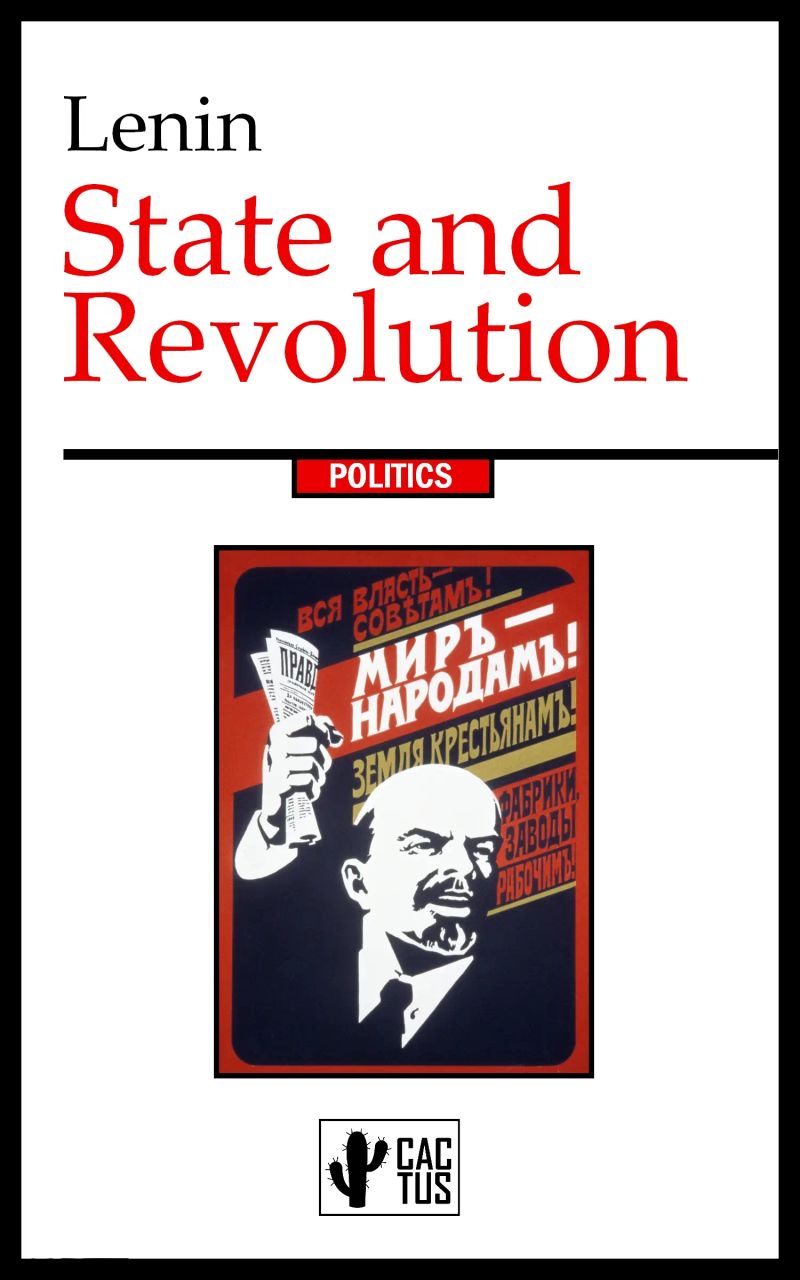


Length4h 28m
About this audiobook
On the eve of the October Revolution, with the state machinery of the old order in collapse, V.I. Lenin penned his most concentrated work of political theory. State and Revolution is a forceful return to the core Marxist teachings on the state, arguing that it is not a neutral arbiter but an instrument of class oppression—"special bodies of armed men" serving the ruling class.
Lenin systematically dismantles reformist illusions, insisting that the proletariat cannot simply take over the existing bourgeois state; it must smash it. Drawing extensively from Marx and Engels, he outlines the necessity of a violent revolution to replace it with a new, transitional "dictatorship of the proletariat"—a state of the majority, which would begin to wither away immediately as class distinctions dissolve. He vividly imagines this new commune-state, where all officials are elected, paid average workers' wages, and subject to instant recall.
This is a practical manual for seizing and transforming power. Urgent, polemical, and uncompromising, State and Revolution articulates the philosophical and organizational justification for the Bolshevik path. It remains one of the most influential and controversial political manifestos ever written, a stark vision of the destruction of the old world and the fraught, uncertain birth of the new.
Audiobook details
Rating★★★★ 4.3 (22.4K)
Includes Goodreads, Amazon, LibraryThing
GenrePolitics and Government, History
Length4 hrs 28 mins
Narrated byListen with 1,000+ voices
FormateBook with Audio
LanguageEnglish
Table of contents
1By Lenin in Cactus Catalogue:
2Preface to the First Edition
3Preface to the Second Edition : Endnotes
4Endnotes
5Class society and State
Show all chaptersShow less
61. The State: A Product of the Irreconcilability of Class Antagonisms
7 2. Special Bodies of Armed Men, Prisons, etc.
8 3. The State: an Instrument for the Exploitation of the Oppressed Class
9 4. The “Withering Away” of the State, and Violent Revolution
10The experience of 1848-1851
111. The Eve of Revolution
12 2. The Revolution Summed Up
13 3. The Presentation of the Question by Marx in 1852
14Experience of the Paris Commune of 1871. Marx’s analysis
151. What Made the Communards' Attempt Heroic?
16 2. What is to Replace the Smashed State Machine?
17 3. Abolition of Parliamentarism
18 4. Organisation of National Unity
19 5. Abolition of the Parasite State
20Supplementary explanation by Engels
21 1. The Housing Question
22 Controversy with the Anarchists
23Letter to Bebel
24 2. Criticism of the Draft of the Erfurt Programme
25 The 1891 Preface to Marx's "The Civil War in France"
26Engels on the Overcoming of Democracy
27The economic basis on the withering away of the State
28 1. Presentation of the Question by Marx
29 2. The Transition from Capitalism to Communism
30 3. The First Phase of Communist Society
314. The Higher Phase of Communist Society
32The vulgarisation of Marxism by the opportunists
33 1. Plekhanov’ s Controversy with the Anarchists
34 2. Kautsky’ s Controversy with the Opportunists
35 3. Kautsky’ s Controversy with Pannekoek
36PostScript to the First Edition
More from Vladimir Lenin
Imperialism, the Highest Stage of CapitalismVladimir Lenin4h 31m4.3 (14.3K)$4 · $0.00
Left-Wing Communism: an Infantile DisorderVladimir Lenin4h 18m4.3 (3.8K)$4 · $0.00
Il socialismo e la guerraVladimir Lenin1h 44m4.2 (291)$3 · $0.00
The collapse of the Second InternationalVladimir Lenin2h 56m4.2 (33)$4 · $0.00
What is to be done?Vladimir Lenin7h 23m4.2 (8.2K)$4 · $0.00
Imperialismo fase suprema del capitalismoVladimir Lenin5h 33m4.3 (16.7K)$3 · $0.00
Che fare?Vladimir Lenin7h 51m4.2 (8K)$3 · $0.00
Stato e RivoluzioneVladimir Lenin4h 42m4.3 (27.9K)$3 · $0.00

KrantikariSanjeev Sanyal11h 44m4.6 (1.3K)$16 · $0.00

Unbroken Bonds of BattleJohnny Joey Jones8h 31m4.6 (2.6K)$8 · $0.00

On Democracies and Death CultsDouglas Murray10h 38m4.6 (6.5K)$29 · $0.00

Balcony Over Jerusalem: A Middle East Memoir - Israel, Palestine and BeyondJohn Lyons12h 37m4.6 (1.4K)$33 · $0.00

RiggedMollie Hemingway12h 48m4.6 (4.2K)$23 · $0.00

SledgehammerDavid Friedman8h 21m4.7 (589)$26 · $0.00

Citizenship in a Republic (Annotated)Theodore Roosevelt2h 44m4.6 (1.4K)$2 · $0.00

No EscapeNury Turkel9h 30m4.6 (809)$28 · $0.00

Always FaithfulThomas Schueman, Zainullah Zaki12h 12m4.6 (977)$29 · $0.00

UnthinkableJamie Raskin15h 8m4.5 (9.3K)$8 · $0.00

My Fourth Time, We DrownedSally Hayden13h 59m4.6 (2.9K)$23 · $0.00

A Revolution of Common SenseScott Jennings9h 29m4.6 (528)$29 · $0.00

Statement From the Dock at the Rivonia TrialNelson Mandela2h 18m4.6 (1.3K)$1 · $0.00

Lessons from the EdgeMarie Yovanovitch17h 11m4.5 (5.9K)$40 · $0.00

To Rescue the American SpiritBret Baier10h 12m4.5 (2.7K)$8 · $0.00

StonewalledSharyl Attkisson15h 19m4.5 (4.3K)$33 · $0.00
The World According to Orwell: 1984 & Animal FarmGeorge Orwell15h 42m4.6 (1.1K)$1 · $0.00
Basic EconomicsThomas Sowell18h 32m4.5 (29.3K)$28 · $0.00

To Rescue the RepublicBret Baier, Catherine Whitney11h 42m4.5 (8.6K)$29 · $0.00

Modern WarriorsPete Hegseth7h 10m4.5 (4.7K)$24 · $0.00

A Brief History of IntelligenceMax S. Bennett12h 18m4.6 (6.6K)$29 · $0.00

RevolutionariesSanjeev Sanyal11h 23m4.6 (2.6K)$29 · $0.00

We Crossed a Bridge and It TrembledWendy Pearlman6h4.6 (5.2K)$24 · $0.00
Unbroken Bonds of BattleJohnny Joey Jones8h 31m4.6 (2.6K)$8 · $0.00

The Daughter of AuschwitzTova Friedman, Malcolm Brabant7h 54m4.6 (16.7K)$26 · $0.00

Lily's PromiseLily Ebert, Dov Forman8h 54m4.6 (16.1K)$29 · $0.00
On Democracies and Death CultsDouglas Murray10h 38m4.6 (6.5K)$29 · $0.00

Across the RiverKent Babb11h 40m4.6 (927)$29 · $0.00
Balcony Over Jerusalem: A Middle East Memoir - Israel, Palestine and BeyondJohn Lyons12h 37m4.6 (1.4K)$33 · $0.00

BeyondStephen Walker15h 39m4.6 (3.2K)$33 · $0.00
Kings and PawnsHoward Bryant10h 9m4.6 (678)$29 · $0.00
No EscapeNury Turkel9h 30m4.6 (809)$28 · $0.00

Jubal Stone: U.S. Marshal: Blood Trail To Hell: A Western Adventure NovelCasey Nash3h 42m4.6 (3.2K)$18 · $0.00

Fall and RiseMitchell Zuckoff17h 23m4.6 (9.8K)$40 · $0.00

The SurvivorJosef Lewkowicz, Michael Calvin9h 22m4.6 (2.5K)$29 · $0.00
Always FaithfulThomas Schueman, Zainullah Zaki12h 12m4.6 (977)$29 · $0.00

The State of Society in France Before the Revolution of 1789 (Annotated)Alexis de Tocqueville17h 25m4.6 (1.2K)$2 · $0.00

All the Gallant MenDonald Stratton, Ken Gire5h 55m4.6 (11.8K)$24 · $0.00

Saint Joan (Annotated)George Bernard Shaw6h 20m4.6 (1.2K)$1.20 · $0.00

Medgar and MyrlieJoy-Ann Reid10h 52m4.5 (27.8K)$29 · $0.00
You may also like

Federalist & Anti-Federalist Papers - Complete EditionAlexander Hamilton, James Madison, John Jay, Samuel Bryan, Patrick Henry22h 28m4.3 (3K)$1.99 · $0.00
The Greatest Works of Karl MarxKarl Marx127h 53m4.4 (417)$0.99 · $0.00
The Conscience of a ConservativeBarry Goldwater, CC Goldwater4h 7m4.0 (14.7K)$20
The Communist ManifestoKarl Marx1h 13m3.9 (240.6K)$3 · $0.00

The River WarWinston Churchill14h 9m4.1 (1.5K)$2 · $0.00

Hellenica (The History of the Peloponnesian War and Its Aftermath)Xenophon15h 14m4.1 (4.3K)$1.99 · $0.00

Wages, Price and ProfitKarl Marx2h 18m4.3 (3.8K)$2 · $0.00
Common SenseThomas Paine2h 24m4.1 (297.3K)$1.20 · $0.00

FDR’s FollyJim Powell9h 27m4.0 (1.1K)$20

The River War / An Account of the Reconquest of the SudanWinston Churchill14h 8m4.1 (1.6K)$2.30
The SpartansPaul Cartledge8h 37m3.9 (3.6K)$17

The Conscience of a Conservative (Annotated)Barry Goldwater4h 41m4.3 (13.1K)$2 · $0.00

No Trade Is FreeRobert Lighthizer12h 28m4.2 (564)$29 · $0.00

Ted, White, and BlueNugent, Ted9h 10m3.9 (940)Free

History of the United States of America, Volume IIIGeorge Bancroft20h 9m3.9 (26)$30

Should the Working Class support the Liberal Party?the Socialist Party of Great Britain1h 25m$2 · $0.00

Revolt!Dick Morris, Eileen McGann10h 2m3.8 (201)$29 · $0.00
Collected Works Of Marxism, Anarchism, CommunismKarl Marx, Friedrich Engels, Rosa Luxemburg, Peter Kropotkin, Emma Goldman, Vladimir Lenin, Leon Trotsky18h 32m$12 · $0.00

Island on FireTom Zoellner10h 20m$20
Black Rebellion: The History of Slave RevoltsThomas Wentworth Higginson5h 15m4.1 (207)$1.99 · $0.00