
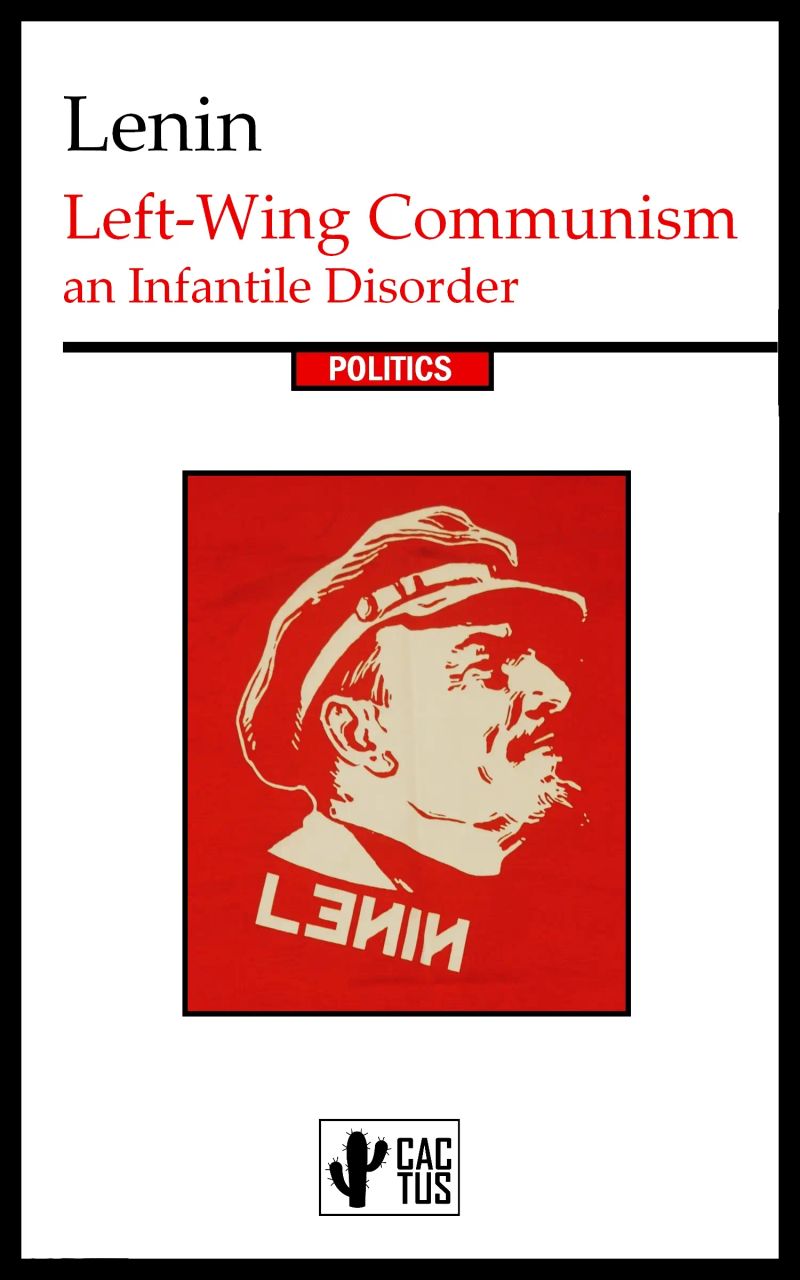
Left-Wing Communism: an Infantile Disorder
By Vladimir Lenin


Length4h 18m
About this audiobook
Written in 1920, at a critical juncture for the world revolutionary movement, Lenin’s "Left-Wing" Communism: an Infantile Disorder is a brilliant polemic and a masterclass in revolutionary strategy. With the Bolshevik Revolution’s hard-won victory still fragile, Lenin turns his attention to the rising communist parties of Western Europe. He identifies a dangerous trend: a "Left-wing" doctrinairism that, in its zeal for purity, rejects all compromise, refuses to work within reactionary trade unions and parliaments, and risks isolating the vanguard from the working class masses.
With fierce wit and unwavering focus on the ultimate goal—the seizure of political power—Lenin argues that such inflexibility is not a sign of revolutionary strength, but a political malady, an "infantile disorder." Drawing crucial lessons from the successful, and often tactically flexible, experience of Russian Bolshevism, he insists that communists must be prepared to make necessary compromises, to "go where the people are," and to navigate the complex realities of the class struggle.
More than a historical document, this work remains a foundational text on political tactics, party organization, and the relationship between revolutionary theory and practical action. It is essential reading for anyone seeking to understand the dynamics of revolutionary politics and the challenges of building an effective movement for radical change.
Audiobook details
Rating★★★★ 4.3 (3.8K)
Includes Goodreads, Amazon, LibraryThing
GenrePolitics and Government, History
Length4 hrs 18 mins
Narrated byListen with 1,000+ voices
FormateBook with Audio
LanguageEnglish
Table of contents
1By Lenin in Cactus Catalogue:
2INTRODUCTION
3CHAPTER I. IN WHAT SENSE CAN WE SPEAK OF THE INTERNATIONAL SIGNIFICANCE OF THE RUSSIAN REVOLUTION?
4CHAPTER II. ONE OF THE PRINCIPAL CONDITIONS OF THE SUCCESS OF THE BOLSHEVIKS.
5CHAPTER III. THE CHIEF STAGES IN THE HISTORY OF BOLSHEVISM.
Show all chaptersShow less
6The Years of Preparation for the Revolution (1902–1905).
7The Years of Revolution (1905–1907).
8The Years of Reaction (1907–1910).
9The Years of Revival (1910–1914).
10The First Imperialist World-War (1914–1917).
11The Second Revolution in Russia (from February to October, 1917).
12CHAPTER IV. WHO WERE THE ENEMIES IN THE WORKING-CLASS MOVEMENT IN THE STRUGGLE AGAINST WHOM BOLSHEVISM GREW, GAINED STRENGTH AND BECAME HARDENED?
13CHAPTER V. "LEFT" COMMUNISM IN GERMANY: LEADERS-PARTY-CLASSES THE MASSES.
14CHAPTER VII. SHOULD WE PARTICIPATE IN BOURGEOIS PARLIAMENTS?
15CHAPTER VIII. NO COMPROMISE WHATEVER?
16CHAPTER IX. "LEFT" COMMUNISM IN GREAT BRITAIN.
17CHAPTER X. SOME CONCLUSIONS
18APPENDIX
19APPENDIX I. THE SPLIT OF THE GERMAN COMMUNIST PARTY.
20APPENDIX II. COMMUNISTS AND INDEPENDENTS IN GERMANY.
21APPENDIX III. TURATI & CO. IN ITALY.
22APPENDIX IV. INCORRECT CONCLUSIONS DRAWN FROM CORRECT PREMISES.
23APPENDIX V.
More from Vladimir Lenin
State and RevolutionVladimir Lenin4h 29m4.3 (22.4K)$4 · $0.00
Imperialism, the Highest Stage of CapitalismVladimir Lenin4h 31m4.3 (14.3K)$4 · $0.00

Il socialismo e la guerraVladimir Lenin1h 44m4.2 (291)$3 · $0.00
The collapse of the Second InternationalVladimir Lenin2h 56m4.2 (33)$4 · $0.00
What is to be done?Vladimir Lenin7h 23m4.2 (8.2K)$4 · $0.00
Imperialismo fase suprema del capitalismoVladimir Lenin5h 33m4.3 (16.7K)$3 · $0.00
Che fare?Vladimir Lenin7h 51m4.2 (8K)$3 · $0.00
Stato e RivoluzioneVladimir Lenin4h 42m4.3 (27.9K)$3 · $0.00

Balcony Over Jerusalem: A Middle East Memoir - Israel, Palestine and BeyondJohn Lyons12h 37m4.6 (1.4K)$33 · $0.00

RiggedMollie Hemingway12h 48m4.6 (4.2K)$23 · $0.00

SledgehammerDavid Friedman8h 21m4.7 (589)$26 · $0.00

Citizenship in a Republic (Annotated)Theodore Roosevelt2h 44m4.6 (1.4K)$2 · $0.00

No EscapeNury Turkel9h 30m4.6 (809)$28 · $0.00

Always FaithfulThomas Schueman, Zainullah Zaki12h 12m4.6 (977)$29 · $0.00

UnthinkableJamie Raskin15h 8m4.5 (9.3K)$8 · $0.00

My Fourth Time, We DrownedSally Hayden13h 59m4.6 (2.9K)$23 · $0.00

A Revolution of Common SenseScott Jennings9h 29m4.6 (528)$29 · $0.00

Statement From the Dock at the Rivonia TrialNelson Mandela2h 18m4.6 (1.3K)$1 · $0.00

Lessons from the EdgeMarie Yovanovitch17h 11m4.5 (5.9K)$40 · $0.00

To Rescue the American SpiritBret Baier10h 12m4.5 (2.7K)$8 · $0.00

StonewalledSharyl Attkisson15h 19m4.5 (4.3K)$33 · $0.00
The World According to Orwell: 1984 & Animal FarmGeorge Orwell15h 42m4.6 (1.1K)$1 · $0.00

Basic EconomicsThomas Sowell18h 32m4.5 (29.3K)$28 · $0.00

To Rescue the RepublicBret Baier, Catherine Whitney11h 42m4.5 (8.6K)$29 · $0.00

Modern WarriorsPete Hegseth7h 10m4.5 (4.7K)$24 · $0.00
Philosophy and Opinions of Marcus Garvey (Annotated)Marcus Mosiah Garvey4h 42m4.5 (1.7K)$1.99 · $0.00

A Plague Upon Our HouseScott W. Atlas MD10h 37m4.5 (3.4K)$20 · $0.00

One Bright MoonAndrew Kwong12h 21m4.5 (813)$29 · $0.00

A Brief History of IntelligenceMax S. Bennett12h 18m4.6 (6.6K)$29 · $0.00

The Daughter of AuschwitzTova Friedman, Malcolm Brabant7h 54m4.6 (16.7K)$26 · $0.00

Lily's PromiseLily Ebert, Dov Forman8h 54m4.6 (16.1K)$29 · $0.00

On Democracies and Death CultsDouglas Murray10h 38m4.6 (6.5K)$29 · $0.00

Across the RiverKent Babb11h 40m4.6 (927)$29 · $0.00
Balcony Over Jerusalem: A Middle East Memoir - Israel, Palestine and BeyondJohn Lyons12h 37m4.6 (1.4K)$33 · $0.00

BeyondStephen Walker15h 39m4.6 (3.2K)$33 · $0.00
Kings and PawnsHoward Bryant10h 9m4.6 (678)$29 · $0.00
No EscapeNury Turkel9h 30m4.6 (809)$28 · $0.00

Jubal Stone: U.S. Marshal: Blood Trail To Hell: A Western Adventure NovelCasey Nash3h 42m4.6 (3.2K)$18 · $0.00

Fall and RiseMitchell Zuckoff17h 23m4.6 (9.8K)$40 · $0.00

The SurvivorJosef Lewkowicz, Michael Calvin9h 22m4.6 (2.5K)$29 · $0.00
Always FaithfulThomas Schueman, Zainullah Zaki12h 12m4.6 (977)$29 · $0.00

The State of Society in France Before the Revolution of 1789 (Annotated)Alexis de Tocqueville17h 25m4.6 (1.2K)$2 · $0.00

All the Gallant MenDonald Stratton, Ken Gire5h 55m4.6 (11.8K)$24 · $0.00
Saint Joan (Annotated)George Bernard Shaw6h 20m4.6 (1.2K)$1.20 · $0.00

Medgar and MyrlieJoy-Ann Reid10h 52m4.5 (27.8K)$29 · $0.00

The History of the Peloponnesian War (Annotated)Thucydides24h 3m4.6 (1.1K)$2 · $0.00

Where the Birds Never SingJack Sacco10h 31m4.6 (3.8K)$29 · $0.00

Serviceman J: The Untold Story of an NZSAS SoldierJamie Pennell5h 51m4.6 (452)$24 · $0.00
You may also like

Founding FaithSteven Waldman9h 46m4.1 (1K)$26

The History of the Peloponnesian WarThucydides22h 10m4.2 (54.2K)$2.30

FormidableElisabeth Griffith17h 14m4.2 (276)$25

What Hath God WroughtDaniel Walker Howe32h 50m4.3 (12.5K)$42

History of the United States (Annotated)Charles A. Beard, Mary R. Beard22h 59m4.2 (607)$1.99 · $0.00

A Diplomat in Japan- The Inner History of the Critical Years in the Evolution of JapanErnest Mason Satow18h 20m4.2 (396)$1.99 · $0.00

The Red and the BlueSteve Kornacki17h 27m4.2 (5.5K)$40 · $0.00

A History of the Arab PeoplesAlbert Hourani21h 5m4.1 (7.3K)$32

History of the United States (Vol. 1-7) (Annotated)Charles A. Beard, Mary R. Beard23h 1m3.9 (729)$2 · $0.00

History of the United StatesCharles A. Beard, Mary R. Beard22h 56m3.9 (253)$2 · $0.00

Union and DemocracyAllen Johnson10h 34m$2 · $0.00

Dublin at the Turn of the MillenniumIngo Latotzki, Claudia Latotzki1h 19m$8 · $0.00

The Early Beginnings of USACarl Lotus Becker21h 44m$2 · $0.00

Changing ChinaWilliam Gascoyne-Cecil, Florence Mary Lady Cecil8h 19m3.7 (12)$2 · $0.00

History of the United States: A 30-Volume AnthologyJames Ford Rhodes, D. H. Montgomery, Julius E. Olson, Edward Everett Hale, Elizabeth Hodges, Carl Lotus Becker, Azel Ames, William Bradford, Bureau of Military and Civic Achievement, Herbert Eugene Bolton, Thomas Maitland Marshall, Madison Grant, James Truslow Adams, John Fiske, Robert W. Coakley, Stetson Conn, U.S. Army Center of Military History, L. Carroll Judson, John Jay, Helen Campbell, Emory Speer, U.S. Government, James Madison, Alexander Hamilton, Samuel Bryan, Patrick Henry, Joel Tyler Headley, Theodore Roosevelt, Henry Schoolcraft, Norman B. Wood, Frederic L. Paxson, George Cary Eggleston, Wilbur Fisk Gordy, Adam Gurowski, Felix Gregory De Fontaine, Susan B. Anthony, Elizabeth Cady Stanton, Matilda Gage, Harriot Stanton Blatch, Ida H. Harper, Richard W. Stewart797h 35m$1.99

My Diary – North and South (Vol. 1&2) (Annotated)William Howard Russell27h 31m4.3 (24)$2 · $0.00

Ireland's DiseasePhilippe Daryl8h 2m$2.30

Building a New NationChristopher Collier, James Lincoln Collier1h 51m4.0 (303)$15

History of Woman Suffrage (Complete Six-Volume Edition) (Annotated)Various305h 48m4.4 (147)$1.99 · $0.00

Competing for the Global SouthFilippo Fasulo, Nicola Missaglia3h 54m$8 · $0.00