
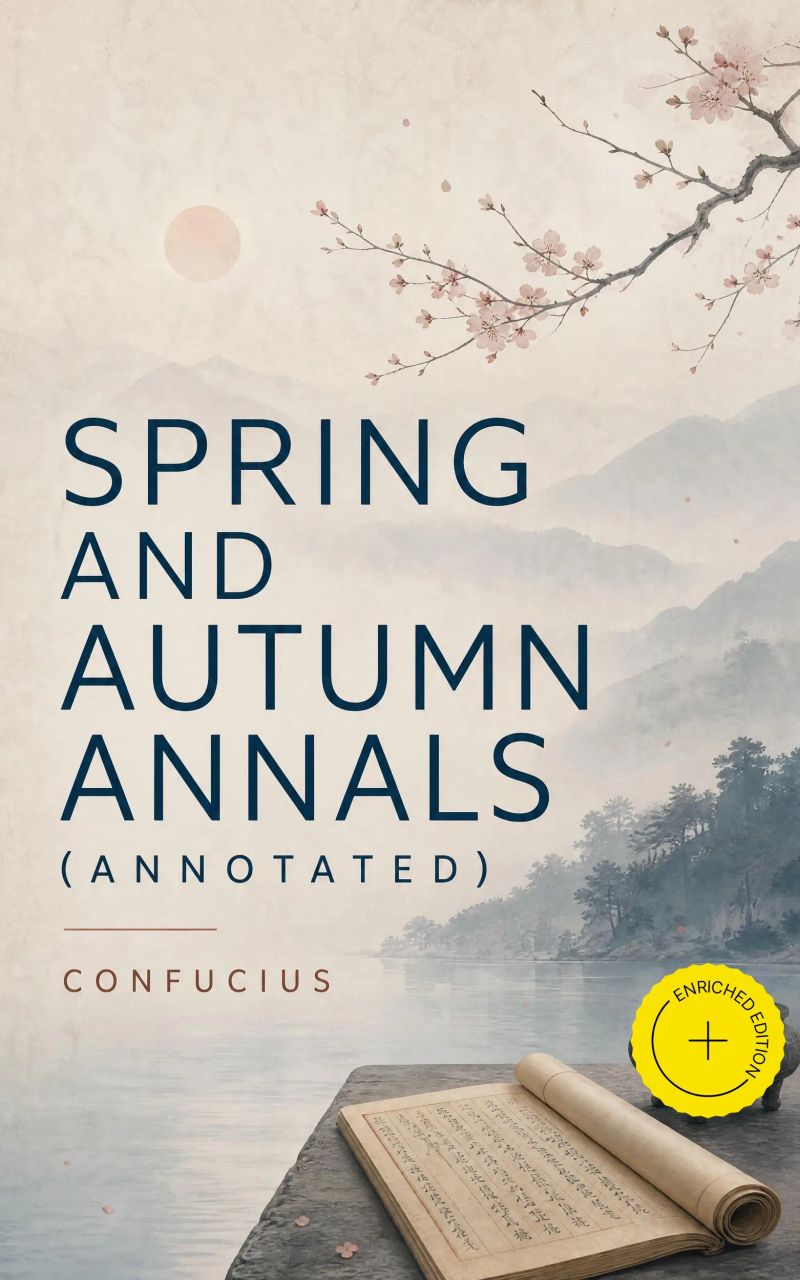
Spring and Autumn Annals (Annotated)
Enriched Edition. A Terse Chronicle of Lu, Eastern Zhou Politics, and the Moral Foundations of Chinese HistoriographyBy Confucius


Length10h 57m
About this audiobook
The Spring and Autumn Annals is a terse chronicle of the state of Lu, covering the years 722–481 BCE and recording accessions, wars, treaties, sacrifices, omens, and deaths with remarkable economy. Its spare, annalistic style—often no more than a sentence per event—became central to classical Chinese historiography because later readers found in its wording a subtle moral judgment. Set amid the fragmentation of the Eastern Zhou world, it preserves the political anxieties and ritual ideals that shaped early Confucian thought. Traditionally attributed to Confucius, the work reflects concerns associated with his life as a Lu-born teacher, ritual specialist, and frustrated political adviser. Living in an age of declining royal authority and aggressive regional powers, Confucius sought the restoration of ethical government through proper names, rites, and exemplary conduct. The Annals' disciplined selection and phrasing were therefore understood as an extension of his moral pedagogy: history becomes a vehicle for praise, blame, and political correction. This book is recommended to readers interested in the foundations of Chinese political philosophy, historiography, and classical literature. Though deceptively austere, it rewards patient reading, especially alongside its traditional commentaries, revealing how a brief chronicle could become a profound meditation on authority, legitimacy, and moral order.
This enriched edition has been carefully crafted to add value to your reading experience.
- A succinct Introduction situates the work's timeless appeal and themes.
- The Synopsis outlines the central plot, highlighting key developments without spoiling critical twists.
- A detailed Historical Context immerses you in the era's events and influences that shaped the writing.
- An Author Biography reveals milestones in the author's life, illuminating the personal insights behind the text.
- A thorough Analysis dissects symbols, motifs, and character arcs to unearth underlying meanings.
- Reflection questions prompt you to engage personally with the work's messages, connecting them to modern life.
- Hand‐picked Memorable Quotes shine a spotlight on moments of literary brilliance.
- Interactive footnotes clarify unusual references, historical allusions, and archaic phrases for an effortless, more informed read.
Audiobook details
Rating★★★★ 4.3 (10)
Includes Goodreads
GenreHistory
Length10 hrs 57 mins
Narrated byListen with 1,000+ voices
FormateBook with Audio
Publish dateSep 10, 2021
LanguageEnglish
Table of contents
1Introduction
2Introduction
3Synopsis
4Historical Context
5Author Biography
Show all chaptersShow less
6Chapter I. The Nature and Value of the Ch‘un Ts‘ew.
7Section II. The Sources of the Ch‘un Ts‘ëw, and Its Nature. Did Confucius Allow Himself Any Liberty of Addition or Retrenchment in the Use of His Authorities?
8Section III. Recovery of the Ch‘un Ts‘ëw During the Han Dynasty. Was This Indeed the Ch‘un Ts‘ëw of Confucius?
9Section IV. The Three Early Commentaries on the Ch‘un Ts‘ëw.
10Section V. The Value of the Ch‘un Ts‘ëw.
11Appendix I. Specimens of the Commentaries of Kung-yang and Kuh-lëang.
12Appendix II. A Letter Questioning the Confucian Authorship of the Ch‘un Ts‘ëw, by Yuen Mei.
13Chapter II. The Chronology of the Ch‘un Ts‘ew.
14Section II. The Dates in the Tso Chuen.
15Section III. Lists of the Kings of Chow, and of the Princes of the Principal Fiefs, From the Beginning to the Close of the Chow Dynasty.
16Chapter III. The China of the Ch‘un Ts‘ew Period:—considered in Relation to Its Territorial Extent: the Disorder Which Prevailed; the Growth and Encroachments of the Larger States; and the Barbarous Tribes Which Surrounded It.
17Chapter IV. List of the Principal Works Which Have Been Employed in the Preparation of This Volume.
18Section II. Translations and Other Foreign Works.
19Book I. Duke Yin
20Book II. Duke Hwan
21Book III. Duke Chwang
22Book IV. Duke Min
23Book V. Duke He
24Book VI. Duke Wăn
25Book VII. Duke Seuen
26Book VIII. Duke Ch•ing
27Book IX. Duke Sëang
28Book X. Duke Ch‘aou
29Book XI. Duke Ting
30Book XII. Duke Gae
31Analysis
32Reflection
33Memorable Quotes
The Shih King: Book of Poetry (Annotated)Confucius7h 28m$2 · $0.00
The Great Books of Chinese Wisdom (Annotated)Confucius, Mencius, Sun Tzu, Ernest J. Eitel, Anonymous39h 10m4.4 (65)$2 · $0.00
Classic of History (Part 1 & 2: The Book of Thang & The Books of Yü) (Annotated)Confucius2h 36m$2 · $0.00
The Wisdom of Confucius with Critical and Biographical SketchesConfucius5h 9m3.7 (291)$2 · $0.00
The Life, Labours and Doctrines of Confucius (Unabridged) (Annotated)Confucius3h 19m$2 · $0.00

Shu KingConfucius10h 4m4.0 (1.3K)$2 · $0.00
The AnalectsConfucius4h 56m4.0 (35K)$2 · $0.00

The Great Learning (Unabridged) (Annotated)Confucius2h 6m$2 · $0.00
The Five Classics (Annotated)Confucius45h 4m4.2 (485)$1.99 · $0.00
The Great Learning (A short Confucian text + Commentary by Tsang) (Annotated)Confucius1h 57m4.5 (12)$1.99 · $0.00
Spring and Autumn AnnalsConfucius10h 49m4.1 (36)$1.99 · $0.00
DOCTRINE OF THE MEAN (The Confucian Way to Achieve Equilibrium)Confucius55m3.9 (630)$1.99 · $0.00
THE LIFE, LABOURS AND DOCTRINES OF CONFUCIUSConfucius1h 49m3.8 (23)$1.99 · $0.00
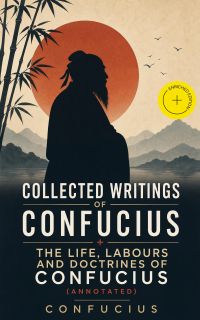
Collected Writings of Confucius + The Life, Labours and Doctrines of Confucius (Annotated)Confucius8h 53m$1.99 · $0.00

Los Tres Reyes Magos chinos, Confucio, Lao Tzu, Buda...Confucius, Laozi, Bouddha1h 9m$8 · $0.00
100 citazioni di ConfucioConfucius23m4.6 (23)$5 · $0.00
100 citat från KonfuciusConfucius21m$5 · $0.00
100 citaten van ConfuciusConfucius25m$5 · $0.00
400 citations de philosophes essentielsConfucius, Érasme, Lao Tseu, Baruch Spinoza, Søren Kierkegaard, Nicolas Machiavel, Thomas d'Aquin, Henry David Thoreau1h 15m$3 · $0.00
A Brief History of IntelligenceMax S. Bennett12h 18m4.6 (6.6K)$29 · $0.00

Black AF HistoryMichael Harriot15h 43m4.7 (14.6K)$33 · $0.00
The Gulag Archipelago Volume 3Aleksandr I. Solzhenitsyn21h 56m4.7 (8.9K)$46 · $0.00

Pearl of Great PriceJoseph Smith3h 8m4.7 (7.2K)$1.20 · $0.00

The Happiest Man on EarthEddie Jaku3h 48m4.6 (178K)$7 · $0.00

MotherlandJulia Ioffe17h 52m4.7 (2.5K)$40 · $0.00

Where Cowards Go to DieBenjamin Sledge8h 42m4.7 (351)$20 · $0.00

RevolutionariesSanjeev Sanyal11h 23m4.6 (2.6K)$29 · $0.00

We Crossed a Bridge and It TrembledWendy Pearlman6h4.6 (5.2K)$24 · $0.00

Unbroken Bonds of BattleJohnny Joey Jones8h 31m4.6 (2.6K)$8 · $0.00

The Daughter of AuschwitzTova Friedman, Malcolm Brabant7h 54m4.6 (16.7K)$26 · $0.00

Lily's PromiseLily Ebert, Dov Forman8h 54m4.6 (16.1K)$29 · $0.00

On Democracies and Death CultsDouglas Murray10h 38m4.6 (6.5K)$29 · $0.00

Across the RiverKent Babb11h 40m4.6 (927)$29 · $0.00
Balcony Over Jerusalem: A Middle East Memoir - Israel, Palestine and BeyondJohn Lyons12h 37m4.6 (1.4K)$33 · $0.00

BeyondStephen Walker15h 39m4.6 (3.2K)$33 · $0.00
Kings and PawnsHoward Bryant10h 9m4.6 (678)$29 · $0.00

No EscapeNury Turkel9h 30m4.6 (809)$28 · $0.00

Jubal Stone: U.S. Marshal: Blood Trail To Hell: A Western Adventure NovelCasey Nash3h 42m4.6 (3.2K)$18 · $0.00

Fall and RiseMitchell Zuckoff17h 23m4.6 (9.8K)$40 · $0.00
You may also like
Politics (Annotated)Aristotle12h4.2 (46.6K)$2 · $0.00
The Theory of the Leisure ClassThorstein Veblen10h 42m4.0 (14.5K)$10 · $0.00

Notes on the State of VirginiaThomas Jefferson11h 48m3.7 (1K)$2 · $0.00

Tâo Teh KingLaozi2h 34m4.4 (230.9K)$2 · $0.00

The Poetry of Oscar WildeOscar Wilde5h 55m4.1 (1.3K)$2 · $0.00

The Romance of Leonardo da Vinci, the Forerunner (Annotated)Dmitry Sergeyevich Merezhkovsky19h 3m4.1 (1.8K)$2 · $0.00
The Seven Lamps of ArchitectureJohn Ruskin8h 15m3.8 (1.7K)$2.30
The Social Contract & DiscoursesJean-Jaques Rousseau13h 19m4.1 (5.8K)$2.30

Shooting an Elephant and other essaysEric Arthur Blair13h 12m4.2 (16.5K)$2 · $0.00
The Social ContractJean-Jacques Rousseau10h 49m3.9 (68.7K)$9 · $0.00

DetroitScott Martelle10h 5m3.9 (2.4K)$20
Nicomachean EthicsAristotle10h 50m4.2 (76K)$1 · $0.00
LEVIATHAN (Complete Edition)Thomas Hobbes23h 49m3.9 (69.8K)$1.99 · $0.00

Democracy in America - Volume 1Alexis de Tocqueville21h 5m4.2 (4.2K)$2.30

GROUP PSYCHOLOGY AND THE ANALYSIS OF THE EGO (Annotated)Sigmund Freud4h 59m3.7 (1.8K)$2 · $0.00
LeviathanThomas Hobbes22h4.0 (64.5K)$12 · $0.00
Nicomachean EthicsAristotle11h 37m4.2 (71.7K)$4 · $0.00
The Essential Works of TagoreRabindranath Tagore64h 57m4.6 (304)$1.99 · $0.00
The inequality of human racesArthur comte de Gobineau9h 1m3.4 (205)$2 · $0.00

The Moral and Intellectual Diversity of Racescomte de Arthur Gobineau7h 54m3.6 (44)$1.99 · $0.00