
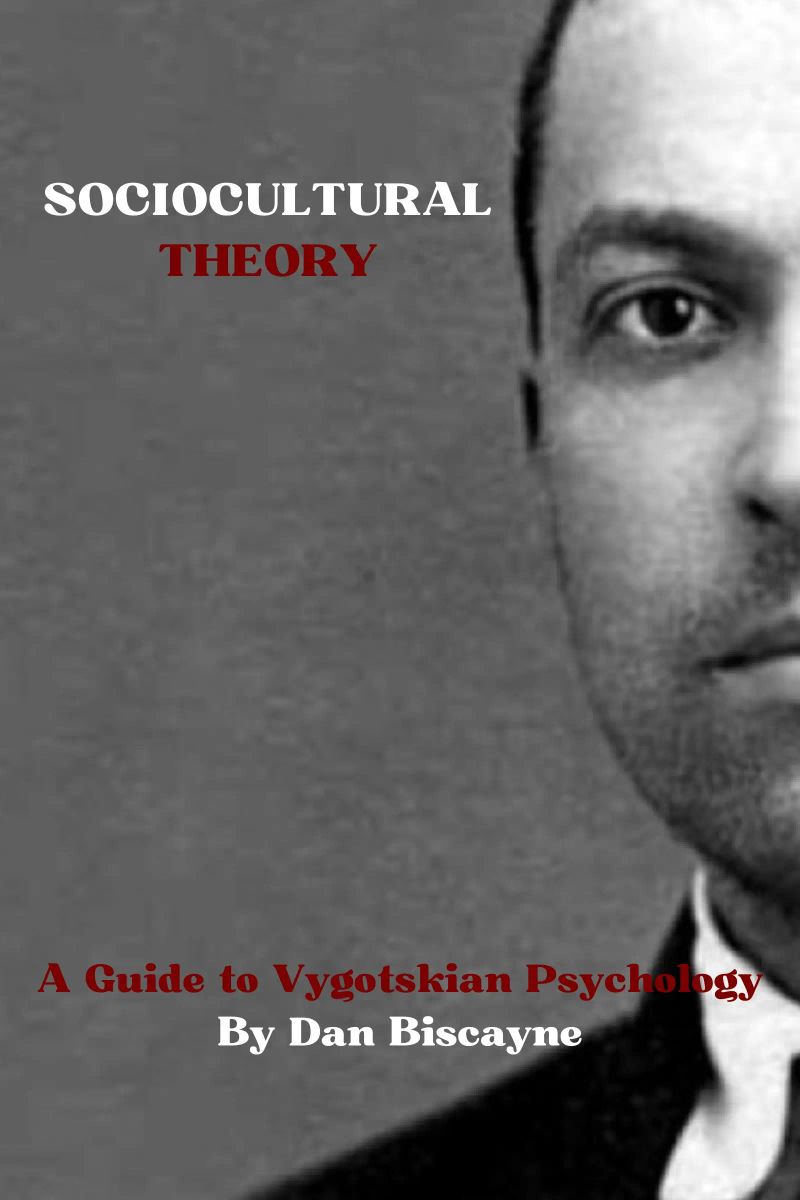
Sociocultural Theory
A Guide to Vygotskian PsychologyBy Dan Biscayne


Length8h 34m
About this audiobook
Lev Vygotsky’s Sociocultural Theory stands as one of the most influential frameworks in modern psychology, offering profound insights into how human thought and behavior are shaped by the social and cultural environments in which they develop. Emerging from early 20th-century Russia—a period of great intellectual and political transformation—Vygotsky’s ideas challenged the dominant psychological paradigms of his time, emphasizing that learning and cognitive growth are not isolated, internal processes, but deeply interactive, collective, and culturally mediated acts.
This book seeks to illuminate the relevance of Vygotsky’s vision. Far more than a theory of child development, the sociocultural perspective reveals how language, tools, and social interaction form the very foundation of human consciousness. Concepts such as the Zone of Proximal Development, More Knowledgeable Others, scaffolding, and mediated learning have become cornerstones in education, developmental psychology, and even fields such as artificial intelligence and organizational learning. Yet, despite their ubiquity, these ideas are often simplified or detached from their original philosophical depth. The goal of this volume is to return to Vygotsky’s writings, to trace their intellectual roots, and to explore their implications for contemporary psychological thought and practice.
Throughout these pages, you will encounter both the historical context and the modern interpretations of Vygotsky’s work. We examine how his theory bridges the individual and the collective, thought and language, culture and mind; and how sociocultural principles continue to inform pedagogy, therapy, cross-cultural research, and digital learning environments.
In revisiting Vygotsky’s legacy, this book invites scholars, students, and practitioners alike to view human development as a fundamentally social enterprise—one that unfolds through dialogue, cooperation, and shared meaning. It is a reminder that to understand the mind, we must first understand the culture that speaks through it.
Audiobook details
GenrePsychology, Self-Help
Length8 hrs 34 mins
Narrated byListen with 1,000+ voices
FormateBook with Audio
Publish dateNov 10, 2025
LanguageEnglish
Table of contents
1SOCIOCULTURAL THEORY
2Introduction to Sociocultural Theory
3Lev Vygotsky – The Man Behind the Theory
4The Zone of Proximal Development
5Language as a Tool for Cognitive Development
Show all chaptersShow less
6Mental Functions - Lower vs. Higher Processes
7Vygotskian View on Peer Collaboration
8Applications of Sociocultural Theory in Psychology
9Critiques and Counterarguments
10Contemporary Extensions & Future Directions
11Vygotsky’s 50 Quotes on Sociocultural Theory
Series


Teoría de la Identidad SocialDan Biscayne7h 50m$9

Social Identity TheoryDan Biscayne7h 2m$8

Theory of Planned BehaviorDan Biscayne6h 15m$8

Teoría del Comportamiento PlanificadoDan Biscayne7h$8

Attachment TheoryDan Biscayne7h 11m$8

Teoría del ApegoDan Biscayne7h 46m$9

Teoría Cognitiva de la DepresiónDan Biscayne9h$9

Cognitive Theory of DepressionDan Biscayne8h 7m$9

Gramática UniversalDan Biscayne7h 15m$8

Universal GrammarDan Biscayne6h 34m$8

Teoría del YoDan Biscayne9h 43m$10

Los Tres ÓrdenesDan Biscayne11h 21m$10

Teoría SocioculturalDan Biscayne9h 26m$10

Teoría VoluntaristaDan Biscayne8h 58m$9

Condicionamiento EmocionalDan Biscayne8h 44m$9

Teoría de la Disonancia CognitivaDan Biscayne8h 51m$9

Desarrollo PsicosocialDan Biscayne7h 20m$9

Teoría del Aprendizaje SocialDan Biscayne7h 24m$9

Teoría de la AutorrealizaciónDan Biscayne7h 40m$9

Teoría Centrada en la PersonaDan Biscayne7h 28m$9
What to Make of a LifeJim Collins13h 31m4.4 (793)$33 · $0.00

Invisible StormJason Kander6h 48m4.7 (3.2K)$24 · $0.00

I Am The StormJanice Dean9h4.6 (1.5K)$8 · $0.00

On Democracies and Death CultsDouglas Murray10h 38m4.6 (6.5K)$29 · $0.00

TerraformPropaganda5h 39m4.7 (594)$24 · $0.00

Southern Horrors: Lynch Law in All Its Phases (Annotated)Ida B. Wells-Barnett2h 44m4.6 (1.3K)$2 · $0.00
Hour of the HeartIrvin D. Yalom, Benjamin Yalom8h 19m4.6 (2.3K)$26 · $0.00

Braving the TruthRachel Held Evans11h 31m4.7 (359)$29 · $0.00
Level UpRob Dial7h 42m4.6 (3.3K)$26 · $0.00

As a JewSarah Hurwitz8h 36m4.6 (1.2K)$26 · $0.00

Saint Joan (Annotated)George Bernard Shaw6h 20m4.6 (1.2K)$1.20 · $0.00

Burn the HaystackJennie Young, PhD9h 30m4.6 (543)$29 · $0.00

Woman and the New Race (Annotated)Margaret Sanger6h 30m4.6 (1K)$1.99 · $0.00

Good InsideBecky Kennedy9h 55m4.5 (59.3K)$29 · $0.00

Du Bois: EssaysW.E.B. Du Bois6h 22m4.6 (1.5K)$1 · $0.00

The North American Indian (Illustrated Edition)Edward S. Curtis, Frederick Webb Hodge5h 59m4.6 (1.4K)$2 · $0.00

Valley of the BirdtailAndrew Stobo Sniderman, Douglas Sanderson10h 1m4.6 (2.4K)$29 · $0.00

Lies My Therapist Told MeGreg E. Gifford9h 3m4.6 (503)$29 · $0.00

Disturbed in Their NestsAlephonsion Deng, Judy A. Bernstein11h 22m4.6 (595)$23 · $0.00

No Name in the StreetJames Baldwin5h4.5 (8.5K)$20 · $0.00
Learning to PrayJames Martin13h 24m4.5 (3.4K)$33 · $0.00

Forever BoyKate Swenson9h 27m4.7 (5K)$29 · $0.00

You Are Worth ItKyle Carpenter, Don Yaeger8h 53m4.7 (4.8K)$29 · $0.00

The Happiest Man on EarthEddie Jaku3h 48m4.6 (178K)$7 · $0.00

Finding MeViola Davis9h 15m4.6 (256.4K)$29 · $0.00

Spiritual AnatomyDaaji Kamlesh D. Patel9h 47m4.7 (319)$29 · $0.00

The Dangerous Truth about Today’s MarijuanaLaura Stack CSP, MBA9h 57m4.7 (385)$20 · $0.00

Birdie & HarlowTaylor Wolfe7h 50m4.6 (6.5K)$26 · $0.00

CrossroadsKaleb Dahlgren7h 56m4.6 (4.9K)$26 · $0.00

Life on the BridgeKaelynn Partlow5h 40m4.6 (1.1K)$24 · $0.00

Keep Your Love OnDanny Silk9h 4m4.6 (8.1K)$10 · $0.00

The Tao of Joy Every DayDerek Lin10h 24m4.6 (762)$20 · $0.00
UndividedVicky Beeching9h 2m4.6 (1.3K)$29 · $0.00
Level UpRob Dial7h 42m4.6 (3.3K)$26 · $0.00

He Can Who Thinks He Can (Annotated)Orison Swett Marden5h 11m4.6 (1.2K)$1.20 · $0.00
Burn the HaystackJennie Young, PhD9h 30m4.6 (543)$29 · $0.00

ACRES OF DIAMONDS: Our Every-day Opportunities (Wisdom & Empowerment Series) (Annotated)Russell Conwell2h 26m4.6 (1K)$2 · $0.00
Good InsideBecky Kennedy9h 55m4.5 (59.3K)$29 · $0.00

The Lost VoiceGreta Morgan8h 30m4.7 (285)$26 · $0.00

Stripped DownBunnie Xo8h 25m4.5 (32.9K)$26 · $0.00
You may also like

How We BreakVincent Deary11h 9m4.2 (257)$25

Creative AuthenticityIan Roberts3h 41m4.4 (650)$15 · $0.00

The Story of PhilosophyWill Durant19h 28m4.2 (30.3K)$32
HOW TO LIVE ON 24 HOURS A DAY (A Self-Improvement Guide)Arnold Bennett2h 15m3.8 (13.8K)$1.99 · $0.00

Meditation Made EasyLorin Roche1h 35m4.2 (409)$16 · $0.00

Above Lifes TurmoilJames Allen2h 12m4.1 (1.3K)$2.30 · $0.00

That's What She SaidJoanne Lipman8h 29m4.1 (1.8K)$26 · $0.00

The Greatest SecretRhonda Byrne6h 20m4.0 (10.5K)$24 · $0.00

Aristotle for EverybodyMortimer J. Adler5h 30m4.0 (3.5K)$16

Best Sex Positions for CouplesDerek Chiasson1h 31m$4 · $0.00

FutileJordan Mack3h 14m5.0 (5) Only with Ultra

Guided Meditation for Greater AwarenessCristian Tuerk22m$13 · $0.00

Entering the MindC von Hassett5h 47m$17

Seated Yoga and RelaxationsSue Fuller3h 2m$15

Life Hacks from the BuddhaDr Tony Fernando12h 2m4.1 (168)$28 · $0.00

The Wealth Around YouAdam Godwod4h 15m$6 · $0.00
The Still PointKevin Krenitsky6h 28m4.4 (49)$17
How and How Not to Be HappyJ. Budziszewski6h 40m4.2 (60)$17 · $0.00

The Mind Beauty FarmRona Persichetti3h 46m$8.10 · $0.00

The Power of Feminine EnergyAmelia Vazquez1h 53m4.4 (124)$14.99