
Audio only
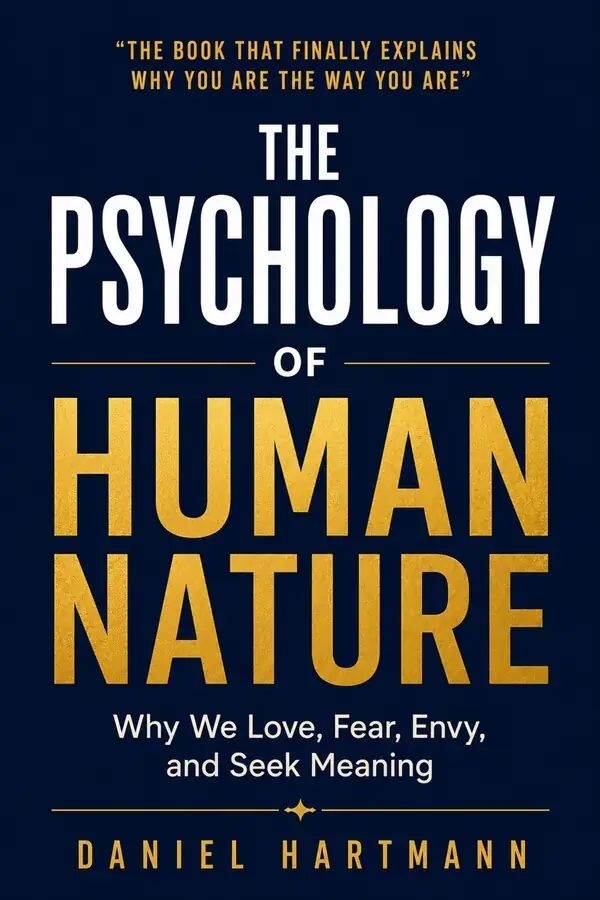
The Psychology of Human Nature
Why We Love, Fear, Envy, and Seek MeaningBy Daniel Hartmann


Length7h 20m
About this audiobook
Why do brilliant people make catastrophic decisions? Why do loving relationships become battlegrounds? Why does success so rarely produce the satisfaction it promised? Why do human beings, across every culture and every century, reach toward something they cannot quite name and never fully find?
The answers are not moral failures. They are not character defects. They are human nature — and for the first time in history, science can explain them.
The Psychology of Human Nature: Why We Love, Fear, Envy, and Seek Meaning by Daniel Hartmann is the definitive, rigorously researched, and compellingly written guide to understanding the forces that drive human behaviour from the inside out. Drawing on evolutionary psychology, neuroscience, social psychology, anthropology, and decades of landmark clinical research, this book delivers what no self-help book, philosophy course, or therapy session has ever provided in a single volume: a complete, honest, scientifically grounded account of what human beings actually are — and what that understanding makes possible.
Audiobook details
GenrePsychology
Length7 hrs 20 mins
Narrated byListen with 1,000+ voices
FormateBook with Audio
Publish dateJun 2, 2026
LanguageEnglish
Table of contents
1Introduction
2Introduction: The Stranger in the Mirror 7
3Chapter 1 — The Primal Blueprint: Understanding the Evolved Human Mind 11
41.1 What Evolution Actually Did to Your Brain — and Why You Are Not as Modern as You Think 11
51.2 The Mismatch Problem: Living a Twenty-First Century Life With a Stone Age Brain 13
Show all chaptersShow less
61.3 Nature Versus Nurture Resolved: What the Science Actually Concludes 14
71.4 The Hidden Architecture of Human Motivation: What Drives Us Beneath Conscious Awareness 15
81.5 Why Self-Knowledge Is the Hardest and Most Important Thing a Human Being Can Pursue 17
9Chapter 2 — The Biology of Love: Why We Bond, Attach, and Cannot Live Without Each Other 19
102.1 The Neurochemistry of Falling in Love: Dopamine, Oxytocin, and the Brain on Romantic Obsession 19
112.2 Why Human Beings Are Wired for Pair Bonding — and Why It Is So Difficult to Sustain 21
122.3 The Evolutionary Logic of Jealousy, Possessiveness, and the Fear of Abandonment 22
132.4 Companionate Love vs. Passionate Love: What the Science Says About Long-Term Commitment 24
142.5 How Childhood Attachment Rewrites the Rules of Every Adult Relationship You Will Ever Have 25
15Chapter 3 — The Architecture of Fear: What Scares Us and Why We Cannot Stop It 28
163.1 The Neuroscience of Fear: How the Brain Detects, Processes, and Remembers Threat 28
173.2 Why Your Fears Are Often Irrational — and Why That Irrationality Makes Perfect Evolutionary Sense 30
183.3 Social Fear: Why Rejection, Humiliation, and Exclusion Hurt Like Physical Pain 31
193.4 Existential Fear: How the Awareness of Death Shapes Almost Every Decision You Make 32
203.5 Transforming Fear From a Prison Into a Compass: The Science of Courage 33
21Chapter 4 — The Green-Eyed Architecture: The Psychology and Biology of Envy 36
224.1 What Envy Actually Is: The Neuroscience Behind the Emotion Nobody Wants to Admit Feeling 36
234.2 Social Comparison Theory and the Evolutionary Roots of Wanting What Others Have 37
244.3 Benign vs. Malicious Envy: How the Same Emotion Can Elevate or Destroy 38
254.4 Status, Prestige, and the Primal Hierarchy: Why Human Beings Cannot Stop Ranking Themselves 39
264.5 Converting Envy Into Ambition: The Psychological Alchemy of Competitive Desire 40
27Chapter 5 — The Meaning Imperative: Why Humans Cannot Live Without Purpose 42
285.1 The Biology of Meaning: Why the Brain Requires Purpose to Function at Full Capacity 42
295.2 Viktor Frankl, Logotherapy, and What Extreme Human Suffering Reveals About the Will to Live 44
305.3 How People Construct Meaning — and What Happens Psychologically When That Construction Collapses 45
315.4 The Four Pillars of Meaning: Belonging, Purpose, Storytelling, and Transcendence 46
325.5 Finding Meaning in Ordinary Life: The Science of Significance Beyond Grand Achievement 48
33Chapter 6 — The Social Animal: Why Human Beings Are Defined by Their Relationships 50
346.1 The Tribal Brain: How Our Social Architecture Was Built for Groups of 150, Not Billions 50
356.2 Belonging as a Biological Need: What Chronic Social Exclusion Does to the Body and Mind 52
366.3 Conformity, Groupthink, and Why Intelligent People Abandon Independent Judgment in Groups 53
376.4 The Psychology of Reputation: Why What Others Think of You Affects Everything You Think of Yourself 54
386.5 Building Genuine Community in a Disconnected World: The Science of Belonging 55
39Chapter 7 — The Irrational Animal: Why Smart People Consistently Make Terrible Decisions 57
407.1 The Systematic Errors Built Into Human Cognition: A Field Guide to Your Own Biases 57
417.2 Confirmation Bias and the Echo Chamber of the Self: How the Mind Protects Its Own Illusions 59
427.3 Loss Aversion, Risk Distortion, and the Emotional Economics of Everyday Choice 60
437.4 The Dunning-Kruger Effect and the Painful Psychology of Not Knowing What You Do Not Know 61
447.5 Debiasing the Mind: Evidence-Based Strategies for Thinking More Clearly Under Pressure 62
45Chapter 8 — The Aggressive Impulse: Understanding Violence, Anger, and Human Darkness 65
468.1 The Evolutionary Origins of Human Aggression: What Biology and Anthropology Actually Say 65
478.2 The Psychology of Evil: How Ordinary People Commit Extraordinary Acts of Cruelty 66
488.3 Anger as Information: What Your Rage Is Actually Trying to Tell You 67
498.4 The Shadow Self: Carl Jung and the Psychological Cost of Denying Your Darker Nature 68
508.5 Channelling Aggressive Energy Into Creative, Competitive, and Constructive Force 69
More from Daniel Hartmann

How to Read Anyone's MindDaniel Hartmann7h 50m$15 · $0.00
The Art of Dealing with FeelingsDaniel Hartmann8h 23m$15 · $0.00
The Secret Of Mastering DetachmentDaniel Hartmann8h 19m$14 · $0.00

How to Stop Being Toxic in Relationships Before It's Too LateDaniel Hartmann6h 31m$15 · $0.00

The Psychology of Male BehaviorDaniel Hartmann5h 42m5.0 (1)$5.20 · $0.00

What to Make of a LifeJim Collins13h 31m4.4 (794)$33 · $0.00

Invisible StormJason Kander6h 48m4.7 (3.2K)$24 · $0.00

I Am The StormJanice Dean9h4.6 (1.5K)$8 · $0.00

On Democracies and Death CultsDouglas Murray10h 38m4.6 (6.5K)$29 · $0.00

TerraformPropaganda5h 39m4.7 (594)$24 · $0.00

Southern Horrors: Lynch Law in All Its Phases (Annotated)Ida B. Wells-Barnett2h 44m4.6 (1.3K)$2 · $0.00
Hour of the HeartIrvin D. Yalom, Benjamin Yalom8h 19m4.6 (2.3K)$26 · $0.00

Braving the TruthRachel Held Evans11h 31m4.7 (359)$29 · $0.00
Level UpRob Dial7h 42m4.6 (3.3K)$26 · $0.00

As a JewSarah Hurwitz8h 36m4.6 (1.2K)$26 · $0.00

Saint Joan (Annotated)George Bernard Shaw6h 20m4.6 (1.2K)$1.20 · $0.00

Burn the HaystackJennie Young, PhD9h 30m4.6 (543)$29 · $0.00

Woman and the New Race (Annotated)Margaret Sanger6h 30m4.6 (1K)$0.99 · $0.00

Good InsideBecky Kennedy9h 55m4.5 (59.3K)$29 · $0.00

The Mis-Education of the NegroCarter Godwin Woodson5h 4m4.5 (29.4K)$1.20 · $0.00

Du Bois: EssaysW.E.B. Du Bois6h 22m4.6 (1.5K)$1 · $0.00

The North American Indian (Illustrated Edition)Edward S. Curtis, Frederick Webb Hodge5h 59m4.6 (1.4K)$2 · $0.00

Valley of the BirdtailAndrew Stobo Sniderman, Douglas Sanderson10h 1m4.6 (2.4K)$29 · $0.00

Lies My Therapist Told MeGreg E. Gifford9h 3m4.6 (503)$29 · $0.00

Disturbed in Their NestsAlephonsion Deng, Judy A. Bernstein11h 22m4.6 (595)$23 · $0.00
You may also like

That's What She SaidJoanne Lipman8h 29m4.1 (1.8K)$26 · $0.00
Personal GrowthSteve Pavlina1h 30m4.1 (5.1K)$12 · $0.00

The Edinburgh Lectures on Mental ScienceT. Troward4h 1m4.4 (1.6K)$2 · $0.00
How We BreakVincent Deary11h 9m4.2 (257)$25

Meditation Made EasyLorin Roche1h 35m4.2 (409)$16 · $0.00
The Essential EnneagramDavid Daniels, Virginia Price4h 30m4.0 (4.4K)$20 · $0.00

Creative AuthenticityIan Roberts3h 41m4.4 (650)$15 · $0.00

A Series of Lessons in Raja YogaWilliam Walker Atkinson8h 9m4.1 (281)$2.30

HOW TO LIVE ON 24 HOURS A DAY (A Self-Improvement Guide)Arnold Bennett2h 15m3.8 (13.8K)$1.99 · $0.00

The Essays of Arthur Schopenhauer (translated)Arthur Schopenhauer4h 55m4.3 (3.2K)$4.70 · $0.00

The Hormone Balance BibleShawn Tassone15h 38m4.0 (646)$33 · $0.00
The Still PointKevin Krenitsky6h 28m4.4 (49)$17

Does self-knowledge come through searching?Jiddu Krishnamurti58m4.4 (13)$4 · $0.00

The Secret of Success: How to Achieve Power, Success & Mental InfluenceWilliam Walker Atkinson24h4.0 (255)$2 · $0.00
20 Zen Lessons For OverthinkersNaomi Mori1h 46m$5.70 · $0.00

CONNECTED THROUGH THE SPIRIT WITHINElias Innerwell2h 55m$19 · $0.00

The First-Time Mum’s Confidence GuideNaomi F. Ridley1h 54m$2.30 · $0.00

The Value Within YouDanniel Silva3h 33m$1.80 · $0.00

Entering the MindC von Hassett5h 47m$17

The Power of Feminine EnergyAmelia Vazquez1h 53m4.4 (124)$14.99