
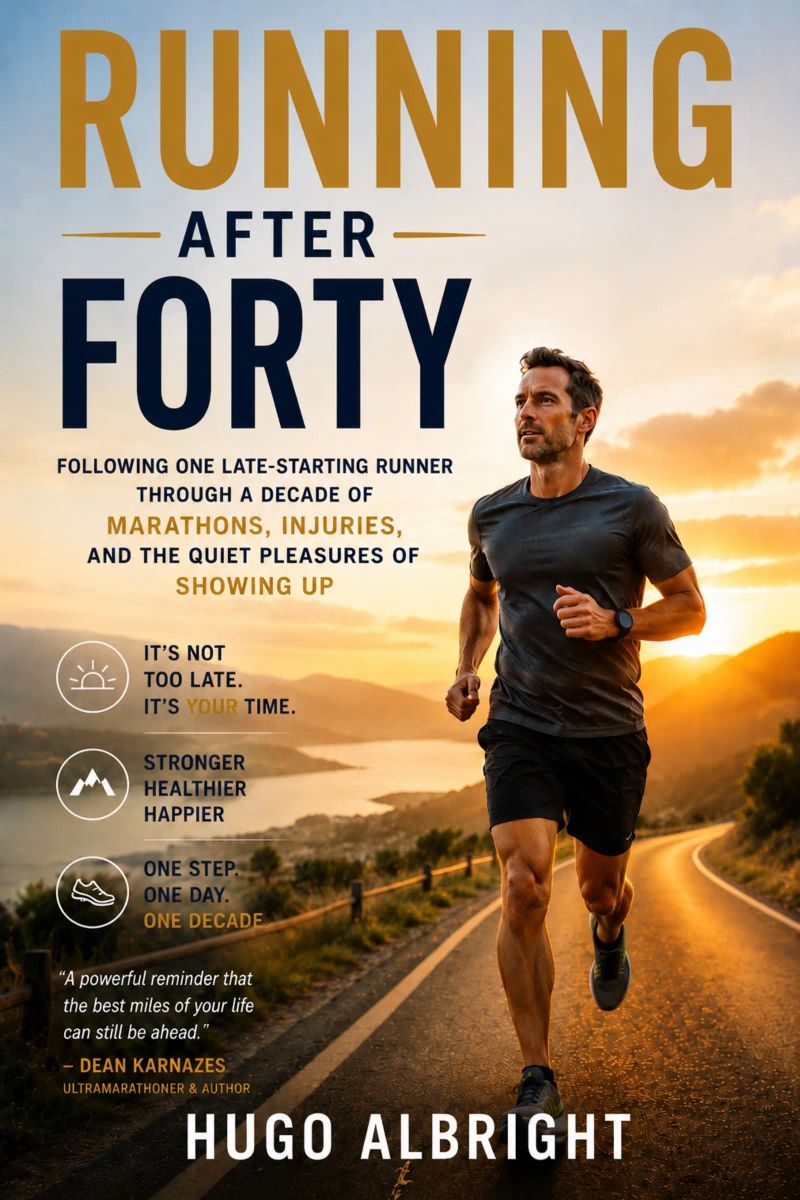
Running After Forty
Following One Late-Starting Runner Through a Decade of Marathons, Injuries, and the Quiet Pleasures of Showing UpBy Hugo AlbrigHt


Length8h 34m
About this audiobook
**Running After Forty: Starting Late, Staying Consistent, and Discovering What Your Body Can Still Do**
When Aaron Whitfield began running at forty-two, he could barely jog for four minutes before stopping. He carried extra weight, worried about his health, and had no athletic background beyond occasional recreational activity. Ten years later, he qualified for the Boston Marathon. His transformation did not happen through talent, genetics, or extreme training. It happened through consistency, patience, and thousands of ordinary runs.
This book follows the journey of a composite masters runner from complete beginner to accomplished endurance athlete. Written by veteran coach Hugo Albright, it offers an honest look at what running after forty actually involves—not the inspirational highlights, but the full reality of starting later in life.
Readers learn how to begin safely using walk-run protocols, manage the common injuries and setbacks that affect new runners, and understand the unique physiological considerations of aging athletes. Albright explains topics such as heart-rate training, recovery, strength work, injury prevention, marathon preparation, and the science of polarized training in language accessible to everyday runners.
The book also addresses issues often ignored in running literature, including balancing training with family responsibilities, navigating career demands, recovering from injury setbacks, and managing health concerns that become increasingly important with age. Special chapters explore cardiovascular health, screening recommendations, and warning signs every masters athlete should understand.
Rather than promising quick transformations, this book focuses on the cumulative benefits of long-term running. Improved blood pressure, lower resting heart rate, better mobility, enhanced mental health, and a renewed sense of capability emerge through years of steady effort.
Running after forty is not about reclaiming youth. It is about discovering what remains possible. Whether your goal is to finish a first 5K, complete a marathon, or simply become a healthier version of yourself, this book provides a realistic and encouraging guide to the journey ahead.
Audiobook details
GenreHealth and Wellness
Length8 hrs 34 mins
Narrated byListen with 1,000+ voices
FormateBook with Audio
Publish dateJun 5, 2026
LanguageEnglish
Table of contents
1Foreword: The Man at the Back of the Pack
2Chapter 1. The Parking Lot at the Reservoir
3Chapter 2. The First Month, Which Almost Ends It
4Chapter 3. The Couch-to-5K Question
5Chapter 4. The First Pair of Real Shoes
Show all chaptersShow less
6Chapter 5. The Hidden Curriculum of the Morning Run
7Chapter 6. The Polarized Question, or What Stephen Seiler Knows
8Chapter 7. The First Real Injury
9Chapter 8. The 10K and the Half Marathon Year
10Chapter 9. The Marathon Decision
11Chapter 10. The First Marathon
12Chapter 11. The Long Winter After the First One
13Chapter 12. Chicago, and What It Costs to Run Sub-Four
14Chapter 13. The Year He Could Not Run
15Chapter 14. The Boston Qualifier, First Attempt
16Chapter 15. Vermont, the Return, and the Second Failure
17Chapter 16. Indianapolis, and the Number on the Wall
18Chapter 17. The Long Quiet Year Between the Qualifier and Boston
19Chapter 18. The Saturday Group, and the Friends a Decade Makes
20Chapter 19. The Year of the Daughters
21Chapter 20. The Boston Build, and the Strangeness of Training for the Race You Live Next To
22Chapter 21. Patriots’ Day, 2024
23Chapter 22. The Day After, and the Year That Followed
24Chapter 23. A Year of Gear, and What a Decade of Equipment Choices Actually Looks Like
25Chapter 24. What the Runner Eats, and What He Stops Eating
26Chapter 25. The Marriage, and the Quiet Architecture of a Running Household
27Chapter 26. The Pandemic Bike Path, and the Friend Aaron Made on It
28Chapter 27. The Cardiac Workup, and What the Masters Runner Should Know About His Heart
29Chapter 28. What I Tell New Runners on Their First Saturday
30Chapter 29. A January Long Run on the Charles, and What It Felt Like to Be Inside It
31Epilogue. Ten Years In, What a Decade of Running Actually Teaches You

Healthy Kids, Happy KidsElisa Song14h 18m4.6 (760)$33 · $0.00
Eat It!Jordan Syatt, Michael Vacanti4h 40m4.6 (1.5K)$20 · $0.00

Consent Laid BareChanel Contos7h 11m4.5 (1.7K)$24 · $0.00
How to Make Disease DisappearRangan Chatterjee5h 26m4.5 (3.5K)$24 · $0.00

The Complete Herbal (Annotated)Nicholas Culpeper29h 8m4.5 (1.4K)$2 · $0.00

A Plague Upon Our HouseScott W. Atlas MD10h 37m4.5 (3.4K)$20 · $0.00

The Cancer CodeDr. Jason Fung10h 48m4.5 (5.3K)$29 · $0.00

The Gift of TherapyIrvin Yalom7h 39m4.5 (38.8K)$26 · $0.00

EarlySarah DiGregorio9h 47m4.5 (1.3K)$29 · $0.00

Bottle of LiesKatherine Eban14h 25m4.4 (12K)$33 · $0.00
The 36-Hour DayNancy L. Mace, Peter V. Rabins17h 13m4.4 (9.2K)$28 · $0.00

FlooredSara Reardon10h 36m4.5 (1K)$29 · $0.00
Radical RemissionKelly A. Turner9h 26m4.4 (8.1K)$29 · $0.00
The Sinatra SolutionStephen T. Sinatra MD9h4.5 (899)$20 · $0.00

The Songaminute ManSimon McDermott6h 12m4.5 (280)$24 · $0.00
Sometimes BrilliantLarry Brilliant12h 27m4.5 (954)$29 · $0.00

Live Your LifeAmanda Kloots, Anna Kloots10h 54m4.4 (13.7K)$29 · $0.00

All in Her HeadElizabeth Comen13h 25m4.4 (18.2K)$33 · $0.00
The Wisdom of Your BodyHillary McBride9h 14m4.4 (6.7K)$29 · $0.00

The Alzheimer's SolutionDean Sherzai, Ayesha Sherzai9h 47m4.4 (1.9K)$29 · $0.00
You may also like

The Parenting MapShefali Tsabary14h 14m4.4 (2.2K)$8 · $0.00

What Shamu Taught Me about Life, Love, and MarriageAmy Sutherland5h 32m3.8 (2K)$14
This Is About Running. This Is Not About Running.Chris Bennett6h 54m4.5 (429)$24 · $0.00
The Goals ProgramZig Ziglar4h 34m4.6 (2.3K)$20
ConfidenceRoxie Nafousi6h 13m4.0 (921)$24 · $0.00
Attitude Is EverythingJeff Keller3h 43m4.2 (37.6K)$18 · $0.00
RebootUnknown Author5h 58m3.9 (39.7K)$24 · $0.00
Self-CompassionKristin Neff9h4.1 (34.4K)$29 · $0.00
The Art of CommunicatingThich Nhat Hanh3h 18m4.3 (25.8K)$6 · $0.00
Things No One Else Can Teach UsHumble the Poet6h 27m4.2 (2K)$24 · $0.00
Thank You PowerDeborah Norville4h 11m3.9 (1.6K)$20 · $0.00
How to Host a Viking FuneralKyle Scheele5h 38m4.1 (1.1K)$24 · $0.00
How to Live on 24 Hours a DayArnold Bennett1h 35m3.8 (15.9K)$10 · $0.00

The Power of ConcentrationWilliam Walker Atkinson4h 21m4.2 (7.5K)$1.99 · $0.00

The Rare Jewel of Christian ContentmentJeremiah Burroughs8h 25m4.5 (7.5K)$20
Taming the Tiger WithinThich Nhat Hanh45m4.3 (9.3K)$4
Champions Body-for-LIFEArt Carey4h 57m4.0 (187)$20 · $0.00
Everything I Needed to Know I Learned from My Six-Month-OldKuwana Haulsey6h 31m3.1 (13)$20

Addiction: Prevent Relapse to Start Living a Mentally Healthy Life (A Guide for the Addict and the Family and Friends That Love Them and Support Their Recovery)Fabian Benavides1h 26m$6.40 · $0.00

Ultimate YouSharon Pearson7h 30m4.1 (29)$17