
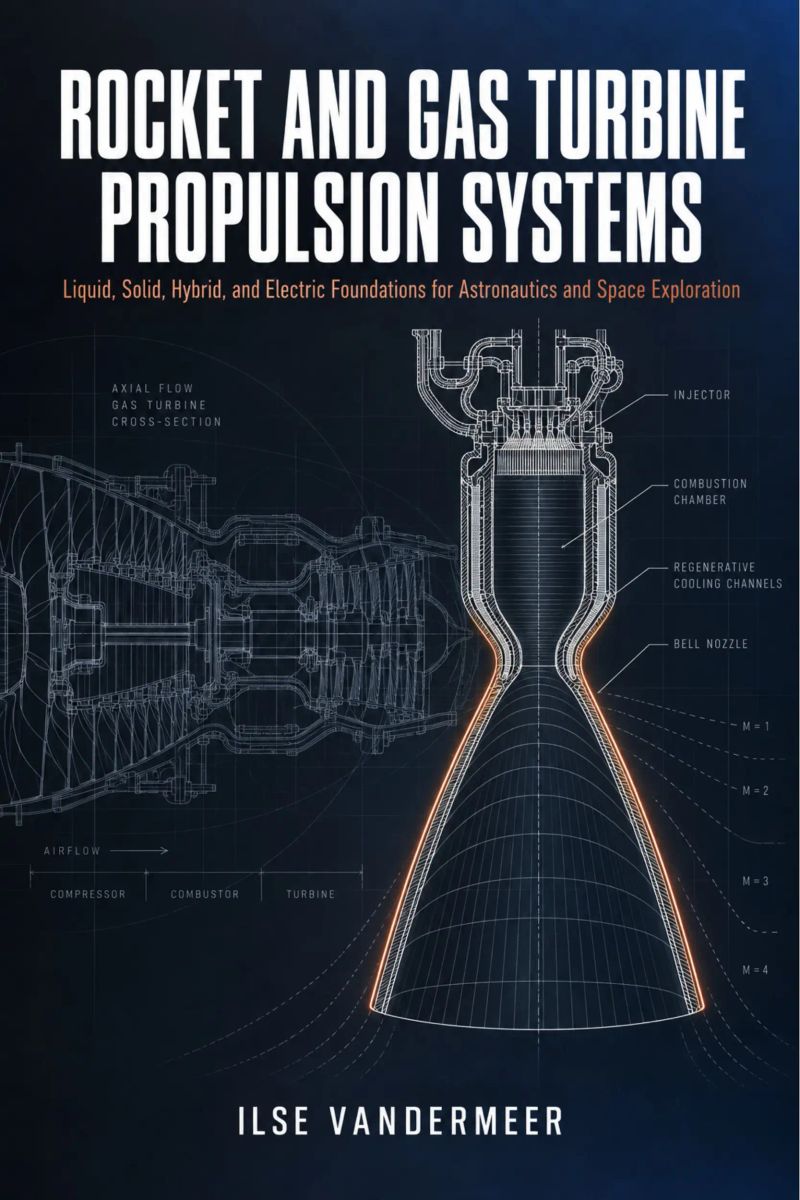
Rocket and Gas Turbine Propulsion Systems
Liquid, Solid, Hybrid, and Electric Foundations for Astronautics and Space ExplorationBy Ilse Vandermeer


Length16h 21m
About this audiobook
You have seen the thrust equation. This book shows you what stands behind it.
Rocket and Gas Turbine Propulsion Systems bridges the gap between thermodynamic theory and real hardware. Starting from stagnation properties and isentropic nozzle flow, it builds the full chain of performance parameters—characteristic velocity, thrust coefficient, and specific impulse—then moves directly into the engineering details that determine whether an engine works. You will examine turbopump cavitation margins, the four engine power cycles and their trade-offs, injector mixing and the combustion instabilities it can trigger, regenerative cooling channel design, solid grain geometry and erosive burning, hybrid regression rates, and the throughput limits of Hall and ion thrusters. Gas turbines receive equal depth, from Brayton cycle work terms to bypass ratio selection and ramjet inlet behavior. The final chapters cover staging and mission delta-v, test-stand instrumentation, range safety, materials, manufacturing, and the failure modes that end development programs. Every derivation concludes with a worked number, so you can connect each equation to a concrete design decision.
Written for propulsion students, graduate researchers, and engineers moving between rocket and turbine work, this text treats liquid, solid, hybrid, and electric systems as one connected discipline. It assumes a first course in thermodynamics and fluid mechanics but builds every propulsion-specific result from the ground up. Whether you are sizing a nozzle, selecting a power cycle, or diagnosing an instability, the book provides the analytical framework and the numerical examples to support your work.
What you will learn:
• Apply stagnation properties and isentropic flow to nozzle design and performance prediction
• Calculate characteristic velocity, thrust coefficient, and specific impulse from first principles
• Evaluate turbopump cavitation margins and select among the four engine power cycles
• Analyze injector mixing, combustion instability, and regenerative cooling channel behavior
• Design solid grain geometries and predict erosive burning effects
• Estimate hybrid rocket regression rates and electric thruster throughput limits
• Work through Brayton cycle terms, bypass ratio trade-offs, and ramjet inlet operation
• Perform staging and mission delta-v calculations with test-stand instrumentation in mind
• Identify materials, manufacturing, and failure mode constraints across propulsion systems
This book is for upper-level undergraduates, graduate students, and practicing engineers in aerospace, mechanical, and energy fields who need a unified, quantitatively rigorous treatment of rocket and gas turbine propulsion. If you are transitioning from coursework to design, or moving between rocket and turbine projects, the worked examples and hardware-focused chapters will serve as a lasting reference.
Audiobook details
GenreTechnology, Science and Nature
Length16 hrs 21 mins
Narrated byListen with 1,000+ voices
FormateBook with Audio
Publish dateSep 27, 2026
LanguageEnglish
Table of contents
1Rocket and Gas Turbine Propulsion Systems
2Foreword
3Preface
4About This Book
5Important Safety Notice
Show all chaptersShow less
6Chapter 1: Thermodynamic Foundations of Propulsion
71.1 The Control Volume and the General Thrust Equation
81.2 Stagnation Properties and Isentropic Relations
91.3 Energy, Enthalpy and the Speed of Sound
101.4 Thrust, Power and Efficiency Definitions
111.5 The Rocket Equation and Its Immediate Consequences
121.6 Worked Synthesis: From Chamber to Delivered Impulse
13Chapter 2: Nozzle Flow and Performance
142.1 Choking and the Critical Pressure Ratio
152.2 Area Ratio and the Isentropic Nozzle Solution
162.3 Mass Flow, Characteristic Velocity and Throat Sizing
172.4 Thrust Coefficient and Nozzle Efficiency
182.5 Over-Expansion, Under-Expansion and Altitude Compensation
192.6 Nozzle Performance Synthesis
20Chapter 3: Chemical Rocket Performance Parameters
213.1 Mixture Ratio, Equivalence Ratio and Stoichiometry
223.2 Adiabatic Flame Temperature and Equilibrium Composition
233.3 Characteristic Velocity and Its Measurement
243.4 Specific Impulse, Density Impulse and Propellant Selection
253.5 Performance Synthesis Across a Mixture-Ratio Sweep
26Chapter 4: Liquid Propellants and Feed Systems
274.1 Propellant Pairs and Their Properties
284.2 Tank Pressurization and Feed-System Layout
294.3 Turbopumps, Cavitation and Net Positive Suction Head
304.4 Valves, Lines, Transients and Propellant Management
314.5 Feed-System Synthesis and Mass Estimate
32Chapter 5: Engine Power Cycles
335.1 The Gas Generator Cycle
345.2 Staged Combustion and Oxidizer-Rich Cycles
355.3 Expander and Expander-Bleed Cycles
365.4 Pressure-Fed Systems and Cycle Comparison
375.5 Cycle Selection Synthesis
38Chapter 6: Injectors, Combustion and Cooling
396.1 Atomization, Spray Formation and Injector Types
406.2 Mixing, Combustion Efficiency and Chamber Length
416.3 Combustion Instability: Modes, Drivers and Damping
426.4 Regenerative and Film Cooling
436.5 Injector and Cooling Synthesis
44Chapter 7: Solid Rocket Motors
457.1 Propellant Composition and Hazard Classes
467.2 Grain Design and Burning Surface Evolution
477.3 Burn-Rate Laws and Pressure Sensitivity
487.4 Erosive Burning and Internal Ballistics
497.5 Case-Bonded Structures and Insulation
507.6 Solid Motor Synthesis

The Honey BusMeredith May9h 31m4.4 (16.6K)$25 · $0.00

Collected Writings of Nikola TeslaThomas Commerford Martin, Nikola Tesla19h 42m4.4 (2.8K)$1.99 · $0.00

Operation PedestalMax Hastings12h 29m4.4 (5.2K)$29 · $0.00

When the Heavens Went on SaleAshlee Vance18h 20m4.4 (3K)$40 · $0.00

Everybody Has a Podcast (Except You)Justin McElroy, Travis McElroy, Griffin McElroy5h 9m4.3 (2.3K)$24 · $0.00

Hands of TimeRebecca Struthers8h 8m4.4 (1.3K)$26 · $0.00

Never Lost AgainBill Kilday10h 1m4.4 (805)$29 · $0.00

How the Internet HappenedBrian McCullough13h 28m4.3 (2.7K)$23 · $0.00

Collected Writings of Nikola TeslaNikola Tesla, Thomas Commerford Martin21h 50m4.3 (1.7K)$1 · $0.00

Just AspireAjai Chowdhry9h 13m4.4 (260)$29 · $0.00

The Little Book of AliensAdam Frank8h 20m4.3 (1.3K)$26 · $0.00

The inventions, researches and writings of Nikola Tesla (Annotated)Thomas Commerford Martin16h 59m4.3 (1.3K)$2 · $0.00

KargilV.P. Malik15h 18m4.3 (2K)$24 · $0.00

Experiments with Alternating CurrentsNikola Tesla9h 16m4.3 (874)$1.99 · $0.00

Fire on the HorizonTom Shroder, John Konrad8h 23m4.3 (858)$26 · $0.00

The Smell of Kerosene (Annotated)National Aeronautics and Space Administration, Donald L. Mallick, Peter W. Merlin11h 32m4.3 (523)$2 · $0.00

The Boy Who Harnessed the WindWilliam Kamkwamba, Bryan Mealer10h 5m4.2 (78.9K)$29 · $0.00

Across the Airless WildsEarl Swift10h 8m4.3 (1.3K)$29 · $0.00

Console WarsBlake J. Harris20h 41m4.2 (13.7K)$46 · $0.00

Improvised Munitions HandbookU.S. Department of Defense4h 49m4.3 (1.6K)$1.99 · $0.00

A Brief History of IntelligenceMax S. Bennett12h 18m4.6 (6.6K)$29 · $0.00
The Story of BirdsSteve Brusatte11h 49m4.6 (401)$29 · $0.00

BeyondStephen Walker15h 39m4.6 (3.2K)$33 · $0.00

LiftoffEric Berger9h 4m4.6 (9.5K)$29 · $0.00

Black Earth WisdomLeah Penniman11h 54m4.6 (577)$8 · $0.00

Total Cat MojoJackson Galaxy10h 13m4.5 (8.4K)$23 · $0.00

My Life Among the UnderdogsTia Torres5h 51m4.5 (4K)$24 · $0.00

What It Takes to Save a LifeKwane Stewart6h4.6 (556)$24 · $0.00

Pastoral SongJames Rebanks8h 35m4.5 (12K)$26 · $0.00

How Stella Learned to TalkChristina Hunger7h4.5 (10.9K)$24 · $0.00

Craig & FredCraig Grossi8h 6m4.5 (9.6K)$26 · $0.00

Celebrating BirdsNatalia Rojas, Ana Maria Martinez6h 47m4.6 (330)$24 · $0.00

Saving JemimaJulie Zickefoose4h 59m4.5 (749)$20 · $0.00

Will's Red CoatTom Ryan8h 23m4.5 (2.3K)$26 · $0.00

Of Time and TurtlesSy Montgomery10h 34m4.5 (5K)$29 · $0.00

THE WOLF TRILOGY: Call of the Wild, White Fang & The Son of the WolfJack London17h 31m4.5 (2.4K)$1.99 · $0.00
Zen and the Art of Saving the PlanetThich Nhat Hanh9h 20m4.5 (3.9K)$29 · $0.00

BLACK BEAUTY (With Original Illustrations)Anna Sewell7h 31m4.5 (1.3K)$1.99 · $0.00

Bottle of LiesKatherine Eban14h 25m4.4 (12K)$33 · $0.00
IngrainedCallum Robinson8h 10m4.5 (1.1K)$26 · $0.00
You may also like

There Are (No) Stupid Questions … in ScienceLeah Elson MS, MPH5h 34m4.2 (389)$17

Taoist Teachings From the Book of Lieh TzŭLie Yukou2h 40m4.2 (1.3K)$1 · $0.00
Aircraft and Spacecraft Engineering FundamentalsTomas Berenguer12h 45m$75
Atomic Rocket Engines and Fission PowerYuri Petrossian12h 28m$70

100,000 Whys for ToddlersKiddies Care2h 20m$10 · $0.00

Ask the Experts: AstronomyScientific American4h 49m4.5 (50)$15

All About Outer Space CollectionValerie Houston, Highlights for Children3h 34m$15

Vestiges of the Natural History of CreationRobert Chambers7h 36m3.5 (159)$1 · $0.00
Meteoric astronomy: A treatise on shooting-stars, fire-balls, and aerolitesDaniel Kirkwood2h 47m$2 · $0.00

Astronomy for AmateursCamille Flammarion5h$1 · $0.00
A plasma chemistry study on global model for argon gas as a propellant to electrostatic gridded ion thrusterBernardo Vieira Magaldi2h 15m$22 · $0.00
Rocket Launch (Annotated)Cyril M. Kornbluth7h 48m$2 · $0.00

100,000 Whys For AdultsKiddies Care3h 13m$10 · $0.00

Conversations About Physics, Volume 2Howard Burton8h 39m$10 · $0.00

The Art of Horse-Shoeing: A Manual for FarriersWilliam Hunting2h 58m4.6 (33)$1.50 · $0.00

How to Choose the Right Formula for Your BabyAurora Brooks1h 2m$3.50 · $0.00

COLORADO MOTORCYCLE PERMIT EXAM PREP 2026–2027Tyler Knox9h 9m$10

On the Execution of Music, and Principally of Ancient MusicCamille Saint-Saëns34m$1 · $0.00

Elements of Foreign Exchange: A Foreign Exchange PrimerFranklin Escher3h 36m4.1 (11)$1 · $0.00

Even IfBill Brown Jr.55m$5