


Length12h 18m
About this audiobook
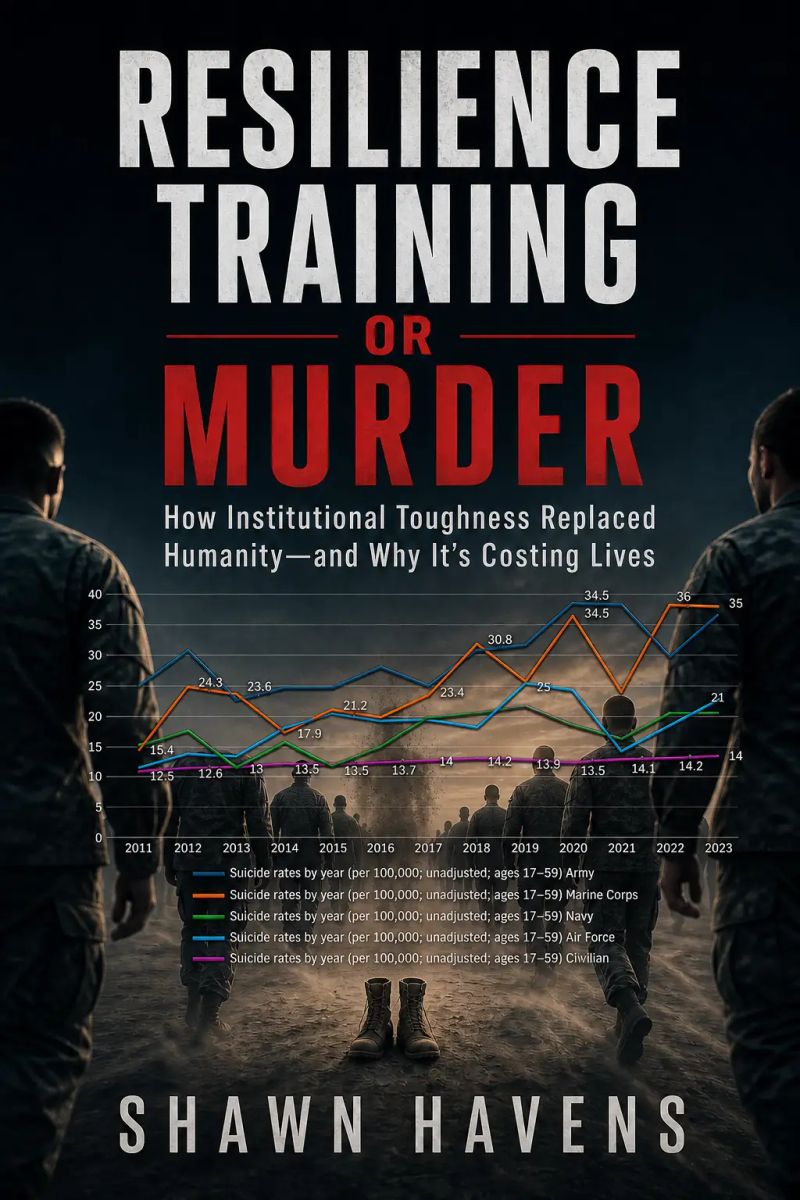
*Resilience Training or Murder* examines the U.S. military suicide crisis through the lens of leadership, culture, policy, and institutional responsibility. Drawing on government investigations, research, military case studies, and survivor testimony, the book challenges the idea that suicide prevention can rely primarily on teaching service members to become more resilient. Instead, it asks whether toxic leadership, excessive operational demands, stigma, institutional betrayal, and failures of accountability are contributing to preventable deaths. The book ultimately argues for a military culture that balances resilience with humanity, psychological safety, responsible leadership, and meaningful organizational reform.
Audiobook details
GenreEducation and Learning, Psychology
Length12 hrs 18 mins
Narrated byListen with 1,000+ voices
FormateBook with Audio
Publish dateFeb 29, 2020
LanguageEnglish
Table of contents
1Introduction
2Part One — The Crisis We Refuse to Name
3Chapter 1: The Deaths That Replaced the War
4Suicide Deaths Overtake Combat Fatalities
5The Post-2004 Turning Point
Show all chaptersShow less
6Not a Simple Wartime PTSD Story
7Military vs. Civilian Suicide Rates: A Stark Comparison
8A Crisis That Demands a Different Explanation
9Chapter 2: The False Comfort of Simple Explanations
10Beyond PTSD and Combat Trauma
11The Social Media & Internet Myth
12Diverging Suicide Trends: Military vs Civilian
13Cultural and Structural Drivers in the Military
14The Perils of Misdiagnosing the Cause
15Chapter 3: When Prevention Becomes Performance
16Compliance Over Culture: The Rise of Mandatory Training
17Timeline: From ACE to CSF – Expansion of Prevention Programs -2009–Present-
182009 – “Ask, Care, Escort” -ACE- Launch
192009 – Comprehensive Soldier Fitness -CSF-
202010–2012 – Continued Program Growth
212013–2018 – ACE Evolves and New Trainings
222019–2021 – Metrics and New Strategies
232022–2023 – “Modernizing” Training and Policy
24The Illusion of Action: Metrics, Briefings, and “Box-Checking”
25Voices from the Ranks: “This Isn’t Helping”
26Conclusion: From Performance Back to Purpose
27Chapter 4 The Rise of Resilience as Doctrine
28Origins of Military Resilience Programs
29Comprehensive Soldier Fitness -CSF- and its Successors
30Comparing Key Programs and Their Philosophies
31Psychological Influences: Positive Psychology and “Learned Optimism”
32Implementation: How Resilience Training Works in Practice
33Efficacy and Critiques of the Resilience Doctrine
34Chapter 5: When Coping Replaces Caring
35Resilience Training – A Quick Fix Since 2009
36Shifting Responsibility from Leaders to Individuals
37“Failure to Cope” vs. Leadership Failures
38Overemphasis on Toughness – Discouraging Help-Seeking
39Toward a Culture of Care and Accountability
40Chapter 6: Emotional Safety vs. Resilience
41Defining Emotional Safety in Hierarchical Organizations
42Resilience: Purpose and Mechanisms
43Differing Purposes and Outcomes
44Comparative Summary: Emotional Safety vs. Resilience
45Real-World Implications When Emotional Safety Is Absent
46Vulnerability in “Tough” Cultures
47Emotional Safety as a Complement to Resilience
48Part III — The Organizational Mechanics of Silence
49Chapter 7: Career Consequences and the Fear Economy
50Introduction: When Honesty Feels Dangerous
More from Shawn Havens

Two Wars, Two SocietiesShawn Havens5h 33m$2.99
Leading Change That LastsShawn Havens6h 33m Only with Ultra

Exerted Fear Theory Shawn Havens16h 2m$2.99 · $0.00

E Pluribus UnumShawn Havens9h 25m$2.99 · $0.00
Interrupted by GraceShawn Havens7h 54m$2.99

Carried By the CrossShawn Havens14h 7m$2.99

A Brief History of IntelligenceMax S. Bennett12h 18m4.6 (6.6K)$29 · $0.00

HomeschooledStefan Merrill Block7h 10m3.6 (18.5K)$28 · $0.00

Parents and Children (Annotated)Charlotte Mason9h 23m4.6 (988)$2 · $0.00

Children Under FireJohn Woodrow Cox10h 17m4.5 (1.6K)$29 · $0.00

The State Must ProvideAdam Harris7h 15m4.5 (775)$24 · $0.00

The Call of the Wild and FreeAinsley Arment9h 7m4.4 (21.2K)$29 · $0.00
The Freelance WayRobert Vlach19h 48m4.5 (528)$40 · $0.00
Race to the BottomLuke Rosiak9h 20m4.5 (600)$29 · $0.00

They Came for the SchoolsMike Hixenbaugh9h 5m4.5 (2.6K)$8 · $0.00

Find Me UnafraidKennedy Odede, Jessica Posner11h 11m4.5 (2.7K)$29 · $0.00

Asking for ItKate Harding8h 55m4.4 (5.3K)$20 · $0.00
Defining Moments in Black HistoryDick Gregory7h 37m4.4 (6K)$26 · $0.00

The Emerald Tablets of Thoth the AtlanteanMaurice Doreal3h 4m4.4 (8.8K)$6 · $0.00

Learning AmericaLuma Mufleh6h 37m4.4 (564)$24 · $0.00

Math-ishJo Boaler7h 21m4.4 (588)$24 · $0.00
It Worked For MeColin Powell7h 42m4.3 (9.8K)$26 · $0.00

Little SoldiersLenora Chu11h 30m4.3 (3.1K)$29 · $0.00

Financial FeministTori Dunlap8h 3m4.2 (22.2K)$8 · $0.00

Grammar-land; Or, Grammar in Fun for the Children of Schoolroom-shireM. L. Nesbitt2h 36m4.4 (487)$1 · $0.00

DarkwaterWilliam Edward Burghardt Du Bois6h 40m4.3 (1.4K)$11 · $0.00

What to Make of a LifeJim Collins13h 31m4.4 (794)$33 · $0.00

Braving the TruthRachel Held Evans11h 31m4.7 (359)$29 · $0.00
Level UpRob Dial7h 42m4.6 (3.3K)$26 · $0.00

As a JewSarah Hurwitz8h 36m4.6 (1.2K)$26 · $0.00

Saint Joan (Annotated)George Bernard Shaw6h 20m4.6 (1.2K)$1.20 · $0.00
Burn the HaystackJennie Young, PhD9h 30m4.6 (543)$29 · $0.00

Woman and the New Race (Annotated)Margaret Sanger6h 30m4.6 (1K)$1.99 · $0.00

Good InsideBecky Kennedy9h 55m4.5 (59.3K)$29 · $0.00

The Mis-Education of the NegroCarter Godwin Woodson5h 4m4.5 (29.4K)$1.20 · $0.00

Du Bois: EssaysW.E.B. Du Bois6h 22m4.6 (1.5K)$1 · $0.00

The North American Indian (Illustrated Edition)Edward S. Curtis, Frederick Webb Hodge5h 59m4.6 (1.4K)$2 · $0.00

Valley of the BirdtailAndrew Stobo Sniderman, Douglas Sanderson10h 1m4.6 (2.4K)$29 · $0.00

Lies My Therapist Told MeGreg E. Gifford9h 3m4.6 (503)$29 · $0.00

Disturbed in Their NestsAlephonsion Deng, Judy A. Bernstein11h 22m4.6 (595)$23 · $0.00
No Name in the StreetJames Baldwin5h4.5 (8.5K)$20 · $0.00

Narrative of the Life of Frederick DouglassFrederick Douglass4h 13m4.5 (309.9K)$1.20 · $0.00

Magic SeasonWade Rouse6h 41m4.6 (855)$24 · $0.00

Consent Laid BareChanel Contos7h 11m4.5 (1.7K)$24 · $0.00

The Big RevealSasha Velour6h 15m4.5 (2.1K)$24 · $0.00

EssaysGeorge Orwell26h 38m4.5 (8.4K)$4 · $0.00
You may also like
BrokenJessica Pryce8h 11m4.2 (564)$26 · $0.00

All the RageDarcy Lockman8h 53m4.2 (3.5K)$29 · $0.00
Live FreeDeVon Franklin8h 33m4.3 (524)$26 · $0.00

Mothers Who Can't LoveSusan Forward, Donna Frazier Glynn8h 28m4.3 (7.1K)$26 · $0.00

How the Light Gets InJoyce Maynard16h 39m4.2 (7.2K)$40 · $0.00
The Proper Care and Feeding of HusbandsDr. Laura Schlessinger2h 21m3.8 (22.6K)$16 · $0.00

Will I Ever Be Free of You?Dr. Karyl McBride PhD6h 45m4.2 (970)$20

The Angel of RomeJess Walter8h 9m4.1 (7.4K)$26 · $0.00

Choice TheoryWilliam Glasser12h 7m4.2 (6.1K)$29 · $0.00

Prisoner of LustJackson S. Kingsley7h 5m$4.10 · $0.00

The Nervous HousewifeAbraham Myerson3h 47m3.6 (30)$1 · $0.00

My Black MotherhoodSandra Igwe6h 59m4.7 (10)$17

Unf*ck Your BoundariesFaith G. Harper PhD2h 48m$15
Dear PrudenceDaniel M. Lavery8h 52m3.9 (596)$29 · $0.00

Icing on the CakeLa Toya Hankins26m$1 · $0.00

UPTON SINCLAIR: 29 Books in One VolumeUpton Sinclair222h 20m$1 · $0.00

Manipulation: A Complete Guide to Navigating Toxic Relationships (Defend Yourself From Insidious Tactics and Learn to Recognize Covert Manipulation)John Smith3h 33m$3.50 · $0.00

This Is Why We Can’t Have Nice ThingsNaomi Wood6h 21m2.8 (1K)$24 · $0.00

Manipulation: A Complete Guide to Navigating Toxic Relationships (Defend Yourself From Insidious Tactics and Learn to Recognize Covert Manipulation)Joshua Urbanski3h 11m$3.50 · $0.00

Surviving InfidelityImad Muratspahic4h 5m$12 · $0.00