


Length6h 32m
About this audiobook
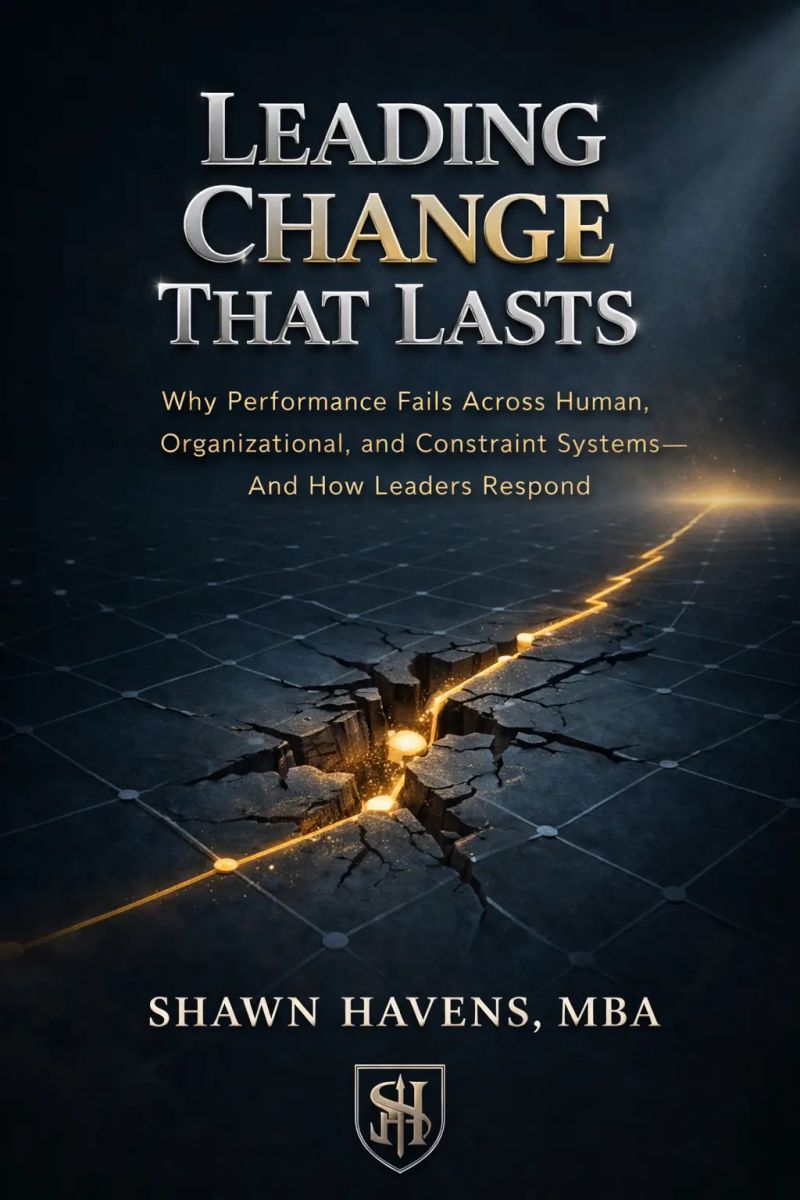
Leading Change That Lasts explores why capable people, strong teams, and well-intentioned organizations still fail to sustain performance and change. It introduces Integrated Constraint-Aware Change Theory (ICACT), a framework that examines three interacting forces: the human system, the organizational system, and external constraints.
The book shows how stress, cognitive load, execution problems, culture, limited visibility, and structural barriers can distort performance even when effort and capability are present. Rather than blaming individuals too quickly, it gives leaders a way to diagnose where failure actually begins and how problems move across systems.
At its core, Leading Change That Lasts is about helping leaders design change for real operating conditions—so improvement does not depend on temporary pressure, heroic effort, or ideal circumstances, but can endure under stress, uncertainty, and everyday organizational demands.
Audiobook details
GenreBusiness and Economics, Self-Help
Length6 hrs 32 mins
Narrated byListen with 1,000+ voices
FormateBook with Audio
Publish dateJun 15, 2020
LanguageEnglish
Table of contents
1Introduction
2PART I — THE HUMAN SYSTEM
3Performance begins before the organization
4Chapter 1 — The Hidden Foundation of Performance
5Performance Is Biologically Constrained Before It Is Organizationally Expressed
Show all chaptersShow less
61.1 The Illusion of Unlimited Human Capacity
71.2 Sleep, Recovery, and Cognitive Degradation
81.3 The Invisible Nature of Cognitive Decline
91.4 Performance Begins Before Work Starts
10Chapter 2 — Cognitive Load and Decision Breakdown
11Why the Mind Fails Before the System Notices
122.1 Attention as a Limited Resource
132.2 Decision Fatigue and Error Rates
142.3 Multitasking and Fragmented Execution
152.4 Cognitive Overload as a System Condition
16Chapter 3 — Stress, Trauma, and Behavioral Adaptation
17Why People Change Before Performance Metrics Do
183.1 Stress Response in Modern Work Environments
193.2 Risk Avoidance and Silence
203.3 Trauma and Long-Term Cognitive Effects
213.4 Behavior Under Pressure
22PART II — THE ORGANIZATIONAL SYSTEM
23Where leaders focus—but often misunderstand
24Chapter 4 — Organizations Are Adaptive Systems
25Why Leaders Misread What They Are Actually Leading
264.1 Systems vs Machines
274.2 Why Linear Change Models Fail
284.3 Adaptive Behavior Under Pressure
294.4 Structural Failure vs Human Failure
30Chapter 5 — Execution: Movement vs Activity
31Why Work Can Look Busy While Going Nowhere
325.1 Execution as Flow
335.2 Bottlenecks and System Friction
345.3 Activity Illusions
355.4 Failure Propagation
36Chapter 6 — Capability: Load, Capacity, Constraint
37Why Ability Alone Does Not Produce Reliable Performance
386.1 Capability vs Talent
396.2 System Capacity Limits
406.3 Overload Behavior Patterns
416.4 Capability Imbalance Across Teams
42Chapter 7 — Culture: Behavior Under Pressure
43Why Culture Is Not What Organizations Say, but What They Reinforce
447.1 Culture as Reinforced Behavior
457.2 Reward Systems and Reality
467.3 Silent Resistance
477.4 Cultural Compensation (Heroics & Risk)
48Chapter 8 — Performance Intelligence
49Why Leaders Need to See the System Before the System Breaks
508.1 Why Dashboards Fail
More from Shawn Havens
Resilience Training or Murder Shawn Havens12h 19m$2.99 · $0.00

Two Wars, Two SocietiesShawn Havens5h 33m$2.99

Exerted Fear Theory Shawn Havens16h 2m$2.99 · $0.00

E Pluribus UnumShawn Havens9h 25m$2.99 · $0.00

Interrupted by GraceShawn Havens7h 54m$2.99

Carried By the CrossShawn Havens14h 7m$2.99
Never Split the DifferenceChris Voss, Tahl Raz8h 7m4.4 (277.7K)$26 · $0.00
The Intelligent Investor Rev Ed.Benjamin Graham17h 48m4.3 (191.5K)$40 · $0.00
The Hard Thing About Hard ThingsBen Horowitz7h 57m4.2 (134.3K)$26 · $0.00
Boundaries for LeadersHenry Cloud7h 36m4.3 (3.6K)$26 · $0.00

The Secret Door to SuccessFlorence Scovel Shinn2h 25m4.5 (2.1K)$1.20 · $0.00

This Is Going to HurtAdam Kay5h 47m4.4 (444.7K)$24 · $0.00

Big TrustShadé Zahrai, Fayçal Sekkouah8h 36m4.6 (406)$26 · $0.00
The Intelligent Investor Third EditionBenjamin Graham, Jason Zweig20h4.4 (156.6K)$46 · $0.00

Bottle of LiesKatherine Eban14h 25m4.4 (12K)$33 · $0.00

The Antiracist Business BookTrudi Lebrón6h 10m4.6 (275)$17 · $0.00

The FormulaJoshua Robinson, Jonathan Clegg10h 41m4.4 (6.9K)$29 · $0.00

Let Them LeadJohn U. Bacon7h 10m4.5 (1.4K)$24 · $0.00

Secrets of the Millionaire MindT. Harv Eker5h 11m4.4 (301.4K)$24 · $0.00

The Person You Mean to BeDolly Chugh9h 6m4.4 (7.2K)$29 · $0.00
BoundlessNick Kostov, Sean McLain9h 17m4.5 (1.1K)$29 · $0.00

Everyday DharmaSuneel Gupta5h 2m4.5 (761)$20 · $0.00

Let's Talk Mutual FundsMonika Halan7h 5m4.4 (2.4K)$16 · $0.00

Secret PowerDwight Lyman Moody3h 7m4.4 (1.4K)$1.20 · $0.00
The Law of Success in Sixteen LessonsNapoleon Hill2h 39m4.4 (17.2K)$2 · $0.00
Barbarians at the GateBryan Burrough, John Helyar3h 3m4.4 (52.7K)$18 · $0.00
Learning to PrayJames Martin13h 24m4.5 (3.4K)$33 · $0.00

The Dangerous Truth about Today’s MarijuanaLaura Stack CSP, MBA9h 57m4.7 (385)$20 · $0.00
The Gospel according to Spiritualism (Translated)Allan Kardec14h 39m4.6 (3.9K)$5.70 · $0.00

Birdie & HarlowTaylor Wolfe7h 50m4.6 (6.5K)$26 · $0.00

CrossroadsKaleb Dahlgren7h 56m4.6 (4.9K)$26 · $0.00

Life on the BridgeKaelynn Partlow5h 40m4.6 (1.1K)$24 · $0.00

Keep Your Love OnDanny Silk9h 4m4.6 (8.1K)$10 · $0.00

The Tao of Joy Every DayDerek Lin10h 24m4.6 (762)$20 · $0.00

UndividedVicky Beeching9h 2m4.6 (1.3K)$29 · $0.00

HE CAN WHO THINKS HE CAN & OTHER BOOKS ON SUCCESSOrison Swett Marden5h 54m4.6 (1.2K)$1.99 · $0.00
Level UpRob Dial7h 42m4.6 (3.3K)$26 · $0.00

Burn the HaystackJennie Young, PhD9h 30m4.6 (543)$29 · $0.00

ACRES OF DIAMONDS: Our Every-day Opportunities (Wisdom & Empowerment Series) (Annotated)Russell Conwell2h 26m4.6 (1K)$2 · $0.00

Good InsideBecky Kennedy9h 55m4.5 (59.3K)$29 · $0.00

The Lost VoiceGreta Morgan8h 30m4.7 (285)$26 · $0.00

Stripped DownBunnie Xo8h 25m4.5 (32.9K)$26 · $0.00

UnthinkableJamie Raskin15h 8m4.5 (9.3K)$8 · $0.00

Wallace D. Wattles Ultimate Collection Wallace D. Wattles16h 53m4.6 (1.3K)$1 · $0.00

Inquire WithinIn-Q2h 18m4.6 (993)$16 · $0.00

Under His WingsEmily Compagno7h 16m4.6 (848)$22 · $0.00
You may also like

THE THEORY OF THE LEISURE CLASS: An Economic Study of American Institutions and a Social Critique of Conspicuous Consumption (Annotated)Thorstein Veblen12h 58m4.4 (1K)$1.99 · $0.00

The World as Will and Idea (Vol. 1 of 3)Arthur Schopenhauer20h 17m4.4 (519)$2.30

An Enquiry Concerning Human UnderstandingDavid Hume5h 59m4.1 (29.2K)$2.30

An Enquiry Concerning Human UnderstandingDavid Hume7h 23m4.1 (24.2K)$1 · $0.00

Democracy and Education An Introduction to the Philosophy of EducationJohn Dewey15h 33m4.1 (4K)$2.30
The Art of Logical Thinking, or, The Laws of ReasoningWilliam Walker Atkinson3h 50m4.0 (287)$2.30

Blackboard DrawingFrederick Whitney25m4.2 (51)$2 · $0.00

Ultimate Customer ServiceMade for Success8h 9m4.2 (46)$20

Business & Economics Collection: Thorstein Veblen Edition (30+ Works in One Volume)Thorstein Veblen91h 26m4.5 (11)$2 · $0.00

Sell to Anyone!Zig Ziglar, Brian Tracy3h 13m4.2 (20)$20

A Book of PrefacesH. L. Mencken7h 33m3.8 (67)$2 · $0.00

Leibniz's New Essays Concerning the Human Understanding: A Critical ExpositionJohn Dewey8h 57m3.9 (24)$1 · $0.00

How to Write a Novel: A Practical Guide to the Art of FictionAnonymous3h 5m3.6 (65)$2 · $0.00
Public Speaking SuperstarMade for Success7h 25m3.6 (72)$30

CEO Communication SkillsMade for Success8h 59m3.8 (28)$20

Why Women BuyDawn Jones3h 54m3.5 (62)$20

The Return-to-Office PlaybookImad Muratspahic4h 6m$13 · $0.00

Profits, Prophets, Coaches, and KingsJared Diamond9h 59m$29 · $0.00

Navigating Towards Professional SuccessEdivaldo Ascaneo34m$6 · $0.00

Mediation in state courtsFlávia Maria Aires Freire Allemão5h 20m$12 · $0.00