
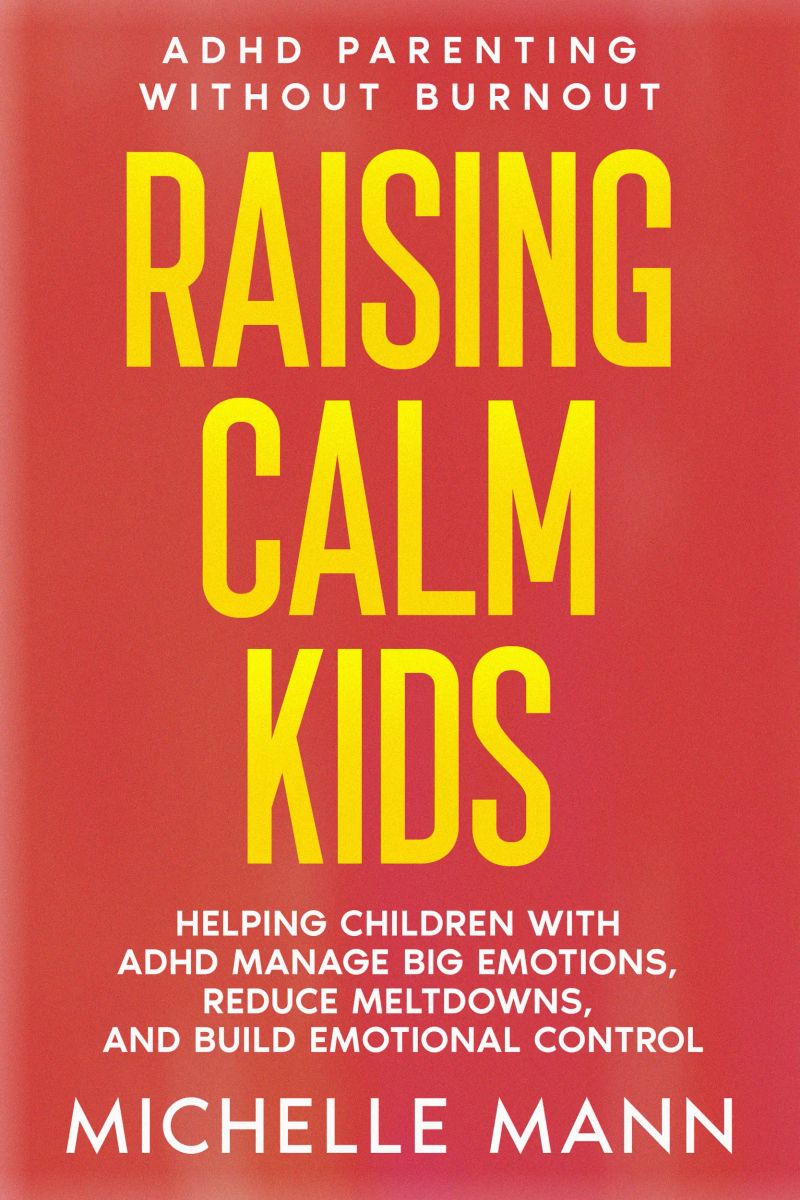
Raising Calm Kids
Helping Children with ADHD Manage Big Emotions, Reduce Meltdowns, And Build Emotional ControlBy Michelle Mann

Length4h 39m
About this audiobook
Are you exhausted by your child's big emotions, constant meltdowns, and the daily struggle to help them find calm? Do you ever feel like traditional discipline simply doesn't work for your child with ADHD, leaving both of you frustrated and overwhelmed? Do you worry about their future, wishing they had the tools to manage their feelings and thrive?
If so, Raising Calm Kids is your essential guide. Author Michelle Mann, a dedicated psychologist and a mother who has personally navigated the complexities of raising a child with ADHD, understands your struggles intimately. She knows firsthand the emotional rollercoaster families face and bridges the gap between clinical expertise and real-world parenting, offering a straight-to-the-point guide that actually works. Imagine a home where you can confidently guide your child through emotional challenges, reducing meltdowns and fostering vital self-management skills.
In this book, you will discover:
- How to demystify the ADHD brain and understand why traditional discipline often backfires
- A simple system to pinpoint your child's unique meltdown triggers and create a personalized "Meltdown Map" to intervene early
- Practical, immediate de-escalation techniques like Time-In and co-regulation to calm emotional storms in the moment
- Powerful strategies to equip your child with essential emotional skills, from naming feelings to building their own "calm kit" of coping strategies
- How to design simple, effective routines for smoother mornings, focused afternoons, and peaceful evenings
- Actionable techniques for mastering transitions, turning potential chaos into predictable calm
- The science behind regulating your own nervous system, allowing you to become your child's most effective calm anchor
- Proven troubleshooting tips to adjust your approach and embrace imperfection on your unique parenting journey
This isn't another generic parenting book filled with abstract theories that don't apply to your family. Michelle Mann's strategies are mom-tested and psychologist-approved, designed for real-world application by busy parents like you. Even if past methods have failed, this straight-to-the-point guide offers adaptable solutions tailored to your child's unique needs, proving that a calmer home is within reach.
If you are ready to transform your home into a haven of peace and empower your child with lasting emotional control, then grab Raising Calm Kids today!
Audiobook details
GenreOther, General Fiction
Length4 hrs 39 mins
Narrated byListen with 1,000+ voices
FormateBook with Audio
Publish dateMar 24, 2026
LanguageEnglish
Table of contents
1Chapter 1 – Why I Wrote This Book: A Psychologist's Personal Journey with ADHD Parenting
2The Diagnosis: When Professional Knowledge Meets Personal Reality
3Bridging Two Worlds: Clinical Expertise and Parenting Challenges
4A Mission to Share: Turning Experience into Empowerment
5Chapter 2 – Understanding the ADHD Brain: Why Your Child Can't Just Calm Down
Show all chaptersShow less
6The ADHD Brain Unplugged: A Parent-Friendly Introduction
7From Reaction to Regulation: Why Discipline Often Backfires
8Seeing Beyond the Behavior: Recognizing Neurological Triggers
9Chapter 3 – Spotting the Spiral: Recognizing Your Child's Warning Signs Before a Meltdown
10Decoding the Signals: Identifying Early Warning Signs
11Creating Your Child's Meltdown Map
12Common Triggers and How to Spot Them
13Chapter 4 – In the Heat of the Moment: Practical De-escalation Techniques That Actually Work
14Understanding the Meltdown Mechanism: Why It's Not Just Misbehavior
15Immediate Intervention: Proven Techniques to Calm the Storm
16Time-In and Co-Regulation: Building Emotional Resilience Together
17Chapter 5 – Teaching Emotional Skills: How to Coach Emotional Control, Not Punish Big Feelings
18Validating Emotions: The Power of Acknowledgment
19Naming the Feeling: Building an Emotional Vocabulary
20Teaching Coping Strategies: Tools for Emotional Control
21Chapter 6 – Building Simple Routines: The Foundation for a Calmer Home
22Morning Magic: Starting the Day Off Right
23Afternoon Alignments: Keeping the Momentum
24Evening Ease: Winding Down for a Restful Night
25Chapter 7 – Mastering Transitions: Strategies for Moving Between Activities Without Meltdowns
26The Power of Preparation: Setting the Stage for Smooth Transitions
27Navigating Emotional Hurdles: Calming Techniques for Transition Times
28Flexibility in Action: Adjusting Plans Without Meltdowns
29Chapter 8 – Parent Regulation First: Taking Care of Your Own Nervous System So You Can Help Your Child
30The Science of Self-Regulation: Why Your Calm Matters
31Quick Wins for Everyday Peace: Simple Self-Care Strategies
32Creating Your Calm: Building a Sustainable Self-Care Routine
33Chapter 9 – When Strategies Aren't Working: Troubleshooting, Adjusting, and Letting Go of Perfection
34Identifying the Roadblocks: What’s Not Working and Why
35Adjusting Your Approach: Tailoring Strategies to Your Child’s Needs
36Embracing Imperfection: Letting Go of the All-or-Nothing Mindset
37Chapter 10 – From Chaos to Calm: Building a Lasting Foundation for Emotional Resilience
38Celebrating Progress: Reflecting on the Journey
39Maintaining Momentum: Sustainable Strategies for the Future
40A Heartfelt Conclusion: Encouragement for the Road Ahead
41Conclusion
Raising Focused KidsMichelle Mann3h 37m$5

Not ‘Him’ Or ‘Her’Supporting My Non-Binary ChildMichelle Mann3h 18m4.4 (13)$10

Journey to ConfidenceMichelle Mann3h 55m$10

Professional ConfidenceMichelle Mann4h 57m$7

The Anxiety AntidoteMichelle Mann2h 44m$5

Rewiring Your BrainMichelle Mann3h 6m$5

Mindfulness and Mental HealthMichelle Mann1h 43m$3

Conquering PhobiasMichelle Mann3h 22m$3

Creating Safe SpacesMichelle Mann3h 55m$5

Courageous ComfortMichelle Mann17h 22m$10

Reignite Your PassionMichelle Mann2h 8m$4

Raising Strong-Willed ToddlersMichelle Mann3h 2m$10
Breaking Free from AnxietyMichelle Mann4h 13m$10

Natural RemediesMichelle Mann4h 29m$5

The Crying BabyMichelle Mann1h 57m$3

Embracing Your Inner ChildMichelle Mann2h 57m$3

A New ChapterMichelle Mann3h 26m$3
How to Set BoundariesMichelle Mann2h 22m$3

How to be CharismaticMichelle Mann3h 3m$3

Mere ChristianityC. S. Lewis7h 7m4.4 (519.7K)$24 · $0.00

Her Daily BreadKate Wood12h 57m4.6 (153)$33 · $0.00

The Holy Bible - 1 SamuelKing James2h 13m4.8 (1.6K)$3 · $0.00

The American Standard Bible — The Gospel of MatthewMatthew3h 56m4.7 (3K)$2 · $0.00

Bad Fat Black GirlSesali Bowen6h 32m4.7 (2.8K)$24 · $0.00

The King James Audio Bible New Testament CompleteChristopher Glyn20h 2m4.7 (2.6K)$12 · $0.00

Faiths CheckbookCharles Spurgeon12h 44m4.7 (3.2K)$11 · $0.00
Ten Things I Wish You Knew About Your Child's Mental HealthDr. Billy Garvey4h 53m4.7 (2.4K)$20 · $0.00

Designing Terry Pratchett’s DiscworldPaul Kidby3h 52m4.7 (343)$20 · $0.00

The Chosen Book OneAmanda Jenkins, Kristen Hendricks, Dallas Jenkins3h 8m4.6 (4.9K)$10 · $0.00

The Lives of BrianBrian Johnson9h 45m4.6 (3.5K)$29 · $0.00

Expository Thoughts on the Gospel of LukeJ.C. Ryle27h 13m4.7 (536)$18 · $0.00

CrossroadsKaleb Dahlgren7h 56m4.6 (4.9K)$26 · $0.00

Across the RiverKent Babb11h 40m4.6 (927)$29 · $0.00
Brain Training for RidersAndrea Monsarrat Waldo5h 56m4.7 (550)$19 · $0.00

My Effin' LifeGeddy Lee17h 11m4.6 (13.1K)$40 · $0.00

Kings and PawnsHoward Bryant10h 9m4.6 (678)$29 · $0.00

The Elementia Chronicles #2: The New OrderSean Fay Wolfe11h 17m4.6 (841)$29 · $0.00

The ActsLuke2h 55m4.6 (19.7K)$12 · $0.00

New Testament - Easy NavigationWorld English Bible19h 35m4.6 (1.3K)$1.30 · $0.00

WhistlerAnn Patchett10h 45m4.6 (4.6K)$29 · $0.00

Demon CopperheadBarbara Kingsolver21h 3m4.5 (949.4K)$46 · $0.00

To Kill a MockingbirdHarper Lee12h 18m4.5 (7.4M)$29 · $0.00

Remarkably Bright CreaturesShelby Van Pelt11h 17m4.4 (1.7M)$29 · $0.00

The Old Man and the Sea (Annotated)Ernest Hemingway4h 27m4.6 (1.4K)$2 · $0.00

White HotIlona Andrews13h 18m4.5 (136.9K)$5 · $0.00

The Ghost by the Billabong (The Matilda Saga, #5)Jackie French14h 58m4.6 (773)$33 · $0.00

Cast in BloodMichelle Sagara16h 35m4.6 (607)$33 · $0.00

The Captain Blood Trilogy (Annotated)Rafael Sabatini29h 20m4.6 (1K)$3 · $0.00

Ship of the Line (Annotated)Cecil Louis Troughton Smith11h 13m4.6 (1K)$2 · $0.00

The George Orwell CollectionGeorge Orwell24h 46m4.5 (14.4K)$12 · $0.00

Time RegainedMarcel Proust15h 38m4.5 (9.2K)$2 · $0.00

Driving ForceElle James4h 58m4.6 (407)$20 · $0.00

When God Calls the HeartBrian Bird, Michelle Cox3h 24m4.6 (439)$10 · $0.00

Five Little IndiansMichelle Good10h 34m4.5 (64.5K)$29 · $0.00

Lolth's WarriorR. A. Salvatore13h 20m4.6 (2.4K)$33 · $0.00

The Things We Cannot SayKelly Rimmer13h 48m4.5 (359.1K)$33 · $0.00

The Love Songs of W.E.B. Du BoisHonoree Fanonne Jeffers29h 49m4.5 (58K)$8 · $0.00

Going PostalTerry Pratchett11h 23m4.5 (189.9K)$29 · $0.00

Glen AffricKarine Giebel22h 51m4.5 (3.2K)$46 · $0.00