
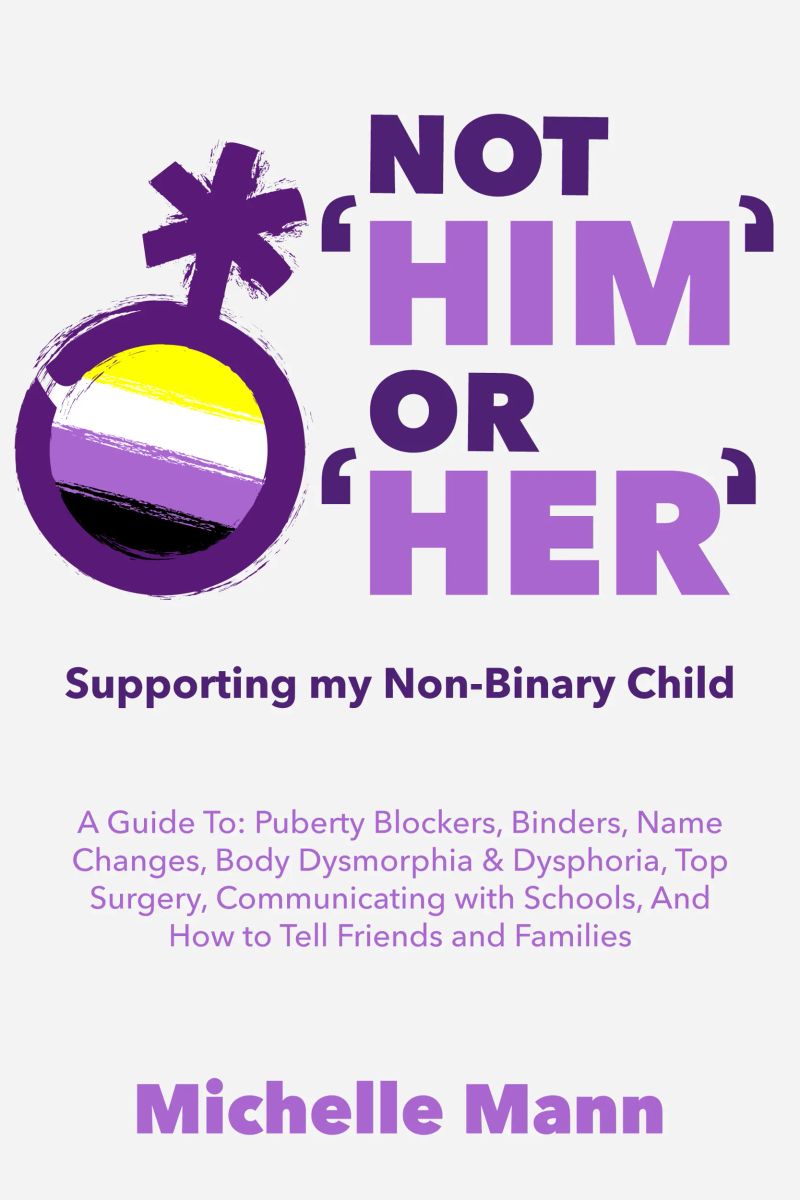
Not ‘Him’ Or ‘Her’Supporting My Non-Binary Child
A Guide to Puberty Blockers, Dead Names, Binders, Body Dysmorphia and Dysphoria, Top Surgery, and Telling Friends, Families, and SchoolsBy Michelle Mann


Length3h 17m
About this audiobook
Learn the best ways to support your non-binary child.
Do you have a non-binary child and want to learn about what your child is going through? Are you trying to be supportive but don’t know where to start?
This book is the perfect guide to help you learn every aspect of transitioning, what it means to be a non-binary child, and being a supportive parent. In this book, you will:
Understand what it means to be a non-binary child and how to support your child’s transition.
Learn how to ease yourself into using your child’s new name and pronouns and how to change their name in the legal system.
Discover the adverse effects of body dysphoria and dysmorphia that your child may experience.
Discover how binders are used and how to shop for your non-binary child.
Understand all aspects of puberty blockers and top surgeries and their side effects.
Learn how to tell the world about your non-binary child and explain to them about your child’s journey.
Discover all the non-binary terminologies and how to differentiate between them.
Find out all the information you need to understand your non-binary child’s transition, so get your copy right now to get started.
Audiobook details
Rating★★★★ 4.4 (13)
Includes Goodreads
GenreBiography and Memoir, History
Length3 hrs 17 mins
Narrated byListen with 1,000+ voices
FormateBook with Audio
Publish dateJan 28, 2025
LanguageEnglish
Table of contents
1Chapter 1: A Parent’s Intro to Non-Binary
2What Is Non-Binary?
3What It Means for the Child to Define Themselves as Non-Binary
4How to Show Your Child Support During the Transition
5How to Choose the Right Therapist
Show all chaptersShow less
6What Happens If They Don’t Get the Right Support?
7Non-Binary Identity Red Flags for Parents
8Chapter 2: Name and Identity
9How to Ease into Using New Pronouns
10Things to Consider
11How to Talk to Others about It
12How to Change Your Child’s Name Legally
13Chapter 3: Body Dysphoria and Dysmorphia
14Body Dysmorphia
15Gender Dysphoria
16Difference Between Dysphoria and Dysmorphia
17What Challenges Affect the Ability to Live Normally?
18Chapter 4: Binders and Clothing
19Chest Binding and Its Importance
20How to Deal as a Parent
21Chapter 5: Puberty Blockers
22Types of Puberty Blockers
23Benefits and Future Additional Treatment
24Chapter 6: Top Surgery
25The Benefits of Top Surgery
26Risks Involved with Top Surgery
27Additional Factors to Consider
28Chapter 7: Telling the World
29Expressing Their Identity
30Importance of Gender Pronouns
31Informing Friends and Family
32Chapter 8: Non-Binary Terms: Understanding Non-Binary Identity
33Conclusion
34References

Raising Calm KidsMichelle Mann4h 40m$5
Raising Focused KidsMichelle Mann3h 37m$5
Journey to ConfidenceMichelle Mann3h 55m$10

Professional ConfidenceMichelle Mann4h 57m$7

The Anxiety AntidoteMichelle Mann2h 44m$5

Rewiring Your BrainMichelle Mann3h 6m$5

Mindfulness and Mental HealthMichelle Mann1h 43m$3

Conquering PhobiasMichelle Mann3h 22m$3

Creating Safe SpacesMichelle Mann3h 55m$5

Courageous ComfortMichelle Mann17h 22m$10

Reignite Your PassionMichelle Mann2h 8m$4

Raising Strong-Willed ToddlersMichelle Mann3h 2m$10
Breaking Free from AnxietyMichelle Mann4h 13m$10

Natural RemediesMichelle Mann4h 29m$5

The Crying BabyMichelle Mann1h 57m$3

Embracing Your Inner ChildMichelle Mann2h 57m$3

A New ChapterMichelle Mann3h 26m$3
How to Set BoundariesMichelle Mann2h 22m$3

How to be CharismaticMichelle Mann3h 3m$3

Invisible StormJason Kander6h 48m4.7 (3.2K)$24 · $0.00

Forever BoyKate Swenson9h 27m4.7 (5K)$29 · $0.00

You Are Worth ItKyle Carpenter, Don Yaeger8h 53m4.7 (4.8K)$29 · $0.00

The Happiest Man on EarthEddie Jaku3h 48m4.6 (178K)$7 · $0.00

MotherlandJulia Ioffe17h 52m4.7 (2.5K)$40 · $0.00

Evidence Not SeenDarlene Deibler Rose11h 11m4.6 (11.9K)$29 · $0.00

Where Cowards Go to DieBenjamin Sledge8h 42m4.7 (351)$20 · $0.00

Will You Love Me?Cathy Glass9h 5m4.6 (9.3K)$29 · $0.00

Designing Terry Pratchett’s DiscworldPaul Kidby3h 52m4.7 (343)$20 · $0.00

HostageEli Sharabi5h 25m4.6 (10.8K)$24 · $0.00

Finding MeViola Davis9h 15m4.6 (256.4K)$29 · $0.00

The Dangerous Truth about Today’s MarijuanaLaura Stack CSP, MBA9h 57m4.7 (384)$20 · $0.00

Birdie & HarlowTaylor Wolfe7h 50m4.6 (6.5K)$26 · $0.00

The Lives of BrianBrian Johnson9h 45m4.6 (3.5K)$29 · $0.00

I Am The StormJanice Dean9h4.6 (1.5K)$8 · $0.00

Black History CollectionFrederick Douglass, Harriet Ann Jacobs, Booker T. Washington, W.E.B. Du Bois27h 9m4.6 (2.6K)$18 · $0.00

Just as I AmCicely Tyson16h 8m4.6 (99K)$33 · $0.00

Unbroken Bonds of BattleJohnny Joey Jones8h 31m4.6 (2.6K)$8 · $0.00

The Daughter of AuschwitzTova Friedman, Malcolm Brabant7h 54m4.6 (16.7K)$26 · $0.00

My Bondage and My Freedom (Annotated)Frederick Douglass15h 30m4.6 (2.4K)$2 · $0.00

A Brief History of IntelligenceMax S. Bennett12h 18m4.6 (6.6K)$29 · $0.00

Ghosts of HiroshimaCharles Pellegrino8h 59m4.5 (877)$23

We Crossed a Bridge and It TrembledWendy Pearlman6h4.6 (5.2K)$24 · $0.00
Unbroken Bonds of BattleJohnny Joey Jones8h 31m4.6 (2.6K)$8 · $0.00
The Daughter of AuschwitzTova Friedman, Malcolm Brabant7h 54m4.6 (16.7K)$26 · $0.00

Lily's PromiseLily Ebert, Dov Forman8h 54m4.6 (16.1K)$29 · $0.00

On Democracies and Death CultsDouglas Murray10h 38m4.6 (6.5K)$29 · $0.00

Across the RiverKent Babb11h 40m4.6 (927)$29 · $0.00

Balcony Over Jerusalem: A Middle East Memoir - Israel, Palestine and BeyondJohn Lyons12h 37m4.6 (1.4K)$33 · $0.00

BeyondStephen Walker15h 39m4.6 (3.2K)$33 · $0.00

Kings and PawnsHoward Bryant10h 9m4.6 (678)$29 · $0.00

No EscapeNury Turkel9h 30m4.6 (809)$28 · $0.00

Jubal Stone: U.S. Marshal: Blood Trail To Hell: A Western Adventure NovelCasey Nash3h 42m4.6 (3.2K)$18 · $0.00

Fall and RiseMitchell Zuckoff17h 23m4.6 (9.8K)$40 · $0.00

The SurvivorJosef Lewkowicz, Michael Calvin9h 22m4.6 (2.5K)$29 · $0.00

Always FaithfulThomas Schueman, Zainullah Zaki12h 12m4.6 (977)$29 · $0.00

The State of Society in France Before the Revolution of 1789 (Annotated)Alexis de Tocqueville17h 25m4.6 (1.2K)$2 · $0.00

All the Gallant MenDonald Stratton, Ken Gire5h 55m4.6 (11.8K)$24 · $0.00

Medgar and MyrlieJoy-Ann Reid10h 52m4.5 (27.8K)$29 · $0.00

The History of the Peloponnesian War (Annotated)Thucydides24h 3m4.6 (1.1K)$2 · $0.00
You may also like

Teach Your Children WellMadeline Levine10h 57m4.0 (1.8K)$29 · $0.00
The New RulebookDr Chris Cheers3h 44m4.2 (399)$25 · $0.00

When Chickenheads Come Home to RoostJoan Morgan5h 32m4.2 (3.9K)$20

WannabeAisha Harris7h 38m3.9 (2K)$26 · $0.00

Raising RylandHillary Whittington7h 7m4.3 (2.1K)$24 · $0.00

The Dance of AngerHarriet Lerner2h 58m4.3 (71K)$18 · $0.00

Man EnoughJustin Baldoni12h 37m4.3 (10.8K)$33 · $0.00
Being the ChangeSara K. Ahmed5h 27m4.5 (1.4K)$20

The Blessing of a Skinned KneeWendy Mogel PhD8h 17m4.4 (7.2K)$17
The Confidence CodeKatty Kay, Claire Shipman6h 45m3.9 (23.2K)$24 · $0.00

Radical KindnessAngela Santomero3h 23m4.2 (1.3K)$18 · $0.00

You Are Here: Connecting FlightsEllen Oh5h 40m4.3 (3K)$24 · $0.00

Ramona Quimby, Age 8Beverly Cleary2h 7m4.3 (92.9K)$16 · $0.00

Book GirlSarah Clarkson8h 24m4.2 (4.5K)$20 · $0.00

The Hidden Power of F*cking UpThe Try Guys, Keith Habersberger, Zach Kornfeld, Eugene Lee Yang, Ned Fulmer8h 56m4.2 (9K)$29 · $0.00

The Sex BookLeeza Mangaldas6h 34m4.3 (657)$18 · $0.00
Big Kids, Bigger FeelingsAlyssa Blask Campbell, Rachel Stuart Lounder9h 29m4.2 (629)$29 · $0.00
Ready or NotMadeline Levine7h 24m4.2 (455)$24 · $0.00

Boys Will Be HumanJustin Baldoni7h4.3 (1K)$24 · $0.00
Thinking DifferentlyDavid Flink6h 39m4.3 (353)$24 · $0.00