
Audio only
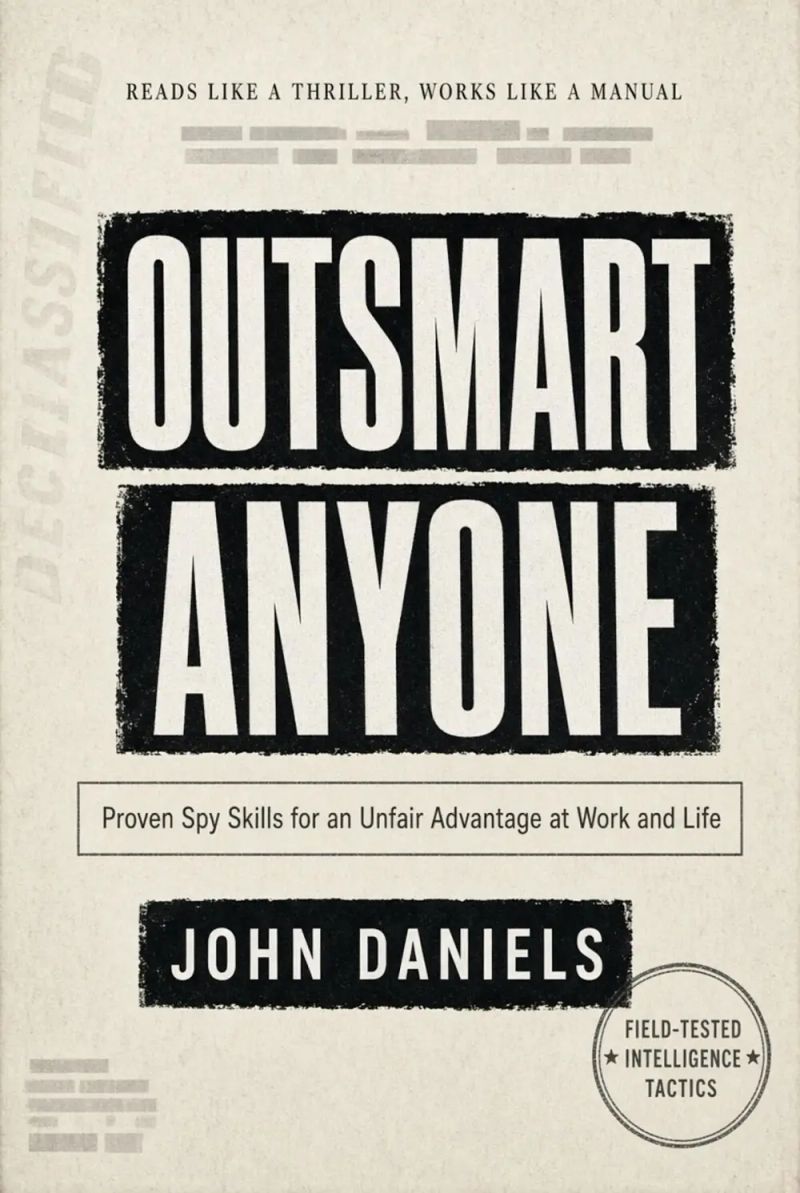
Outsmart Anyone
Proven Spy Skills for an Unfair Advantage at Work and LifeBy John Daniels


Length2h 29m
About this audiobook
What if the biggest advantage in work and life isn't working harder, but thinking like a trained intelligence officer?
In a world flooded with information, noise, and constant distraction, success belongs to the person who can filter what matters, read what isn't said, and act before anyone else does. Outsmart Anyone reveals the field-tested spy skills real intelligence operatives use to turn chaos into clarity, spot deception before it costs you, and build trust and influence that actually lasts — no gadgets, no fiction, no fluff.
Drawing on real, documented case studies — from the FBI mole who operated undetected for over two decades, to the interrogator who located a top terrorist through patient questioning rather than pressure, to the CIA's own declassified training on reading people, detecting lies, and building trust — this book translates real intelligence tradecraft into practical tools anyone can use.
Inside, you'll learn how to:
Read people accurately using the same behavioral analysis techniques the FBI and CIA use to detect deception and hidden motives
Turn information overload into clear, confident decisions using an analyst's proven filtering system
Ask the right questions to get real answers, using elicitation techniques that get people to volunteer the truth
Build trust and influence without manipulation, using the same relationship-building methods used to manage high-stakes sources
Navigate office politics, negotiations, and workplace relationships with a genuine strategic edge
Spot when you're being manipulated, and protect your own information and reputation
Think three steps ahead in any negotiation, meeting, or high-stakes conversation
Whether you're leading a team, closing a deal, networking, interviewing, or simply trying to stop being blindsided by people and situations you should have seen coming, this book gives you a repeatable system for critical thinking, emotional intelligence, persuasion, and strategic advantage — the same skills real intelligence professionals train for years to master.
Stop reacting. Start operating three steps ahead.
Perfect for readers of Spy the Lie, Never Split the Difference, The Like Switch, Influence, and How to Read People — and for anyone searching for practical body language, deception detection, negotiation tactics, critical thinking skills, and emotional intelligence techniques that actually work in the real world.
Audiobook details
GenreTrue Crime, Biography and Memoir, Politics and Government
Length2 hrs 29 mins
Narrated byListen with 1,000+ voices
FormateBook with Audio
Publish dateSep 15, 2026
LanguageEnglish
Table of contents
1Introduction
2Introduction: Think Like an Operative 8
3Part One: Collection — Seeing What Others Miss 12
4Chapter 1 — The Discipline of Observation 13
51.1 Training Your Eyes to Notice Before Your Mind Judges 13
Show all chaptersShow less
61.2 Baseline First: Knowing "Normal" Before You Can Spot "Off” 14
71.3 The Details Everyone Else Filters Out 15
8Chapter 2 — Reading People Without Being Told Anything 17
92.1 Microexpressions and the Seven-Second Truth Window 17
102.2 Body Language, Baseline Shifts, and Tells That Actually Mean Something 18
112.3 Listening for What Isn't Said 18
12Chapter 3 — Turning Noise Into Signal 20
133.1 The Information Overload Problem — and the Operative's Filter 20
143.2 Separating Fact, Inference, and Assumption 21
153.3 Building a Personal Intelligence Picture Before You Decide 21
16Part Two: Analysis — Thinking Three Steps Ahead 23
17Chapter 4 — Spotting Deception and Hidden Motives 24
184.1 The Anatomy of a Lie: Verbal and Behavioral Clusters 24
194.2 Follow the Incentive: Why Motive Explains More Than Words 25
204.3 Testing the Story: Questions Liars Can't Answer Smoothly 25
21Chapter 5 — Strategic Questioning 27
225.1 The Difference Between Interrogation and Elicitation 27
235.2 Open Loops: Getting People to Volunteer the Truth 28
245.3 The Follow-Up That Cracks the Real Answer 28
25Chapter 6 — Thinking in Scenarios, Not Certainties 30
266.1 The problem with a prediction 30
276.2 A short framework worth memorizing 30
286.3 Red-Teaming Your Own Assumptions 31
296.4 Planning three moves ahead 31
30Part Three: Tradecraft — Building Influence and Trust 33
31Chapter 7 — The Recruitment Mindset 34
327.1 What case officers actually look for before they trust anyone 34
337.2 MICE and beyond: what really motivates people 34
347.3 Building rapport that doesn't feel engineered 35
35Chapter 8 — Influence Without Manipulation 36
368.1 The Line Between Persuasion and Deception 36
378.2 Mirroring, Pacing, and Earning the Room 36
388.3 How to Be Remembered as Trustworthy in Thirty Seconds 37
39Chapter 9 — Managing High-Stakes Relationships 38
409.1 The handler's actual playbook 38
419.2 Reading loyalty, leverage, and risk 38
429.3 When to walk away 39
43Part Four: Operations — Applying Spy Skills to Work and Life 40
44Chapter 10 — Navigating Office Politics Like a Professional 41
4510.1 Mapping the Real Power Structure vs. the Org Chart 41
4610.2 Identifying Allies, Gatekeepers, and Threats Early 41
4710.3 Operating Without Becoming a Target Yourself 42
48Chapter 11 — Negotiating With an Intelligence Edge 43
4911.1 Preparing the way operatives prepare for a meet 43
5011.2 Reading leverage in real time 43
More from John Daniels

How to Escape from PrisonPaul Wood10h 29m4.5 (653)$29 · $0.00

Killer TriggersJoe Kenda8h 31m4.4 (6K)$20 · $0.00
BoundlessNick Kostov, Sean McLain9h 17m4.5 (1.1K)$29 · $0.00
Deadly ForceLawrence O'Donnell17h 18m4.5 (342)$40 · $0.00

Walking the BowlChris Lockhart, Daniel Mulilo Chama9h 7m4.4 (1.5K)$29 · $0.00

PapillonHenri Charriere18h 19m4.3 (90.2K)$40 · $0.00
The SuspectKent Alexander, Kevin Salwen14h 12m4.4 (3K)$23 · $0.00

The Cause of DeathCynric Temple-Camp8h 59m4.4 (1.4K)$29 · $0.00

GanglandJared Savage9h 21m4.4 (1.4K)$29 · $0.00
Riding with EvilKen Croke, Dave Wedge9h 42m4.3 (3.4K)$29 · $0.00
The Two FBIsNicole Parker10h 8m4.4 (499)$29 · $0.00
I Catch KillersGary Jubelin15h 32m4.3 (6.6K)$33 · $0.00

The Redemption Of Bobby LoveBobby Love, Cheryl Love9h 13m4.4 (956)$29 · $0.00

The Life We ChoseMatt Birkbeck8h 57m4.4 (1K)$29 · $0.00

The Truth About AaronJonathan Hernandez5h 15m4.3 (2.5K)$24 · $0.00

No Ordinary BirdArtis Henderson6h 23m4.4 (597)$24 · $0.00

I'll Be Gone in the DarkMichelle McNamara10h 7m4.3 (302.5K)$29 · $0.00

Beyond the Body FarmBill Bass, Jon Jefferson6h 17m4.3 (10.2K)$24 · $0.00
The Killer Across the TableJohn E. Douglas, Mark Olshaker11h 7m4.3 (37.5K)$8 · $0.00

Inside the CartelMartin Suarez, Ian Frisch10h 50m4.4 (583)$29 · $0.00

Matters of the HeartJacinta Nampijinpa Price9h 35m4.8 (359)$29 · $0.00
The StepsSylvester Stallone9h 4m4.8 (635)$29 · $0.00
How to Test Negative for StupidJohn Kennedy8h 13m4.7 (9.7K)$28 · $0.00

Bad Fat Black GirlSesali Bowen6h 32m4.7 (2.8K)$24 · $0.00

Send MeMarty Skovlund, Joe Kent8h 10m4.7 (1.6K)$26 · $0.00

John Muir: The Story of My Boyhood and Youth & Letters to a Friend (Annotated)John Muir10h 13m4.7 (1.1K)$1.99 · $0.00

Invisible StormJason Kander6h 48m4.7 (3.2K)$24 · $0.00

Forever BoyKate Swenson9h 27m4.7 (5K)$29 · $0.00

You Are Worth ItKyle Carpenter, Don Yaeger8h 53m4.7 (4.8K)$29 · $0.00

The Happiest Man on EarthEddie Jaku3h 48m4.6 (178K)$7 · $0.00

MotherlandJulia Ioffe17h 52m4.7 (2.5K)$40 · $0.00

Evidence Not SeenDarlene Deibler Rose11h 11m4.6 (11.9K)$29 · $0.00

Where Cowards Go to DieBenjamin Sledge8h 42m4.7 (351)$20 · $0.00

Will You Love Me?Cathy Glass9h 5m4.6 (9.3K)$29 · $0.00

Designing Terry Pratchett’s DiscworldPaul Kidby3h 52m4.7 (343)$20 · $0.00

HostageEli Sharabi5h 25m4.6 (10.8K)$24 · $0.00

Finding MeViola Davis9h 15m4.6 (256.4K)$29 · $0.00

The Dangerous Truth about Today’s MarijuanaLaura Stack CSP, MBA9h 57m4.7 (385)$20 · $0.00

Birdie & HarlowTaylor Wolfe7h 50m4.6 (6.5K)$26 · $0.00
The Lives of BrianBrian Johnson9h 45m4.6 (3.5K)$29 · $0.00
How to Test Negative for StupidJohn Kennedy8h 13m4.7 (9.7K)$28 · $0.00

Black AF HistoryMichael Harriot15h 43m4.7 (14.6K)$33 · $0.00

The Gulag Archipelago Volume 3Aleksandr I. Solzhenitsyn21h 56m4.7 (8.9K)$46 · $0.00
MotherlandJulia Ioffe17h 52m4.7 (2.5K)$40 · $0.00
HostageEli Sharabi5h 25m4.6 (10.8K)$24 · $0.00

KrantikariSanjeev Sanyal11h 44m4.6 (1.3K)$16 · $0.00

Unbroken Bonds of BattleJohnny Joey Jones8h 31m4.6 (2.6K)$8 · $0.00
On Democracies and Death CultsDouglas Murray10h 38m4.6 (6.5K)$29 · $0.00

Balcony Over Jerusalem: A Middle East Memoir - Israel, Palestine and BeyondJohn Lyons12h 37m4.6 (1.4K)$33 · $0.00
RiggedMollie Hemingway12h 48m4.6 (4.2K)$23 · $0.00

SledgehammerDavid Friedman8h 21m4.7 (589)$26 · $0.00
Citizenship in a Republic (Annotated)Theodore Roosevelt2h 44m4.6 (1.4K)$2 · $0.00

No EscapeNury Turkel9h 30m4.6 (809)$28 · $0.00

Always FaithfulThomas Schueman, Zainullah Zaki12h 12m4.6 (977)$29 · $0.00
UnthinkableJamie Raskin15h 8m4.5 (9.3K)$8 · $0.00

My Fourth Time, We DrownedSally Hayden13h 59m4.6 (2.9K)$23 · $0.00

A Revolution of Common SenseScott Jennings9h 29m4.6 (528)$29 · $0.00
Statement From the Dock at the Rivonia TrialNelson Mandela2h 18m4.6 (1.3K)$1 · $0.00

Lessons from the EdgeMarie Yovanovitch17h 11m4.5 (5.9K)$40 · $0.00

To Rescue the American SpiritBret Baier10h 12m4.5 (2.7K)$8 · $0.00
You may also like
Human Intelligence Collector OperationsDepartment of the Army Headquarters18h4.3 (268)$2 · $0.00

The Submarine PlansAgatha Christie29m3.6 (1.2K)$2 · $0.00
Human Intelligence Collector OperationsDepartment of the Army Headquarters16h 13m4.1 (269)$2 · $0.00
You Can't Lie to MeJanine Driver9h 20m3.9 (1.8K)$29 · $0.00
The Kidnapped Prime MinisterAgatha Christie42m3.9 (2.4K)$9 · $0.00

The Kidnapped Prime MinisterAgatha Christie40m3.9 (2.7K)$2 · $0.00

The Purloined LetterEdgar Allan Poe50m3.9 (17.6K)$1

The Adventure of the Second StainArthur Conan Doyle52m3.7 (1.3K)$2 · $0.00

Ashenden Or the British AgentSomerset Maugham9h 29m4.0 (5.9K)$2.30

Human Intelligence Collector OperationsDepartment of the Army Headquarters17h 33m$1 · $0.00
Control the ConversationJames O. Pyle, Maryann Karinch4h 28m3.6 (103)$17 · $0.00
The Report on Unidentified Flying Objects (Annotated)Edward J. Ruppelt11h 49m3.6 (59)$1.99 · $0.00
The Civilian's Guide to CIA Tactics, Intelligence Skills, and TechniquesJohn Daniels11h 16m$11.50 · $0.00
The Official CIA interrogation and manipulation ManualCentral Intelligence Agency4h 29m3.9 (381)$12 · $0.00
Behind Enemy Lines: 40 Spy ThrillersJohn Buchan, Arthur Conan Doyle, James Fenimore Cooper, E. Phillips Oppenheim, Joseph Conrad, Harry Leon Wilson, Natalie Sumner Lincoln, Warwick Deeping, J. E. Collins, B. K. Benson, Frederic Arnold Kummer, Melville Davisson Post, Randall Parrish, Talbot Mundy, Harold MacGrath, Valentine Williams, William Le Queux, Fred M. White, Richard Harding Davis, Robert W. Chambers, T. C. Harbaugh, Charles James Lever, Dorothea Conyers, Baroness Orczy, Edgar Wallace, Allen Upward, Harry Hazelton, J. Storer Clouston, Frank L. Packard, Frederick Whittaker327h 43m$1.99

The Forced Crime; or, Nick Carter's Brazen ClewNick Carter3h 57m$2.30

Tingling Treats for Halloween: Detective Yarns, Supernatural Mysteries & Ghost StoriesMark Twain, Robert Louis Stevenson, Edgar Allan Poe, Jack London, Théophile Gautier, Arthur Conan Doyle, Ralph Adams Cram, Guy de Maupassant, Thomas Hardy, William Archer, Daniel Defoe, Cleveland Moffett, Rudyard Kipling, Ambrose Bierce, Frederick Marryat, Ellis Parker Butler, Nathaniel Hawthorne, Wilkie Collins, Thomas W. Hanshew, Erckmann-Chatrian, Mary E. Hanshew, Leopold Kompert, Chester Bailey Fernald, Florence Marryat, Vincent O'Sullivan, E. F. Benson, M. R. James, Arthur B. Reeve, E. T. A. Hoffmann, Anton Chekhov, Margaret Oliphant, A. T. Quiller-Couch, Amelia B. Edwards, Anna Katherine Green, Fitz-James O'Brien, Katherine Rickford, Pliny the Younger, Helena Blavatsky, Villiers de l'Isle Adam, William F. Harvey, Fiona Macleod, William T. Stead, Gambier Bolton, Andrew Jackson Davis, Nizida, Walter F. Prince, Sir Robert Anderson, Lord Edward Bulwer-Lytton45h 41m$1 · $0.00

Havana SyndromeRobert W. Baloh, Robert E. Bartholomew9h 3m3.1 (56)$20
The Conspiracy Behind the Murder of Martin Luther King, Jr.Various Authors8h 1m4.0 (54)$1.99 · $0.00
CIA UFO InvestigationsMichael Harrington1h 31m$5.70 · $0.00