
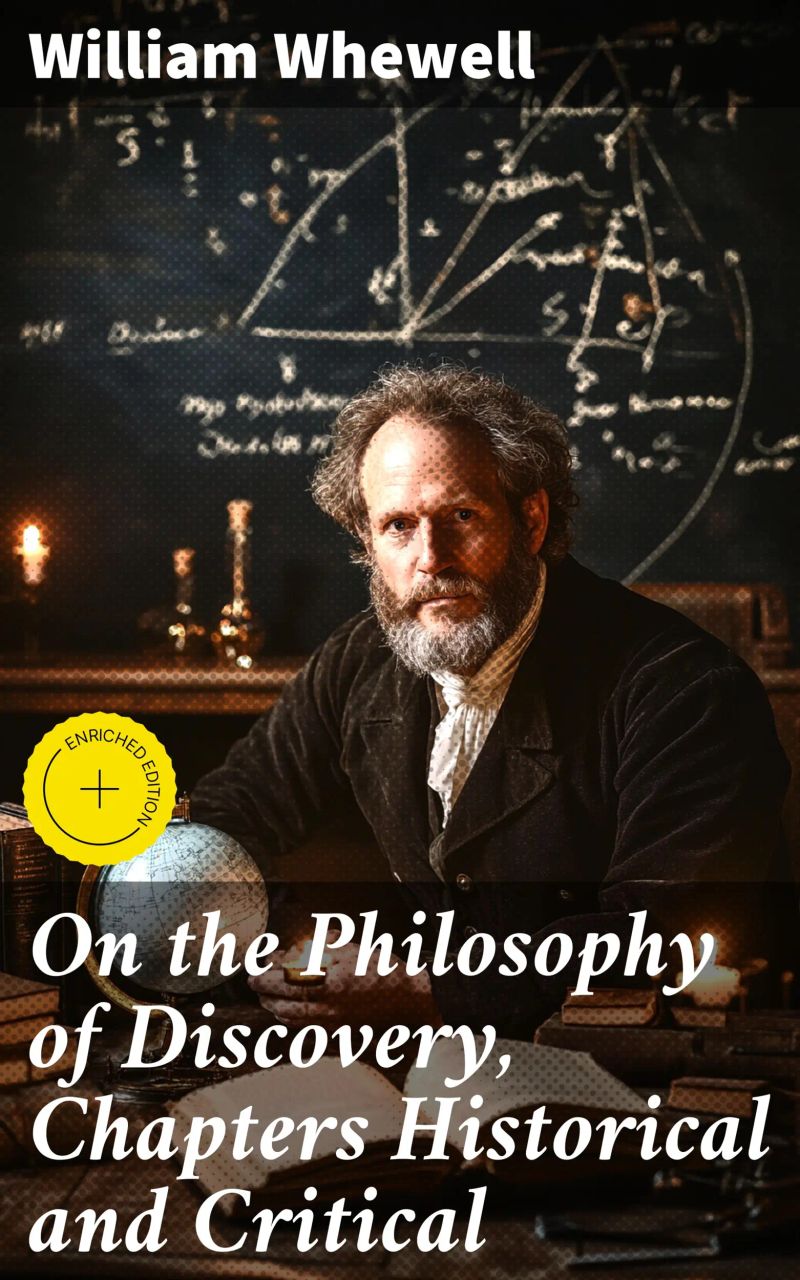
On the Philosophy of Discovery, Chapters Historical and Critical
Enriched edition. Uncovering the Essence of Scientific BreakthroughsBy William Whewell


Length21h 23m
About this audiobook
William Whewell's "On the Philosophy of Discovery, Chapters Historical and Critical" delves into the intricate relationship between scientific advancement and philosophical inquiry. Employing a rigorous yet accessible literary style, Whewell intertwines historical analysis with critical examination, presenting a comprehensive overview of the scientific method and its evolution. The book situates itself within the broader context of 19th-century epistemology, addressing the essential questions surrounding the nature of discovery and the processes that underpin scientific thought. As a polymath and a significant figure in philosophy of science, Whewell's background as an educator and a scientist informs his thoughtful exploration in this work. Straddling the line between philosophy and practical science, Whewell sought to bridge the gap between empirical observation and theoretical reasoning. His fervent advocacy for the systematic study of scientific principles demonstrates a commitment to enhancing the understanding of how discoveries are made, reflecting both his intellectual rigor and the historical climate of the scientific revolution. Readers interested in the philosophy of science or the history of scientific thought will find Whewell's exploration both enlightening and essential. This book is a compelling invitation to ponder the very foundations of discovery itself and is a must-read for anyone seeking to understand the principles that govern scientific inquiry.
In this enriched edition, we have carefully created added value for your reading experience:
- A succinct Introduction situates the work's timeless appeal and themes.
- The Synopsis outlines the central plot, highlighting key developments without spoiling critical twists.
- A detailed Historical Context immerses you in the era's events and influences that shaped the writing.
- A thorough Analysis dissects symbols, motifs, and character arcs to unearth underlying meanings.
- Reflection questions prompt you to engage personally with the work's messages, connecting them to modern life.
- Hand‐picked Memorable Quotes shine a spotlight on moments of literary brilliance.
- Interactive footnotes clarify unusual references, historical allusions, and archaic phrases for an effortless, more informed read.
Audiobook details
GenrePhilosophy
Length21 hrs 23 mins
Narrated byListen with 1,000+ voices
FormateBook with Audio
Publish dateNov 27, 2019
LanguageEnglish
Table of contents
1Introduction
2Introduction
3Synopsis
4Historical Context
5PREFACE
Show all chaptersShow less
6CHAPTER I. INTRODUCTION.
7CHAPTER II. Plato.
8CHAPTER III. Additional Remarks on Plato.
9CHAPTER IV. Aristotle.
10CHAPTER V. Additional Remarks on Aristotle.
11CHAPTER VI. The Later Greeks.
12CHAPTER VII. The Romans.
13CHAPTER VIII. Arabian Philosophers.
14CHAPTER IX. The Schoolmen of the Middle Ages.
15CHAPTER X. The Innovators of the Middle Ages.
16CHAPTER XI. The Innovators of the Middle Ages—continued.
17CHAPTER XII. The Revival of Platonism.
18CHAPTER XIII. The Theoretical Reformers of Science.
19CHAPTER XIV. The Practical Reformers of Science.
20CHAPTER XV. Francis Bacon.
21CHAPTER XVI. Additional Remarks on Francis Bacon.
22CHAPTER XVII. From Bacon to Newton.
23CHAPTER XVIII. Newton.
24CHAPTER XIX. Locke and his French Followers.
25CHAPTER XX. The Reaction against the Sensational School.
26CHAPTER XXI. Further Advance of the Sensational School. M. Auguste Comte.
27CHAPTER XXII. Mr. Mill's Logic .
28CHAPTER XXIII. Political Economy as an Inductive Science.
29CHAPTER XXIV. Modern German Philosophy .
30CHAPTER XXV. The Fundamental Antithesis as it exists in the Moral World.
31CHAPTER XXVI. Of the "Philosophy of the Infinite."
32CHAPTER XXVII. Sir William Hamilton on Inertia and Weight.
33CHAPTER XXVIII. Influence of German Systems of Philosophy in Britain.
34CHAPTER XXIX. Necessary Truth is progressive. Objections considered.
35CHAPTER XXX. The Theological Bearing of the Philosophy of Discovery.
36CHAPTER XXXI. Man's Knowledge of God.
37CHAPTER XXXII. Analogies of Physical and Religious Philosophy.
38APPENDIX.
39Appendix C. OF THE INTELLECTUAL POWERS ACCORDING TO PLATO.
40Appendix E. ON THE FUNDAMENTAL ANTITHESIS OF PHILOSOPHY.
41Appendix G. OF THE TRANSFORMATION OF HYPOTHESES IN THE HISTORY OF SCIENCE.
42APPENDIX TO THE MEMOIR ON HEGEL'S CRITICISM OF NEWTON'S PRINCIPIA.
43WORKS BY WILLIAM WHEWELL, D.D. F.R.S. MASTER OF TRINITY COLLEGE, CAMBRIDGE .
44Analysis
45Reflection
46Memorable Quotes
The Discourses of EpictetusP. E. MATHESOM12h 47m4.4 (17.7K)$1.20 · $0.00

IlluminationsWalter Benjamin10h 12m4.4 (16.2K)$20 · $0.00

That Bird Has My WingsJarvis Jay Masters9h 49m4.4 (13.7K)$29 · $0.00

Tâo Teh KingLaozi2h 34m4.4 (230.9K)$2 · $0.00
SymposiumPlato3h 26m4.4 (97.9K)$1.20 · $0.00

Buddhist Boot CampTimber Hawkeye2h 39m4.4 (8.4K)$18 · $0.00
Enchiridion & The Discourses of Epictetus (Annotated)Arrian Epictetus18h 9m4.4 (3.5K)$2 · $0.00

The Meditations of the Emperor Marcus Aurelius AntoninusEmperor of Rome Marcus Aurelius5h 41m4.4 (1.8M)$1 · $0.00

Crime and PunishmentFyodor Dostoevsky23h 11m4.4 (1.3M)$12 · $0.00

MeditationsMarcus Aurelius5h 52m4.4 (433.7K)$1 · $0.00

Everyday DharmaSuneel Gupta5h 2m4.5 (761)$20 · $0.00

The Joyful Wisdom ("La Gaya Scienza")Friedrich Wilhelm Nietzsche11h 37m4.4 (26.6K)$1 · $0.00
The Art of LivingEpictetus, Sharon Lebell3h 16m4.4 (50.1K)$18 · $0.00
MeditationsEmperor Of Rome Marcus Aurelius7h 23m4.3 (477.5K)$1.20 · $0.00

The Imitation of ChristThomas à Kempis6h 27m4.3 (84.6K)$21 · $0.00

Sadhana: the realisation of lifeRabindranath Tagore3h 49m4.4 (8.6K)$6 · $0.00
SapiensYuval Noah Harari15h 18m4.3 (1.4M) · 1342$33 · $0.00

You BelongSebene Selassie8h 35m4.4 (2.7K)$26 · $0.00

The Song Celestial; Or, Bhagavad-Gîtâ (from the Mahâbhârata)Anonymous2h 18m4.4 (3.2K)$2 · $0.00

The KybalionThe Three Initiates3h 47m4.3 (58.7K)$20 · $0.00
You may also like
Kant's Prolegomena to Any Future MetaphysicsImmanuel Kant4h 21m4.1 (12.1K)$1 · $0.00

Hegel: The Science of LogicGeorg Wilhelm Friedrich Hegel17h 53m4.3 (4.5K)$1.99 · $0.00
The Principle of RelativityAlbert Einstein, H. Minkowski7h 43m4.4 (1.4K)$1 · $0.00
Tertium Organum: The Third Canon of ThoughtP. D. Ouspensky14h 48m4.3 (688)$0.99 · $0.00
Questions Are the AnswerHal Gregersen8h 45m4.1 (682)$29 · $0.00

The FieldLynne McTaggart10h 13m4.2 (8.8K)$29 · $0.00
Kant's Prolegomena to Any Future MetaphysicsImmanuel Kant5h 2m4.1 (12.3K)$2.30

Beyond Good and EvilFriedrich Nietzsche8h 10m4.2 (136.2K)$17
Kant's Prolegomena to Any Future Metaphysics (Annotated)Immanuel Kant6h 3m4.1 (12.9K)$2 · $0.00

The Mystique of Enlightenment (Summarized Edition)U. G. Krishnamurti3h 11m4.4 (349)$2

The Critique of Pure ReasonImmanuel Kant20h 32m4.1 (40.4K)$15 · $0.00
THE THREE CRITIQUES: The Critique of Pure Reason, The Critique of Practical Reason & The Critique of JudgmentImmanuel Kant46h 10m4.5 (1.4K)$1 · $0.00

Several Short Sentences about WritingVerlyn Klinkenborg4h 26m4.0 (6.6K)$15
Introduction to Mathematical PhilosophyBertrand Russell9h4.1 (2.8K)$1 · $0.00
After BuddhismStephen Batchelor17h 39m4.3 (1.5K)$23
A Discourse on Method, Meditations on the First Philosophy, and Principles of PhilosophyRené Descartes8h 8m3.9 (126)$17
The Distinction between Mind and Its ObjectsBernard Bosanquet2h 4m$2 · $0.00
On Sense and Reference (Annotated)Gottlob Frege1h 34m$2 · $0.00

Chapter 1. The Discourse Of Method.René Descartes19m$17 · $0.00

Cathode RaysJoseph John Thomson2h 21m$1 · $0.00