
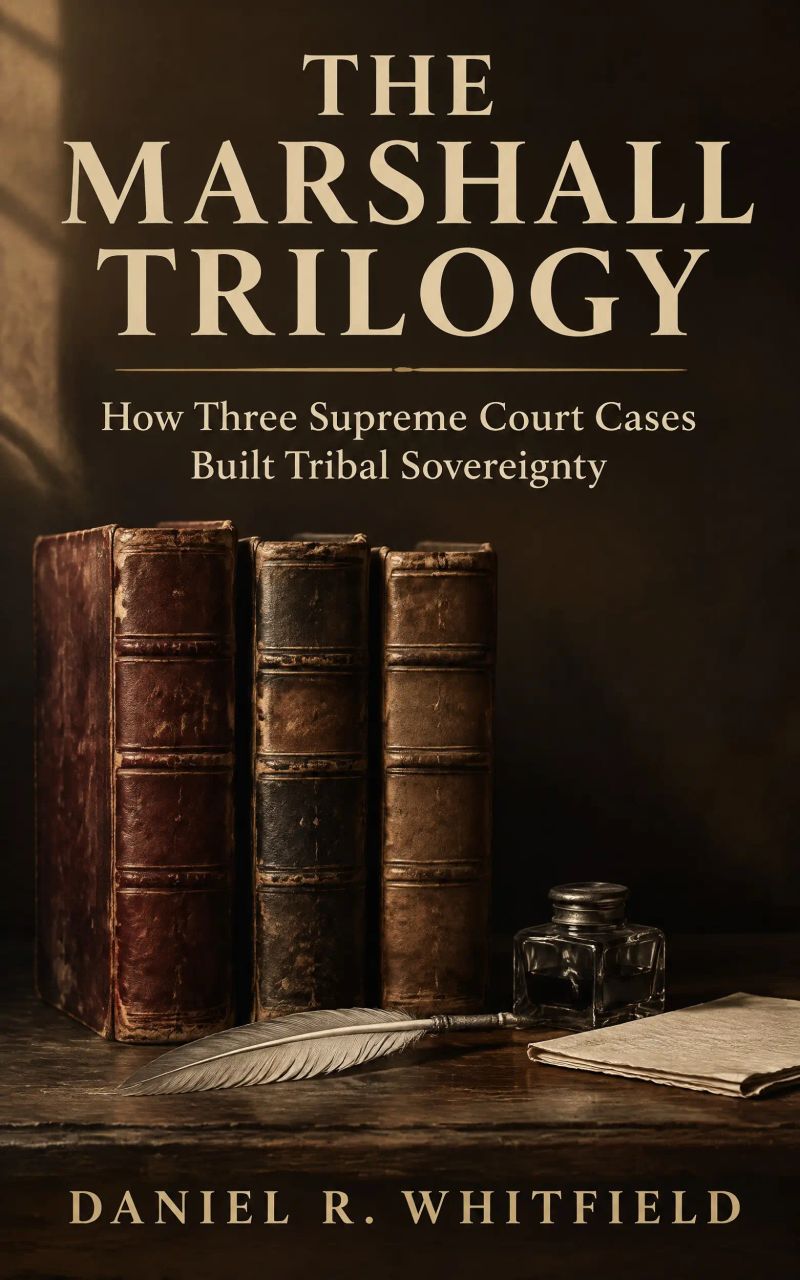
The Marshall Trilogy: How Three Supreme Court Cases Built Tribal Sovereignty
By Daniel R. Whitfield


Length4h 42m
About this audiobook
Pope Nicholas V's bull of January 1455 gave the king of Portugal license to "invade, search out, capture, vanquish, and subdue" every non-Christian people his ships could reach, and to take their lands and goods for the crown. Three hundred and sixty-eight years later, ruling on land that the Illinois and Piankeshaw nations had sold to a company of speculators in the 1770s, Chief Justice John Marshall wrote the same idea into American law. He called it discovery.
Here Marshall's three great Indian cases are read as a single argument. Johnson v. McIntosh (1823) left Native nations the right to occupy their land but not to sell it to anyone except the government. Cherokee Nation v. Georgia (1831) named them "domestic dependent nations." Worcester v. Georgia (1832) held that Georgia's laws had no force inside the Cherokee Nation, and Georgia ignored it while President Jackson made no move to enforce it. The Indian Removal Act had been law since 1830.
Around the cases stand the people who lived them: the Cherokee who wrote a constitution and printed a newspaper in their own syllabary, the missionary who went to a Georgia prison rather than swear an oath to the state, the leaders who split over the Treaty of New Echota, and the thousands forced west on the Trail of Tears. From there the doctrine travels west with the removed nations and on through the twentieth century to McGirt v. Oklahoma in 2020.
The contradiction at the heart of Marshall's opinions, a nation at once sovereign and dependent, is the foundation federal Indian law still stands on.
Audiobook details
GenreHistory
Length4 hrs 42 mins
Narrated byListen with 1,000+ voices
FormateBook with Audio
Publish dateSep 19, 2026
LanguageEnglish
Table of contents
1Chapter 1: Before the Doctrine
2Chapter 2: A Court of Nine Men in a New Capital
3Chapter 3: Johnson v. McIntosh, 1823: The Land and the Lie
4Chapter 4: Georgia's Law and the Cherokee Constitution
5Chapter 5: Cherokee Nation v. Georgia, 1831: What Kind of Nation?
Show all chaptersShow less
6Chapter 6: The Missionary and the Jailhouse Door
7Chapter 7: Worcester v. Georgia, 1832: The Law of Nations
8Chapter 8: The Removal Winter, 1832-1834
9Chapter 9: The Treaty of New Echota and the Trail of Tears
10Chapter 10: After Marshall: The Doctrine in the West
11Chapter 11: Twentieth-Century Reckoning
12Chapter 12: The Doctrine Today
13About the Author
More from Daniel R. Whitfield

Jim Thorpe: The Greatest Athlete and the Fight for His MedalsDaniel R. Whitfield4h 19m$6

Ninety Million Acres: The Dawes Act and the Theft of Indian LandDaniel R. Whitfield4h 47m$6

The Osage Empire Before OilDaniel R. Whitfield4h 38m$6

The World They Made: Native America in 1491Daniel R. Whitfield4h 24m$6

The Prophet and the Confederacy: Tenskwatawa, Tippecanoe, and the War for Native PowerDaniel R. Whitfield4h 17m$6

Ely Parker: The Seneca Engineer Who Wrote the Surrender at AppomattoxDaniel R. Whitfield3h 27m$6

The Chickasaw Wars: The Nation That Never SurrenderedDaniel R. Whitfield3h 55m$6

The Kiowa and the Southern Plains: Horse Trade, Sun Dance, and the Long Road to ReservationDaniel R. Whitfield4h 50m$6

A Brief History of IntelligenceMax S. Bennett12h 18m4.6 (6.6K)$29 · $0.00

The Happiest Man on EarthEddie Jaku3h 48m4.6 (178K)$7 · $0.00

MotherlandJulia Ioffe17h 52m4.7 (2.5K)$40 · $0.00

Where Cowards Go to DieBenjamin Sledge8h 42m4.7 (351)$20 · $0.00

RevolutionariesSanjeev Sanyal11h 23m4.6 (2.6K)$29 · $0.00

We Crossed a Bridge and It TrembledWendy Pearlman6h4.6 (5.2K)$24 · $0.00

Unbroken Bonds of BattleJohnny Joey Jones8h 31m4.6 (2.6K)$8 · $0.00

The Daughter of AuschwitzTova Friedman, Malcolm Brabant7h 54m4.6 (16.7K)$26 · $0.00

Lily's PromiseLily Ebert, Dov Forman8h 54m4.6 (16.1K)$29 · $0.00

On Democracies and Death CultsDouglas Murray10h 38m4.6 (6.5K)$29 · $0.00

Across the RiverKent Babb11h 40m4.6 (927)$29 · $0.00

Balcony Over Jerusalem: A Middle East Memoir - Israel, Palestine and BeyondJohn Lyons12h 37m4.6 (1.4K)$33 · $0.00

BeyondStephen Walker15h 39m4.6 (3.2K)$33 · $0.00
Kings and PawnsHoward Bryant10h 9m4.6 (678)$29 · $0.00

No EscapeNury Turkel9h 30m4.6 (809)$28 · $0.00

Jubal Stone: U.S. Marshal: Blood Trail To Hell: A Western Adventure NovelCasey Nash3h 42m4.6 (3.2K)$18 · $0.00

Fall and RiseMitchell Zuckoff17h 23m4.6 (9.8K)$40 · $0.00

The SurvivorJosef Lewkowicz, Michael Calvin9h 22m4.6 (2.5K)$29 · $0.00

Always FaithfulThomas Schueman, Zainullah Zaki12h 12m4.6 (977)$29 · $0.00

The State of Society in France Before the Revolution of 1789 (Annotated)Alexis de Tocqueville17h 25m4.6 (1.2K)$2 · $0.00
You may also like

The Interesting Narrative of the Life of Olaudah EquianoOlaudah Equiano8h 8m4.0 (20.8K)$21 · $0.00

Impossible Takes LongerDaniel Gordis11h 59m4.2 (488)$29 · $0.00

Black BoxShiori Itō6h 21m4.5 (2.9K)$17 · $0.00
The Life of Olaudah Equiano, Gustavus Vassa the AfricanOlaudah Equiano8h 12m4.0 (20K)$2 · $0.00

GoliathMax Blumenthal22h 19m4.3 (1.6K)$30

The Life of Olaudah Equiano, Gustavus Vassa the African (Annotated)Olaudah Equiano9h 55m4.1 (17.9K)$0.99 · $0.00

Blood, Sweat, and PixelsJason Schreier7h 58m4.3 (32.8K)$26 · $0.00

UnleashedBoris Johnson25h 41m4.1 (4.2K)$53 · $0.00

South to AmericaImani Perry16h 33m4.1 (10.7K)$40 · $0.00

The Autobiographical WorksGeorge Orwell35h 35m4.5 (2.3K)$2 · $0.00

KatrinaGary Rivlin15h 26m4.1 (1.4K)$25 · $0.00

How Dare the Sun RiseSandra Uwiringiyimana, Abigail Pesta6h 25m4.4 (9.7K)$24 · $0.00

By the Fire We CarryRebecca Nagle8h 15m4.5 (5.5K)$26 · $0.00

The Pacific: In The Wake of Captain CookMeaghan Wilson Anastasios13h 32m4.3 (258)$33 · $0.00

Life Among the Piutes: The First Autobiography of a Native American WomanSarah Winnemucca Hopkins9h4.1 (1.1K)$1 · $0.00

The Age of LincolnOrville Vernon Burton14h 58m4.0 (446)$28

ReconstructionEric Foner30h 45m4.4 (10K)$30
Twenty-Two Years a Slave and Forty Years a FreemanAustin Steward8h 53m4.2 (255)$1 · $0.00

Cursed VictoryAhron Bregman13h 15m4.4 (296)$23
Of Blood and SweatClyde W. Ford12h 35m4.5 (235)$33 · $0.00