
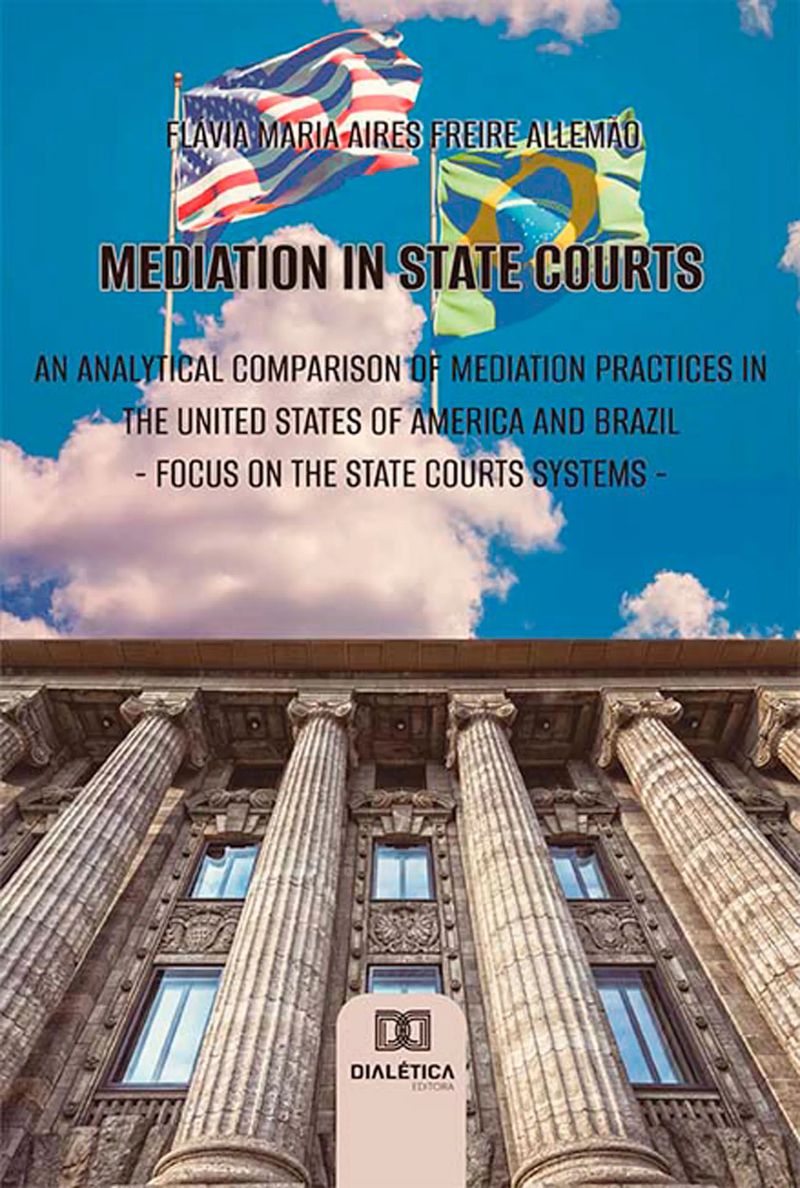
Mediation in state courts
an analytical comparison of mediation practices in the United States of America and BrazilBy Flávia Maria Aires Freire Allemão


Length5h 20m
About this audiobook
The large caseloads to be tried in the courts and the dissatisfaction of jurisdictions with the judgments are the main reasons for the application of mediation in the courts. The culture of litigation and the Civil Law system applied in Brazil are driving factors in order to arise more lawsuits, given to a greater possibility of different decisions for similar situations, in contrast to the Common Law, applied in almost all of the United States, where the citizen is more cautious when filing lawsuits, because it is more difficult to reverse a precedent. Given the need to change this situation, a movement began in Brazil to encourage agreements between the parties in the process, with the National Council of Justice having issued the Resolution No. 125/2010 instituting mediation and, later, the provision of such institute by the new Code of Civil Procedure of 2015. The previous Code of Civil Procedure, from 1973, already regulated conciliation, although it does not have the same effectiveness as mediation in the resolution of conflicts in a more definitive way, especially in demands whose conflict parties have a continued relationship among themselves, such as those involving Family Law, for example. Indeed, among the different types of alternative methods of conflict resolution, mediation is within the best results. So, it is of fundamental importance the comparative study of the mediation in Brazil and the United States, analyzing the participants of mediation, the types of mediation, how it is applied in practice in each country, the advantages and disadvantages and thinking how to improve the institute of mediation in both countries, considering the differences and similarities between them.
Audiobook details
GenrePolitics and Government
Length5 hrs 20 mins
Narrated byListen with 1,000+ voices
FormateBook with Audio
Publish dateOct 29, 2021
LanguageEnglish
Table of contents
1PREFACE TO FLÁVIA MARIA AIRES FREIRE ALLEMÃO, MEDIATION IN STATE COURTS: AN ANALYTICAL COMPARISON OF MEDIATION PRACTICES IN THE UNITED STATES OF AMERICA AND BRAZIL (2021)
2I. INTRODUCTION
3II – OVERVIEW OF ALTERNATIVE DISPUTE RESOLUTION (ADR) MECHANISMS
4A. THE NATURE OF CONFLICT
5B. BASICS OF NEGOTIATION
Show all chaptersShow less
6C. BASICS OF MEDIATION
7D. BASICS OF CONCILIATION
8E. BASICS OF EARLY NEUTRAL EVALUATION
9F. BASICS OF ARBITRATION
10III. MEDIATION AS A MEANS OF RESOLVING DISPUTES
11A. THE CONCEPTUAL BASICS AND PRINCIPLES OF MEDIATION
121. Liberty or Power of Decision of the Parties
132. Informality
143. Cooperation
154. Participation of an Impartial Third Person
165. Confidentiality
176. Fastness and Economy
18B. THE PARTICIPANTS IN A TYPICAL MEDIATION
191. The Parties
202. The Mediator and Co-Mediator
213. The Lawyers
224. The Judge
23C. MEDIATION TECHNIQUES
241. Principal Styles or Models of Mediation
251.Separate people from the problem
262. Stages of a Mediation
27D. INSTITUTIONALIZATION OF THE MEDIATION WITHIN THE COURTS: 2) The risks and effects of institutionalization
28E. CURRENT PRACTICE OF MEDIATION IN THE UNITED STATES OF AMERICA
291. History and Areas of Mediation
303. Settlement Week
314. Judicial Mediation
32E. CURRENT PRACTICE OF MEDIATION IN BRAZIL
331. History and Areas of Mediation
342. “Semana da Conciliação” [Settlement Week]
353. Judicial Mediation
36IV. ASSESSMENT OF MEDIATION AS A DISPUTE RESOLUTION TOOL
37A. BENEFITS AND ADVANTAGES OF MEDIATION
381. Subjective Benefits and Advantages
392. Objective Benefits and Advantages
401. To block the Judiciary in its principal function of giving meaning to the public values
412. Privatization of justice
422. Lack of Predictability
433. Waste of Time
444. Sometimes Unfair or Against Legal Rights, Principles or Fundamental Public Polices
455. Not Adequate if a Precedent is Needed
467. Detrimental to Lawyers by reducing their Works in Courts
47V. ANALYSIS AND RECOMMENDATIONS: B. FURTHER CONCERNS AND OPPORTUNITIES FOR MEDIATION IN BRAZIL
48CONCLUSION

Matters of the HeartJacinta Nampijinpa Price9h 35m4.8 (359)$29 · $0.00

How to Test Negative for StupidJohn Kennedy8h 13m4.7 (9.7K)$28 · $0.00

Black AF HistoryMichael Harriot15h 43m4.7 (14.6K)$33 · $0.00

The Gulag Archipelago Volume 3Aleksandr I. Solzhenitsyn21h 56m4.7 (8.9K)$46 · $0.00

MotherlandJulia Ioffe17h 52m4.7 (2.5K)$40 · $0.00

HostageEli Sharabi5h 25m4.6 (10.8K)$24 · $0.00

KrantikariSanjeev Sanyal11h 44m4.6 (1.3K)$16 · $0.00

Unbroken Bonds of BattleJohnny Joey Jones8h 31m4.6 (2.6K)$8 · $0.00

On Democracies and Death CultsDouglas Murray10h 38m4.6 (6.5K)$29 · $0.00

Balcony Over Jerusalem: A Middle East Memoir - Israel, Palestine and BeyondJohn Lyons12h 37m4.6 (1.4K)$33 · $0.00
RiggedMollie Hemingway12h 48m4.6 (4.2K)$23 · $0.00

SledgehammerDavid Friedman8h 21m4.7 (589)$26 · $0.00
Citizenship in a Republic (Annotated)Theodore Roosevelt2h 44m4.6 (1.4K)$2 · $0.00

No EscapeNury Turkel9h 30m4.6 (809)$28 · $0.00

Always FaithfulThomas Schueman, Zainullah Zaki12h 12m4.6 (977)$29 · $0.00

UnthinkableJamie Raskin15h 8m4.5 (9.3K)$8 · $0.00

My Fourth Time, We DrownedSally Hayden13h 59m4.6 (2.9K)$23 · $0.00

A Revolution of Common SenseScott Jennings9h 29m4.6 (528)$29 · $0.00

Statement From the Dock at the Rivonia TrialNelson Mandela2h 18m4.6 (1.3K)$1 · $0.00

Lessons from the EdgeMarie Yovanovitch17h 11m4.5 (5.9K)$40 · $0.00
You may also like
THE THEORY OF THE LEISURE CLASS: An Economic Study of American Institutions and a Social Critique of Conspicuous Consumption (Annotated)Thorstein Veblen12h 58m4.4 (1K)$1.99 · $0.00

The World as Will and Idea (Vol. 1 of 3)Arthur Schopenhauer20h 17m4.4 (519)$2.30

An Enquiry Concerning Human UnderstandingDavid Hume5h 59m4.1 (29.2K)$2.30

An Enquiry Concerning Human UnderstandingDavid Hume7h 23m4.1 (24.2K)$1 · $0.00
Democracy and Education An Introduction to the Philosophy of EducationJohn Dewey15h 33m4.1 (4K)$2.30

The Collected Works of Wallace D. Wattles (10 Books in One Edition)Wallace D. Wattles17h 18m4.6 (186)$2 · $0.00

Sign Language Among North American Indians (Annotated)Garrick Mallery14h 32m4.2 (174)$1.99 · $0.00
The Art of Logical Thinking, or, The Laws of ReasoningWilliam Walker Atkinson3h 50m4.0 (287)$2.30

Blackboard DrawingFrederick Whitney25m4.2 (51)$2 · $0.00

Ultimate Customer ServiceMade for Success8h 9m4.2 (46)$20

Business & Economics Collection: Thorstein Veblen Edition (30+ Works in One Volume)Thorstein Veblen91h 26m4.5 (11)$2 · $0.00

Sell to Anyone!Zig Ziglar, Brian Tracy3h 13m4.2 (20)$20

A Book of PrefacesH. L. Mencken7h 33m3.8 (67)$2 · $0.00

Leibniz's New Essays Concerning the Human Understanding: A Critical ExpositionJohn Dewey8h 57m3.9 (24)$1 · $0.00

How to Write a Novel: A Practical Guide to the Art of FictionAnonymous3h 5m3.6 (65)$2 · $0.00

Public Speaking SuperstarMade for Success7h 25m3.6 (72)$30

CEO Communication SkillsMade for Success8h 59m3.8 (28)$20

Why Women BuyDawn Jones3h 54m3.5 (62)$20

Navigating Towards Professional SuccessEdivaldo Ascaneo34m$6 · $0.00

The Millionaire Race: Mindset Of AchievementIgor Augusto3h 56m$9 · $0.00