

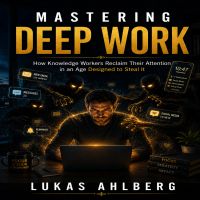
Mastering Deep Work
How Knowledge Workers Reclaim Their Attention in an Age Designed to Steal ItBy Lukas ahLberg


Length10h 57m
About this audiobook
Why do intelligent, capable people repeatedly make financial decisions they later regret? Why do high earners struggle to save, investors panic during market downturns, and successful professionals remain trapped in unhealthy money habits? In *The Psychology of Money for Smart People Who Make Bad Financial Decisions*, certified financial planner Wesley Garrison argues that most financial mistakes are not caused by a lack of knowledge—they are driven by hidden beliefs, emotional patterns, and deeply rooted money stories formed long before adulthood.
Drawing on fourteen years of experience working with clients from diverse financial backgrounds, Garrison reveals how emotions often influence financial behavior more than spreadsheets, calculators, or investment strategies. He explains that every money decision operates on three levels: the technical layer, the habit layer, and the meaning layer. While most financial advice focuses on technical knowledge, lasting change requires understanding the deeper beliefs that shape behavior.
The book explores common psychological traps that affect decision-making, including loss aversion, status spending, lifestyle inflation, anchoring, and the sunk-cost fallacy. Readers learn why they hold losing investments too long, overspend to maintain appearances, or avoid financial decisions altogether. Garrison also examines the money beliefs inherited from childhood and shows how these invisible narratives continue to shape adult choices.
Beyond psychology, the book provides practical guidance on saving, investing, retirement planning, debt management, insurance, and financial conversations with partners and family members. Rather than overwhelming readers with complex systems, each chapter concludes with one actionable step designed to create immediate progress.
This is not a promise of overnight wealth or financial freedom through shortcuts. Instead, it offers a deeper understanding of why people behave the way they do with money and how to create healthier financial habits that align with personal values and long-term goals. The result is greater confidence, better decision-making, and a more intentional relationship with money throughout every stage of life.
Audiobook details
GenreBusiness and Economics
Length10 hrs 57 mins
Narrated byListen with 1,000+ voices
FormateBook with Audio
Publish dateJun 4, 2026
LanguageEnglish
Table of contents
1Introduction
2Chapter 1 — The Attention Problem of Our Time
3Chapter 2 — What Deep Work Is, and What It Isn’t
4Chapter 3 — The Cost of Shallow Work You Don’t See
5Chapter 4 — The Mental Conditions That Make Deep Work Possible
Show all chaptersShow less
6Chapter 5 — Designing a Day That Holds a Deep Block
7Chapter 6 — The Two-Hour Block: Anatomy of a Useful Deep Session
8Chapter 7 — The Friction You Don’t See: Why You Can’t Stay With Hard Work
9Chapter 8 — Notifications, Tabs, and the Surface-Level Noise Layer
10Chapter 9 — Email and Slack as the Designed Distraction Stack
11Chapter 10 — The Calendar That Makes Deep Work Possible
12Chapter 11 — The Workspace: Physical, Digital, and Social
13Chapter 12 — Tools You Actually Need (and the Ones You Don’t)
14Chapter 13 — Working Deeply in an Open-Plan Office
15Chapter 14 — Deep Work From Home: The Other Set of Problems
16Chapter 15 — Deep Work in Short Windows: When You Only Have 90 Minutes
17Chapter 16 — The Recovery After: Why Rest Is Part of Deep Work
18Chapter 17 — Building the Habit: Months 1-6
19Chapter 18 — When Deep Work Stops Working (and What That Means)
20Chapter 19 — Deep Work With ADHD or Atypical Attention
21Chapter 20 — Deep Work as a Manager (Where Your Calendar Isn’t Yours)
22Chapter 21 — Deep Work and Career: The Quiet Career Compounding Effect
23Chapter 22 — A Decade of Practice: What Lukas Has Seen
24Conclusion
25About the Author
26Appendix A — A Day-by-Day Walkthrough of a Deep Work Week
27Appendix B — Twenty Common Obstacles and How to Get Past Each
28Appendix C — Reading List for People Who Want to Go Deeper
29Appendix D — Case Studies From the Coaching Practice
30Appendix E — A Glossary of Working Concepts
31Appendix F — Questions I Get Asked Most Often
32Appendix G — More Stories From the Practice
33Appendix H — Sample Practice Weeks Across Professions
34Appendix I — Final Reflections After the Coaching Is Done
35Appendix J — A Final List of Practices
36Appendix K — Specific Practices for Specific Kinds of Work
37Appendix L — A Note on Building the Practice With Others
38Appendix M — A Final Word
39Appendix N — A Year in the Life of a New Practitioner
40Appendix O — On Failure
41Appendix P — Closing
42Appendix Q — Letters From Readers
43Appendix R — A Postscript on Skanör
44Acknowledgments
45Appendix S — Notes Toward a Second Edition
More from Lukas ahLberg

Never Split the DifferenceChris Voss, Tahl Raz8h 7m4.4 (277.7K)$26 · $0.00
The Intelligent Investor Rev Ed.Benjamin Graham17h 48m4.3 (191.5K)$40 · $0.00

The Hard Thing About Hard ThingsBen Horowitz7h 57m4.2 (134.3K)$26 · $0.00
Boundaries for LeadersHenry Cloud7h 36m4.3 (3.6K)$26 · $0.00

Not Everything Counts but Everything Matters: The powerful and inspirational new book about leadership and achieving success from the visionary multi-premiership winning Panthers coachIvan Cleary6h 1m4.6 (680)$24 · $0.00
BuildTony Fadell11h 5m4.5 (14.3K)$8 · $0.00
The Joys Of CompoundingGautam Baid17h 34m4.5 (2.5K)$18 · $0.00

Basic EconomicsThomas Sowell18h 32m4.5 (29.3K)$28 · $0.00

Poor Charlie’s AlmanackGrover Gardener, Charles T. Munger13h 9m4.5 (24.7K)$18 · $0.00

The Ambuja StoryNarotam Sekhsaria13h 59m4.5 (830)$33 · $0.00

The Secret Door to SuccessFlorence Scovel Shinn2h 25m4.5 (2.1K)$1.20 · $0.00

This Is Going to HurtAdam Kay5h 47m4.4 (444.7K)$24 · $0.00

Big TrustShadé Zahrai, Fayçal Sekkouah8h 36m4.6 (406)$26 · $0.00
The Intelligent Investor Third EditionBenjamin Graham, Jason Zweig20h4.4 (156.6K)$46 · $0.00

Bottle of LiesKatherine Eban14h 25m4.4 (12K)$33 · $0.00

The Antiracist Business BookTrudi Lebrón6h 10m4.6 (275)$17 · $0.00

The FormulaJoshua Robinson, Jonathan Clegg10h 41m4.4 (6.9K)$29 · $0.00

Let Them LeadJohn U. Bacon7h 10m4.5 (1.4K)$24 · $0.00

Secrets of the Millionaire MindT. Harv Eker5h 11m4.4 (301.4K)$24 · $0.00

The Person You Mean to BeDolly Chugh9h 6m4.4 (7.2K)$29 · $0.00
You may also like

Body LoveKelly LeVeque5h 18m4.0 (6.6K)$6 · $0.00

Time MagicMelissa Ambrosini, Nick Broadhurst8h 2m4.0 (420)$26 · $0.00

The New RulebookDr Chris Cheers3h 44m4.1 (1.2K)$18 · $0.00

Hot and UnbotheredYana Tallon-Hicks10h 44m4.5 (600)$29 · $0.00

Pep Talks for WritersGrant Faulkner5h 38m4.3 (978)$20

The Tantra ExperienceOSHO16h 18m4.4 (1.4K)$20 · $0.00

Eat to Beat Depression and AnxietyDrew Ramsey6h 28m4.2 (2.1K)$24 · $0.00

Peace Is Every StepThich Nhat Hanh3h 29m4.4 (63.7K)$14 · $0.00

Hormone IntelligenceAviva Romm15h 18m4.4 (3.1K)$33 · $0.00

The Subtle Art of Not Giving a F*ck JournalMark Manson1h 21m4.2 (1.6K)$16 · $0.00

How to Be EverythingEmilie Wapnick5h4.0 (6.2K)$20 · $0.00

Women Don't Owe You PrettyFlorence Given3h 30m3.8 (94.7K)$15

In Emergency, Break GlassNate Anderson5h 33m4.2 (329)$17 · $0.00

The Compassionate AchieverChristopher L. Kukk8h 15m4.1 (317)$26 · $0.00
The Pathless PathPaul Millerd6h 14m4.2 (8K)$9.99 · $0.00

NO RUSH JUST LIVINGJacob James1h5.0 (38) Only with Ultra

MoneyzenManisha Thakor, Lisa Sweetingham6h 48m3.8 (443)$24 · $0.00

Simple Qi Gong for Weight LossLaura Chen5h 37m$5

A Logic of Facts; Or, Every-day ReasoningGeorge Jacob Holyoake4h 30m3.5 (10)$1 · $0.00

Insights Into EducationJ Krishnamurti5h 22m4.3 (153)$7 · $0.00