
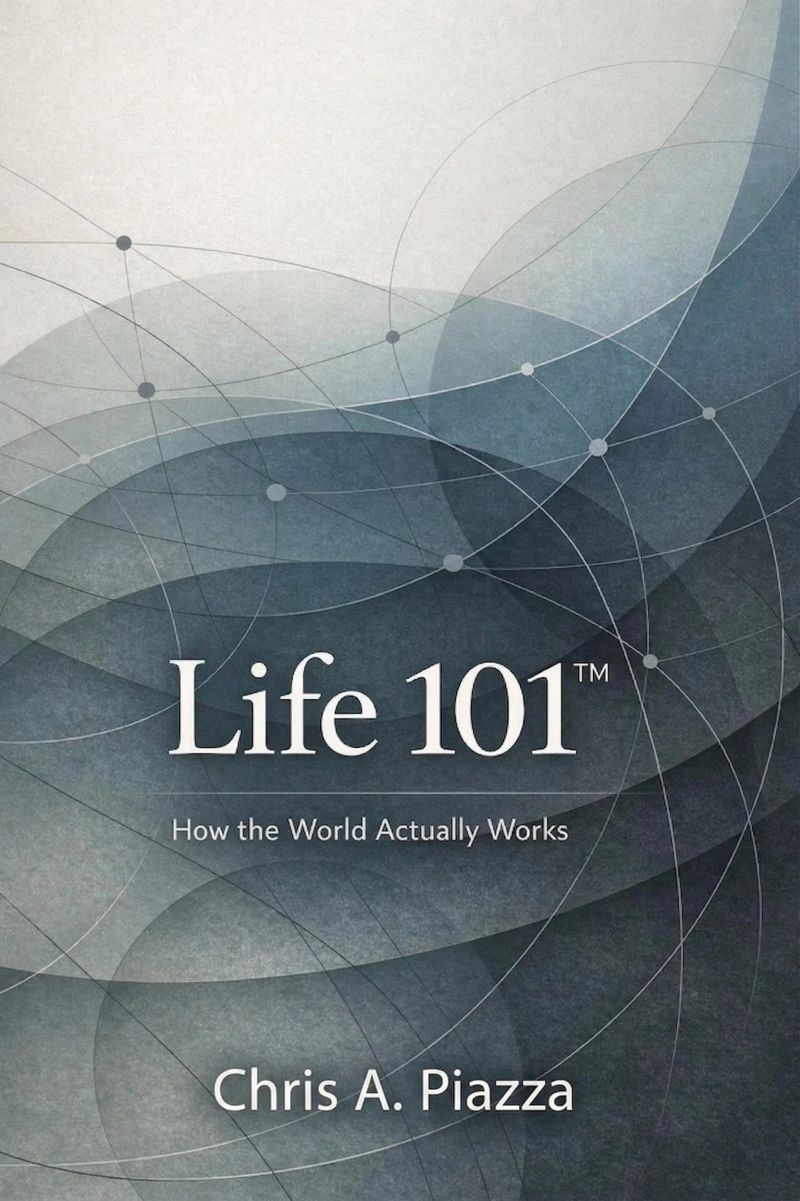
Life 101
How the World Actually WorksBy Chris A. Piazza | Antherra™

Length1h 45m
About this audiobook
You've stumbled through adulthood's grind—bills stacking up, jobs shifting underfoot, relationships fraying—wondering why advice never sticks amid the fog. Life 101 reframes this as a legibility problem: systems respond to behaviors in hidden ways, turning confusion into your real enemy, not incompetence. It invites you to map those patterns in your own chaos, preserving your choices while exposing the structure.
Audiobook details
GenreEducation and Learning, Health and Wellness
Length1 hr 45 mins
Narrated byListen with 1,000+ voices
FormateBook with Audio
Publish dateFeb 2, 2025
LanguageEnglish
Table of contents
1Introduction
2Preface
3Why This. Why Now.
41. Systems Have Become Less Forgiving
52. Advice Has Collapsed, but Tools Have Exploded
Show all chaptersShow less
63. Authority No Longer Teaches Well
7What This Is Really About
8PART I — What This Is
9Chapter 1 — The Problem We’re Actually Solving
10Chapter 2 — What This Is Not
11Chapter 3 — Reality Mirrors, Not Answer Keys
123.1 Why “Answers” Don’t Transfer Well
133.2 What a “Reality Mirror” Actually Is
143.3 The Four Core Mirror Moves
153.4 Why Mirrors Preserve Dignity
163.5 Why This Works With (and Without) AI
173.6 The Non-Negotiable Rule
18Chapter 4 — The Triad: Kid ↔ AI ↔ Parent
194.1 Why a Triad (Not a Teacher, Not a Tool)
204.2 The Kid’s Role: Ownership Without Isolation
214.3 The AI’s Role: Pattern Engine, Not Authority
224.4 The Parent’s Role: Meaning, Context, and Boundaries
234.5 What Each Node Prevents
244.6 The Direction of Flow (This Matters)
254.7 Why This Reduces Conflict Instead of Creating It
264.8 The Quiet Outcome
27PART II — The Framework
28Chapter 5 — The 10 Clusters (The Invisible Curriculum)
295.1 Resource Flow
305.2 Obligations & Commitments
315.3 Risk & Exposure
325.4 Maintenance & Decay
335.5 Systems & Institutions
345.6 Information & Signal
355.7 Incentives & Power
365.8 Identity & Roles
375.9 Transitions & Timing
385.10 Agency & Choice Architecture
395.11 Why These Clusters Repeat Everywhere
40Chapter 6 — First-Pain Moments (Where Learning Actually Starts)
416.1 What a First-Pain Moment Is (and Is Not)
426.2 Why First-Pain Moments Teach Better Than Warnings
436.3 Common First-Pain Moments (Across Clusters)
446.4 The Emotional Layer (This Is Where Adults Usually Mess Up)
456.5 What the Mirror Does in a First-Pain Moment
466.6 Timing Matters More Than Thoroughness
476.7 First-Pain ≠ Last-Pain (and That’s Fine)
486.8 Why First-Pain Moments Preserve Dignity
49Chapter 7 — Age Band Exposure Map (When the Clusters Show Up)
507.1 The Four Exposure Bands

Heavenly KingdomChris A. Piazza | Antherra™1h 26m$4.99

Circuit: ExhaleChris A. Piazza | Antherra™1h 33m$4.99

Cultural TariffsChris A. Piazza | Antherra™1h 14m$4.99

CatchmentChris A. Piazza | Antherra™1h 24m$4.99

Nanny StateChris A. Piazza | Antherra™1h 12m$4.99

The ViaChris A. Piazza | Antherra™1h 20m$4.99

LoggedChris A. Piazza | Antherra™37m$4.99
DeaccessionChris A. Piazza | Antherra™48m$4.99

RemandChris A. Piazza | Antherra™37m$4.99

Color Me DrunkChris A. Piazza | Antherra™45m$4.99

StemsChris A. Piazza | Antherra™1h 18m$4.99

15 Buried InventionsChris A. Piazza | Antherra™1h$4.99

The Civilization That Could BeChris A. Piazza | Antherra™46m$4.99

Chain of CustodyChris A. Piazza | Antherra™42m$4.99

TitrationChris A. Piazza | Antherra™49m$4.99

CompactChris A. Piazza | Antherra™1h 48m$4.99
Discount RateChris A. Piazza | Antherra™1h 24m$4.99

The Long Vacancy, Volume IIIChris A. Piazza | Antherra™1h 19m$4.99

The Long Vacancy, Volume IIChris A. Piazza | Antherra™1h 6m$4.99

The Long Vacancy, Volume IChris A. Piazza | Antherra™1h 3m$4.99
A Brief History of IntelligenceMax S. Bennett12h 18m4.6 (6.6K)$29 · $0.00

HomeschooledStefan Merrill Block7h 10m3.6 (18.5K)$28 · $0.00

Parents and Children (Annotated)Charlotte Mason9h 23m4.6 (988)$2 · $0.00

Children Under FireJohn Woodrow Cox10h 17m4.5 (1.6K)$29 · $0.00

The State Must ProvideAdam Harris7h 15m4.5 (775)$24 · $0.00

The Call of the Wild and FreeAinsley Arment9h 7m4.4 (21.2K)$29 · $0.00
The Freelance WayRobert Vlach19h 48m4.5 (528)$40 · $0.00
Race to the BottomLuke Rosiak9h 20m4.5 (600)$29 · $0.00

They Came for the SchoolsMike Hixenbaugh9h 5m4.5 (2.6K)$8 · $0.00

Find Me UnafraidKennedy Odede, Jessica Posner11h 11m4.5 (2.7K)$29 · $0.00

Asking for ItKate Harding8h 55m4.4 (5.3K)$20 · $0.00
Defining Moments in Black HistoryDick Gregory7h 37m4.4 (6K)$26 · $0.00

The Emerald Tablets of Thoth the AtlanteanMaurice Doreal3h 4m4.4 (8.8K)$6 · $0.00

Learning AmericaLuma Mufleh6h 37m4.4 (564)$24 · $0.00
Math-ishJo Boaler7h 21m4.4 (588)$24 · $0.00
It Worked For MeColin Powell7h 42m4.3 (9.8K)$26 · $0.00

Little SoldiersLenora Chu11h 30m4.3 (3.1K)$29 · $0.00

Financial FeministTori Dunlap8h 3m4.2 (22.2K)$8 · $0.00

Grammar-land; Or, Grammar in Fun for the Children of Schoolroom-shireM. L. Nesbitt2h 36m4.4 (487)$1 · $0.00

DarkwaterWilliam Edward Burghardt Du Bois6h 40m4.3 (1.4K)$11 · $0.00

How to Make Disease DisappearRangan Chatterjee5h 26m4.5 (3.5K)$24 · $0.00

The Complete Herbal (Annotated)Nicholas Culpeper29h 8m4.5 (1.4K)$2 · $0.00

A Plague Upon Our HouseScott W. Atlas MD10h 37m4.5 (3.4K)$20 · $0.00

The Cancer CodeDr. Jason Fung10h 48m4.5 (5.3K)$29 · $0.00

The Gift of TherapyIrvin Yalom7h 39m4.5 (38.8K)$26 · $0.00

EarlySarah DiGregorio9h 47m4.5 (1.3K)$29 · $0.00

Bottle of LiesKatherine Eban14h 25m4.4 (12K)$33 · $0.00
The 36-Hour DayNancy L. Mace, Peter V. Rabins17h 13m4.4 (9.2K)$28 · $0.00

FlooredSara Reardon10h 36m4.5 (1K)$29 · $0.00
Radical RemissionKelly A. Turner9h 26m4.4 (8.1K)$29 · $0.00
The Sinatra SolutionStephen T. Sinatra MD9h4.5 (899)$20 · $0.00

The Songaminute ManSimon McDermott6h 12m4.5 (280)$24 · $0.00
Sometimes BrilliantLarry Brilliant12h 27m4.5 (954)$29 · $0.00

Live Your LifeAmanda Kloots, Anna Kloots10h 54m4.4 (13.7K)$29 · $0.00

All in Her HeadElizabeth Comen13h 25m4.4 (18.2K)$33 · $0.00
The Wisdom of Your BodyHillary McBride9h 14m4.4 (6.7K)$29 · $0.00

The Alzheimer's SolutionDean Sherzai, Ayesha Sherzai9h 47m4.4 (1.9K)$29 · $0.00
Rewire Your MindsetBrian Keane6h 49m4.5 (896)$23 · $0.00
Tuning The Human Biofield: Healing With Vibrational MedicineCENTER FOR SOUND THERAPY13h 28m4.4 (2.5K)$35 · $0.00

VaccinatedPaul A. Offit8h 30m4.4 (3.7K)$26 · $0.00
You may also like

Does Anyone Else Feel This Way?Eli Rallo7h 32m3.7 (3.7K)$26 · $0.00
Almost AdultingArden Rose3h 4m3.5 (6.8K)$18 · $0.00

Girls & SexPeggy Orenstein7h 26m4.1 (14.4K)$24 · $0.00

Redburn. His First VoyageHerman Melville13h 25m3.8 (6.9K)$3 · $0.00
The Confidence Code for GirlsKatty Kay, Claire Shipman4h 35m4.2 (2.8K)$20 · $0.00
The Shadow-LineJoseph Conrad3h 51m3.8 (7.4K)$12 · $0.00
Why We Make Things and Why It MattersPeter Korn5h 38m4.0 (2.3K)$17
Adulting 101 Book 1Josh Burnette, Pete Hardesty6h 2m4.2 (1.6K)$10 · $0.00

Post GradCaroline Kitchener9h 5m3.7 (1.1K)$29 · $0.00

The Bell JarSylvia Plath9h 8m4.2 (1.4M)$1 · $0.00

Hotel CubaAaron Hamburger12h 50m4.0 (1.7K)$33 · $0.00

THE WEIGHT OF CONCRETEJudson Powers55m5.0 (11) Only with Ultra

The Rocket YearsElizabeth Segran, Benjamin Schneer7h3.7 (574)$24 · $0.00
The Happiness TrailRamesh Venkateswaran6h 14m4.3 (48)$24 · $0.00

WHAT NOW?Gabriel Pipkin42m4.1 (8) Only with Ultra

Sunrise Over LagosADEOLA ADENIRAN 37m4.0 (19) Only with Ultra

Life in Lashes: The Story of a Drag SuperstarKita Mean6h 51m4.0 (171)$24 · $0.00

Harry Grows Up: The Early Years of Lee Kuan YewPatrick Yee16m4.1 (21)$6 · $0.00

EndoMEtriosisTamer Seckin MD4h 50m4.3 (244)$15

Flock without BirdsFilip Dousek13h 36m3.8 (277)$23