
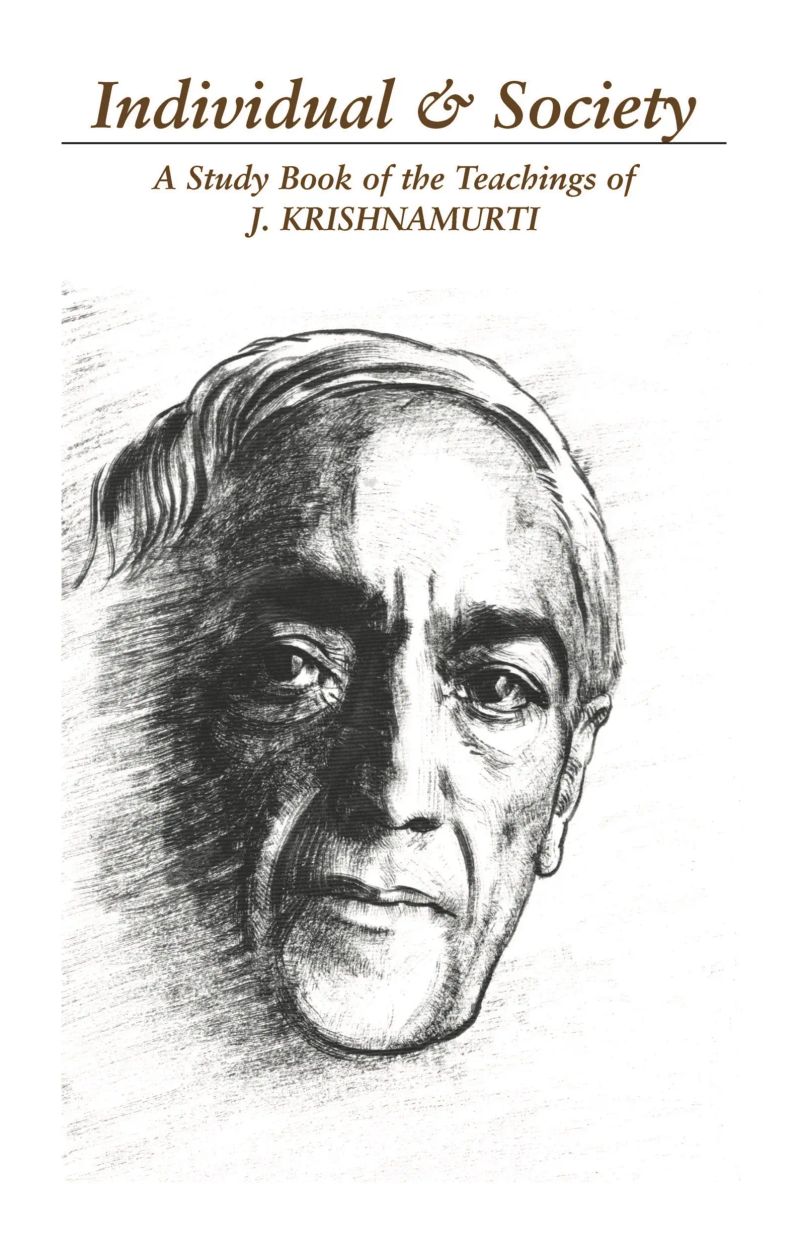
Individual and Society: The Bondage of Conditioning
A Selection of Passages from the Teaching of KrishnamurtiBy J Krishnamurti


Length3h 50m
About this audiobook
In this incredibly penetrating talk, Krishnamurti describes the psychological pressures of life and how these pressures affect right living: We were saying that any form of pressure on the brain affects our whole way of life. We were also saying that this pressure affects our activities, our attitudes, our character, and our way of living. The pressure--economic, social, ethical, and religious--invariably distorts not only our actions but the quality of the brain ... ideals affect, oppress, and act as pressure upon our daily life. Is it possible not to have any ideals but only deal with actually what is? --then there is no pressure whatsoever. Krishnamurti goes on to say that, unless the mind is free of pressure, there is no new way of living. He states that this insight on freedom requires a great deal of investigation into the whole nature and movement of pressure.
Audiobook details
Rating★★★★ 3.8 (20)
Includes Goodreads
GenrePhilosophy
Length3 hrs 50 mins
Narrated byListen with 1,000+ voices
FormateBook with Audio
Publish dateAug 8, 2012
LanguageEnglish
Table of contents
1Introduction
2Editor’s Note
3Talking things over together as two friends…
4I. An overview
5II. What is the individual? What is society? What is the relationship between them?
Show all chaptersShow less
6Obviously, society exists for the individual, and not the other way round. Society exists for the fruition of man; it exists to give freedom to the individual so that he may have the opportunity to awaken the highest intelligence.
7Why is society crumbling, collapsing, as it surely is? One of the fundamental reasons is that the individual, you, has ceased to be creative.
8The individual’s responsibility is not to society, but to himself. And if he is responsible to himself, he will act upon society.
9III. The importance of the individual
10Anything really true must be totally individual not in the sense of self-centeredness, but individual in the sense that each one of us must experience for himself, uninfluenced, something which is not the outcome of any self-centered interest or drive.
11What the individual is, the society is.
12In any creative action it is the individual who matters.
13As long as the individual, which is you and I, does not take responsibility for the complete transformation of society, society will remain as it is.
14IV. The bondage of conditioning
15Introduction
16What is conditioning?
17The mind is the result of conditioning.
18Surely, we are aware, not of our conditioning, but only of conflict, of pain and pleasure.
19Factors of conditioning: Organized religion, nationalism, governments
20Religion, as it is, is essentially based on ideas, on faith, on authority. But most of us are caught in it and we cannot get out. To get out, to break through our conditioning requires a great deal of energy.
21The mind must be free from belief and nonbelief.
22So, the individual is destroyed through compulsion, through propaganda, and is controlled, dominated for the sake of the society, for the sake of the state and so on.
23We are bound by beliefs, by dogmas, for which we are willing to die and destroy each other.
24V. Problems of unconditioning
25Man, the human being, has done everything to bring about a radical change; and yet, fundamentally, man has not changed at all. We are what we have been for two million years!
26Thought, which is the product of yesterday, can only respond in terms of yesterday, of time.
27The difficulty, it seems to me, lies in understanding the fact that any form of change in a conditioned mind gives only a different conditioning, not a transformation.
28When a conditioned mind seeks an answer to a problem, it is going around in circles; its search has no meaning.
29Freedom from conditioning comes into being only when we see the necessity of a mind that is unconditioned. But we have never thought about it, we have never inquired…
30VI. Wrong approaches to unconditioning
31Effort does not clear up any of our problems.
32The thinker and his thoughts are the outcome of desire.
33There is peace only when there is no desire to become something.
34It is only a confused mind that chooses.
35Power and authority
36The fact is that the human mind is seeking power; and in the search for power it loses its individuality.
37To be free of society implies psychological freedom that is, to be totally free from ambition, from envy, greed, power, position, prestige.
38The authority of one’s conditioning leads to every form of illusion.
39Reform
40Total transformation can never take place within the pattern of any society, whether that society be tyrannical or so-called democratic.
41Analysis.
42Analysis is not the way to understand the unconscious.
43To meet the challenge of the new, the mind must be new.
44Methods, systems, patterns.
45There is no method to uncondition you.
46To see the truth, there must be freedom.
47Self-improvement
48Religiously, socially and politically, there is the constant urge of self-improvement.
49Self-improvement is progress in sorrow, not the cessation of sorrow.
50You have taken the wrong road. You have walked a long, weary way and you discover that the path or road doesn't lead to where you want to go.
More from J Krishnamurti
The Art of ListeningJ Krishnamurti14h 8m4.6 (48)$6 · $0.00
ActionJ Krishnamurti5h 28m4.2 (18)$6 · $0.00
The New MindJ Krishnamurti21h 54m4.6 (25)$6 · $0.00
Commentaries On Living 2J Krishnamurti9h 58m4.5 (606)$6 · $0.00

Krishnamurtis NotebookJ Krishnamurti11h4.5 (3.8K)$6
The Years of AwakeningJ Krishnamurti13h 33m4.4 (298)$6 · $0.00

The World Within; You Are The Story of HumanityJ Krishnamurti6h 27m4.0 (14)$6 · $0.00
The Mirror of RelationshipJ Krishnamurti17h 19m4.2 (97)$6 · $0.00

Insights Into EducationJ Krishnamurti5h 22m4.3 (153)$6 · $0.00

Mary Lutyens - 3. Krishnamurti. The Open DoorJ Krishnamurti, Mary Lutyens7h4.3 (33)$7 · $0.00
The Observer ObservedJ Krishnamurti2h 50m4.5 (25)$7 · $0.00
Mary Lutyens - 1. Krishnamurti. The Years of AwakeningJ Krishnamurti, Mary Lutyens13h 33m4.2 (161)$6 · $0.00
What Are You Seeking ?J Krishnamurti15h 6m4.5 (242)$7 · $0.00
Choiceless AwarenessJ Krishnamurti5h 10m4.2 (123)$7 · $0.00
What is Right Action ?J Krishnamurti16h 29m4.5 (33)$7 · $0.00
What Are You Seeking ?J Krishnamurti24h 50m$7 · $0.00

The RepublicPlato22h 18m4.1 (267.4K) · 1511Free

The Magic PresenceGodfré Ray King10h 21m4.6 (307)$1.20 · $0.00
The Art of LivingThich Nhat Hanh5h 1m4.5 (14.2K)$24 · $0.00

Moral Letters to LuciliusLucius Annaeus Seneca24h 26m4.5 (71.7K)$1.99 · $0.00
Complete Works of Marcus AureliusMarcus Aurelius5h 1m4.5 (2.4K)$10 · $0.00

Lessons in TruthH. Emilie Cady3h 50m4.5 (2.4K)$20 · $0.00

Letters from a StoicSeneca6h 5m4.4 (80.4K)$6 · $0.00

The Discourses of EpictetusP. E. MATHESOM12h 47m4.4 (17.7K)$1.20 · $0.00

IlluminationsWalter Benjamin10h 12m4.4 (16.2K)$20 · $0.00
The Awakening of IntelligenceJ. Krishnamurti19h 1m4.5 (2.7K)$7 · $0.00

That Bird Has My WingsJarvis Jay Masters9h 49m4.4 (13.7K)$29 · $0.00

Tâo Teh KingLaozi2h 34m4.4 (230.9K)$2 · $0.00

SymposiumPlato3h 26m4.4 (97.9K)$1.20 · $0.00

Buddhist Boot CampTimber Hawkeye2h 39m4.4 (8.4K)$18 · $0.00
Commentaries On Living 2J Krishnamurti9h 58m4.5 (606)$6 · $0.00
Enchiridion & The Discourses of Epictetus (Annotated)Arrian Epictetus18h 9m4.4 (3.5K)$2 · $0.00

The Meditations of the Emperor Marcus Aurelius AntoninusEmperor of Rome Marcus Aurelius5h 41m4.4 (1.8M)$1 · $0.00

Crime and PunishmentFyodor Dostoevsky23h 11m4.4 (1.3M)$12 · $0.00

Everyday DharmaSuneel Gupta5h 2m4.5 (761)$20 · $0.00

The Joyful Wisdom ("La Gaya Scienza")Friedrich Wilhelm Nietzsche11h 37m4.4 (26.6K)$1 · $0.00
You may also like
The Awakening of IntelligenceJ. Krishnamurti19h 1m4.5 (2.7K)$7 · $0.00
The Autistic BrainTemple Grandin, Richard Panek7h 51m4.2 (13.9K)$26 · $0.00

In Emergency, Break GlassNate Anderson5h 33m4.2 (329)$17 · $0.00

Taming Your Gremlin (Revised Edition)Rick Carson6h 2m4.0 (3.2K)$24 · $0.00
BounceMatthew Syed7h 51m4.2 (21.8K)$26 · $0.00

Seeing with New EyesSmith Daniel47m4.3 (1.6K) Only with Ultra

The Art of MemoirMary Karr7h 21m4.1 (11.4K)$24 · $0.00
The Inside GameKeith Law8h 22m4.0 (1.9K)$26 · $0.00
Being WrongKathryn Schulz14h 18m4.0 (9.1K)$33 · $0.00

SurpriseTania Luna, LeeAnn Renninger PhD6h 40m4.0 (404)$17

The Gift of TherapyIrvin Yalom7h 39m4.5 (38.8K)$26 · $0.00

Growing OldElizabeth Marshall Thomas5h 52m4.1 (751)$24 · $0.00
The Art of ListeningJ Krishnamurti14h 8m4.6 (48)$6 · $0.00
What is the operation of thought?Jiddu Krishnamurti1h 24m4.5 (17)$5 · $0.00
The New MindJ Krishnamurti21h 54m4.6 (25)$6 · $0.00
Meditation is to discover an area in which there is no movement of thoughtJiddu Krishnamurti1h 24m$5 · $0.00

I Live on Autopilot and Can't Remember Last Tuesday - How to Pay Attention to Your Own Life Again, Make Small Changes, and Stop Reaching the End of the Month Wondering Where the Time WentMax Paradox4h 46m$7.50

Is pleasure love?Jiddu Krishnamurti1h 36m4.4 (47)$5 · $0.00
Can thought bring order?Jiddu Krishnamurti1h 23m$5 · $0.00
Can There Be Complete Freedom Of Thought?Jiddu Krishnamurti8h 14m$6 · $0.00