
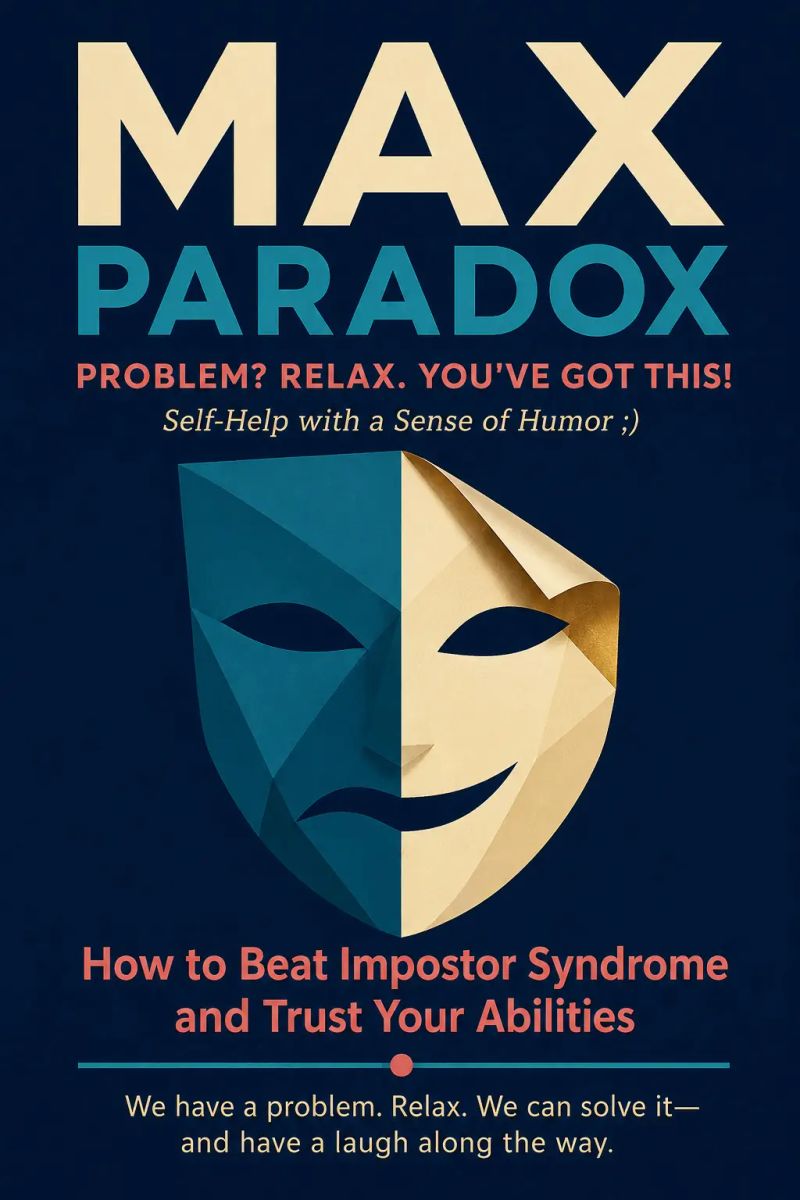
How to Beat Impostor Syndrome and Trust Your Abilities
By Max Paradox

Length6h 23m
About this audiobook
You can be competent, experienced, prepared, and still walk into a meeting convinced that everyone else received a secret manual you somehow missed. You can earn praise and immediately explain it away. You can get promoted and assume the company has made an unusually expensive administrative error. You can succeed repeatedly and still wait for the day someone finally discovers that you are "not really that good."
How to Beat Impostor Syndrome and Trust Your Abilities is a practical, funny, no-guru guide to stopping that cycle.
Max Paradox takes impostor syndrome apart without turning the book into a motivational fog machine. Instead of telling you to "just believe in yourself," he shows you how to evaluate your abilities more accurately, stop treating every mistake like an identity crisis, and build confidence from evidence rather than mood.
Inside, you will learn how to recognize the thinking patterns that keep impostor feelings alive, including perfectionism, comparison, overpreparation, reassurance seeking, praise rejection, fear of asking questions, and the belief that competent people should always know what they are doing. You will also learn how to separate a real skill gap from a distorted self-judgment, accept positive feedback without immediately filing an appeal, speak more directly, handle criticism without collapsing, and enter opportunities before you feel perfectly ready.
The book also tackles an uncomfortable truth: sometimes the problem is not entirely inside your head. Unclear expectations, poor feedback, difficult workplace cultures, and impossible roles can make capable people feel chronically inadequate. You will learn how to tell the difference between internal impostor thinking and external conditions that genuinely need to change.
The approach is designed for ordinary life: meetings where your mind goes blank, job applications you almost do not send, projects you overprepare for, praise you cannot accept, and moments when somebody asks a perfectly normal question and your nervous system treats it like a televised competency hearing. The methods are concrete enough to use immediately, even if your current confidence level is somewhere between "uncertain" and "please do not ask me to share my screen."
Most importantly, this is not a book about becoming loud, arrogant, endlessly positive, or convinced that you are brilliant at everything. The goal is accurate self-trust. That means knowing what you do well, knowing where your limits are, asking for help when needed, correcting mistakes, learning faster, and allowing your successes to count.
Expect practical exercises, specific scripts, evidence-based self-checks, realistic fallback plans, and a great deal of uncomfortable recognition. If you have ever received a compliment and responded by explaining why it was technically incorrect, this book may know you too well.
You do not need to become fearless. You do not need to become someone else. You need a fairer relationship with the abilities you already have - and the ones you are still building.
This publication was prepared with the assistance of tools that support the creative process, including artificial intelligence-based solutions. The final concept, structure, and editing belong to the author.
Audiobook details
GenreSelf-Help
Length6 hrs 23 mins
Narrated byListen with 1,000+ voices
FormateBook with Audio
Publish dateSep 7, 2026
LanguageEnglish
Table of contents
1INTRO
2Chapter 1 - The Fraud Nobody Has Discovered
3Chapter 2 - Why Success Never Seems to Count
4Chapter 3 - The Standard Nobody Could Pass
5Chapter 4 - Stop Auditioning for a Job You Already Have
Show all chaptersShow less
6Chapter 5 - Everyone Else Looks More Qualified
7Chapter 6 - Confidence Is Not a Feeling You Have to Wait For
8Chapter 7 - The Praise Problem
9Chapter 8 - What If They Really Do Find a Weakness?
10Chapter 9 - Stop Treating Questions Like Evidence Against You
11Chapter 10 - The Perfection of Other People’s Confidence
12Chapter 11 - Your Inner Critic Is Not a Senior Consultant
13Chapter 12 - You Are Allowed to Outgrow the Version of You Who Was Unsure
14Chapter 13 - Stop Waiting for Permission to Belong
15Chapter 14 - When Success Makes the Impostor Feeling Worse
16Chapter 15 - Maybe the Problem Is Not Entirely Inside Your Head
17Chapter 16 - Learn to Talk About What You’re Good At
18Chapter 17 - Build a Personal Definition of Enough
19Chapter 18 - Trust Yourself When Nobody Is Reassuring You
20Chapter 19 - You Do Not Need to Feel Like an Expert to Act Like One
21Chapter 20 - Trust Yourself Without Needing to Become Someone Else
How to Reclaim Your Focus in a World Full of DistractionsMax Paradox6h 18m$7.70 · $0.00

Absurdity of Being a Programmer - Deadlines, Production Bugs, Impostor Syndrome, AI Panic - and the Quiet Pride No One SeesMax Paradox3h 42m$7.70 · $0.00

Mam dość aplikacji randkowych: Jak szukać miłości bez zamieniania jej w drugą pracęMax Paradox5h 53m$7.70 · $0.00

Jak chronić wizerunek i prywatność dziecka w epoce AI - Jak rozsądnie publikować, chronić dane i przygotować dziecko na deepfake, oszustwa oraz internet bez zamieniania domu w cyfrowy bunkierMax Paradox5h 47m$7.70 · $0.00
I Have Too Much Stuff - How to Get Rid of Clutter Without Asking Every Mug Whether It Sparks JoyMax Paradox6h 20m$7.70 · $0.00

Everyone Thinks They’re a Good Driver - The Absurd Psychology of Traffic, Ego, and Losing Your Mind at 60 mphMax Paradox4h 22m$7.70 · $0.00

Kupiłem Samochód i Teraz Boję Się Każdej Kontrolki - Jak ogarnąć serwis, ubezpieczenie, koszty i podstawową obsługę auta bez udawania mechanikaMax Paradox5h 41m$7.70 · $0.00

I Think I Just Became the Boss - How to Start Managing People, Delegate, Give Feedback, and Stop Trying to Do Everything YourselfMax Paradox8h$7.70 · $0.00

I Can't Separate Work from Life - How to Stop Mentally Sitting at the Office During Dinner, Vacations, and SleepMax Paradox6h 9m$7.70 · $0.00

I Put Off All My Paperwork Until the Last Day - How to Handle Documents, Phone Calls, and Forms Without Moving to the WoodsMax Paradox6h 31m$7.70 · $0.00

Za dużo biorę na siebie - Jak przestać być jednoosobowym działem ratunkowym dla całego świataMax Paradox5h 11m4.3 (23)$7.70 · $0.00

How to Build Self-Confidence from the Ground UpMax Paradox6h 50m$7.70 · $0.00

I Take on Too Much - How to Stop Being the Entire World's One-Person Rescue SquadMax Paradox7h 8m$7.70 · $0.00

Nie wiem już, czy to zdjęcie jest prawdziwe - Jak przeżyć epokę deepfake’ów, AI i internetu, który potrafi podrobić wszystkoMax Paradox5h 46m$7.70 · $0.00

Mam etat, ale internet twierdzi, że potrzebuję jeszcze trzech biznesów - Jak przestać czuć się przegrywem bez side hustleMax Paradox5h 24m4.1 (21)$7.70 · $0.00

The Brutal Truth About Social Media - You scroll. You compare. You perform. Then you say you don’t care.Max Paradox6h 27m$7.70 · $0.00

Mam Kupić Prezent i Nagle Nie Znam Tej Osoby - Jak wybierać prezenty bez paniki, przepłacania i kupowania kolejnego kubka tylko dlatego, że zostały trzy godzinyMax Paradox5h 11m$7.70 · $0.00

The Brutal Truth About Slavic Gods and Traditions - Perun, Veles, Spirits, Rituals, and Our Ancestors’ Beliefs Without Romantic LegendsMax Paradox6h 27m$7.70 · $0.00

Brutalna prawda o Bolesławie Chrobrym - Wojny, żony, namiętności i bezwzględna droga pierwszego króla Polski do koronyMax Paradox5h 15m$7.70 · $0.00
Learning to PrayJames Martin13h 24m4.5 (3.4K)$33 · $0.00

Swayam Ki AwaazPrem Rawat8h 34m4.7 (1.1K)$26 · $0.00

Forever BoyKate Swenson9h 27m4.7 (5K)$29 · $0.00

You Are Worth ItKyle Carpenter, Don Yaeger8h 53m4.7 (4.8K)$29 · $0.00

The Happiest Man on EarthEddie Jaku3h 48m4.6 (178K)$7 · $0.00

Finding MeViola Davis9h 15m4.6 (256.4K)$29 · $0.00

Spiritual AnatomyDaaji Kamlesh D. Patel9h 47m4.7 (319)$29 · $0.00

The Dangerous Truth about Today’s MarijuanaLaura Stack CSP, MBA9h 57m4.7 (385)$20 · $0.00

The Gospel according to Spiritualism (Translated)Allan Kardec14h 39m4.6 (3.9K)$5.70 · $0.00

Birdie & HarlowTaylor Wolfe7h 50m4.6 (6.5K)$26 · $0.00

CrossroadsKaleb Dahlgren7h 56m4.6 (4.9K)$26 · $0.00

Life on the BridgeKaelynn Partlow5h 40m4.6 (1.1K)$24 · $0.00

Keep Your Love OnDanny Silk9h 4m4.6 (8.1K)$10 · $0.00

The Tao of Joy Every DayDerek Lin10h 24m4.6 (762)$20 · $0.00

UndividedVicky Beeching9h 2m4.6 (1.3K)$29 · $0.00

HE CAN WHO THINKS HE CAN & OTHER BOOKS ON SUCCESSOrison Swett Marden5h 54m4.6 (1.2K)$1.99 · $0.00
Level UpRob Dial7h 42m4.6 (3.3K)$26 · $0.00

Burn the HaystackJennie Young, PhD9h 30m4.6 (543)$29 · $0.00

ACRES OF DIAMONDS: Our Every-day Opportunities (Wisdom & Empowerment Series) (Annotated)Russell Conwell2h 26m4.6 (1K)$2 · $0.00

Good InsideBecky Kennedy9h 55m4.5 (59.3K)$29 · $0.00
You may also like

Believe in YourselfJoseph Murphy1h 56m4.2 (4.1K)$3 · $0.00

The Articulate AdvocateBrian K. Johnson, Marsha Hunter7h 45m4.2 (341)$19.70 · $0.00

Scientific Healing AffirmationsParamahansa Yogananda2h 24m4.4 (2.2K)$1 · $0.00

The EnchiridionEpictetus43m4.3 (52.1K)$6 · $0.00

ComparisonitisMelissa Ambrosini7h 50m4.0 (466)$26 · $0.00

Getting Things DoneMade for Success31m4.2 (12)$5

Achieve Harmony with Cosmic LawHenry Thomas Hamblin8h 41m$2 · $0.00

Men, Women and RelationshipsJohn Gray1h 26m4.0 (555)$16 · $0.00

Finding Order in ChaosSteve Pavlina7m$4 · $0.00

12 Guided Meditations for Anxiety ReliefGuided Meditation Studio1h 34m$6 · $0.00
How to Stop Fearing RejectionMax Paradox6h 40m$7.70 · $0.00

Stress and Anxiety Mind-Training HypnosisAnthony Peters23m$10 · $0.00
Quiet Power Through UnderstandingJasper Livingstone5h 55m$14.50 · $0.00

I Can't Get Along with My Coworkers - How to Survive Eight Hours a Day with People You Would Never Have ChosenMax Paradox6h 37m$7.70 · $0.00
Low Mood Mind-Training HypnosisAnthony Peters30m$10 · $0.00
Mobility TrainingLaura Chen5h 41m$5
ToastDr. Larry Iverson7h 34m$50

Becoming slim through hypnosisMichael Bauer52m3.8 (12)$35 · $0.00
Affirmations: Transform Your Financial Life With Daily Positive Affirmations (The Fastest Way to Build Positive Thinking and a Success Mindset That Attracts Anything You Want)James Sanders2h 28m$3.50 · $0.00

Enneagram in Real LifeStephanie Barron Hall9h 44m3.7 (117)$29 · $0.00