
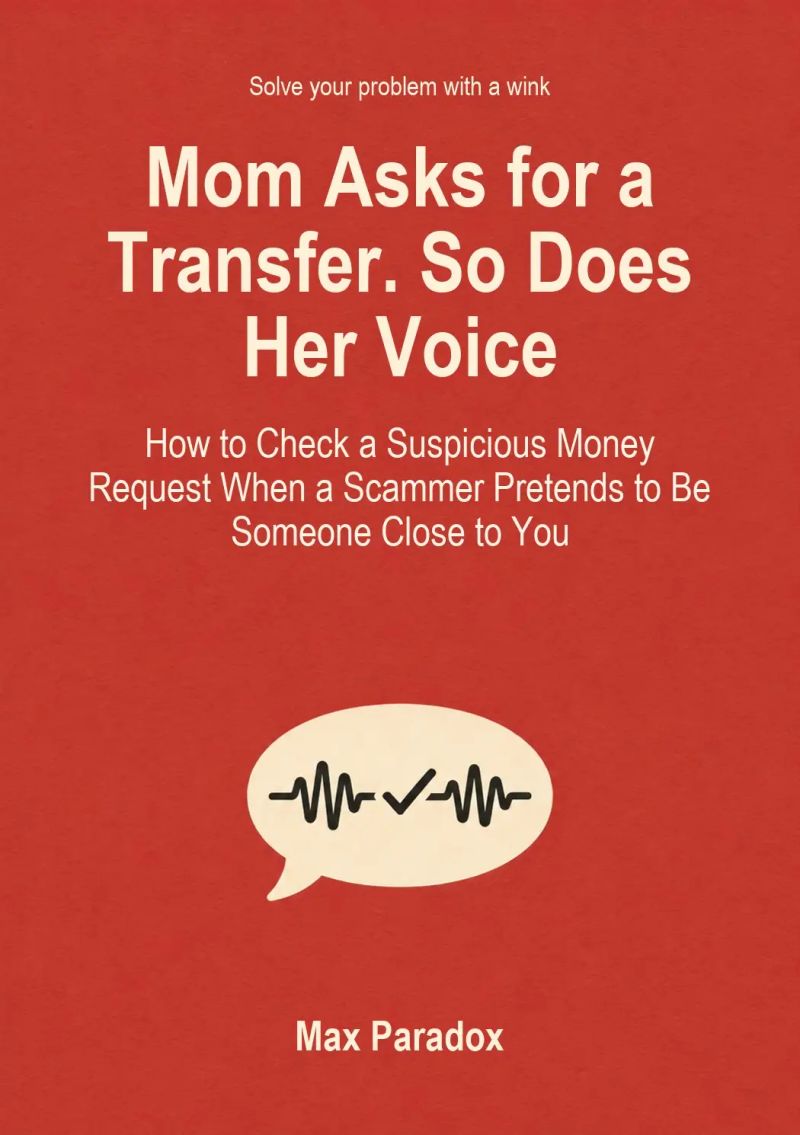
Mom Asks for a Transfer. So Does Her Voice - How to Check a Suspicious Money Request When a Scammer Pretends to Be Someone Close to You
By Max Paradox


Length8h 19m
About this audiobook
What if the voice asking you for money really sounds like your mother?
You pick up the phone. You hear a familiar voice, recognize the way someone speaks, and perhaps even hear a reference to a recent family event. The person on the other end sounds frightened. Something terrible has happened, and they need money immediately. There is no time to call anyone else. No time to ask questions. Just one urgent request: make a bank transfer.
But what if it isn't your mother?
Artificial intelligence has made it possible to imitate human voices using available recordings. Scammers can also exploit messaging applications, stolen accounts, copied photographs, and manipulated phone numbers. They do not always need sophisticated technology. Sometimes a convincing story, a familiar name, and a few minutes of emotional pressure are enough.
In Mom Asks for a Transfer. So Does Her Voice, Max Paradox explores how modern impersonation scams work and, more importantly, how to protect yourself and the people closest to you.
This practical guide takes you through the mechanisms of fraud that exploit family relationships, emotional connections, and our natural desire to help. It explains why even careful, intelligent people can make mistakes when fear, guilt, and urgency take control of their decisions.
Inside, you will discover:
How scammers imitate the voices, identities, and communication styles of family members.
Why familiar phone numbers, photographs, personal details, and shared memories are not sufficient proof of identity.
Which warning signs deserve attention, including unusual payment instructions, secrecy, changing stories, and pressure to act immediately.
How artificial intelligence, deepfakes, compromised accounts, and phone number spoofing can be used in impersonation attempts.
How to independently verify suspicious requests without turning a family conversation into an interrogation.
How to check bank transfers, BLIK payments, payment links, account numbers, and transaction authorization screens.
How to protect your digital footprint, email, messaging applications, passwords, and personal recordings.
What to do when someone has already transferred money, disclosed banking information, or lost access to an account.
How to recognize follow-up scams in which criminals promise to recover previously lost money.
How to establish practical family security rules that work across generations and different communication channels.
The book also addresses situations that are not always straightforward: when a loved one cannot answer their usual phone, when family members disagree about security, when an older parent refuses assistance, or when an apparently genuine emergency makes verification difficult.
Rather than promising a magical test that can expose every scammer, this guide focuses on a simple, repeatable approach: pause, establish independent contact, confirm the request, and check the recipient and payment details before authorizing a transaction.
You will also learn why protecting someone does not mean taking away their independence, why victims should never be ridiculed, and why reporting suspicious activity quickly matters.
This is not a book about living in constant fear of technology. It is about understanding its limitations and developing sensible habits that allow you to continue using modern communication without surrendering control of your financial decisions.
Because helping your family and protecting your money are not competing goals.
The next time someone says, "Mum, it's me. I need a bank transfer", you can take a moment to make sure you know exactly who is asking.
And that moment could make all the difference.
This publication was prepared using tools that support the creative process, including artificial intelligence solutions. The final concept, structure and editing are the responsibility of the author.
Audiobook details
GenreTechnology
Length8 hrs 19 mins
Narrated byListen with 1,000+ voices
FormateBook with Audio
Publish dateNov 22, 2026
LanguageEnglish
Table of contents
1INTRO
2Chapter 1 - Who Is Really Asking for the Money? The New Face of Impersonation Scams
3Chapter 2 - Why Do We Believe Before We Verify? The Psychology of Trust and Pressure
4Chapter 3 - Red Flags You Should Never Ignore: How to Recognize When Something Doesn't Add Up
5Chapter 4 - A False Sense of Security: Why Popular Verification Methods Fail
Show all chaptersShow less
6Chapter 5 - Don't Help the Scammer Scam You: Mistakes That Make Fraud Easier
7Chapter 6 - Your Family Leaves Digital Footprints: How to Protect Information That Helps Scammers
8Chapter 7 - The Shame That Helps Scammers: Why Victims Stay Silent and How to Break the Silence
9Chapter 8 - A Scam in Several Acts: How Criminals Exploit Trust Between Family Members
10Chapter 9 - Before You Click "Send": A Family Procedure for Checking Suspicious Requests
11Chapter 10 - A Safe Bank Transfer from A to Z: How Not to Lose Your Money with One Wrong Click
12Chapter 11 - A Family Security System: Agree on the Rules Before Someone Calls Asking for Money
13Chapter 12 - When Help Is Genuinely Needed: How to Act Without Falling for a False Alarm
14Chapter 13 - You Don't Have to Be an IT Expert: How to Use Technology to Check Suspicious Contacts
15Chapter 14 - When the Scam Has Already Happened: How to Limit the Damage and Avoid Being Scammed Twice
16Chapter 15 - When the Usual Rules Are Not Enough: Difficult Situations in Which Verification Becomes a Challenge
17Chapter 16 - When Someone Steals Your Voice: How to Protect Your Identity Against Digital Impersonation
18Chapter 17 - When Someone Close to You Refuses to Believe They Are Being Scammed: How to Help Without Starting a Family War
19Chapter 18 - How to Maintain Security Every Day: Good Habits That Continue Working After You Finish Reading
20Chapter 19 - When the Scammer Returns with a New Story: How to Recognize a Recurring Threat Before You Lose Money Again
21Chapter 20 - Your Family, Your Rules, Your Decision: How to Protect Yourself Independently in the Future

Meine Telefonnummer hat gerade einen neuen Besitzer bekommen - Wie du dich auf einen Nummernwechsel vorbereitest und den Zugang zu deinen wichtigen Konten behältstMax Paradox6h 58m$7.40

I'm Selling a Sofa, So Why Does the Buyer Want My Card? - How to Buy and Sell Safely on Online Classifieds PlatformsMax Paradox6h 8m$7.40

Mój szef kazał zautomatyzować coś, czego nikt nie rozumie - Jak uporządkować proces przed wdrożeniem AI i mierzyć realny zyskMax Paradox5h 35m$7.40

Pan z banku zna moje imię i ma za dużo czasu - Jak rozpoznać fałszywy telefon z banku i samodzielnie zweryfikować rozmówcęMax Paradox5h 30m$7.40

The App Asks About My Health, I Ask About My Privacy - How to Use Health Apps Wisely and Limit the Personal Data You ShareMax Paradox5h 54m$7.40

Mama bittet um eine Überweisung. Ihre Stimme auch. - Wie du eine verdächtige Geldforderung überprüfst, wenn ein Betrüger sich als eine nahestehende Person ausgibtMax Paradox8h$7.40
The Man from the Bank Knows My Name and Has Way Too Much Time - How to Spot a Fake Bank Call and Verify the Caller YourselfMax Paradox5h 41m$7.40

My Address Is Traveling the Internet Without a Suitcase - How to Find Where Your Personal Data Appears and Reduce Its Public VisibilityMax Paradox5h 54m$7.40

Mam pięć paczek i nie pamiętam, którą zamówiłem - Jak śledzić zakupy, reklamacje i zwroty bez polowania na potwierdzeniaMax Paradox5h 52m$7.40

Mój numer telefonu właśnie zmienił właściciela - Jak przygotować się do zmiany numeru i utrzymać dostęp do ważnych kontMax Paradox5h 45m$7.40

Der Mann von der Bank kennt meinen Namen und hat viel zu viel Zeit - Wie du einen gefälschten Bankanruf erkennst und die Identität des Anrufers selbst überprüfstMax Paradox6h 33m$7.40

Wszystko jest w chmurze, tylko nie wiem, w której - Jak uporządkować dokumenty cyfrowe, ich dostępność i kopie zapasoweMax Paradox6h 13m$7.40

Everything Is in the Cloud, I Just Don't Know Which One - How to Organize Your Digital Documents, Keep Them Accessible, and Back Them UpMax Paradox6h 22m$7.40

Zmienił się system, przeciążyłem się ja - Jak przejść przez obowiązkową zmianę narzędzi w pracy bez brania całej migracji na siebieMax Paradox6h 8m$7.40

Ich habe das perfekte Jobangebot gefunden. Offenbar hat es mich zuerst gefunden. - Wie du gefälschte Stellenanzeigen erkennst und deine persönlichen Daten bei der Jobsuche schütztMax Paradox7h 23m$7.40

Alles ist in der Cloud, ich weiß nur nicht, in welcher - Wie du deine digitalen Dokumente organisierst, jederzeit darauf zugreifen kannst und zuverlässige Backups erstellstMax Paradox7h 24m$7.40

AI Summarized the Contract. The Contract Disagrees - How to Compare AI Summaries with the Original Document and Spot Missing ExceptionsMax Paradox5h 58m$7.40

AI streściło umowę. Umowa ma inne zdanie - Jak porównywać streszczenia AI z dokumentem i rozpoznawać pominięte wyjątkiMax Paradox5h 44m$7.40

The System Changed, and I Got Overloaded - How to Navigate a Mandatory Workplace Tool Migration Without Taking the Entire Transition on Your ShouldersMax Paradox6h 26m$7.40

Collected Writings of Nikola TeslaThomas Commerford Martin, Nikola Tesla19h 42m4.4 (2.8K)$1.99 · $0.00

Operation PedestalMax Hastings12h 29m4.4 (5.2K)$29 · $0.00

When the Heavens Went on SaleAshlee Vance18h 20m4.4 (3K)$40 · $0.00

Everybody Has a Podcast (Except You)Justin McElroy, Travis McElroy, Griffin McElroy5h 9m4.3 (2.3K)$24 · $0.00

Hands of TimeRebecca Struthers8h 8m4.4 (1.3K)$26 · $0.00

Never Lost AgainBill Kilday10h 1m4.4 (805)$29 · $0.00
How the Internet HappenedBrian McCullough13h 28m4.3 (2.7K)$23 · $0.00

Collected Writings of Nikola TeslaNikola Tesla, Thomas Commerford Martin21h 50m4.3 (1.7K)$1 · $0.00

Just AspireAjai Chowdhry9h 13m4.4 (260)$29 · $0.00

The Little Book of AliensAdam Frank8h 20m4.3 (1.3K)$26 · $0.00

The inventions, researches and writings of Nikola Tesla (Annotated)Thomas Commerford Martin16h 59m4.3 (1.3K)$2 · $0.00

KargilV.P. Malik15h 18m4.3 (2K)$24 · $0.00

Experiments with Alternating CurrentsNikola Tesla9h 16m4.3 (874)$1.99 · $0.00

Fire on the HorizonTom Shroder, John Konrad8h 23m4.3 (858)$26 · $0.00

The Smell of Kerosene (Annotated)National Aeronautics and Space Administration, Donald L. Mallick, Peter W. Merlin11h 32m4.3 (523)$2 · $0.00

The Boy Who Harnessed the WindWilliam Kamkwamba, Bryan Mealer10h 5m4.2 (78.9K)$29 · $0.00

Across the Airless WildsEarl Swift10h 8m4.3 (1.3K)$29 · $0.00

Console WarsBlake J. Harris20h 41m4.2 (13.7K)$46 · $0.00
Improvised Munitions HandbookU.S. Department of Defense4h 49m4.3 (1.6K)$1.99 · $0.00

Escaping GravityLori Garver10h 54m4.2 (2.2K)$20 · $0.00