
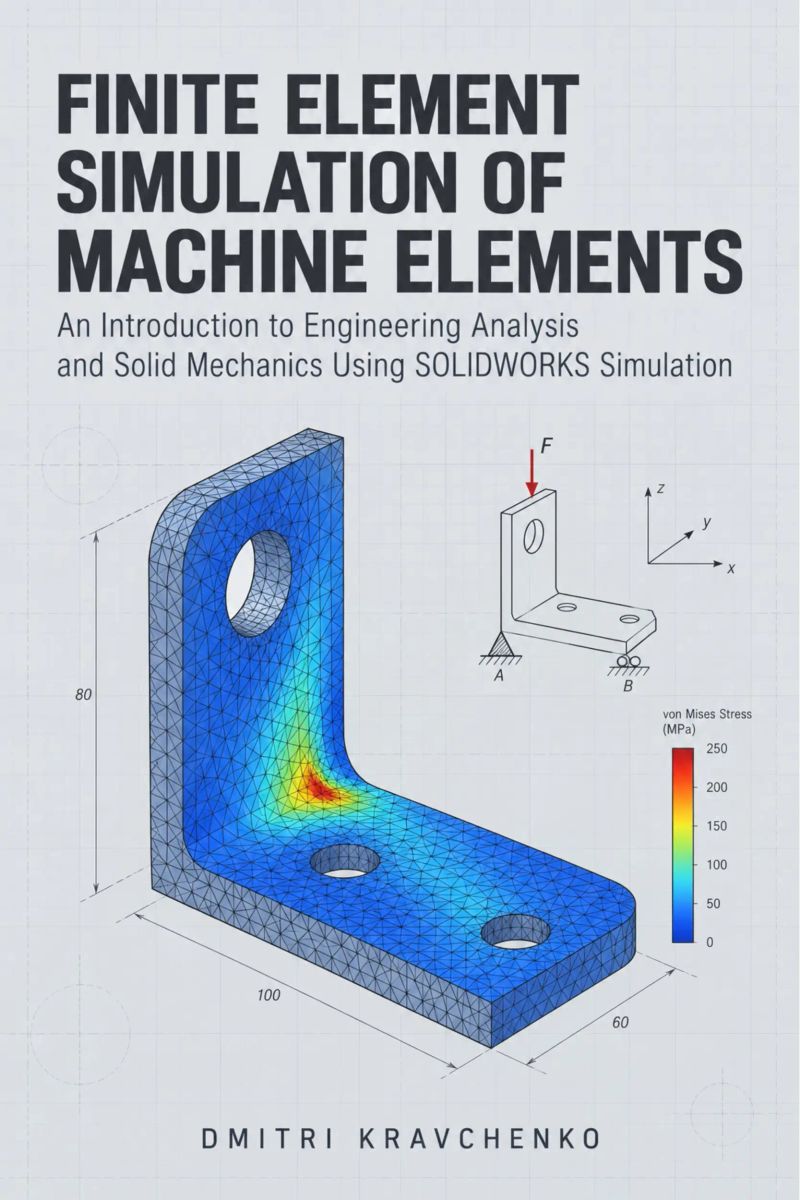
Finite Element Simulation of Machine Elements
An Introduction to Engineering Analysis and Solid Mechanics Using SOLIDWORKS SimulationBy Dmitri Kravchenko

Length13h 35m
About this audiobook
A colourful stress plot is not an answer.
This book teaches you to produce results you can defend, using machine elements you already design. You will set up studies properly, choose between solid and shell elements, run genuine mesh convergence studies, and recognise the restraint mistakes that quietly inflate stresses. Component chapters take you through brackets and frames checked against beam theory, shafts and press fits with stress concentrations, bolted joints with preload and contact, sheet metal shells, springs, buckling factors, thermal stress, fatigue damage and modal frequencies. Every model is validated against a hand calculation before it is believed, and the closing chapter shows how to document assumptions so your analysis survives review.
For mechanical designers, engineering students and new simulation users, this practical guide bridges the gap between theory and software. It focuses on the engineering decisions that determine whether a simulation is trustworthy, not just on how to click through menus. By the end, you will have a repeatable workflow for verifying and validating your models, and the confidence to present your results to colleagues, clients, or reviewers.
What you will learn:
• How finite element analysis actually computes displacements, strains, and stresses
• The solid mechanics you must recall to interpret results correctly
• A complete simulation workflow from CAD to results
• How to create quality meshes and run mesh convergence studies
• How to apply boundary conditions and load cases without over-constraining
• How to analyse beams, brackets, frames, shafts, keys, and press fits
• How to model bolted joints with preload and contact
• How to handle shells, sheet metal, springs, buckling, thermal stress, fatigue, and modal frequencies
• How to verify, validate, and report your analysis so it survives review
Whether you are a practising mechanical designer, an engineering student, or a new simulation user, this book will help you move beyond colourful plots to defensible engineering answers. If you design machine elements and want to use SOLIDWORKS Simulation with confidence, this book is for you.
Audiobook details
GenreTechnology
Length13 hrs 35 mins
Narrated byListen with 1,000+ voices
FormateBook with Audio
Publish dateSep 27, 2026
LanguageEnglish
Table of contents
1Finite Element Simulation of Machine Elements
2Foreword
3Preface
4About This Book
5Important Safety Notice
Show all chaptersShow less
6Chapter 1: What Finite Element Analysis Actually Computes
71.1 From Machine Element to Discrete Model
81.2 Degrees of Freedom and What the Solver Stores
91.3 Interpolation, Shape Functions, and Why Results Are Approximate
101.4 Sources of Error and the Meaning of Convergence
111.5 What the Solver Cannot Tell You
12Chapter 2: Solid Mechanics You Must Recall
132.1 Stress and Strain at a Point
142.2 Hooke’s Law in Three Dimensions
152.3 Principal Stresses and Mohr’s Circle
162.4 The von Mises Yield Criterion
172.5 Stress Concentration, Contact Pressure, and Superposition Limits
18Chapter 3: The Simulation Workflow
193.1 Choosing the Study Type
203.2 Materials, Units, and Property Entry
213.3 Fixtures, Loads, and Their Physical Meaning
223.4 Meshing, Solving, and Reading Results
233.5 A Complete First Study, Start to Finish
24Chapter 4: Meshing and Element Quality
254.1 Solid and Shell Elements and When to Use Each
264.2 Mesh Controls, Sizing, and Local Refinement
274.3 Element Quality Metrics and How to Read Them
284.4 Mesh Convergence Studies Done Properly
294.5 Adaptive Refinement and Practical Mesh Budgets
30Chapter 5: Boundary Conditions and Load Cases
315.1 Restraints as Idealised Supports
325.2 Bearing Loads, Remote Loads, and Load Application
335.3 Symmetry and Anti-Symmetry
345.4 Rigid-Body Motion and Over-Restraint Diagnosis
355.5 Building a Defensible Load Case Set
36Chapter 6: Beams, Brackets, and Frames
376.1 Beam Theory Results to Check Against
386.2 Solid Models of Brackets and Their Comparison
396.3 Fillets, Gussets, and Stress Concentration in Practice
406.4 Torsion in Shafts and Frames
416.5 Frames, Joints, and Load Path Assumptions
42Chapter 7: Shafts, Keys, and Press Fits
437.1 Shaft Stresses from Combined Loading
447.2 Stress Concentration at Shoulders, Grooves, and Keyways
457.3 Press Fits and Interference Contact
467.4 Keys, Splines, and Torque Paths
477.5 Verifying a Shaft Study Against Hand Calculations
48Chapter 8: Bolted Joints and Contact
498.1 Bolt Preload and Joint Stiffness
508.2 Modelling Bolts: Solid, Beam, and Connector Approaches

The Honey BusMeredith May9h 31m4.4 (16.6K)$25 · $0.00

Collected Writings of Nikola TeslaThomas Commerford Martin, Nikola Tesla19h 42m4.4 (2.8K)$1.99 · $0.00

Operation PedestalMax Hastings12h 29m4.4 (5.2K)$29 · $0.00

When the Heavens Went on SaleAshlee Vance18h 20m4.4 (3K)$40 · $0.00

Everybody Has a Podcast (Except You)Justin McElroy, Travis McElroy, Griffin McElroy5h 9m4.3 (2.3K)$24 · $0.00

Hands of TimeRebecca Struthers8h 8m4.4 (1.3K)$26 · $0.00

Never Lost AgainBill Kilday10h 1m4.4 (805)$29 · $0.00

How the Internet HappenedBrian McCullough13h 28m4.3 (2.7K)$23 · $0.00

Collected Writings of Nikola TeslaNikola Tesla, Thomas Commerford Martin21h 50m4.3 (1.7K)$1 · $0.00

Just AspireAjai Chowdhry9h 13m4.4 (260)$29 · $0.00

The Little Book of AliensAdam Frank8h 20m4.3 (1.3K)$26 · $0.00

The inventions, researches and writings of Nikola Tesla (Annotated)Thomas Commerford Martin16h 59m4.3 (1.3K)$2 · $0.00

KargilV.P. Malik15h 18m4.3 (2K)$24 · $0.00

Experiments with Alternating CurrentsNikola Tesla9h 16m4.3 (874)$1.99 · $0.00

Fire on the HorizonTom Shroder, John Konrad8h 23m4.3 (858)$26 · $0.00

The Smell of Kerosene (Annotated)National Aeronautics and Space Administration, Donald L. Mallick, Peter W. Merlin11h 32m4.3 (523)$2 · $0.00

The Boy Who Harnessed the WindWilliam Kamkwamba, Bryan Mealer10h 5m4.2 (78.9K)$29 · $0.00

Across the Airless WildsEarl Swift10h 8m4.3 (1.3K)$29 · $0.00

Console WarsBlake J. Harris20h 41m4.2 (13.7K)$46 · $0.00

Improvised Munitions HandbookU.S. Department of Defense4h 49m4.3 (1.6K)$1.99 · $0.00
You may also like

Writer to WriterGail Carson Levine5h 40m4.2 (1.1K)$24 · $0.00

Pete the Cat's Not So Groovy DayJames Dean, Kimberly Dean7m4.3 (282)$4 · $0.00

The 4 Percent UniverseRichard Panek10h 7m4.0 (9.5K)$20

Odd Owls & Stout PigsArnold Lobel10m3.7 (217)$4 · $0.00

Crystal ClearImad Muratspahic3h 25m$12 · $0.00

Short-story masterpieces: FrenchVarious3h 18m$2 · $0.00

How to Make Money Flipping Websites and Online Businesses - How to Verify Traffic and Revenue, Improve Digital Assets, and Sell at a Higher MultipleJACK FLIPWELL11h 6m$7.90 · $0.00

Discounted Cash Flow DemystifiedLuna Z. Rainstorm8h 4m$6.40 · $0.00

Skin in the GameJim Gilreath11h 5m$25

How to Make Money Flipping Trading Cards - How to Research Sold Prices, Assess Condition, Decide When to Grade, and Manage Market RiskJACK FLIPWELL8h 33m$7.90 · $0.00

The Origin of VertebratesWalter Holbrook Gaskell21h 35m$1 · $0.00

South Dakota Notary Public Exam Prep and Handbook 2026/2027Marisol Achterberg8h 49m$15

South Carolina NMLS SAFE MLO Exam Study Guide 2026/2027Ignatius Farrow15h 49m$30

North Dakota Notary Public Exam Prep and Handbook 2026/2027Marisol Achterberg8h 59m$15

How to Host a Virtual Baby Shower- Tips for Celebrating from AfarAurora Brooks45m4.1 (24)$3.50 · $0.00

Ultimate Multi Level Marketing SecretsFernando Moreira13m$6 · $0.00

ARDMS Vascular Technology Exam Study GuideMarie Peterson9h 15m$10

Capital: The Process of Circulation of Capital (Annotated)Karl Marx23h 39m4.3 (18)$2 · $0.00

Massachusetts Notary Public Exam Prep and Handbook 2026/2027Marisol Achterberg8h 43m$15

Electric Bells and All About Them: A Practical Book for Practical MenSelimo Romeo Bottone2h 42m4.3 (11)$2 · $0.00