
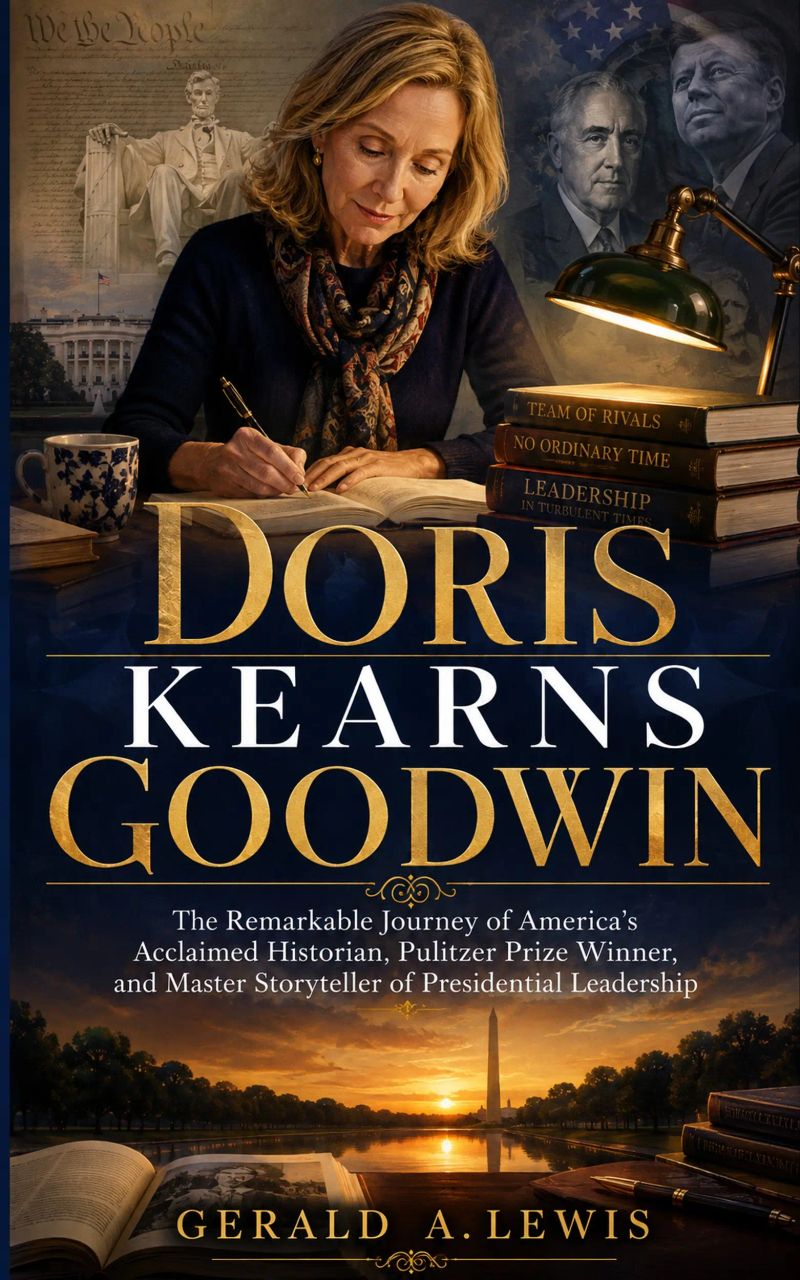
Doris Kearns Goodwin
The Remarkable Journey of America’s Acclaimed Historian, Pulitzer Prize Winner, and Master Storyteller of Presidential LeadershipBy Gerald A. Lewis


Length4h 17m
About this audiobook
Here it is — 3,906 characters, leaning hard into the dramatic hook while staying true to what's actually in the book:
---
DORIS KEARNS GOODWIN
The Remarkable Journey of America's Acclaimed Historian, Pulitzer Prize Winner, and Master Storyteller of Presidential Leadership
She criticized a sitting president in print — and he hired her anyway. Then he danced with her at a White House ball, brought her into the Oval Office, and years later, walked her across his Texas ranch, confessing doubts he shared with almost no one else alive. That relationship turned a twenty-four-year-old graduate student into the historian who would go on to win a Pulitzer Prize, help write the film that won Daniel Day-Lewis an Oscar, and become one of the most trusted voices in America — right before nearly losing it all.
This is the book that tells the whole story. Not the flattering highlight reel. The real one.
Before she was interviewing presidents, she was a six-year-old at a Long Island kitchen table, reconstructing entire Brooklyn Dodgers games from memory to relay to her father, pitch by pitch, because he couldn't listen live. That instinct — turning scattered facts into a story someone could believe in — never left her. It carried her to Harvard, into Lyndon Johnson's White House during the most explosive year of his presidency, and eventually into the archives of Lincoln, the Roosevelts, and the Kennedys.
Then, in 2002, it nearly destroyed her.
Reporters discovered that passages in her book on the Kennedy family echoed another author's work almost word for word. She'd quietly settled with that author a decade earlier — and never told anyone. As the scandal widened, she resigned from the Pulitzer Prize board in disgrace, and critics openly called for her own Pulitzer to be revoked. Most biographies rush past this. This one doesn't blink. You get the timeline, the apology, the fallout — and the astonishing decade that followed, when she came back stronger than before.
Inside, you'll discover:
- The White House dance that rewrote her entire career, straight from a president she'd publicly tried to remove from office
- How eight years alongside a dying ex-president's memories became the most intimate presidential research ever conducted
- The full, unflinching account of the 2002 plagiarism scandal — what she hid, what she admitted, and how it almost ended everything
- The literary marriage behind the scenes: her 42 years with speechwriter Richard Goodwin, the man who wrote Robert Kennedy's most famous words
- How a disgraced historian rebuilt her reputation by writing the book that became Spielberg's Lincoln
- The mentor who taught her that presidents aren't born powerful — they're built by crisis, exactly like she was
- Why business schools and military academies now teach her books as leadership doctrine
- What she's doing right now, in her ninth decade, still unwilling to stop
This is a story about the price of ambition, the fragility of reputation, and the astonishing fact that the same instincts that made Doris Kearns Goodwin one of America's greatest storytellers are the exact instincts that almost ended her career. Her own life's work insists that no leader should be remembered for a single moment, good or bad. This book finally turns that unflinching standard back on her.
If you loved Team of Rivals or No Ordinary Time, you've only read half her story. If you think you know how scandals end careers, her comeback will surprise you.
Includes a complete timeline, reading guide, discussion questions, and bibliography.
An…
Audiobook details
GenreBiography and Memoir, Other
Length4 hrs 17 mins
Narrated byListen with 1,000+ voices
FormateBook with Audio
LanguageEnglish
Table of contents
1Introduction
2Introduction
3Chapter 1: A Curious Mind Is Born
4Chapter 2: Discovering the Power of Education
5Chapter 3: College Years and Finding Her Voice
Show all chaptersShow less
6Chapter 4: Entering Public Service
7Chapter 5: Inside the White House
8Chapter 6: Becoming a Historian
9Chapter 7: The First Major Success
10Chapter 8: Winning the Pulitzer Prize
11Chapter 9: Bringing Presidents to Life
12Chapter 10: Challenges Behind the Success
13Chapter 11: Leadership Lessons Across History
14Chapter 12: Becoming America’s Trusted Historian
15Chapter 13: Richard and Doris: A Marriage of Two Historians
16Chapter 14: Inspiring a New Generation
17Chapter 15: A Lifetime of Achievement
18Chapter 16: The Legacy of Storytelling
19Chapter 17: Beyond the Books
20Chapter 18: Inside the Archive — How the Books Get Made
21Chapter 19: Kearns Goodwin Among Her Contemporaries
22Chapter 20: The Business of Bestsellers
23Chapter 21: Presidents as People — The Common Thread Across Four Books
24Chapter 22: A Reader’s Guide to Key Figures
25Chapter 23: What the Critics Say
26Chapter 24: The Great Society — What Johnson Built
27Chapter 25: The Vietnam War and a Presidency Under Strain
28Chapter 26: Lincoln’s Cabinet at War
29Chapter 27: The Roosevelts and the Second World War
30Chapter 28: Richard Neustadt and the Harvard School of Presidential Studies
31Chapter 29: The White House Fellows Program — An American Institution
32Chapter 30: Baseball as American Memory
33Chapter 31: Colby College and the Liberal Arts Tradition
34Chapter 32: Writing About the Living — The Ethics of Contemporary Biography
35Chapter 33: The Kennedy School and the Institute of Politics
36Chapter 34: Theodore Roosevelt Before the Presidency
37Chapter 35: William Howard Taft’s Reluctant Ambition
38Chapter 36: Franklin Roosevelt Before the White House
39Chapter 37: Lyndon Johnson’s Rise to Power
40Chapter 38: The 1964 Election and the Great Society Mandate
41Chapter 39: Grief and Biography — Writing About Death
42Chapter 40: The Historian as Public Intellectual
43Chapter 41: Presidential Libraries and the Preservation of Memory
44Chapter 42: The Ninth Decade
45Chapter 43: The Papers of a Marriage — Inside the Briscoe Archive
46Chapter 44: Teaching Leadership — A Curriculum in Four Presidents
47Chapter 45: The Reader’s Verdict — Sales, Syllabi, and Staying Power
48Chapter 46: What Comes Next for Presidential History
49Chapter 47: The Vantage Point — Inside Johnson’s Own Memoir
50Chapter 48: Concord, Massachusetts and the Weight of History
More from Gerald A. Lewis

STUCK BETWEEN STATIONSGerald A. Lewis2h 8m$6
Five Dollars And Fifty CentsGerald A. Lewis4h 5m$5

PECCOGerald A. Lewis1h 6m$5

UNCLE CLAYGerald A. Lewis2h 25m$6.50
THE LONG SLEEVESGerald A. Lewis3h 7m$6.50 · $0.00

Reece WalshGerald A. Lewis43m$6.50 · $0.00
ALLISON MACKGerald A. Lewis36m$6.50 · $0.00

THE LEDGERGerald A. Lewis3h 21m$6.50 · $0.00
SUSIE WOLFFGerald A. Lewis39m$6.50 · $0.00
FUNNIEST CHAPTER YETGerald A. Lewis2h 43m$6.50 · $0.00

Peter magyarGerald A. Lewis1h 16m$6.50 · $0.00
BEYOND THE FRETBOARDGerald A. Lewis4h 42m$6.50 · $0.00
HANK WILLIAMS BIOGRAPHYGerald A. Lewis4h 46m$6.50 · $0.00

MotherlandJulia Ioffe17h 52m4.7 (2.5K)$40 · $0.00
Evidence Not SeenDarlene Deibler Rose11h 11m4.6 (11.9K)$29 · $0.00

Where Cowards Go to DieBenjamin Sledge8h 42m4.7 (351)$20 · $0.00

Will You Love Me?Cathy Glass9h 5m4.6 (9.3K)$29 · $0.00

Designing Terry Pratchett’s DiscworldPaul Kidby3h 52m4.7 (343)$20 · $0.00

HostageEli Sharabi5h 25m4.6 (10.8K)$24 · $0.00
Finding MeViola Davis9h 15m4.6 (256.4K)$29 · $0.00

The Dangerous Truth about Today’s MarijuanaLaura Stack CSP, MBA9h 57m4.7 (385)$20 · $0.00

Birdie & HarlowTaylor Wolfe7h 50m4.6 (6.5K)$26 · $0.00
The Lives of BrianBrian Johnson9h 45m4.6 (3.5K)$29 · $0.00

I Am The StormJanice Dean9h4.6 (1.5K)$8 · $0.00
Black History CollectionFrederick Douglass, Harriet Ann Jacobs, Booker T. Washington, W.E.B. Du Bois27h 9m4.6 (2.6K)$18 · $0.00
Just as I AmCicely Tyson16h 8m4.6 (99K)$33 · $0.00

Unbroken Bonds of BattleJohnny Joey Jones8h 31m4.6 (2.6K)$8 · $0.00

The Daughter of AuschwitzTova Friedman, Malcolm Brabant7h 54m4.6 (16.7K)$26 · $0.00
My Bondage and My Freedom (Annotated)Frederick Douglass15h 30m4.6 (2.4K)$2 · $0.00
Lily's PromiseLily Ebert, Dov Forman8h 54m4.6 (16.1K)$29 · $0.00

CrossroadsKaleb Dahlgren7h 56m4.6 (4.9K)$26 · $0.00

Across the RiverKent Babb11h 40m4.6 (927)$29 · $0.00

The Biography of Robert Murray M'CheyneAndrew A. Bonar7h 41m4.6 (2.2K)$1 · $0.00
Mere ChristianityC. S. Lewis7h 7m4.4 (519.7K)$24 · $0.00

Her Daily BreadKate Wood12h 57m4.6 (153)$33 · $0.00
The Holy Bible - 1 SamuelKing James2h 13m4.8 (1.6K)$3 · $0.00
The American Standard Bible — The Gospel of MatthewMatthew3h 56m4.7 (3K)$2 · $0.00

Bad Fat Black GirlSesali Bowen6h 32m4.7 (2.8K)$24 · $0.00
The King James Audio Bible New Testament CompleteChristopher Glyn20h 2m4.7 (2.6K)$12 · $0.00
Faiths CheckbookCharles Spurgeon12h 44m4.7 (3.2K)$11 · $0.00
Ten Things I Wish You Knew About Your Child's Mental HealthDr. Billy Garvey4h 53m4.7 (2.4K)$20 · $0.00
Designing Terry Pratchett’s DiscworldPaul Kidby3h 52m4.7 (343)$20 · $0.00
The Chosen Book OneAmanda Jenkins, Kristen Hendricks, Dallas Jenkins3h 8m4.6 (4.9K)$10 · $0.00
The Lives of BrianBrian Johnson9h 45m4.6 (3.5K)$29 · $0.00
Expository Thoughts on the Gospel of LukeJ.C. Ryle27h 13m4.7 (536)$18 · $0.00
CrossroadsKaleb Dahlgren7h 56m4.6 (4.9K)$26 · $0.00
Across the RiverKent Babb11h 40m4.6 (927)$29 · $0.00

Brain Training for RidersAndrea Monsarrat Waldo5h 56m4.7 (550)$19 · $0.00
My Effin' LifeGeddy Lee17h 11m4.6 (13.1K)$40 · $0.00
Kings and PawnsHoward Bryant10h 9m4.6 (678)$29 · $0.00

The Elementia Chronicles #2: The New OrderSean Fay Wolfe11h 17m4.6 (841)$29 · $0.00
The ActsLuke2h 55m4.6 (19.7K)$12 · $0.00

New Testament - Easy NavigationWorld English Bible19h 35m4.6 (1.3K)$1.30 · $0.00
You may also like
The Analects of ConfuiusConfucius3h 4m4.0 (50.2K)$2.30
George Washington's Rules of CivilityMoncure Daniel Conway, George Washington3h 37m4.2 (1.5K)$2 · $0.00

The BertramsAnthony Trollope25h 28m3.7 (1.7K)$2 · $0.00
The Education of Henry AdamsHenry Adams19h 18m3.8 (8.2K)$2.30
The Disappearance of ChildhoodNeil Postman5h 58m4.1 (2.8K)$14
Nice TryJosh Gondelman5h 59m4.0 (2K)$24 · $0.00
There Is Simply Too Much to Think AboutSaul Bellow20h 28m4.0 (272)$30
Me, Inc.Gene Simmons6h 4m4.0 (1.5K)$24 · $0.00

The Education of Henry Adams (Annotated)Henry Adams21h 22m4.1 (16.9K)$2 · $0.00
Letters to His Son, 1750Philip Dormer Stanhope Earl of Chesterfield3h 34m4.1 (752)$2 · $0.00
The LacunaBarbara Kingsolver19h 16m4.0 (81.6K)$40 · $0.00

The Life of Thomas MorePeter Ackroyd18h 7m4.2 (5.9K)$28 · $0.00

A PORTRAIT OF THE ARTIST AS A YOUNG MAN (Awakening of Stephen Dedalus) (Annotated)James Joyce11h 13m3.8 (197.1K)$1.99 · $0.00
Letters to His Son, 1750Philip Dormer Stanhope Earl of Chesterfield3h 34m4.0 (2.1K)$1 · $0.00
George Washington's Rules of CivilityMoncure Daniel Conway, George Washington3h 38m4.1 (1.5K)$1 · $0.00
Loss and Gain (Annotated)John Henry Newman13h 29m4.2 (370)$3 · $0.00
The Home and the WorldRabindranath Tagore7h 19m4.0 (8.6K)$2.30
Searching for Bobby FischerFred Waitzkin8h 48m4.1 (2.1K)$17 · $0.00

The Life & Legacy of W.E. GladstoneJohn Morley80h 27m4.3 (131)$2 · $0.00
Piety & PowerTom LoBianco11h 30m3.7 (366)$29 · $0.00