
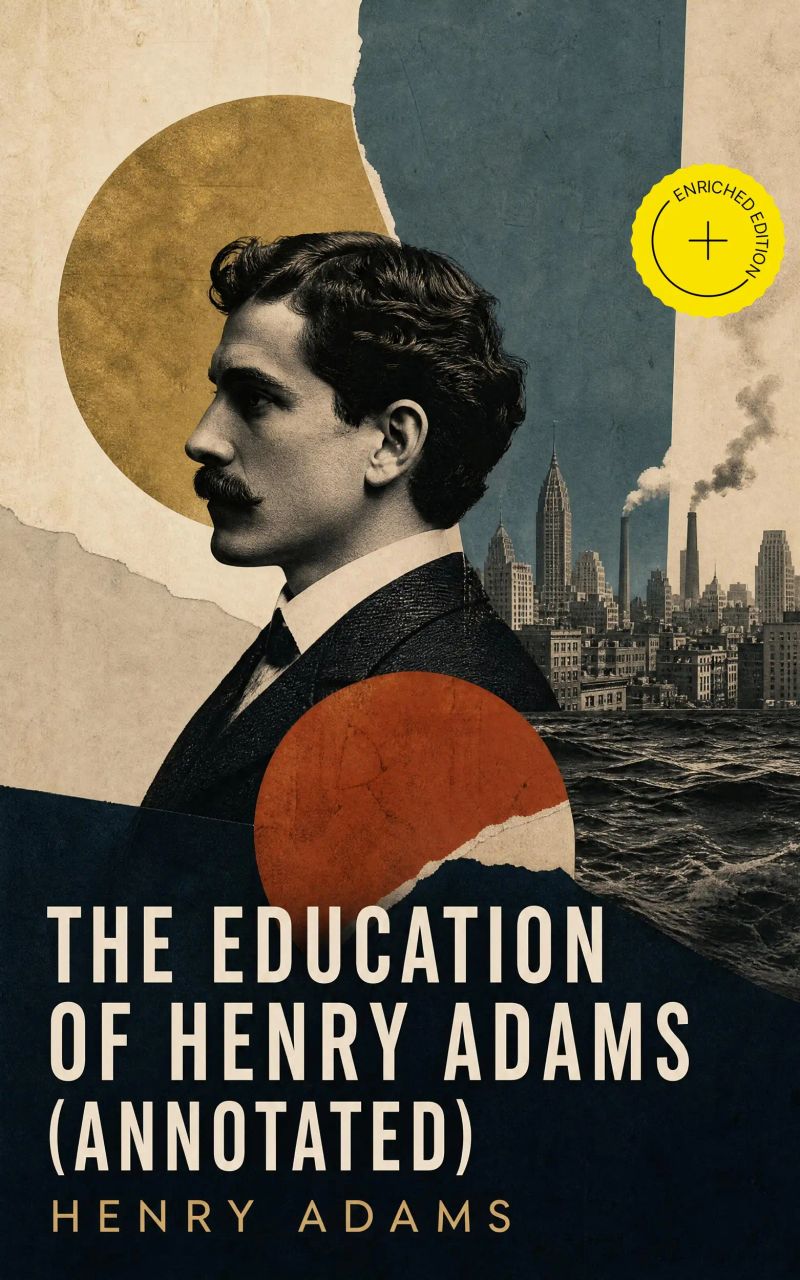
The Education of Henry Adams (Annotated)
Enriched Edition. A Third-Person Memoir of Gilded Age America, Political Inheritance, and the Crisis of ModernityBy Henry Adams


Length21h 21m
About this audiobook
The Education of Henry Adams is a singular work of American autobiography: less a linear memoir than a searching intellectual history of the nineteenth century confronting the bewildering energies of the twentieth. Written in a cool, ironic third person, Adams examines his own formation amid politics, history, science, and art, contrasting inherited classical ideals with the disruptive forces of democracy, capitalism, and technology. Its famous meditations on the Virgin and the dynamo make the book a landmark of modern historical consciousness. Henry Adams, born in 1838 into one of America's most distinguished political families, was the grandson and great-grandson of presidents and was educated at Harvard before serving as a journalist, historian, teacher, and private secretary to his father in diplomatic London. His privileged proximity to power, combined with a profound skepticism about progress, gave him the vantage point from which to transform personal experience into a critique of modern civilization. This book is recommended to readers interested in autobiography, intellectual history, and the crisis of modernity. Demanding yet elegant, it rewards those willing to follow Adams's subtle argument that education is not mastery, but the painful recognition of one's inadequacy before a changing world.
This enriched edition has been carefully crafted to add value to your reading experience.
- A succinct Introduction situates the work's timeless appeal and themes.
- The Synopsis outlines the central plot, highlighting key developments without spoiling critical twists.
- A detailed Historical Context immerses you in the era's events and influences that shaped the writing.
- An Author Biography reveals milestones in the author's life, illuminating the personal insights behind the text.
- A thorough Analysis dissects symbols, motifs, and character arcs to unearth underlying meanings.
- Reflection questions prompt you to engage personally with the work's messages, connecting them to modern life.
- Hand‐picked Memorable Quotes shine a spotlight on moments of literary brilliance.
- Interactive footnotes clarify unusual references, historical allusions, and archaic phrases for an effortless, more informed read.
Audiobook details
Rating★★★★ 4.1 (16.9K)
Includes Goodreads, LibraryThing, Amazon, StoryGraph
GenreBiography and Memoir
Length21 hrs 21 mins
Narrated byListen with 1,000+ voices
FormateBook with Audio
Publish dateJul 10, 2013
LanguageEnglish
Table of contents
1Introduction
2Introduction
3Synopsis
4Historical Context
5Author Biography
Show all chaptersShow less
6EDITOR'S PREFACE
7PREFACE
8CHAPTER I. QUINCY (1838-1848)
9CHAPTER II. BOSTON (1848-1854)
10CHAPTER III. WASHINGTON (1850-1854)
11CHAPTER IV. HARVARD COLLEGE (1854-1858)
12CHAPTER V. BERLIN (1858-1859)
13CHAPTER VI. ROME (1859-1860)
14CHAPTER VII. TREASON (1860-1861)
15CHAPTER VIII. DIPLOMACY (1861)
16CHAPTER IX. FOES OR FRIENDS (1862)
17CHAPTER X. POLITICAL MORALITY (1862)
18CHAPTER XI. THE BATTLE OF THE RAMS (1863)
19CHAPTER XII. ECCENTRICITY (1863)
20CHAPTER XIII. THE PERFECTION OF HUMAN SOCIETY (1864)
21CHAPTER XIV. DILETTANTISM (1865-1866)
22CHAPTER XV. DARWINISM (1867-1868)
23CHAPTER XVI. THE PRESS (1868)
24CHAPTER XVII. PRESIDENT GRANT (1869)
25CHAPTER XVIII. FREE FIGHT (1869-1870)
26CHAPTER XIX. CHAOS (1870)
27CHAPTER XX. FAILURE (1871)
28CHAPTER XXI. TWENTY YEARS AFTER (1892)
29CHAPTER XXII. CHICAGO (1893)
30CHAPTER XXIII. SILENCE (1894-1898)
31CHAPTER XXIV. INDIAN SUMMER (1898-1899)
32CHAPTER XXV. THE DYNAMO AND THE VIRGIN (1900)
33CHAPTER XXVI. TWILIGHT (1901)
34CHAPTER XXVII. TEUFELSDRÖCKH (1901)
35CHAPTER XXVIII. THE HEIGHT OF KNOWLEDGE (1902)
36CHAPTER XXIX. THE ABYSS OF IGNORANCE (1902)
37CHAPTER XXX. VIS INERTIAE (1903)
38CHAPTER XXXI. THE GRAMMAR OF SCIENCE (1903)
39CHAPTER XXXII. VIS NOVA (1903-1904)
40CHAPTER XXXIII. A DYNAMIC THEORY OF HISTORY (1904)
41CHAPTER XXXIV. A LAW OF ACCELERATION (1904)
42CHAPTER XXXV. NUNC AGE (1905)
43Analysis
44Reflection
45Memorable Quotes
More from Henry Adams
THE EDUCATION OF HENRY ADAMSHenry Adams20h 50m3.8 (8.2K)$1.99 · $0.00
History of the United States During Thomas Jefferson's Administrations (Complete 4 Volumes)Henry Adams52h 49m4.4 (362)$1.99 · $0.00

History of the United States: The Administration of Thomas Jefferson (Annotated)Henry Adams52h 28m$3 · $0.00

History of the United States During Thomas Jefferson's Administrations (All 4 Volumes) (Annotated)Henry Adams53h 1m$2 · $0.00
Democracy, an American novelHenry Adams8h 59m3.6 (1.5K)$2 · $0.00

History of the United States During Thomas Jefferson's Administrations (All 4 Volumes)Henry Adams52h 33m4.4 (365)$2 · $0.00

History of the United States during Thomas Jefferson's Administrations (Summarized Edition)Henry Adams11h 25m4.2 (151)$2
Democracy, an American novelHenry Adams7h 40m3.6 (1.5K)$2 · $0.00
The Life of Albert Gallatin (Annotated)Henry Adams29h 13m$0.99 · $0.00
The History of Thomas Jefferson PresidencyHenry Adams52h 50m4.4 (439)$1.99 · $0.00

How to Test Negative for StupidJohn Kennedy8h 13m4.7 (9.7K)$28 · $0.00

Bad Fat Black GirlSesali Bowen6h 32m4.7 (2.8K)$24 · $0.00

Send MeMarty Skovlund, Joe Kent8h 10m4.7 (1.6K)$26 · $0.00
John Muir: The Story of My Boyhood and Youth & Letters to a Friend (Annotated)John Muir10h 13m4.7 (1.1K)$0.99 · $0.00

Invisible StormJason Kander6h 48m4.7 (3.2K)$24 · $0.00

Forever BoyKate Swenson9h 27m4.7 (5K)$29 · $0.00

You Are Worth ItKyle Carpenter, Don Yaeger8h 53m4.7 (4.8K)$29 · $0.00

The Happiest Man on EarthEddie Jaku3h 48m4.6 (178K)$7 · $0.00

MotherlandJulia Ioffe17h 52m4.7 (2.5K)$40 · $0.00

Evidence Not SeenDarlene Deibler Rose11h 11m4.6 (11.9K)$29 · $0.00

Where Cowards Go to DieBenjamin Sledge8h 42m4.7 (351)$20 · $0.00

Will You Love Me?Cathy Glass9h 5m4.6 (9.3K)$29 · $0.00

Designing Terry Pratchett’s DiscworldPaul Kidby3h 52m4.7 (343)$20 · $0.00

HostageEli Sharabi5h 25m4.6 (10.8K)$24 · $0.00

Finding MeViola Davis9h 15m4.6 (256.4K)$29 · $0.00

The Dangerous Truth about Today’s MarijuanaLaura Stack CSP, MBA9h 57m4.7 (385)$20 · $0.00

Birdie & HarlowTaylor Wolfe7h 50m4.6 (6.5K)$26 · $0.00
The Lives of BrianBrian Johnson9h 45m4.6 (3.5K)$29 · $0.00

I Am The StormJanice Dean9h4.6 (1.5K)$8 · $0.00

Black History CollectionFrederick Douglass, Harriet Ann Jacobs, Booker T. Washington, W.E.B. Du Bois27h 9m4.6 (2.6K)$18 · $0.00
You may also like

HomesickJean Fritz4h 29m4.0 (3.9K)$20

Portrait of the Artist as a Young ManJames Joyce9h 19m3.8 (206.3K)$2.30
The Home and the WorldRabindranath Tagore7h 19m4.0 (8.6K)$2.30

A Portrait of the Artist as a Young ManJames Joyce9h 24m3.9 (258.2K)$1.80 · $0.00

NegrolandMargo Jefferson7h 59m3.7 (9.2K)$20

Doctor CopernicusJohn Banville10h 45m3.7 (1.6K)$29 · $0.00

The YearsVirginia Woolf14h 23m3.9 (9.7K)$3.50 · $0.00
The Analects of ConfuiusConfucius3h 4m4.0 (50.2K)$2.30

The ProfessorCharlotte Bronte10h3.7 (36.1K)$2.30 · $0.00
Jefferson DavisWilliam C. Davis30h 50m4.1 (301)$30
A HAZARD OF NEW FORTUNESWilliam Dean Howells19h 24m3.7 (1.6K)$1.99 · $0.00

Heavier Than HeavenCharles R. Cross14h 51m4.4 (37.2K)$25
Settle for MoreMegyn Kelly10h 7m4.1 (13K)$29 · $0.00

Poverty and the Iron Heel - 4 Classic Literary Realism NovelsCharles Dickens, Charles Kingsley, Elizabeth Gaskell, George Gissing140h 30m$2

Miss Eden's LettersEmily Eden9h 21m3.9 (13)$1 · $0.00

René DescartesSantiago Machain5h 37m$21 · $0.00

180 Masterpieces of World Literature (Vol.2) (Annotated)Johann Wolfgang von Goethe, Stendhal, Jules Verne, Gustave Flaubert, Theodor Storm, Henrik Ibsen, Charles Dickens, Honoré de Balzac, Harriet Beecher Stowe, Rabindranath Tagore, Fyodor Dostoyevsky, James Fenimore Cooper, Edgar Allan Poe, John Buchan, Confucius, George MacDonald, Bram Stoker, Henry James, Victor Hugo, Joseph Conrad, Jane Austen, Walter Scott, Laurence Sterne, Thomas Hardy, Jonathan Swift, Edith Wharton, Benito Pérez Galdós, Daniel Defoe, Henry Fielding, Sinclair Lewis, Anthony Trollope, Alexandre Dumas, William Dean Howells, Virginia Woolf, William Walker Atkinson, Kenneth Grahame, Washington Irving, Willa Cather, Nathaniel Hawthorne, Homer, Gaston Leroux, Ford Madox Ford, Benjamin Franklin, Kate Chopin, John Milton, Edgar Wallace, Laozi, James Joyce, Ann Ward Radcliffe, Kakuzo Okakura, H. G. Wells, W. B. Yeats, J. M. Barrie, G. K. Chesterton, Jerome K. Jerome, L. M. Montgomery, W. Somerset Maugham, E. M. Forster, F. Scott Fitzgerald, Lewis Wallace, Ivan Turgenev, Leo Tolstoy, Nikolai Gogol, George Bernard Shaw, Cao Xueqin, Emile Zola, Bankim Chandra Chatterjee, P. B. Shelley, Elizabeth von Arnim, Dante, Pedro Calderon de la Barca, Émile Coué, George Weedon Grossmith, Willkie Collins, D.H. Lawrence, Machiavelli1195h 9m4.5 (12)$2 · $0.00

The Rising TideMargaret Wade Campbell Deland6h 50m$2 · $0.00
Rising StarDavid Garrow56h 10m3.7 (666)$53 · $0.00

Harvard Classics: The Shelf of Fiction - Complete Edition: Vol.1-20 (Annotated)Bjørnstjerne Bjørnson, Theodor Storm, Charles Dickens, Theodor Fontane, Gottfried Keller, Mark Twain, Edgar Allan Poe, Henry James, Victor Hugo, Jane Austen, Alphonse Daudet, Guy de Maupassant, George Eliot, Walter Scott, Laurence Sterne, Henry Fielding, George Sand, Washington Irving, Juan Valera, Alfred de Musset, Nathaniel Hawthorne, William Makepeace Thackeray, Edward Everett Hale, Francis Bret Harte, Ivan Turgenev, Leo Tolstoy, Fyodor Dostoevsky, Johann Wolfgang Goethe, Honoré Balzac, Alexander L. Kielland387h 13m4.4 (105)$2 · $0.00