
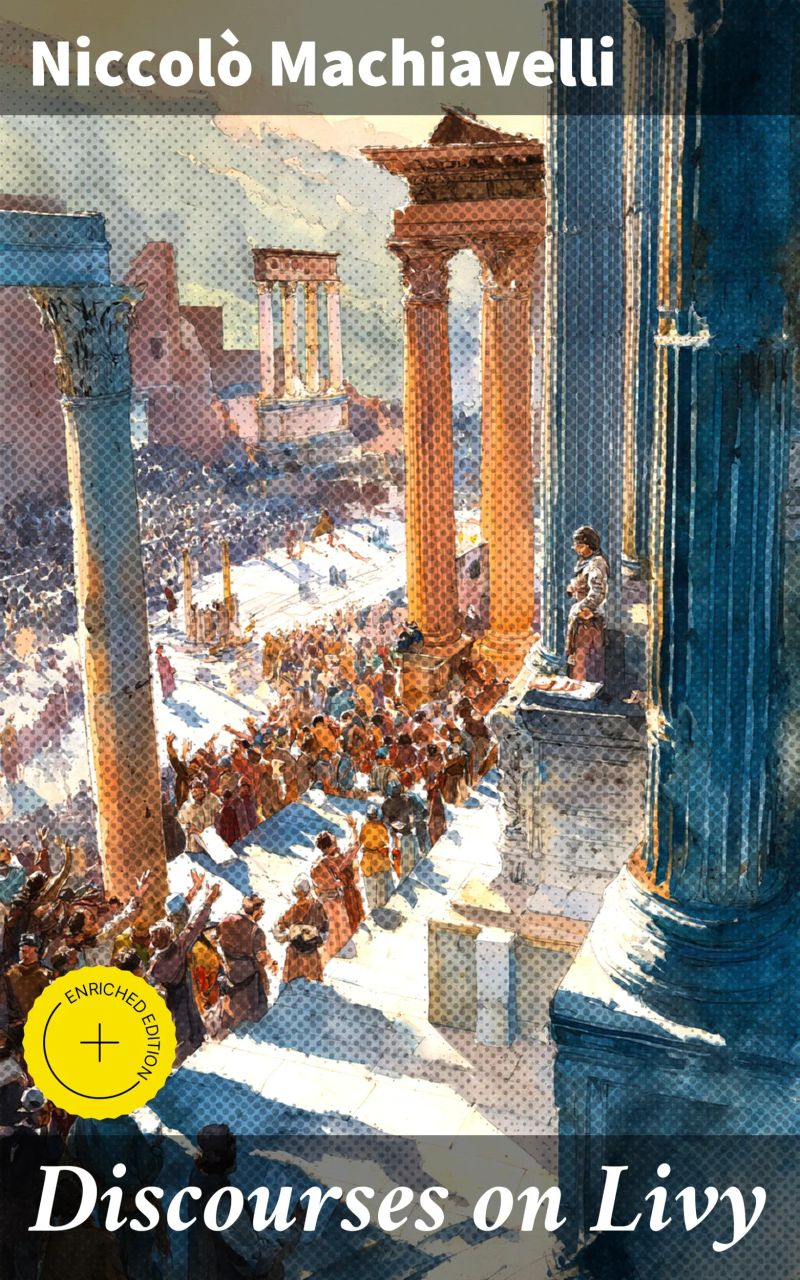
Discourses on Livy
Enriched edition. Insightful Analysis of Ancient Roman Politics and GovernanceBy Niccolò Machiavelli


Length16h 2m
About this audiobook
In "Discourses on Livy," Niccolò Machiavelli delves into the intricacies of Roman history to elucidate the principles of governance and civic virtue. Written in a time of political upheaval in Renaissance Italy, Machiavelli employs a rigorous analytical style that transcends mere narrative'—engaging in philosophical discourse on the balance of power, the dynamics of popular governance, and the importance of civic participation. His examination of ancient Roman figures serves to draw parallels and lessons applicable to contemporary governance, situating the work within the broader context of humanist thought and political theory of the 16th century. Machiavelli, often regarded as the father of modern political science, was shaped by the turbulent political landscape of his time, witnessing the rise and fall of principalities in Italy. His earlier work, "The Prince," while pragmatic, lacked the comprehensive exploration found in the "Discourses." This later work reflects his belief in republicanism and the potential for a balanced government, influenced by his personal experiences in diplomacy and political theory, as he sought to articulate a framework for stability and justice. For readers seeking a profound understanding of governance and its ethical ramifications, "Discourses on Livy" provides vital insights rooted in both history and philosophy. It is essential for those interested in the intersections of power, morality, and civic duty, rendering it a cornerstone text in the study of political thought.
In this enriched edition, we have carefully created added value for your reading experience:
- A succinct Introduction situates the work's timeless appeal and themes.
- The Synopsis outlines the central plot, highlighting key developments without spoiling critical twists.
- A detailed Historical Context immerses you in the era's events and influences that shaped the writing.
- An Author Biography reveals milestones in the author's life, illuminating the personal insights behind the text.
- A thorough Analysis dissects symbols, motifs, and character arcs to unearth underlying meanings.
- Reflection questions prompt you to engage personally with the work's messages, connecting them to modern life.
- Hand‐picked Memorable Quotes shine a spotlight on moments of literary brilliance.
- Interactive footnotes clarify unusual references, historical allusions, and archaic phrases for an effortless, more informed read.
Audiobook details
Rating★★★★ 4.2 (12.5K)
Includes Goodreads, LibraryThing, Amazon, StoryGraph
GenrePolitics and Government
Length16 hrs 2 mins
Narrated byListen with 1,000+ voices
FormateBook with Audio
Publish dateNov 16, 2023
LanguageEnglish
Table of contents
1Introduction
2Introduction
3Synopsis
4Historical Context
5Author Biography
Show all chaptersShow less
6HEALTH.
7BOOK I.
8PREFACE.
9CHAPTER I.—Of the Beginnings of Cities in general, and in particular of that of Rome.
10CHAPTER II.—Of the various kinds of Government; and to which of them the Roman Commonwealth belonged.
11CHAPTER III.—Of the Accidents which led in Rome to the creation of Tribunes of the People; whereby the Republic was made more perfect.
12CHAPTER IV.—That the Dissensions between the Senate and Commons of Rome, made Rome free and powerful.
13CHAPTER V.—Whether the Guardianship of public Freedom is safer in the hands of the Commons or of the Nobles; and whether those who seek to acquire Power or they who seek to maintain it are the greater cause of Commotions.
14CHAPTER VI.—Whether it was possible in Rome to contrive such a Government as would have composed the Differences between the Commons and the Senate.
15CHAPTER VII.—That to preserve Liberty in a State there must exist the Right to accuse.
16CHAPTER VIII.—That Calumny is as hurtful in a Commonwealth as the power to accuse is useful.
17CHAPTER IX.—That to give new Institutions to a Commonwealth, or to reconstruct old Institutions on an entirely new basis, must be the work of one Man.
18CHAPTER X.—That in proportion as the Founder of a Kingdom or Commonwealth merits Praise, he who founds a Tyranny deserves Blame.
19CHAPTER XI.—Of the Religion of the Romans.
20CHAPTER XII.—That it is of much moment to make account of Religion; and that Italy, through the Roman Church, being wanting therein, has been ruined.
21CHAPTER XIII.—Of the use the Romans made of Religion in giving Institutions to their City, in carrying out their Enterprises, and in quelling Tumults.
22CHAPTER XIV.—That the Romans interpreted the Auspices to meet the occasion; and made a prudent show of observing the Rites of Religion even when forced to disregard them; and any who rashly slighted Religion they punished.
23CHAPTER XV.—How the Samnites, as a last resource in their broken Fortunes, had recourse to Religion.
24CHAPTER XVI.—That a People accustomed to live under a Prince, if by any accident it become free, can hardly preserve that Freedom.
25CHAPTER XVII.—That a corrupt People obtaining Freedom can hardly preserve it.
26CHAPTER XVIII.—How a Free Government existing in a corrupt City may be preserved, or not existing may be created.
27CHAPTER XIX.—After a strong Prince a weak Prince may maintain himself: but after one weak Prince no Kingdom can stand a second.
28CHAPTER XX.—That the consecutive Reigns of two valiant Princes produce great results: and that well-ordered Commonwealths are assured of a Succession of valiant Rulers by whom their Power and Growth are rapidly extended.
29CHAPTER XXI.—That it is a great reproach to a Prince or to a Commonwealth to be without a national Army.
30CHAPTER XXII.—What is to be noted in the combat of the three Roman Horatii and the three Alban Curiatii.
31CHAPTER XXIII.—That we should never hazard our whole Fortunes where we put not forth our entire Strength; for which reason to guard a Defile is often hurtful.
32CHAPTER XXIV.—That well-ordered States always provide Rewards and Punishments for their Citizens; and never set off Deserts against Misdeeds.
33CHAPTER XXV.—That he who would reform the Institutions of a free State, must retain at least the semblance of old Ways.
34CHAPTER XXVI.—A new Prince in a City or Province of which he has taken Possession, ought to make Everything new.
35CHAPTER XXVII.—That Men seldom know how to be wholly good or wholly bad.
36CHAPTER XXVIII.—Whence it came that the Romans were less ungrateful to their Citizens than were the Athenians.
37CHAPTER XXIX.—Whether a People or a Prince is the more ungrateful.
38CHAPTER XXX.—How Princes and Commonwealths may avoid the vice of Ingratitude; and how a Captain or Citizen may escape being undone by it.
39CHAPTER XXXI.—That the Roman Captains were never punished with extreme severity for Misconduct; and where loss resulted to the Republic merely through their Ignorance or Want of Judgment, were not punished at all.
40CHAPTER XXXII.—That a Prince or Commonwealth should not delay conferring Benefits until they are themselves in difficulties.
41CHAPTER XXXIII.—When a Mischief has grown up in, or against a State, it is safer to temporize with than to meet it with Violence.
42CHAPTER XXXIV.—That the authority of the Dictator did good and not harm to the Roman Republic: and that it is not those Powers which are given by the free suffrages of the People, but those which ambitious Citizens usurp for themselves, that are pernicious to a State.
43CHAPTER XXXV—Why the Creation of the Decemvirate in Rome, although brought about by the free and open Suffrage of the Citizens, was hurtful to the Liberties of that Republic
44CHAPTER XXXVI.—That Citizens who have held the higher Offices of a Commonwealth should not disdain the lower.
45CHAPTER XXXVII.—Of the Mischief bred in Rome by the Agrarian Law: and how it is a great source of disorder in a Commonwealth to pass a Law opposed to ancient Usage and with stringent retrospective Effect.
46CHAPTER XXXVIII.—That weak Republics are irresolute and undecided; and that the course they may take depends more on Necessity than Choice.
47CHAPTER XXXIX.—That often the same Accidents are seen to befall different Nations.
48CHAPTER XL.—Of the creation of the Decemvirate in Rome, and what therein is to be noted. Wherein among other Matters is shown how the same Causes may lead to the Safety or to the Ruin of a Commonwealth.
49CHAPTER XLI.—That it is unwise to pass at a bound from leniency to severity, or to a haughty bearing from a humble.
50CHAPTER XLII.—How easily Men become corrupted.

Das Buch der hundert altitalienischen NovellenNiccolò Machiavelli, Pietro Fortini, Carlo Graf Gozzi, Eustachio Manfredi, Baldassare Castiglione, Francesco Molza, Liberale Motense, Ser Giovanni Fiorentino, Luigi da Porto49h 26m$1 · $0.00

Mensch und StaatNiccolò Machiavelli3h 10m4.3 (29)$1 · $0.00

DER FÜRSTNiccolò Machiavelli3h 43m4.0 (455.4K)$1 · $0.00

Gesammelte Werke von Niccolò MachiavelliNiccolò Machiavelli39h 38m4.4 (124)$2 · $0.00

THE ART OF WAR & THE PRINCENiccolò Machiavelli7h 9m4.0 (1.8K)$1.99 · $0.00

Machiavelli: The PrinceNiccolò Machiavelli5h 13m4.1 (730.3K)$1.99 · $0.00

THE STRATEGY: The Art of War & The Prince (2 Classics in One Edition)Niccolò Machiavelli7h 7m4.3 (123)$1.99 · $0.00

Die Kunst der Staatsführung: Regieren mit WeisheitNiccolò Machiavelli, Platon, Marcus Aurelius, Marcus Tullius Cicero, Carl von Clausewitz, Friedrich der Große, Benjamin Franklin, Otto von Bismarck, Friedrich Christoph Dahlmann, Karel Čapek, Hans Delbrück238h 47m$1 · $0.00
RuhtinasNiccolò Machiavelli4h 4m4.0 (17.2K)$0.99 · $0.00

Philosophie der RenaissanceNiccolò Machiavelli, Michel de Montaigne, Erasmus von Rotterdam, Thomas Morus, Francis Bacon, Tommaso Campanella, Martin Luther, Ludwig Kuhlenbeck66h 17m$1.50 · $0.00

Das Buch der hundert altitalienischen NovellenNiccolò Machiavelli, Pietro Fortini, Carlo Graf Gozzi, Eustachio Manfredi, Baldassare Castiglione, Francesco Molza, Liberale Motense, Ser Giovanni Fiorentino, Luigi da Porto49h 28m$1 · $0.00

Essenzielle Klassiker der politischen PhilosophieNiccolò Machiavelli, Montesquieu, Friedrich der Große, Platon, Aristoteles, Marcus Tullius Cicero, Tommaso Campanella, Thomas Morus, Samuel von Pufendorf, Abbé Castel de Saint-Pierre, Jean Jacques Rousseau, Immanuel Kant, Johann Gottlieb Fichte, Karl Marx, Friedrich Engels, Wilhelm von Humboldt, Friedrich Christoph Dahlmann, Franz Mehring, Johann Most, John Henry Mackay, Rosa Luxemburg, Erich Mühsam393h 52m$1 · $0.00

Die Discorsi (Deutsche Ausgabe) (Kommentiert)Niccolò Machiavelli17h 53m$1 · $0.00

Der Fürst (Il Principe) (Kommentiert)Niccolò Machiavelli7h 3m4.0 (76.6K)$1 · $0.00

Mensch und Staat (Kommentiert)Niccolò Machiavelli3h 18m4.3 (121)$1 · $0.00

Gesammelte Werke: Der Fürst + Die Discorsi + Mensch und Staat + Geschichte von Florenz (Kommentiert)Niccolò Machiavelli39h 44m4.4 (11)$2 · $0.00

Geschichte von Florenz (Kommentiert)Niccolò Machiavelli19h 51m3.8 (508)$1 · $0.00
Discourses on Livy (Annotated)Niccolò Machiavelli16h 35m4.1 (10.2K)$2 · $0.00

The Prince + The Art of War (2 Unabridged Machiavellian Masterpieces)Niccolò Machiavelli7h 51m$1 · $0.00
Discourses on the First Decade of Titus LiviusNiccolò Machiavelli15h 3m4.2 (11.3K)$2 · $0.00

KrantikariSanjeev Sanyal11h 44m4.6 (1.3K)$16 · $0.00

Unbroken Bonds of BattleJohnny Joey Jones8h 31m4.6 (2.6K)$8 · $0.00

On Democracies and Death CultsDouglas Murray10h 38m4.6 (6.5K)$29 · $0.00

Balcony Over Jerusalem: A Middle East Memoir - Israel, Palestine and BeyondJohn Lyons12h 37m4.6 (1.4K)$33 · $0.00

RiggedMollie Hemingway12h 48m4.6 (4.2K)$23 · $0.00

SledgehammerDavid Friedman8h 21m4.7 (589)$26 · $0.00

Citizenship in a Republic (Annotated)Theodore Roosevelt2h 44m4.6 (1.4K)$2 · $0.00

No EscapeNury Turkel9h 30m4.6 (809)$28 · $0.00

Always FaithfulThomas Schueman, Zainullah Zaki12h 12m4.6 (977)$29 · $0.00

UnthinkableJamie Raskin15h 8m4.5 (9.3K)$8 · $0.00

My Fourth Time, We DrownedSally Hayden13h 59m4.6 (2.9K)$23 · $0.00

A Revolution of Common SenseScott Jennings9h 29m4.6 (528)$29 · $0.00

Statement From the Dock at the Rivonia TrialNelson Mandela2h 18m4.6 (1.3K)$1 · $0.00

Lessons from the EdgeMarie Yovanovitch17h 11m4.5 (5.9K)$40 · $0.00

To Rescue the American SpiritBret Baier10h 12m4.5 (2.7K)$8 · $0.00

StonewalledSharyl Attkisson15h 19m4.5 (4.3K)$33 · $0.00
The World According to Orwell: 1984 & Animal FarmGeorge Orwell15h 42m4.6 (1.1K)$1 · $0.00

Basic EconomicsThomas Sowell18h 32m4.5 (29.3K)$28 · $0.00

To Rescue the RepublicBret Baier, Catherine Whitney11h 42m4.5 (8.6K)$29 · $0.00

Modern WarriorsPete Hegseth7h 10m4.5 (4.7K)$24 · $0.00
You may also like
What is to be done?Vladimir Lenin7h 23m4.2 (8.2K)$4 · $0.00

The Madman TheoryJim Sciutto8h 24m4.1 (320)$26 · $0.00

The Histories of Polybius (Vol.1&2)Polybius53h 55m4.3 (1.1K)$1.99 · $0.00

Darwin on TrialPhillip E. Johnson6h 35m4.0 (2.5K)$20

Discourses on LivyNiccolò Machiavelli16h 44m4.2 (12.5K)$2 · $0.00

The Art of Political War and Other Radical PursuitsDavid Horowitz6h 15m4.1 (271)$14

Shepherds for SaleMegan Basham11h 23m4.4 (4.7K)$29 · $0.00

The March of FollyBarbara W. Tuchman17h 54m4.1 (51.2K)$28

History of The Decline and Fall of The Roman Empire Vol IEdward Gibbon30h 34m4.4 (6.2K)$2.30

American CarnageTim Alberta26h 21m4.3 (6K)$53 · $0.00

Take No PrisonersDavid Horowitz6h 10m4.2 (497)$20

The Histories (Annotated)Tacitus12h 25m4.2 (5.6K)$2 · $0.00

The Parasitic MindGad Saad7h 37m4.2 (13.1K)$17

PascendiPope Pius X2h 24m4.7 (279)$1 · $0.00

The PrinceNiccolò Machiavelli4h 32m4.1 (423.6K)$12

The PrinceNiccolo Machiavelli5h 3m3.9 (446.2K)$7 · $0.00
The Eighteenth Brumaire of Louis NapoleonKarl Marx4h 42m4.3 (9.3K)$4 · $0.00

Caesar' Gallic WarJulius Caesar10h 35m4.2 (17K)$2 · $0.00
The Ruins; Or, Meditation on the Revolutions of Empires and the Law of Nature (Annotated)C.-F. Volney9h 58m4.1 (394)$0.99 · $0.00
History of Catiline's ConspiracySallust3h 39m4.0 (3.5K)$1 · $0.00