
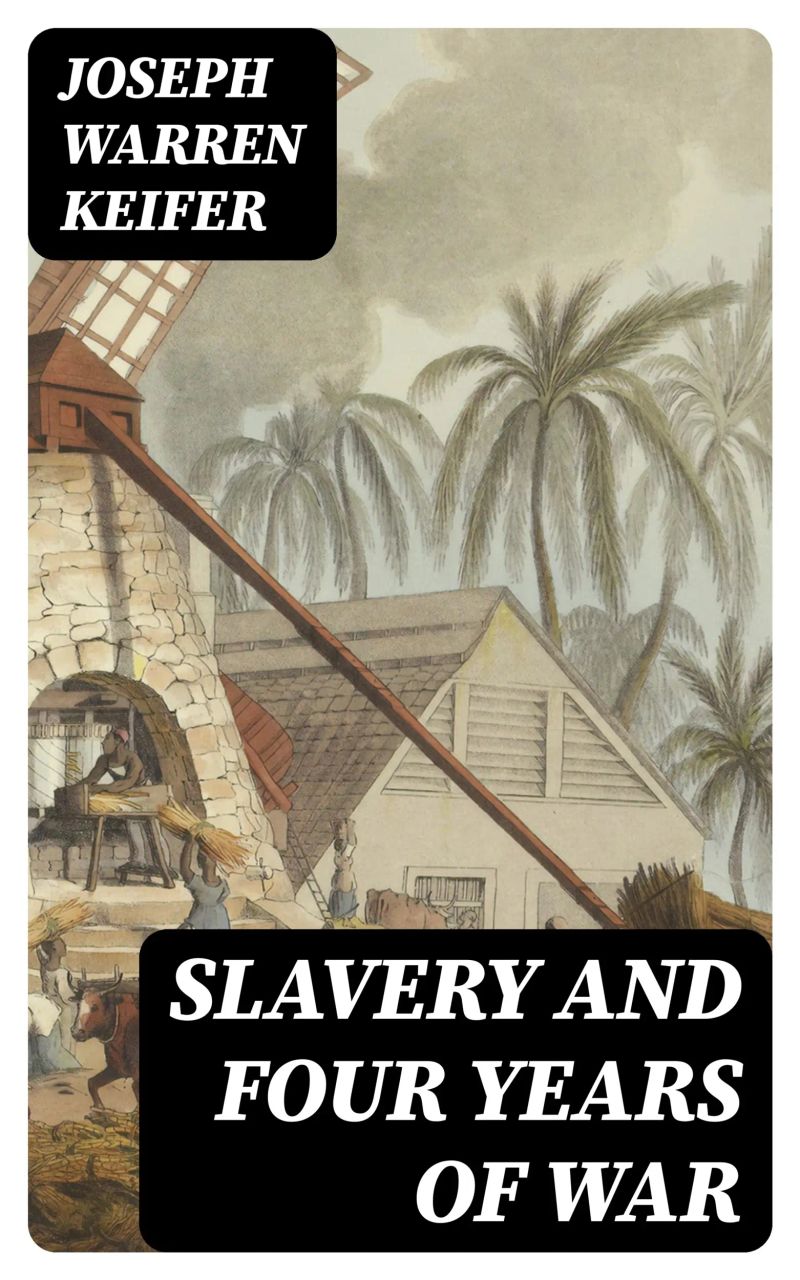
Slavery and Four Years of War
By Joseph Warren Keifer


Length23h 47m
About this audiobook
In "Slavery and Four Years of War," Joseph Warren Keifer delivers a compelling examination of the intertwined destinies of slavery and the American Civil War. This meticulously researched work combines personal narratives, historical analysis, and reflective commentary, showcasing Keifer's adeptness in weaving a rich literary tapestry that captures the tumultuous spirit of the era. His narrative style is both engaging and informative, allowing readers to grasp the complexities of the socio-political landscape while remaining accessible to a broad audience. The book situates itself within the context of post-war America, marking an essential contribution to Civil War literature and the discourse on race and freedom. Joseph Warren Keifer's background as a Union soldier and politician profoundly shapes his perspective in this work. His first-hand experiences on the battlefield and his later roles in government provide him with unique insights into the impact of slavery on both individual lives and national policy. Keifer's scholarly intentions are further underscored by his commitment to preserving the memory of the war and shaping the narrative of freedom in the United States, which resonates throughout his writing. "Slavery and Four Years of War" is recommended for scholars, enthusiasts, and anyone interested in the intricate relationship between slavery and warfare. It offers valuable perspectives for understanding the Civil War's enduring legacy, making it an indispensable read for those seeking to engage with the themes of justice, sacrifice, and reconciliation in American history.
Audiobook details
Rating★★★★★ 4.6 (10)
Includes Amazon
GenreHistory
Length23 hrs 47 mins
Narrated byListen with 1,000+ voices
FormateBook with Audio
Publish dateNov 13, 2022
LanguageEnglish
Table of contents
1Slavery & Four Years of War (Vol.1&2)
2VOLUME I.
3PREFACE
4CHAPTER I Slavery: Its Political History in the United States
5II. INTRODUCTION OF SLAVERY INTO THE COLONIES
Show all chaptersShow less
6III. DECLARATION OF INDEPENDENCE
7IV. CONTINENTAL CONGRESS—ARTICLES OF CONFEDERATION 1774-1789
8V. ORDINANCE OF 1787
9VI. CONSTITUTION OF THE UNITED STATES
10VII. CAUSES OF GROWTH OF SLAVERY
11VIII. FUGITIVE SLAVE LAW—1793
12IX. SLAVE TRADE: ABOLISHED BY LAW
13X. LOUISIANA PURCHASE
14XI. FLORIDA
15XII. MISSOURI COMPROMISE—1820
16XIII. NULLIFICATION—1832-3 (1835)
17XIV. TEXAS—ADMISSION INTO THE UNION (1845)
18XV. MEXICAN WAR—ACQUISITION OF CALIFORNIA AND NEW MEXICO 1846-8
19XVI. COMPROMISE MEASURES—1850
20XVII. NEBRASKA ACT—1854
21XVIII. KANSAS' STRUGGLE FOR FREEDOM
22XIX. DRED SCOTT CASE—1857
23XX. JOHN BROWN RAID—1859
24XXI. PRESIDENTIAL ELECTIONS, 1856-1860
25XXII. DISSOLUTION OF THE UNION
26XXIII. SECESSION OF STATES—1860-1
27XXIV. ACTION OF RELIGIOUS DENOMINATIONS, ETC.—1860-1
28XXV. PROPOSED CONCESSIONS TO SLAVERY—BUCHANAN'S ADMINISTRATION AND CONGRESS—1860-1
29XXVI. PEACE CONFERENCE—1861
30XXVII. DISTRICT OF COLUMBIA—SLAVERY ABOLISHED—1862
31XXVIII. SLAVERY PROHIBITED IN THE TERRITORIES—1862
32XXIX. BENTON'S SUMMARY
33XXX. PROPHECY AS TO SLAVERY'S FATE: ALSO AS TO DISUNION
34CHAPTER II Sumter Fired on—Seizure by Confederates of Arms, Arsenals, and Forts—Disloyalty of Army and Navy Officers—Proclamation of Lincoln for Seventy-Five Thousand Militia, and Preparation for War on Both Sides
35CHAPTER III Personal Mention—Occupancy of Western Virginia under McClellan (1861)—Campaign and Battle of Rich Mountain, and Incidents
36CHAPTER IV Repulse of General Lee and Affairs of Cheat Mountain and in Tygart's Valley (September, 1861)—Killing of John A. Washington, and Incidents, and Formation of State of West Virginia
37CHAPTER V Union Occupancy of Kentucky—Affair at Green River—Defeat of Humphrey Marshall—Battles of Mill Springs, Forts Henry and Donelson —Capture of Bowling Green and Nashville, and Other Matters
38CHAPTER VI Battle of Shiloh—Capture of Island No. 10—Halleck's Advance on Corinth, and Other Events
39CHAPTER VII Mitchel's Campaign to Northern Alabama—Andrews' Raid into Georgia, and Capture of a Locomotive—Affair at Bridgeport—Sacking of Athens, Alabama, and Court-Martial of Colonel Turchin—Burning of Paint Rock by Colonel Beatty—Other Incidents and Personal Mention —Mitchel Relieved
40CHAPTER VIII Confederate Invasion of Kentucky (1862)—Cincinnati Threatened, and "Squirrel Hunters" Called Out—Battles of Iuka, Corinth, and Hatchie Bridge—Movements of Confederate Armies of Bragg and Kirby Smith—Retirement of Buell's Army to Louisville—Battle of Perryville, with Personal and Other Incidents
41CHAPTER IX Commissioned Colonel of 110th Ohio Volunteers—Campaigns in West Virginia under General Milroy, 1862-3—Emancipation of Slaves in the Shenandoah Valley, and Incidents
42VOLUME II.
43CHAPTER I General Observations on Antietam, Fredericksburg, and Chancellorsville —Battles at Winchester under General Milroy—His Defeat and Retreat to Harper's Ferry—With Incidents
44CHAPTER II Invasion of Pennsylvania—Campaign and Battle of Gettysburg—Lee's Retreat Across the Potomac, and Losses in Both Armies
45CHAPTER III New York Riots, 1863—Pursuit of Lee's Army to the Rappahannock— Action of Wapping Heights, and Skirmishes—Western Troops Sent to New York to Enforce the Draft—Their Return—Incidents, etc.
46CHAPTER IV Advance of Lee's Army, October, 1863 and Retreat of the Army of the Potomac to Centreville—Battle of Bristoe Station—Advance of the Union Army, November, 1863—Assault and Capture of Rappahannock Station, and Forcing the Fords—Affair near Brandy Station and Retreat of Confederate Army Behind the Rapidan—Incidents, etc.
47CHAPTER V Mine Run Campaign and Battle of Orange Grove, November, 1863—Winter Cantonment (1863-64) of Army of the Potomac at Culpeper Court- House, and its Reorganization—Grant Assigned to Command the Union Armies, and Preparation for Aggressive War
48CHAPTER VI Plans of Campaigns, Union and Confederate—Campaign and Battle of the Wilderness, May, 1864—Author Wounded, and Personal Matters— Movements of the Army to the James River, with Mention of Battles of Spotsylvania, Cold Harbor, and Other Engagements, and Statement of Losses and Captures
49CHAPTER VII Campaign South of James River and Petersburg—Hunter's Raid—Battle of Monocacy—Early's Advance on Washington (1864)—Sheridan's Movements in Shenandoah Valley, and Other Events
50CHAPTER VIII Personal Mention of Generals Sheridan, Wright, and Ricketts, and Mrs. Ricketts—Also Generals Crook and Hayes—Battle of Opequon, Under Sheridan, September, 1864, and Incidents
More from Joseph Warren Keifer
Fighting for Freedom: Memoirs of Black Soldiers in the Civil WarJoseph Warren Keifer, Joseph T. Wilson, Thomas Wentworth Higginson, Frank A. Rollin, Joshua M. Addeman, Susie King Taylor68h 39m4.8 (11)$1.99
The True Story of Black Battalions: 6 Civil War MemoirsJoseph Warren Keifer, Joseph T. Wilson, Thomas Wentworth Higginson, Frank A. Rollin, Joshua M. Addeman, Susie King Taylor68h 37m4.6 (11)$1.99

A Brief History of IntelligenceMax S. Bennett12h 18m4.6 (6.6K)$29 · $0.00

The Happiest Man on EarthEddie Jaku3h 48m4.6 (178K)$7 · $0.00

MotherlandJulia Ioffe17h 52m4.7 (2.5K)$40 · $0.00

Where Cowards Go to DieBenjamin Sledge8h 42m4.7 (351)$20 · $0.00

RevolutionariesSanjeev Sanyal11h 23m4.6 (2.6K)$29 · $0.00

We Crossed a Bridge and It TrembledWendy Pearlman6h4.6 (5.2K)$24 · $0.00

Unbroken Bonds of BattleJohnny Joey Jones8h 31m4.6 (2.6K)$8 · $0.00

The Daughter of AuschwitzTova Friedman, Malcolm Brabant7h 54m4.6 (16.7K)$26 · $0.00

Lily's PromiseLily Ebert, Dov Forman8h 54m4.6 (16.1K)$29 · $0.00

On Democracies and Death CultsDouglas Murray10h 38m4.6 (6.5K)$29 · $0.00

Across the RiverKent Babb11h 40m4.6 (927)$29 · $0.00

Balcony Over Jerusalem: A Middle East Memoir - Israel, Palestine and BeyondJohn Lyons12h 37m4.6 (1.4K)$33 · $0.00

BeyondStephen Walker15h 39m4.6 (3.2K)$33 · $0.00
Kings and PawnsHoward Bryant10h 9m4.6 (678)$29 · $0.00

No EscapeNury Turkel9h 30m4.6 (809)$28 · $0.00

Jubal Stone: U.S. Marshal: Blood Trail To Hell: A Western Adventure NovelCasey Nash3h 42m4.6 (3.2K)$18 · $0.00

Fall and RiseMitchell Zuckoff17h 23m4.6 (9.8K)$40 · $0.00
The SurvivorJosef Lewkowicz, Michael Calvin9h 22m4.6 (2.5K)$29 · $0.00

Always FaithfulThomas Schueman, Zainullah Zaki12h 12m4.6 (977)$29 · $0.00

The State of Society in France Before the Revolution of 1789 (Annotated)Alexis de Tocqueville17h 25m4.6 (1.2K)$2 · $0.00
You may also like
What is to be done?Vladimir Lenin7h 23m4.2 (8.2K)$4 · $0.00
History of the Civil War, 1861-1865James Ford Rhodes15h 13m4.0 (2.5K)$2 · $0.00
Darwin on TrialPhillip E. Johnson6h 35m4.0 (2.5K)$20

Discourses on LivyNiccolò Machiavelli16h 2m4.2 (12.5K)$2 · $0.00
The Conscience of a ConservativeBarry Goldwater, CC Goldwater4h 7m4.0 (14.7K)$20

Ten Days That Shook the World (Annotated)John Reed11h 40m4.2 (25.8K)$2 · $0.00
It’s Even Worse Than It LooksThomas E. Mann, Norman J. Ornstein7h 35m4.0 (4.5K)$20 · $0.00

The Histories of Polybius (Vol.1&2)Polybius53h 55m4.3 (1.1K)$1.99 · $0.00

History of the American AbolitionismFelix Gregory De Fontaine4h 26m$1.99 · $0.00

The American Civil WarSantiago Machain5h 58m$21 · $0.00

Great Britain and the American Civil War (Annotated)Ephraim Douglass Adams22h 44m3.6 (55)$2 · $0.00

The Great ConspiracyJohn Alexander Logan26h 53m3.8 (17)$1.99 · $0.00

REBEL YELL: History of the Confederacy, Memoirs and Biographies of the Confederate Leaders & Official DocumentsJefferson Davis, Heros von Borcke, Robert E. Lee, Frank H. Alfriend, John Esten Cooke145h 23m4.3 (11)$2 · $0.00
The Struggle between President Johnson and Congress over ReconstructionCharles E. Chadsey2h 57m$2 · $0.00
The American Revolution (Vol. 1&2) (Annotated)John Fiske19h 53m3.5 (133)$2 · $0.00

AP U.S. Government and Politics Exam Study GuideMarie Peterson8h 43m$10

American Civil War, 1861 To 1865, Volume Ii – The UnionAndré Geraque Kiffer3h 43m$5 · $0.00

ShowdownDavid Corn13h 4m4.0 (396)$33 · $0.00
Sparta's Second Attic WarPaul A. Rahe15h 13m3.9 (45)$23

An Humble Address and Earnest Appeal to Those Respectable Personages in Great-Britain and IrelandJosiah Tucker2h 22m$1 · $0.00