
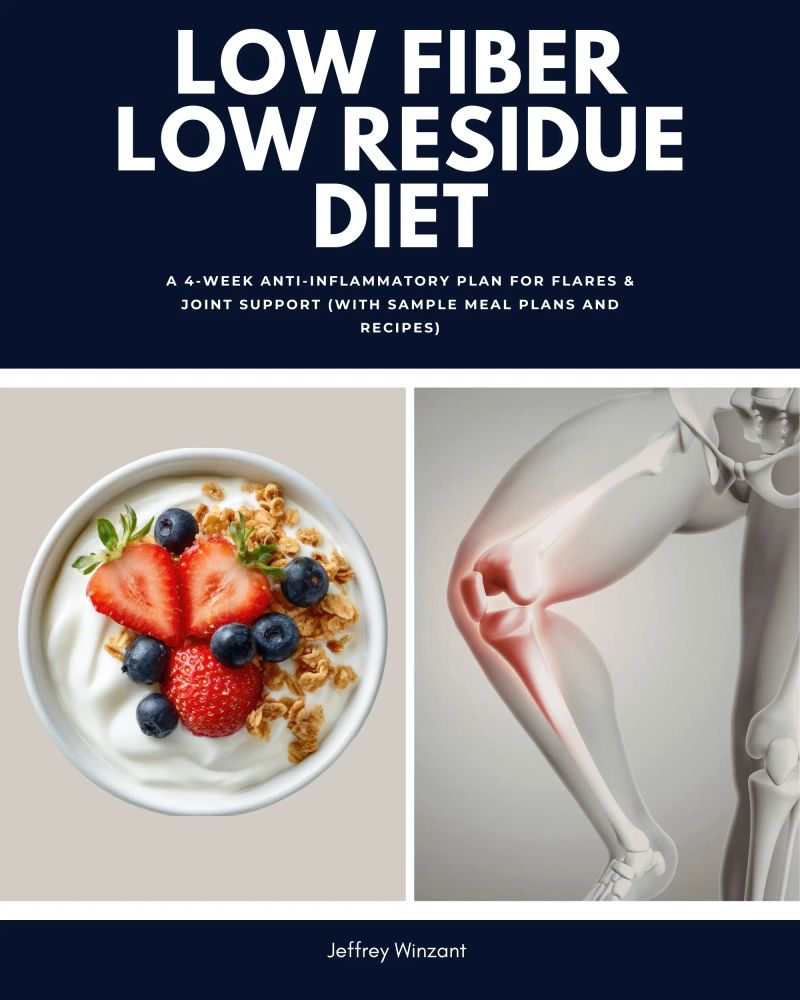
Copy of Low Fiber Low Residue Diet
A 2-Phase Plan for Flares and Recovery (with Food Lists, Reintroduction Steps, Meal Plans and Easy Recipes)By Jeffrey Winzant


Length1h 52m
About this audiobook
A low fiber, low residue diet is a carefully designed approach that plays a vital role in managing certain digestive conditions. Its core purpose is to minimize the workload on the digestive system by reducing both dietary fiber and other food components that leave undigested matter (residue) behind in the gastrointestinal tract. This targeted restriction helps alleviate symptoms, provide digestive rest, and support recovery during vulnerable periods for people living with conditions like inflammatory bowel disease (IBD), Crohn's disease, ulcerative colitis, or those recovering from intestinal surgery.
To fully appreciate the value of this diet, it is important to understand the distinction between fiber and residue. Dietary fiber, found primarily in plant-based foods such as whole grains, fruits, vegetables, and legumes, refers to the portion of food that the body cannot fully digest. Soluble fiber dissolves in water and forms a gel-like substance, while insoluble fiber adds bulk to stool and aids movement through the gut.
Residue, by contrast, encompasses all the undigested parts of food that add volume to stool; this includes dietary fiber, as well as other remnants like some natural sugars, skins, and pulp. While the term "low fiber" focuses solely on restricting fiber, a "low residue" diet is somewhat broader; it limits both fiber and other constituents that remain in the bowel after digestion.
People following a low fiber, low residue diet frequently experience significant symptom relief. Common benefits include reduced abdominal pain, decreased bloating, less frequent bowel movements, and an overall calmer digestive experience. By giving the gut time to rest from its usual workload, the bowel lining can recover from inflammation, irritation, or surgical trauma. However, while symptom minimization is a key strength, this diet is not designed for long-term use and requires careful monitoring to prevent nutritional deficiencies.
In this guide, you will learn:
The science behind low fiber and low residue diets, including clear definitions of fiber and residue
When and why these diets are recommended, with a focus on clinical scenarios
How to implement the diet safely, including detailed food lists for each phase
Sample 7-day meal plans tailored for both acute management and gradual recovery
Easy-to-follow recipes developed specifically to meet dietary requirements at every stage
Practical tips for success and answers to frequently asked questions
This guide presents a practical, two-phase structure to support users through both acute management and gradual recovery. The first phase focuses on strict adherence to low fiber and residue intake the “flare” phase designed to maximize digestive rest. Once symptoms stabilize and healing progresses, the second phase introduces a stepwise reintroduction of fiber and residue, helping individuals safely expand their dietary options while monitoring for tolerance. Throughout, you'll find detailed food lists, sample 7-day meal plans tailored to each phase, and 15 easy-to-follow recipes developed specifically to meet dietary requirements at every stage.
Whether you are navigating an IBD flare, supporting someone after surgery, or simply learning how to care for a sensitive gut, this guide provides clear steps, practical tips, and clear answers to frequently asked questions to help you implement and adapt the low fiber, low residue diet safely and effectively.
Audiobook details
GenreHealth and Wellness, Self-Help
Length1 hr 52 mins
Narrated byListen with 1,000+ voices
FormateBook with Audio
Publish dateMar 22, 2026
LanguageEnglish
Table of contents
1Disclaimer
2Fundamentals of Fiber and Residue
3Different types of dietary fiber and their sources
4Physiological impact of fiber on digestion
5Explanation of residue and its dietary contributors
Show all chaptersShow less
6Consequences of fiber and residue restriction
7Medical scenarios necessitating fiber and residue reduction
8Indications for the Low Fiber Low Residue Diet
9Acute gastrointestinal conditions requiring this diet
10Role in inflammatory bowel disease (IBD) flares
11Indications for GI obstruction or strictures
12Limitations and contraindications of prolonged use
13Phase 1—Flare Management: Strict Low Fiber Low Residue Diet
14Comprehensive list of allowed and restricted foods
15Nutritional considerations during acute restriction
16Sample 7-day meal plan for the flare phase
17Hydration and supplement recommendations
18Signs indicating readiness for dietary progression
19Stepwise approach to increasing fiber content
20Identification of well-tolerated foods during reintroduction
21Monitoring symptoms and adjusting intake
22Detailed Food Lists for Both Phases
23Vegetables, fruits, and grains: phase-appropriate choices
24Animal proteins and dairy: tolerated options and serving suggestions
25Snack foods suitable for low residue intake
26Foods to avoid due to high fiber or roughage
27Grocery list preparation for each phase
28Nutritional Management and Potential Deficiencies
29Key nutrients at risk of inadequacy on a restricted diet
30Strategies to maintain protein, vitamins, and mineral intake
31Supplement options for calcium, iron, and B-vitamins
32Label reading tips for processed foods and additives
33Role of registered dietitians in individualized plans
34Cooking Techniques and Practical Strategies
35Cooking methods that reduce food residue
36Tips for optimal texture and digestibility
37Kitchen tools to aid in food preparation
38Flavor enhancement without adding fiber
39Meal-prep workflows and safe storage practices
40Easy Recipes for the Low Fiber Low Residue Diet
41Breakfast recipes suitable for both phases
42Creamy Rice Porridge
43Scrambled Eggs with Butter
44Cinnamon Applesauce Pancakes
45Lunch and dinner entrees with low residue profiles
46Chicken and Rice Soup
47White Fish Fillet with Mashed Potatoes
48Turkey and White Bread Sandwich
49Creamy Pasta with Chicken
50Baked Egg Custard

The Gout Flare Food PlanJeffrey Winzant2h 2m$5.50

Psoriatic Arthritis Diet GuideJeffrey Winzant2h 3m$5.50
Post-Polio FatigueJeffrey Winzant2h 11m$5.50

Sinusitis Diet GuideJeffrey Winzant2h 4m$5.50
Managing Adult ScoliosisJeffrey Winzant1h 59m$5.50

Epstein Barr VirusJeffrey Winzant1h 34m$5.50

EBV & Autoimmune DiseaseJeffrey Winzant1h 36m$5.50

Epstein-Barr VirusJeffrey Winzant1h 31m$5.50
The Mitochondria Diet CookbookJeffrey Winzant1h 37m$5.50

COPD DietJeffrey Winzant48m$5.50

Quantum Healing HypnosisJeffrey Winzant1h 35m$5.50

Seasonal AllergiesJeffrey Winzant44m$5.50
Mitochondria DietJeffrey Winzant1h 32m4.1 (43)$5.50
Fatty Liver SolutionJeffrey Winzant43m$5.50

Alzheimer's Prevention DietJeffrey Winzant48m$5.50

Ménière's DiseaseJeffrey Winzant40m$5.50
MTHFR DietJeffrey Winzant1h 10m$5.50

Heavy Metal DetoxJeffrey Winzant1h 18m$5.50

Hypoglycemia DietJeffrey Winzant45m$5.50
Hour of the HeartIrvin D. Yalom, Benjamin Yalom8h 19m4.6 (2.3K)$26 · $0.00

The Yoga Sutras of PatanjaliPatanjali4h 8m4.5 (18.5K)$6 · $0.00

The Lost VoiceGreta Morgan8h 30m4.7 (285)$26 · $0.00

Healthy Kids, Happy KidsElisa Song14h 18m4.6 (760)$33 · $0.00
Eat It!Jordan Syatt, Michael Vacanti4h 40m4.6 (1.5K)$20 · $0.00

Consent Laid BareChanel Contos7h 11m4.5 (1.7K)$24 · $0.00
How to Make Disease DisappearRangan Chatterjee5h 26m4.5 (3.5K)$24 · $0.00

The Complete Herbal (Annotated)Nicholas Culpeper29h 8m4.5 (1.4K)$2 · $0.00

A Plague Upon Our HouseScott W. Atlas MD10h 37m4.5 (3.4K)$20 · $0.00

The Cancer CodeDr. Jason Fung10h 48m4.5 (5.3K)$29 · $0.00

The Gift of TherapyIrvin Yalom7h 39m4.5 (38.8K)$26 · $0.00

EarlySarah DiGregorio9h 47m4.5 (1.3K)$29 · $0.00

Bottle of LiesKatherine Eban14h 25m4.4 (12K)$33 · $0.00
The 36-Hour DayNancy L. Mace, Peter V. Rabins17h 13m4.4 (9.2K)$28 · $0.00

FlooredSara Reardon10h 36m4.5 (1K)$29 · $0.00
Radical RemissionKelly A. Turner9h 26m4.4 (8.1K)$29 · $0.00
The Sinatra SolutionStephen T. Sinatra MD9h4.5 (899)$20 · $0.00

The Songaminute ManSimon McDermott6h 12m4.5 (280)$24 · $0.00
Sometimes BrilliantLarry Brilliant12h 27m4.5 (954)$29 · $0.00

Live Your LifeAmanda Kloots, Anna Kloots10h 54m4.4 (13.7K)$29 · $0.00
Learning to PrayJames Martin13h 24m4.5 (3.4K)$33 · $0.00

Swayam Ki AwaazPrem Rawat8h 34m4.7 (1.1K)$26 · $0.00

Forever BoyKate Swenson9h 27m4.7 (5K)$29 · $0.00

You Are Worth ItKyle Carpenter, Don Yaeger8h 53m4.7 (4.8K)$29 · $0.00

The Happiest Man on EarthEddie Jaku3h 48m4.6 (178K)$7 · $0.00

Finding MeViola Davis9h 15m4.6 (256.4K)$29 · $0.00

Spiritual AnatomyDaaji Kamlesh D. Patel9h 47m4.7 (319)$29 · $0.00

The Dangerous Truth about Today’s MarijuanaLaura Stack CSP, MBA9h 57m4.7 (384)$20 · $0.00

Birdie & HarlowTaylor Wolfe7h 50m4.6 (6.5K)$26 · $0.00

CrossroadsKaleb Dahlgren7h 56m4.6 (4.9K)$26 · $0.00

Life on the BridgeKaelynn Partlow5h 40m4.6 (1.1K)$24 · $0.00

Keep Your Love OnDanny Silk9h 4m4.6 (8.1K)$10 · $0.00

The Tao of Joy Every DayDerek Lin10h 24m4.6 (762)$20 · $0.00

UndividedVicky Beeching9h 2m4.6 (1.3K)$29 · $0.00
Level UpRob Dial7h 42m4.6 (3.3K)$26 · $0.00
Burn the HaystackJennie Young, PhD9h 30m4.6 (543)$29 · $0.00

ACRES OF DIAMONDS: Our Every-day Opportunities (Wisdom & Empowerment Series) (Annotated)Russell Conwell2h 26m4.6 (1K)$2 · $0.00

Good InsideBecky Kennedy9h 55m4.5 (59.3K)$29 · $0.00
The Lost VoiceGreta Morgan8h 30m4.7 (285)$26 · $0.00

Stripped DownBunnie Xo8h 25m4.5 (32.9K)$26 · $0.00