


Length6h 42m
About this audiobook
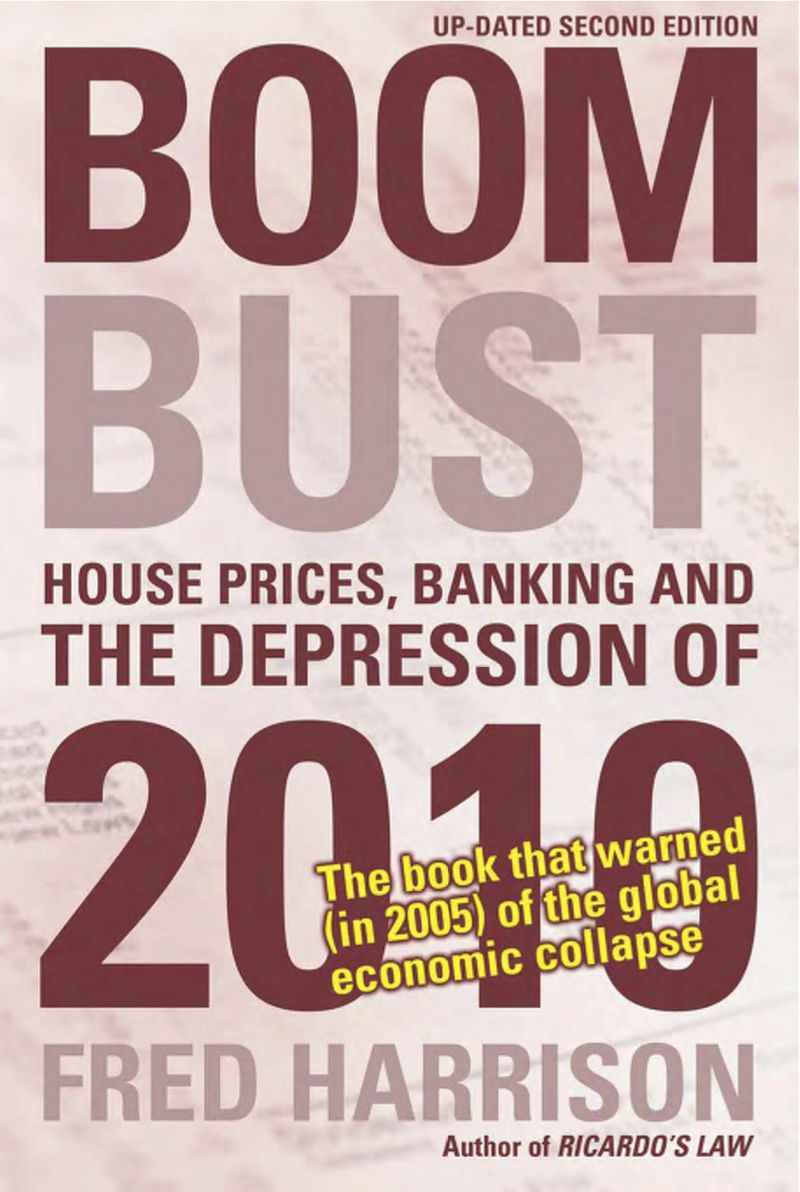
In the two and a half years since the first edition appeared (April 2005), events have unfolded as predicted. Then the consensus among forecasters was that the boom in house prices would cool to an annual 2 or 3% rise over the following years. In fact, in keeping with the 'winner's curse' phase of the cycle described by the author, prices rose by more than 10% per annum in Britain.
Harrison's first book, The Power in the Land, predicted the early 1990s recession. Boom Bust, warned that investing in property is not always a safe bet, because the housing market is subject to a sharp downturn at the end of a remarkably regular 18-year cycle. The crash of 2007/8 occurred exactly as predicted. His forecast was based on a careful study of the evidence from property markets in many countries over the last 200 years. Gordon Brown's claim, last made in his 2007 Budget speech, that 'we will never return to the old boom and bust' has been proved false.
The reason for the instability, Harrison explains, is not the housing market itself but the land market on which all buildings stand. Land is in fixed supply ' as Mark Twain noted: 'They're not making any more of it'. Therefore, as the demand for land for new homes and offices rises with population growth and economic expansion, market forces, which normally increase supply to reduce prices, have the reverse effect: prices rise. This encourages speculation, with banks lending more against escalating asset values and reinforcing the upward spiral.
Under existing government policies, the only way land prices can be brought back to affordable levels is a slump, undermining the banking system and causing widespread unemployment and repossessions. This is exactly what happened in America with the collapse of the sub-prime mortgage market. The run on Northern Rock showed the UK economy is not immune.
Audiobook details
GenreBusiness and Economics
Length6 hrs 42 mins
Narrated byListen with 1,000+ voices
FormateBook with Audio
Publish dateAug 8, 2012
LanguageEnglish
Table of contents
1The Predator Culture
2© 2010 Fred Harrison
3Prologue The Failed State
44 Lawrence and Karim (2007: 7).
5THE FAILED STATE
Show all chaptersShow less
6THE PREDATOR CULTURE
7Part 1 A General Theory of Violence
8Chapter 1 The Spatial Dynamics of Evolution
9THE PREDATOR CULTURE
10Figure 1:1 Structural Dynamics of the Social Universe
11THE PREDATOR CULTURE
12THE SPATIAL DYNAMICS OF EVOLUTION
13Chapter 2 The Culture of Pauperisation
14The Pathology of Rent Privatisation
151 Social Formations
162 The Predators
173 The Excluded
18THE CULTURE OF PAUPERISATION
196 Greenwood and Stini (1977: 147).
207 Harrison (2005).
21THE CULTURE OF PAUPERISATION
229 Harrison (1986).
23Chapter 3 The Socio-Ecology of Peace: Costa Rica
24Figure 3:1 Metrics of the Failed State
25Nicaragua 92 100 49 21
26Source: Garnier et al (1997: 357, Table 12:2).
27Source: Villanueva (1969: 67).
28THE PREDATOR CULTURE
29THE SOCIO-ECOLOGY OF PEACE: COSTA RICA
30Part 2 The Social Pathology of Land Grabs
31THE PREDATOR CULTURE
32COLONIALISM & THE CORRUPTION OF PEOPLE POWER 45
33COLONIALISM & THE CORRUPTION OF PEOPLE POWER 47
34COLONIALISM & THE CORRUPTION OF PEOPLE POWER 49
35COLONIALISM & THE CORRUPTION OF PEOPLE POWER 51
3615 Guatemalan Commission for Historical Clarification (2007), cited in Taylor (2009: 5-6).
37COLONIALISM & THE CORRUPTION OF PEOPLE POWER 53
38THE PREDATOR CULTURE
39Table 4:1 Global Inequality (1820-1992)
40Chapter 5 The Pathology of Re-ordered Space
41THE PREDATOR CULTURE
42THE PATHOLOGY OF RE-ORDERED SPACE
43Images of Humanity
44THE PATHOLOGY OF RE-ORDERED SPACE
45Chapter 6 Genocide & the Concentration Camp
46GENOCIDE & THE CONCENTRATION CAMP
47Equal to: %
4812 Lemarchand (1970).
49GENOCIDE & THE CONCENTRATION CAMP
50THE PREDATOR CULTURE
More from Fred Harrison



Never Split the DifferenceChris Voss, Tahl Raz8h 7m4.4 (277.7K)$26 · $0.00
The Intelligent Investor Rev Ed.Benjamin Graham17h 48m4.3 (191.5K)$40 · $0.00
The Hard Thing About Hard ThingsBen Horowitz7h 57m4.2 (134.3K)$26 · $0.00

Boundaries for LeadersHenry Cloud7h 36m4.3 (3.6K)$26 · $0.00

Not Everything Counts but Everything Matters: The powerful and inspirational new book about leadership and achieving success from the visionary multi-premiership winning Panthers coachIvan Cleary6h 1m4.6 (680)$24 · $0.00
BuildTony Fadell11h 5m4.5 (14.3K)$8 · $0.00
The Joys Of CompoundingGautam Baid17h 34m4.5 (2.5K)$18 · $0.00

Basic EconomicsThomas Sowell18h 32m4.5 (29.3K)$28 · $0.00

Poor Charlie’s AlmanackGrover Gardener, Charles T. Munger13h 9m4.5 (24.7K)$18 · $0.00

The Ambuja StoryNarotam Sekhsaria13h 59m4.5 (830)$33 · $0.00

The Secret Door to SuccessFlorence Scovel Shinn2h 25m4.5 (2.1K)$1.20 · $0.00

This Is Going to HurtAdam Kay5h 47m4.4 (444.7K)$24 · $0.00

Big TrustShadé Zahrai, Fayçal Sekkouah8h 36m4.6 (406)$26 · $0.00
The Intelligent Investor Third EditionBenjamin Graham, Jason Zweig20h4.4 (156.6K)$46 · $0.00

Bottle of LiesKatherine Eban14h 25m4.4 (12K)$33 · $0.00

The Antiracist Business BookTrudi Lebrón6h 10m4.6 (275)$17 · $0.00
The FormulaJoshua Robinson, Jonathan Clegg10h 41m4.4 (6.9K)$29 · $0.00

Let Them LeadJohn U. Bacon7h 10m4.5 (1.4K)$24 · $0.00

Secrets of the Millionaire MindT. Harv Eker5h 11m4.4 (301.4K)$24 · $0.00

The Person You Mean to BeDolly Chugh9h 6m4.4 (7.2K)$29 · $0.00
You may also like

AzadiArundhati Roy6h 15m4.2 (5.1K)$17 · $0.00

CapitalismAyn Rand14h 16m4.0 (5.2K)$25 · $0.00

The Elements of Law, Natural and Politic (Annotated)Thomas Hobbes8h 6m4.0 (553)$2 · $0.00

The Gulag Archipelago 1918-1956Aleksandr I. Solzhenitsyn21h 54m4.5 (44.1K)$46 · $0.00

Jihad AcademyNicolas Hénin4h 28m4.0 (405)$14

Invisible LaborRachel Somerstein10h 34m4.2 (803)$29 · $0.00

The Gulag Archipelago Volume 3Aleksandr I. Solzhenitsyn21h 56m4.7 (8.9K)$46 · $0.00

The Gulag Archipelago Volume 2Aleksandr I. Solzhenitsyn27h 31m4.6 (6K)$53 · $0.00

Southern Horrors: Lynch Law in All Its Phases (Annotated)Ida B. Wells-Barnett2h 44m4.6 (1.3K)$2 · $0.00

City of a Thousand GatesBee Sacks13h 49m3.6 (1.8K)$33 · $0.00

I Want to Burn this Place DownMaris Kreizman4h 40m3.5 (2.1K)$20 · $0.00

The State Must ProvideAdam Harris7h 15m4.5 (775)$24 · $0.00

SonglightMoira Buffini13h 58m4.2 (1.4K)$33 · $0.00

1984George Orwell11h 30m4.3 (6.1M)$1.20 · $0.00

Virtue BombsChristian Toto6h 12m4.3 (150)$17 · $0.00

Martyria; or, Andersonville PrisonAugustus C. Hamlin4h 7m$1 · $0.00

The Collected Works of Du BoisW.E.B. Du Bois35h 55m4.7 (160)$1.99 · $0.00

The Man with the Hoe, and Other Poems (Annotated)Edwin Markham1h 20m4.2 (19)$2 · $0.00

CAPITAL (Annotated)Karl Marx105h 33m$2 · $0.00

Scarlet HourglassSofia Jezler6m$7 · $0.00