
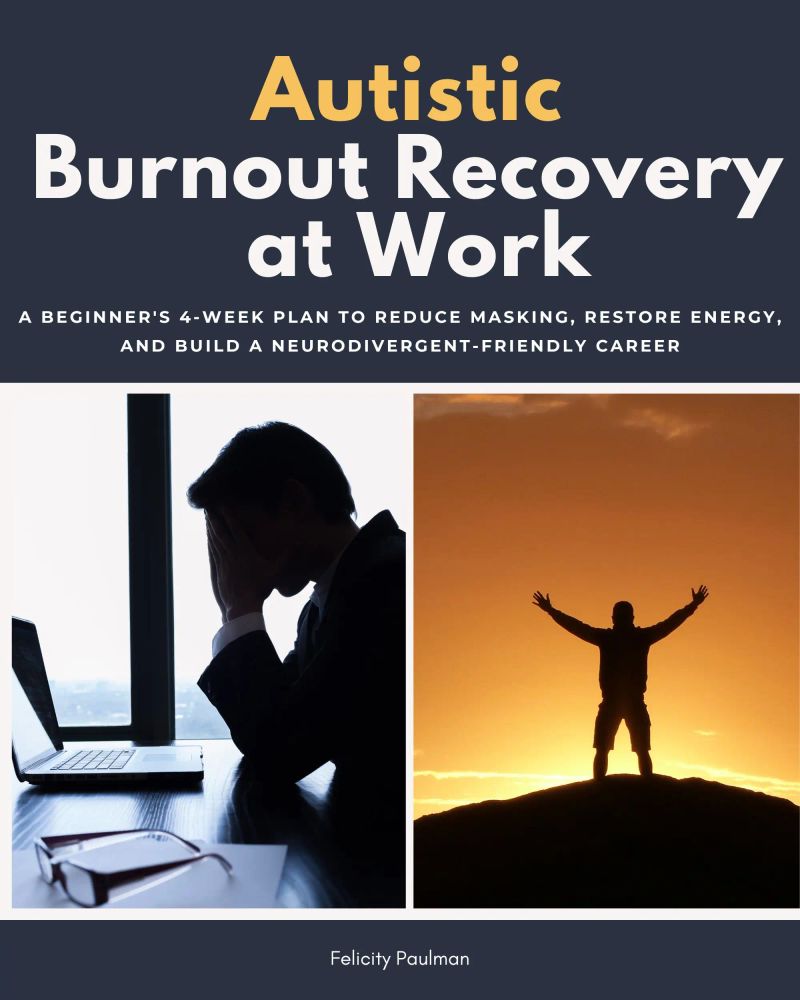
Autistic Burnout Recovery at Work
A Beginner's 4-Week Plan to Reduce Masking, Restore Energy, and Build a Neurodivergent-Friendly CareerBy Felicity Paulman


Length1h 33m
About this audiobook
Workplace burnout can feel overwhelming and lonely, but for autistic individuals, it carries unique challenges that are often misunderstood. Autistic burnout isn’t just exhaustion or stress; it’s a deep, all-encompassing depletion of your emotional, physical, and mental energy. It can leave you disconnected from your sense of self, unable to manage daily tasks, and unsure of how to find your way back to stability and strength.
The difficulties faced in workplaces not designed with neurodivergent needs in mind often magnify this experience. Sensory overload, relentless social pressures, and the constant effort of masking your true self just to fit in can quietly drain your energy day by day.
These challenges are often invisible or overlooked, leading to misdiagnoses such as anxiety, depression, or chronic fatigue. Recovery, in turn, can feel distant and unattainable without the right guidance.
This four-week guide is designed to help you reclaim your energy and honor your limits. It provides a compassionate and practical approach to recovery, tailoring each step to your unique needs. Over the next four weeks, you’ll focus on key pillars of recovery, including:
Week 1: Recognizing burnout and stabilizing your energy
Week 2: Supporting your nervous system and creating sensory safety
Week 3: Unmasking in ways that feel safe and setting strong boundaries
Week 4: Redesigning your work life for long-term alignment with your strengths and values
This plan is not about achieving perfection but about finding relief and rebuilding at a pace that works for you. Progress might look different for everyone, whether you prefer to take small, daily steps or move more slowly, focusing on one week at a time. Flexibility is key. Your recovery isn’t a straight path, and it’s okay to pause, adjust, or revisit earlier stages whenever you need.
By the end of this guide, you’ll have tools to recognize burnout earlier, protect your energy, and craft a work life that truly supports your needs. This is your time to heal with compassion, rediscover your strength, and build a future rooted in self-respect. Whatever pace you choose, this guide will be here to support you at every turn.
Audiobook details
GenreOther, General Fiction
Length1 hr 33 mins
Narrated byListen with 1,000+ voices
FormateBook with Audio
Publish dateJul 4, 2025
LanguageEnglish
Table of contents
1Disclaimer
2What Is Autistic Burnout?
3Core Symptoms and Patterns of Autistic Burnout
4Why It’s Misdiagnosed or Overlooked
5How Autistic Burnout Differs from Typical Stress
Show all chaptersShow less
6The Cost of Masking and Misunderstanding
7The Role of Late Diagnosis, Chronic Masking, and Invisible Expectations
8Understanding the Workplace Triggers
9Environmental Overload, Unsustainable Pacing, and Social Strain
10Micro-Stressors: Emails, Meetings, Multitasking
11The Cycle of Pushing Through → Shutdown → Guilt
12Week 1 – Recognize & Stabilize
13Day 1: Tune Into Your Current State
14Day 2: Start Tracking Energy Levels
15Day 3: Identify Sensory Triggers and Aids
16Day 4: Simplify with a Low-Effort Routine
17Day 5: Introduce “Minimum Viable Days”
18Day 6: Use Spoon Theory to Conserve Energy
19Day 7: Reflect and Adjust
20Day 8: Refine Your Physical Workspace
21Day 10: Strengthen Your Nourishment Routine
22Day 11: Combine Sensory-Aware Movement with Stimming
23Day 12–13: Build a Sensory-Friendly Sleep Routine
24Day 14: Reflect and Reevaluate Your Progress
25Week 3 – Unmask Safely
26Day 15: Understand Your Masking Behaviors
27Day 16: Explore Selective Unmasking
28Day 17–18: Practice Boundary-Setting and Communicating Limits
29Day 19–20: Decide Whether to Disclose Neurodivergence
30Day 21: Reflect and Reassess
31Week 4 – Redesign Your Work Life
32Day 22: Redefine Success Through a Neurodivergent Lens
33Day 23: Analyze and Adjust Workload
34Day 24: Advocating for Task Boundaries
35Day 25–26: Exploring Work Options (Remote, Hybrid, Async, Freelance)
36Day 27–28: Plan Early Exits or Internal Renegotiations
37Day 29: Final Reflection and Future Planning
38Managing Burnout Relapse
39Warning Signs to Watch For
40How to Recalibrate Before Shutdown
41Building a Flexible Personal Maintenance Plan
42Workplace Advocacy (With or Without Disclosure)
43ADA Accommodations vs Informal Adjustments
44Scripts and Templates for HR or Manager Conversations
45Advocating for Yourself Without Over-Explaining
46Designing Your Job to Fit You, Not the Other Way Around
47Thriving, Not Just Surviving
48Reintegration After Burnout
49Honoring Your Neurotype as a Strength
50Finding Community and External Validation

A Parent of Teens Happiness Reset GuideFelicity Paulman1h 54m$5.50

The Newborn Night-Shift Playbook for Two ParentsFelicity Paulman1h 53m$5.50
Tinnitus Retraining Therapy WorkbookFelicity Paulman1h 53m$5.50

Castor Oil for HairFelicity Paulman1h 58m$5.50

High-Conflict Co-Parenting PlaybookFelicity Paulman2h 1m$5.50

Talking to Aging Parents Who Refuse HelpFelicity Paulman2h 2m$5.50

Gaslighting Recovery for Divorced WomenFelicity Paulman1h 42m$5.50

Sobriety for High-Achieving WomenFelicity Paulman1h 35m$5.50

Boundaries for Adult Children of AlcoholicsFelicity Paulman1h 36m$5.50

Inner Child Healing for Highly Sensitive PeopleFelicity Paulman1h 38m$5.50
Pranic Healing for BeginnersFelicity Paulman1h 27m$5.50

Neuro-Linguistic Programming for WomenFelicity Paulman1h 35m$5.50

Happiness for Busy ParentsFelicity Paulman1h 33m$5.50

Swedish Death Cleaning for Adult ChildrenFelicity Paulman1h 29m$5.50

Manifestation for Women Over 40Felicity Paulman1h 32m$5.50

Child Anxiety & Screen TimeFelicity Paulman1h 35m$5.50

Daughters of Narcissistic MothersFelicity Paulman1h 32m$5.50

Vagus Nerve Healing for Women with AnxietyFelicity Paulman1h 26m$5.50

Memory Improvement for Seniors Over 50Felicity Paulman1h 31m$5.50

Highly Sensitive Woman Over 40Felicity Paulman1h 29m$5.50

Mere ChristianityC. S. Lewis7h 7m4.4 (519.7K)$24 · $0.00

Her Daily BreadKate Wood12h 57m4.6 (153)$33 · $0.00

The Holy Bible - 1 SamuelKing James2h 13m4.8 (1.6K)$3 · $0.00

The American Standard Bible — The Gospel of MatthewMatthew3h 56m4.7 (3K)$2 · $0.00

Bad Fat Black GirlSesali Bowen6h 32m4.7 (2.8K)$24 · $0.00

The King James Audio Bible New Testament CompleteChristopher Glyn20h 2m4.7 (2.6K)$12 · $0.00

Faiths CheckbookCharles Spurgeon12h 44m4.7 (3.2K)$11 · $0.00

Ten Things I Wish You Knew About Your Child's Mental HealthDr. Billy Garvey4h 53m4.7 (2.4K)$20 · $0.00

Designing Terry Pratchett’s DiscworldPaul Kidby3h 52m4.7 (343)$20 · $0.00

The Chosen Book OneAmanda Jenkins, Kristen Hendricks, Dallas Jenkins3h 8m4.6 (4.9K)$10 · $0.00

The Lives of BrianBrian Johnson9h 45m4.6 (3.5K)$29 · $0.00

Expository Thoughts on the Gospel of LukeJ.C. Ryle27h 13m4.7 (536)$18 · $0.00

CrossroadsKaleb Dahlgren7h 56m4.6 (4.9K)$26 · $0.00

Across the RiverKent Babb11h 40m4.6 (927)$29 · $0.00

Brain Training for RidersAndrea Monsarrat Waldo5h 56m4.7 (550)$19 · $0.00

My Effin' LifeGeddy Lee17h 11m4.6 (13.1K)$40 · $0.00

Kings and PawnsHoward Bryant10h 9m4.6 (678)$29 · $0.00

The Elementia Chronicles #2: The New OrderSean Fay Wolfe11h 17m4.6 (841)$29 · $0.00

The ActsLuke2h 55m4.6 (19.7K)$12 · $0.00

New Testament - Easy NavigationWorld English Bible19h 35m4.6 (1.3K)$1.30 · $0.00

WhistlerAnn Patchett10h 45m4.6 (4.6K)$29 · $0.00

Demon CopperheadBarbara Kingsolver21h 3m4.5 (949.4K)$46 · $0.00

To Kill a MockingbirdHarper Lee12h 18m4.5 (7.4M)$29 · $0.00

Remarkably Bright CreaturesShelby Van Pelt11h 17m4.4 (1.7M)$29 · $0.00

The Old Man and the Sea (Annotated)Ernest Hemingway4h 27m4.6 (1.4K)$2 · $0.00

White HotIlona Andrews13h 18m4.5 (136.9K)$5 · $0.00

The Ghost by the Billabong (The Matilda Saga, #5)Jackie French14h 58m4.6 (773)$33 · $0.00

Cast in BloodMichelle Sagara16h 35m4.6 (607)$33 · $0.00

The Captain Blood Trilogy (Annotated)Rafael Sabatini29h 20m4.6 (1K)$3 · $0.00

Ship of the Line (Annotated)Cecil Louis Troughton Smith11h 13m4.6 (1K)$2 · $0.00

The George Orwell CollectionGeorge Orwell24h 46m4.5 (14.4K)$12 · $0.00

Time RegainedMarcel Proust15h 38m4.5 (9.2K)$2 · $0.00

Driving ForceElle James4h 58m4.6 (407)$20 · $0.00

When God Calls the HeartBrian Bird, Michelle Cox3h 24m4.6 (439)$10 · $0.00

Five Little IndiansMichelle Good10h 34m4.5 (64.5K)$29 · $0.00

Lolth's WarriorR. A. Salvatore13h 20m4.6 (2.4K)$33 · $0.00

The Things We Cannot SayKelly Rimmer13h 48m4.5 (359.1K)$33 · $0.00

The Love Songs of W.E.B. Du BoisHonoree Fanonne Jeffers29h 49m4.5 (58K)$8 · $0.00

Going PostalTerry Pratchett11h 23m4.5 (189.9K)$29 · $0.00

Glen AffricKarine Giebel22h 51m4.5 (3.2K)$46 · $0.00
You may also like

The Confidence Code for GirlsKatty Kay, Claire Shipman4h 35m4.2 (2.8K)$20 · $0.00

Tired as F*ckCaroline Dooner8h 31m3.7 (3.5K)$26 · $0.00
Do Hard ThingsSteve Magness8h 54m4.1 (10.7K)$29 · $0.00

HOW TO LIVE ON 24 HOURS A DAY (A Self-Improvement Guide)Arnold Bennett2h 3m3.8 (13.8K)$1 · $0.00

Land of Broken PromisesJane Kuo2h 33m4.3 (458)$18 · $0.00

How Not to Kill YourselfSet Sytes, Faith G. Harper PhD2h 41m4.2 (911)$15

This Is Not How It EndsJehan Casinader6h 19m4.2 (417)$24 · $0.00
How to Not Always Be WorkingCody Cook-Parrott1h 58m3.7 (2.2K)$16 · $0.00

Lose WellChris Gethard9h 31m4.2 (4.5K)$29 · $0.00

How to Be a PatientSana Goldberg9h 43m4.2 (423)$29 · $0.00

nectarUpile Chisala40m4.2 (1.6K)$4

Refuse to Choose!Barbara Sher11h 25m4.1 (6.6K)$20

Burn the BoatsMatt Higgins7h 15m4.3 (1.3K)$24 · $0.00

Busy As F*ckKaren Nimmo7h 44m4.0 (258)$26 · $0.00

You Gotta EatMargaret Eby5h 8m4.1 (1K)$20

I Will Not FearMelba Pattillo Beals5h 51m4.3 (923)$17

The Souls of Black FolkW. E. B. Du Bois7h 22m4.4 (60.4K)Free

StretchScott Sonenshein7h 58m3.9 (1.8K)$26 · $0.00

Flowers on the MoonBilly Chapata1h 30m4.3 (5.8K)$15
RedMichael Hall5m4.5 (49.4K)$4 · $0.00