
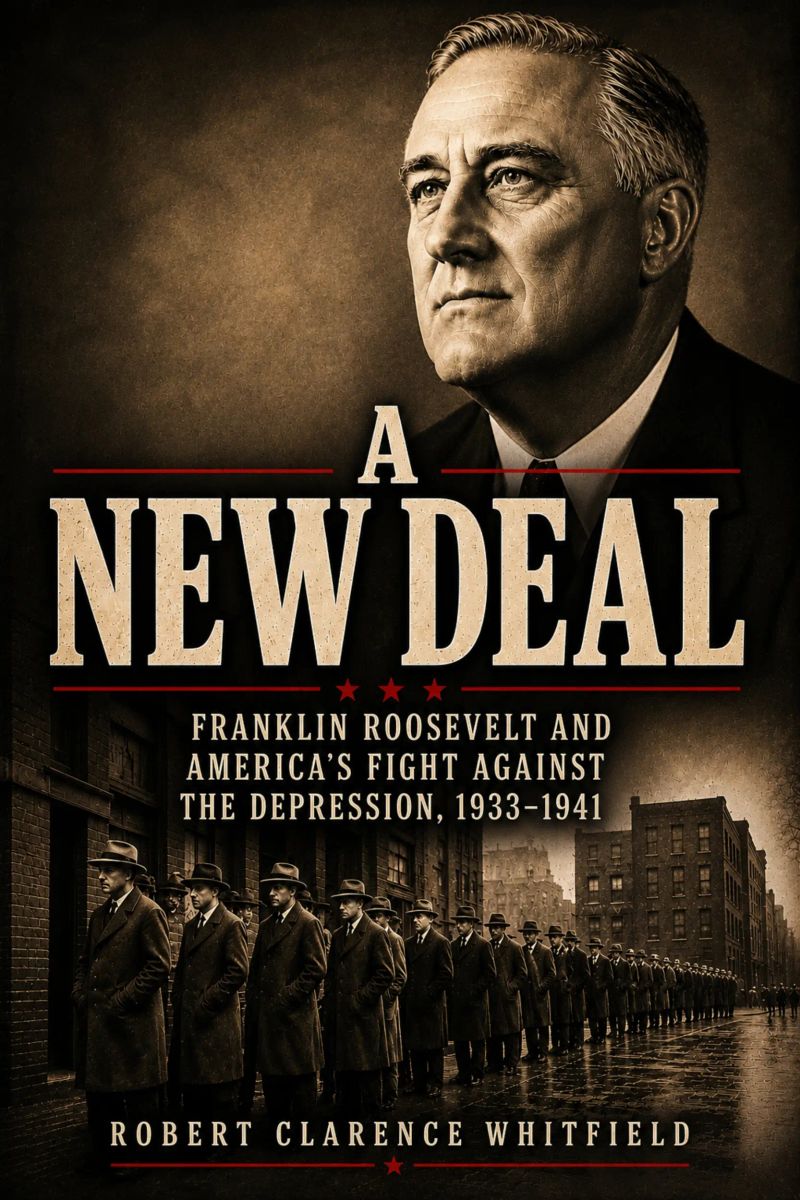
A NEW DEAL
Franklin Roosevelt and America's Fight Against the Depression, 1933-1941By Robert Clarence Whitfield


Length6h 1m
About this audiobook
What happens when a nation runs out of hope?
In 1933, one in four Americans had no work. Banks were padlocked. Families lined up for bread while the richest democracy on earth teetered on collapse. Then one man gripped a radio microphone and told a terrified country it had nothing to fear but fear itself.
If the Great Depression has ever felt like a confusing blur of alphabet agencies, dry dates, and forgettable acronyms, A New Deal finally hands you the story as it actually happened — urgent, human, and impossible to put down. This is Franklin Roosevelt's fight against the Great Depression, told not as a dusty textbook, but as the high‑stakes drama it truly was.
Inside, you'll discover:
- **How FDR's first 100 days** rewrote the rules of American government — and what fearless leadership looks like under fire.
- **Why the New Deal worked (and where it failed)** — Social Security, the WPA, the TVA, and the programs still shaping your paycheck today.
- **The brutal battles behind the New Deal** — the court‑packing showdown, the Liberty League, and the enemies who tried to stop Roosevelt cold.
- **The forgotten voices** — Eleanor Roosevelt, Dust Bowl migrants, Black Americans, and workers who paid the price and demanded more.
This isn't passive history. It's a front‑row seat to how leaders act when everything is on the line — and how Franklin Roosevelt and the New Deal pulled America back from the edge.
If you love sweeping, character‑driven history that reads like a thriller, A New Deal belongs on your shelf.
Scroll up, click "Buy Now," and step inside the decade that saved America.
Audiobook details
GenreOther, Biography and Memoir, Politics and Government
Length6 hrs 1 min
Narrated byListen with 1,000+ voices
FormateBook with Audio
LanguageEnglish
Table of contents
1Introduction
2Author’s Note
3Prologue: The Bank Holiday
4PART ONE: CRISIS — THE HOOVER YEARS (1929-1933)
5Chapter 1: The Crash — October 1929 and Its Aftermath
Show all chaptersShow less
6Chapter 2: Hoover's Response — The Limits of Conservative Government
7Chapter 3: The Bonus Army — Veterans March on Washington, 1932
8Chapter 4: FDR's Rise — The Election of 1932
9PART TWO: THE HUNDRED DAYS (1933)
10Chapter 5: The Banking Crisis and the First Fireside Chat
11Chapter 6: The Alphabet Agencies — NRA, AAA, CCC, and the New Deal Machine
12Chapter 7: Emergency Relief — FERA and the First Federal Safety Net
13Chapter 8: The First New Deal — Philosophy, Structure, and Ambition
14PART THREE: THE PROGRAMS (1933-1938)
15Chapter 9: The Second New Deal — Social Security and the Wagner Act
16Chapter 10: The WPA — Art, Culture, and the Work Relief Program
17Chapter 11: The TVA — Government Power and Regional Development
18Chapter 12: Banking Reform and the SEC — Regulating American Finance
19PART FOUR: OPPOSITION AND LIMITS
20Chapter 13: The Supreme Court Fight — FDR's Court-Packing Plan
21Chapter 14: Conservative Opposition — The Liberty League and the American Right
22Chapter 15: The Left Critique — Socialists, Communists, and Populist Challenges
23Chapter 16: The End of the New Deal — The Conservative Coalition of 1938
24PART FIVE: THE HUMAN DIMENSIONS
25Chapter 17: Eleanor Roosevelt and the New Deal's Social Conscience
26Chapter 18: Black Americans and the New Deal — The Limits of the Coalition
27Chapter 19: Labor and the New Deal — The CIO and Industrial Unionism
28Chapter 20: The Dust Bowl Migrants — Okies, California, and the Human Cost
29PART SIX: LEGACIES
30Chapter 21: Did the New Deal End the Depression?
31Chapter 22: The Welfare State — Social Security's Long Life
32Chapter 23: The Mixed Economy — Government's Permanent New Role
33Chapter 24: FDR's Legacy — The New Deal and American Liberalism
34Epilogue: What Roosevelt Built
35Acknowledgments
36Selected Bibliography
37About the Author
More from Robert Clarence Whitfield
Mere ChristianityC. S. Lewis7h 7m4.4 (519.7K)$24 · $0.00

Her Daily BreadKate Wood12h 57m4.6 (153)$33 · $0.00
The Holy Bible - 1 SamuelKing James2h 13m4.8 (1.6K)$3 · $0.00

The American Standard Bible — The Gospel of MatthewMatthew3h 56m4.7 (3K)$2 · $0.00

Bad Fat Black GirlSesali Bowen6h 32m4.7 (2.8K)$24 · $0.00
The King James Audio Bible New Testament CompleteChristopher Glyn20h 2m4.7 (2.6K)$12 · $0.00
Faiths CheckbookCharles Spurgeon12h 44m4.7 (3.2K)$11 · $0.00
Ten Things I Wish You Knew About Your Child's Mental HealthDr. Billy Garvey4h 53m4.7 (2.4K)$20 · $0.00

Designing Terry Pratchett’s DiscworldPaul Kidby3h 52m4.7 (343)$20 · $0.00
The Chosen Book OneAmanda Jenkins, Kristen Hendricks, Dallas Jenkins3h 8m4.6 (4.9K)$10 · $0.00
The Lives of BrianBrian Johnson9h 45m4.6 (3.5K)$29 · $0.00
Expository Thoughts on the Gospel of LukeJ.C. Ryle27h 13m4.7 (536)$18 · $0.00

CrossroadsKaleb Dahlgren7h 56m4.6 (4.9K)$26 · $0.00

Across the RiverKent Babb11h 40m4.6 (927)$29 · $0.00

Brain Training for RidersAndrea Monsarrat Waldo5h 56m4.7 (550)$19 · $0.00

My Effin' LifeGeddy Lee17h 11m4.6 (13.1K)$40 · $0.00
Kings and PawnsHoward Bryant10h 9m4.6 (678)$29 · $0.00

The Elementia Chronicles #2: The New OrderSean Fay Wolfe11h 17m4.6 (841)$29 · $0.00

The ActsLuke2h 55m4.6 (19.7K)$12 · $0.00

New Testament - Easy NavigationWorld English Bible19h 35m4.6 (1.3K)$1.30 · $0.00

MotherlandJulia Ioffe17h 52m4.7 (2.5K)$40 · $0.00
Evidence Not SeenDarlene Deibler Rose11h 11m4.6 (11.9K)$29 · $0.00

Where Cowards Go to DieBenjamin Sledge8h 42m4.7 (351)$20 · $0.00

Will You Love Me?Cathy Glass9h 5m4.6 (9.3K)$29 · $0.00
Designing Terry Pratchett’s DiscworldPaul Kidby3h 52m4.7 (343)$20 · $0.00

HostageEli Sharabi5h 25m4.6 (10.8K)$24 · $0.00

Finding MeViola Davis9h 15m4.6 (256.4K)$29 · $0.00

The Dangerous Truth about Today’s MarijuanaLaura Stack CSP, MBA9h 57m4.7 (385)$20 · $0.00

Birdie & HarlowTaylor Wolfe7h 50m4.6 (6.5K)$26 · $0.00
The Lives of BrianBrian Johnson9h 45m4.6 (3.5K)$29 · $0.00

I Am The StormJanice Dean9h4.6 (1.5K)$8 · $0.00
Black History CollectionFrederick Douglass, Harriet Ann Jacobs, Booker T. Washington, W.E.B. Du Bois27h 9m4.6 (2.6K)$18 · $0.00

Just as I AmCicely Tyson16h 8m4.6 (99K)$33 · $0.00

Unbroken Bonds of BattleJohnny Joey Jones8h 31m4.6 (2.6K)$8 · $0.00

The Daughter of AuschwitzTova Friedman, Malcolm Brabant7h 54m4.6 (16.7K)$26 · $0.00
My Bondage and My Freedom (Annotated)Frederick Douglass15h 30m4.6 (2.4K)$2 · $0.00

Lily's PromiseLily Ebert, Dov Forman8h 54m4.6 (16.1K)$29 · $0.00
CrossroadsKaleb Dahlgren7h 56m4.6 (4.9K)$26 · $0.00
Across the RiverKent Babb11h 40m4.6 (927)$29 · $0.00

The Biography of Robert Murray M'CheyneAndrew A. Bonar7h 41m4.6 (2.2K)$1 · $0.00
RiggedMollie Hemingway12h 48m4.6 (4.2K)$23 · $0.00

SledgehammerDavid Friedman8h 21m4.7 (589)$26 · $0.00

Citizenship in a Republic (Annotated)Theodore Roosevelt2h 44m4.6 (1.4K)$2 · $0.00

No EscapeNury Turkel9h 30m4.6 (809)$28 · $0.00

Always FaithfulThomas Schueman, Zainullah Zaki12h 12m4.6 (977)$29 · $0.00

UnthinkableJamie Raskin15h 8m4.5 (9.3K)$8 · $0.00
My Fourth Time, We DrownedSally Hayden13h 59m4.6 (2.9K)$23 · $0.00

A Revolution of Common SenseScott Jennings9h 29m4.6 (528)$29 · $0.00

Statement From the Dock at the Rivonia TrialNelson Mandela2h 18m4.6 (1.3K)$1 · $0.00

Lessons from the EdgeMarie Yovanovitch17h 11m4.5 (5.9K)$40 · $0.00
To Rescue the American SpiritBret Baier10h 12m4.5 (2.7K)$8 · $0.00

StonewalledSharyl Attkisson15h 19m4.5 (4.3K)$33 · $0.00
The World According to Orwell: 1984 & Animal FarmGeorge Orwell15h 42m4.6 (1.1K)$1 · $0.00
Basic EconomicsThomas Sowell18h 32m4.5 (29.3K)$28 · $0.00
To Rescue the RepublicBret Baier, Catherine Whitney11h 42m4.5 (8.6K)$29 · $0.00
Modern WarriorsPete Hegseth7h 10m4.5 (4.7K)$24 · $0.00
Philosophy and Opinions of Marcus Garvey (Annotated)Marcus Mosiah Garvey4h 42m4.5 (1.7K)$1.99 · $0.00

A Plague Upon Our HouseScott W. Atlas MD10h 37m4.5 (3.4K)$20 · $0.00

One Bright MoonAndrew Kwong12h 21m4.5 (813)$29 · $0.00

CredibleDeborah Tuerkheimer8h 5m4.6 (551)$26 · $0.00
You may also like

History of the American Civil War (Annotated)James Ford Rhodes16h4.1 (875)$2 · $0.00

The Rise and Fall of the Confederate Government (Vol. 1&2) (Annotated)Jefferson Davis65h 17m4.6 (1.2K)$2 · $0.00

The Cancer CodeDr. Jason Fung10h 48m4.5 (5.3K)$29 · $0.00

Pastoral CarePope Gregory I8h 17m4.3 (1.4K)$1 · $0.00

Enduring VietnamJames Wright15h 33m4.3 (290)$23

The EnchiridionEpictetus58m4.3 (12.9K)Free

A Rebel War Clerk's Diary at the Confederate States CapitalJ. B. Jones38h 11m4.3 (517)$2 · $0.00

Learning to Eat Soup with a KnifeJohn A. Nagl8h 46m4.1 (2.6K)$20

Six Days of WarMichael B. Oren17h 54m4.4 (15.5K)$32
GorgiasPlato4h 1m4.1 (18.3K)$1.80 · $0.00

The Civil War: A Narrative, Vol. 2Shelby Foote52h 41m4.6 (11.7K)$30

40 Civil War Memoirs of Confederate SoldiersHeros von Borcke, John Esten Cooke, Robert E. Lee, George Cary Eggleston, James Longstreet, John Singleton Mosby, Edward M. Boykin, Arthur Peronneau Ford, Marion Johnstone Ford, Isaac Hermann, Gilbert Moxley Sorrel, William Watson, Daniel P. Smith, James Carson Elliott, Thomas D. Duncan, David E. Johnston, Francis Warrington Dawson, John A. Sloan, La Salle Corbell Pickett, Henry Lane Stone, Basil Wilson Duke, Wayland Fuller Dunaway, Rufus H. Peck, Edward Alexander Moore, Raphael Semmes, Cole Younger, William Meade Dame, Caleb Huse, William G. Stevenson, Carlton McCarthy, Samuel Gibbs French, Richard L. Maury, J. Wilkinson, Alfred J. Vaughan, Luther W. Hopkins, John Porter Fort, John Milton Hubbard, John Call Dalton, James H. Wood, Frank M. Myers317h 25m4.4 (18)$1.99

History of the Civil War: 15 Essential BooksLouisa May Alcott, Ulysses S. Grant, James Ford Rhodes, Jefferson Davis, Frank H. Alfriend, John Torrey Morse, John Alexander Logan, Thomas Elbert Vineyard, Ephraim Douglass Adams, John Esten Cooke, William Tecumseh Sherman, John D. Billings, Charles W. Reed, James Madison Page, Heros von Borcke, Mary Boykin Chesnut342h 7m4.6 (13)$1.99
The History of SlaveryAdam Gurowski7h 6m$1 · $0.00

Francisco GoyaSarah Carr-Gomm2h 25m4.0 (25)$10 · $0.00

The Oxford Movement; Twelve Years, 1833-1845R. W. Church11h 29m4.3 (180)$2 · $0.00
THE QUAGMIRERaymond Corbett Ellis5h 57m$8
Defenseless AmericaHudson Maxim5h 17m$1 · $0.00

Outlines Of Jewish History From B.C. 586 to C.E 1885Lady Katie Magnus9h 11m3.9 (34)$2.30

The Greatest Speeches of the Vietnam WarSpeechWorks7h 12m$20