
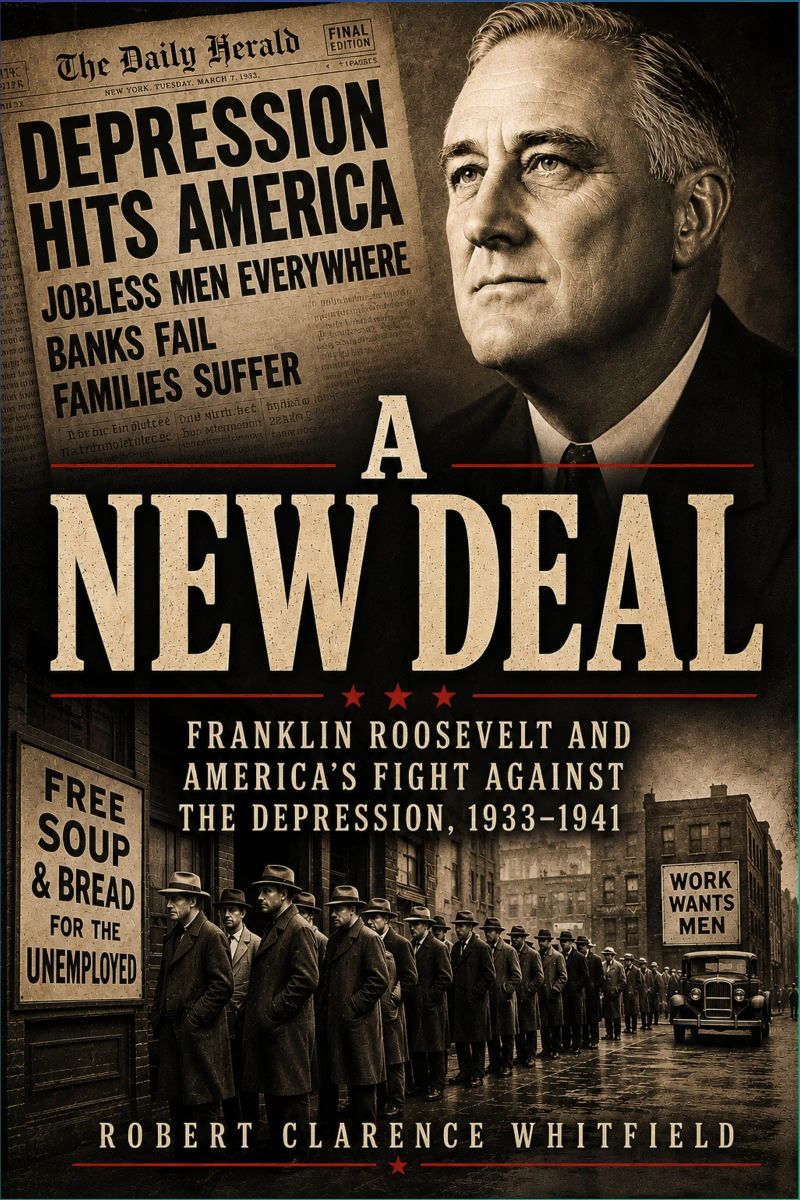
A NEW DEAL
Franklin Roosevelt and America's Fight Against the Depression, 1933-1941By Robert Clarence Whitfield


Length5h 49m
About this audiobook
The definitive narrative history of FDR and the New Deal — Franklin Roosevelt, the Great Depression, Social Security, the WPA, and the complete story of how America's federal government was remade, 1929-1941.
On the morning of March 4, 1933, Franklin Roosevelt placed his hand on a Dutch Reformed Bible and swore to preserve, protect, and defend the Constitution. Nine thousand banks had closed since his election. Unemployment had climbed to twenty-five percent. Industrial output had fallen by half from its 1929 peak. The man who stepped to the microphone sounded like someone who was not afraid. In 1933 America, that sound was revolutionary.
In this complete New Deal history, historian Robert Clarence Whitfield traces the full arc of the Roosevelt years — from the market crash of October 1929 and Herbert Hoover's failure of nerve, through the Hundred Days, the alphabet agencies, the Second New Deal's social insurance legislation, and the conservative coalition that halted reform in 1938. At the center stand Franklin Roosevelt, Eleanor Roosevelt, Harry Hopkins, Frances Perkins, and the millions of ordinary Americans whose lives the New Deal remade — told in their own voices, grounded in the primary record, and unflinching about the program's racial exclusions.
Inside this Great Depression history:
The Bank Holiday and the First Fireside Chat — Roosevelt restored confidence in a week: the Emergency Banking Act signed, examined banks declared solvent, deposits exceeding withdrawals for the first time in months (Chapter 5)
The Hundred Days and the alphabet agencies — NRA, AAA, CCC, FERA: 99 days of the most concentrated lawmaking in American history (Chapter 6)
Social Security and the Wagner Act — Ida May Fuller's first monthly check of $22.54 on January 31, 1940, and the Wagner Act's legally protected collective bargaining (Chapters 9, 22)
The WPA and the cultural New Deal — 8.5 million workers at its peak, including the writers, painters, and theatre workers who produced a government-funded American cultural record (Chapter 10)
Black Americans and the New Deal's limits — Social Security's deliberate exclusion of domestic and agricultural workers to preserve the South's racial wage structure, and what Eleanor Roosevelt did about it (Chapter 18)
Did the New Deal end the Depression? — unemployment was still at ten percent eight years in; the honest assessment of what the programs achieved and why war mobilization succeeded where the New Deal fell short (Chapter 21)
The New Deal left behind Social Security, the FDIC, the SEC, the NLRB — institutions that still govern American life. It also left behind a question only partially answered: what does democratic government owe its people when prosperity fails? This Franklin Roosevelt biography and Great Depression history tells the story of the incomplete, indispensable answer Roosevelt's twelve years produced.
For readers of David Kennedy's FREEDOM FROM FEAR and Arthur Schlesinger Jr.'s THE AGE OF ROOSEVELT.
Audiobook details
GenreBusiness and Economics, Biography and Memoir
Length5 hrs 49 mins
Narrated byListen with 1,000+ voices
FormateBook with Audio
Publish dateJun 3, 2026
LanguageEnglish
Table of contents
1Introduction
2Prologue: The Bank Holiday
3PART ONE: CRISIS — THE HOOVER YEARS (1929-1933)
4Chapter 1: The Crash — October 1929 and Its Aftermath
5Chapter 2: Hoover's Response — The Limits of Conservative Government
Show all chaptersShow less
6Chapter 3: The Bonus Army — Veterans March on Washington, 1932
7Chapter 4: FDR's Rise — The Election of 1932
8PART TWO: THE HUNDRED DAYS (1933)
9Chapter 5: The Banking Crisis and the First Fireside Chat
10Chapter 6: The Alphabet Agencies — NRA, AAA, CCC, and the New Deal Machine
11Chapter 7: Emergency Relief — FERA and the First Federal Safety Net
12Chapter 8: The First New Deal — Philosophy, Structure, and Ambition
13PART THREE: THE PROGRAMS (1933-1938)
14Chapter 9: The Second New Deal — Social Security and the Wagner Act
15Chapter 10: The WPA — Art, Culture, and the Work Relief Program
16Chapter 11: The TVA — Government Power and Regional Development
17Chapter 12: Banking Reform and the SEC — Regulating American Finance
18PART FOUR: OPPOSITION AND LIMITS
19Chapter 13: The Supreme Court Fight — FDR's Court-Packing Plan
20Chapter 14: Conservative Opposition — The Liberty League and the American Right
21Chapter 15: The Left Critique — Socialists, Communists, and Populist Challenges
22Chapter 16: The End of the New Deal — The Conservative Coalition of 1938
23PART FIVE: THE HUMAN DIMENSIONS
24Chapter 17: Eleanor Roosevelt and the New Deal's Social Conscience
25Chapter 18: Black Americans and the New Deal — The Limits of the Coalition
26Chapter 19: Labor and the New Deal — The CIO and Industrial Unionism
27Chapter 20: The Dust Bowl Migrants — Okies, California, and the Human Cost
28PART SIX: LEGACIES
29Chapter 21: Did the New Deal End the Depression?
30Chapter 22: The Welfare State — Social Security's Long Life
31Chapter 23: The Mixed Economy — Government's Permanent New Role
32Chapter 24: FDR's Legacy — The New Deal and American Liberalism
33Epilogue: What Roosevelt Built
34Acknowledgments
35Selected Bibliography
36About the Author
More from Robert Clarence Whitfield
Never Split the DifferenceChris Voss, Tahl Raz8h 7m4.4 (277.7K)$26 · $0.00
The Intelligent Investor Rev Ed.Benjamin Graham17h 48m4.3 (191.5K)$40 · $0.00
The Hard Thing About Hard ThingsBen Horowitz7h 57m4.2 (134.3K)$26 · $0.00
Boundaries for LeadersHenry Cloud7h 36m4.3 (3.6K)$26 · $0.00

Eat It!Jordan Syatt, Michael Vacanti4h 40m4.6 (1.5K)$20 · $0.00
Progress and Poverty, Volumes I and II (Annotated)Henry George19h 21m4.6 (574)$0.99 · $0.00

Not Everything Counts but Everything Matters: The powerful and inspirational new book about leadership and achieving success from the visionary multi-premiership winning Panthers coachIvan Cleary6h 1m4.6 (680)$24 · $0.00
BuildTony Fadell11h 5m4.5 (14.3K)$8 · $0.00
The Joys Of CompoundingGautam Baid17h 34m4.5 (2.5K)$18 · $0.00
Basic EconomicsThomas Sowell18h 32m4.5 (29.3K)$28 · $0.00

Poor Charlie’s AlmanackGrover Gardener, Charles T. Munger13h 9m4.5 (24.7K)$18 · $0.00

The Ambuja StoryNarotam Sekhsaria13h 59m4.5 (830)$33 · $0.00

The Secret Door to SuccessFlorence Scovel Shinn2h 25m4.5 (2.1K)$1.20 · $0.00

This Is Going to HurtAdam Kay5h 47m4.4 (444.7K)$24 · $0.00

Big TrustShadé Zahrai, Fayçal Sekkouah8h 36m4.6 (406)$26 · $0.00

The Intelligent Investor Third EditionBenjamin Graham, Jason Zweig20h4.4 (156.6K)$46 · $0.00

Bottle of LiesKatherine Eban14h 25m4.4 (12K)$33 · $0.00

The Antiracist Business BookTrudi Lebrón6h 10m4.6 (275)$17 · $0.00
The FormulaJoshua Robinson, Jonathan Clegg10h 41m4.4 (6.9K)$29 · $0.00

Let Them LeadJohn U. Bacon7h 10m4.5 (1.4K)$24 · $0.00

Matters of the HeartJacinta Nampijinpa Price9h 35m4.8 (359)$29 · $0.00

The StepsSylvester Stallone9h 4m4.8 (635)$29 · $0.00
How to Test Negative for StupidJohn Kennedy8h 13m4.7 (9.7K)$28 · $0.00

Bad Fat Black GirlSesali Bowen6h 32m4.7 (2.8K)$24 · $0.00

Send MeMarty Skovlund, Joe Kent8h 10m4.7 (1.6K)$26 · $0.00

John Muir: The Story of My Boyhood and Youth & Letters to a Friend (Annotated)John Muir10h 13m4.7 (1.1K)$0.99 · $0.00

Invisible StormJason Kander6h 48m4.7 (3.2K)$24 · $0.00

Forever BoyKate Swenson9h 27m4.7 (5K)$29 · $0.00

You Are Worth ItKyle Carpenter, Don Yaeger8h 53m4.7 (4.8K)$29 · $0.00

The Happiest Man on EarthEddie Jaku3h 48m4.6 (178K)$7 · $0.00

MotherlandJulia Ioffe17h 52m4.7 (2.5K)$40 · $0.00

Evidence Not SeenDarlene Deibler Rose11h 11m4.6 (11.9K)$29 · $0.00

Where Cowards Go to DieBenjamin Sledge8h 42m4.7 (351)$20 · $0.00

Will You Love Me?Cathy Glass9h 5m4.6 (9.3K)$29 · $0.00

Designing Terry Pratchett’s DiscworldPaul Kidby3h 52m4.7 (343)$20 · $0.00

HostageEli Sharabi5h 25m4.6 (10.8K)$24 · $0.00

Finding MeViola Davis9h 15m4.6 (256.4K)$29 · $0.00

The Dangerous Truth about Today’s MarijuanaLaura Stack CSP, MBA9h 57m4.7 (385)$20 · $0.00

Birdie & HarlowTaylor Wolfe7h 50m4.6 (6.5K)$26 · $0.00
The Lives of BrianBrian Johnson9h 45m4.6 (3.5K)$29 · $0.00
You may also like

Get Well SoonJennifer Wright7h 43m4.3 (17.7K)$20
Mighty Be Our PowersLeymah Gbowee9h 7m4.3 (5.4K)$20 · $0.00

We Stand DividedDaniel Gordis8h 6m4.1 (519)$26 · $0.00
The New DealMichael Hiltzik19h 35m4.1 (952)$32

Bring Back Our GirlsJoe Parkinson, Drew Hinshaw11h 8m4.4 (555)$29 · $0.00

Do it Like a WomanCaroline Criado-Perez8h 6m4.2 (1.5K)$20

The New NormalJennifer Ashton8h 42m4.1 (305)$26 · $0.00

Coping SkillsFaith G. Harper PhD1h 56m4.1 (1.2K)$10
We Fed an IslandJosé Andrés10h 35m4.2 (4.2K)$29 · $0.00

KatrinaGary Rivlin15h 26m4.1 (1.4K)$25 · $0.00

The Last HoursMinette Walters15h 29m4.0 (14.7K)$7 · $0.00

Beneath the Tamarind TreeIsha Sesay12h 16m4.1 (2.1K)$29 · $0.00

Riding the LightningAnthony Almojera8h 42m4.1 (1.1K)$26 · $0.00

I Am The StormJanice Dean9h4.6 (1.5K)$8 · $0.00

Anti-Racist AllySophie Williams1h 25m4.5 (4.6K)$16 · $0.00

Strong VoicesTonya Bolden, Cokie Roberts3h 5m4.3 (353)$18 · $0.00

BlindnessJosé Saramago12h 32m4.2 (396.3K)$30

The Collected Works of Frederick DouglassFrederick Douglass63h 40m4.7 (113)$1.99 · $0.00

Feral CityJeremiah Moss8h 56m3.9 (571)$20 · $0.00
Obama's Legacy - Yes We Can, Yes We DidBarack Obama, White House, U.S. Government7h 36m4.1 (70)$2 · $0.00