
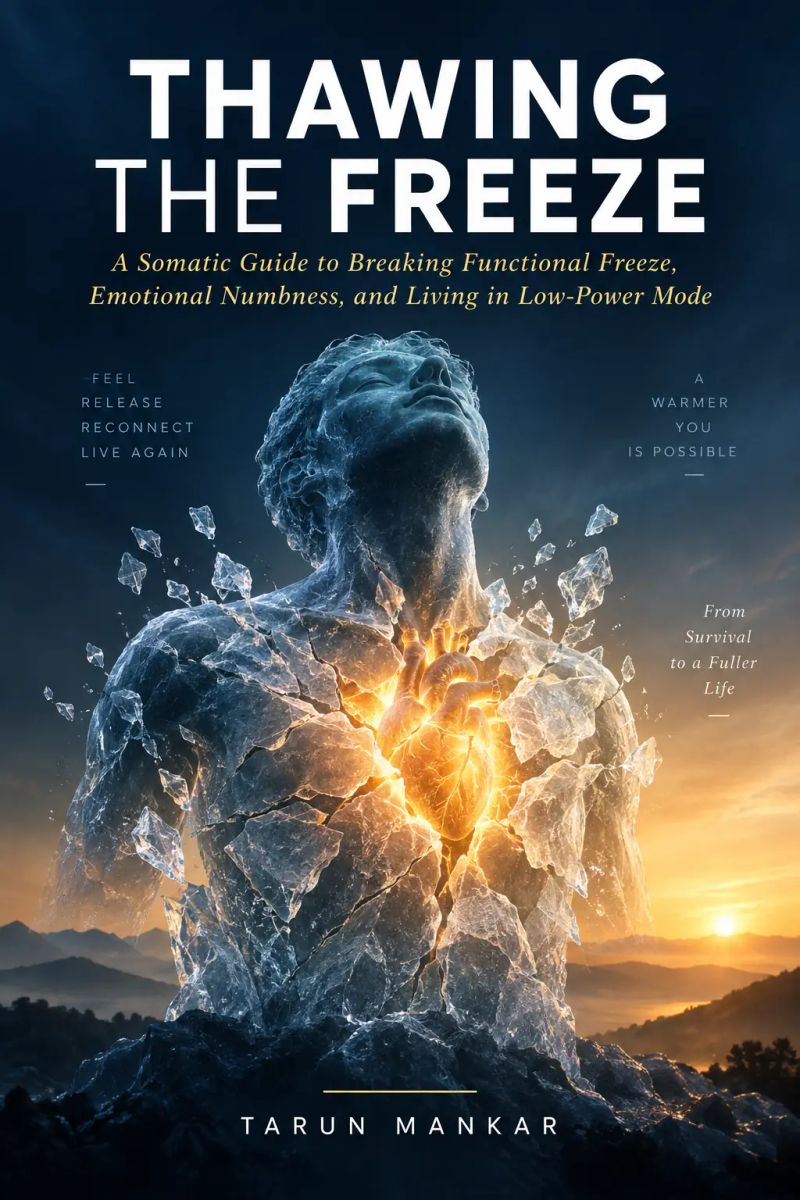
Thawing the Freeze
A Somatic Guide to Breaking Functional Freeze, Emotional Numbness, and Living in Low-Power ModeDe Tarun Mankar

Duração2h 49m
Sobre este audiolivro
You wake up, answer emails, smile at coworkers, and get things done. On the outside, you look totally functional. But on the inside, you feel completely numb, flat, and detached—like you are watching your life through thick glass. You are not lazy or broken. Your nervous system has entered functional freeze, slamming on the emergency brake to protect you from prolonged overwhelm.
Thawing the Freeze offers a practical, compassionate roadmap out of dorsal vagal shutdown. Grounded in polyvagal science and gentle somatic bodywork, this audiobook teaches you how to signal safety to your body without triggering anxiety. Discover how to gently melt physical numbness, expand your emotional capacity, reclaim natural motivation without hustle culture, and rekindle genuine intimacy. It is time to stop surviving on low-power mode and step back into the vibrant warmth of your life.
Detalhes do audiolivro
GêneroSelf-Help, Health and Wellness
Duração2 h 49 min
Narrado porOuça com mais de 1.000 vozes
FormatoeBook com áudio
Data de publicação16 de set. de 2026
IdiomaInglês
Sumário
1Chapter 1 — The Low-Power Mode: Why You Feel Flat, Functional, and Detached
2Chapter 2 — The Biology of the Freeze: Understanding Your Dorsal Vagal Brake
3Chapter 3 — Functional vs. Collapsed: The Mask of Getting Things Done
4Chapter 4 — The Numbness Trap: How We Accidentally Lock the Body in Hibernation
5Chapter 5 — Micro-Moments of Safety: Signaling to the Body That the War Is Over
Mostrar todos os capítulosVer menos
6Chapter 6 — Somatic Unthawing: Gentle Physical Awakenings Without Overwhelm
7Chapter 7 — Feeling Without Flooding: Widening Your Window of Tolerance
8Chapter 8 — Reclaiming Energy and Motivation: Beyond Willpower and Hustle Culture
9Chapter 9 — Reconnecting to People: Moving Past Emotional Flatness in Relationships
10Chapter 10 — Living in Vitality: Anchoring Daily Flow, Joy, and Embodied Presence
11About the Author
12Closing Credits
Mais de Tarun Mankar

The Calm AlarmTarun Mankar2h 55minGrátis
The Imposter AlarmTarun Mankar3h 12minGrátis

The Phantom AlarmTarun Mankar3h 38min$4.99 · $0.00

The Shame CollapseTarun Mankar2h 49min$4.99 · $0.00
The Midnight Nervous SystemTarun Mankar2h 58min$4.99 · $0.00
The Inability to RestTarun Mankar3h 1min$4.99 · $0.00
The Procrastination LoopTarun Mankar2h 56min$4.99 · $0.00

Mastering the Emotional StormTarun Mankar2h 58min$4.99 · $0.00
Wired for SecurityTarun Mankar2h 51min$4.99 · $0.00
The Courage to DisappointTarun Mankar2h 52min4.5 (21)$4.99 · $0.00
Dopamine Reset and Deep FocusTarun Mankar3h 2min4.5 (26)$4.99 · $0.00
Healing The Scarcity MindsetTarun Mankar3h 20min$4.99 · $0.00

Somatic PacingTarun Mankar2h 18min5.0 (1)$4.99 · $0.00
Stop SpiralingTarun Mankar1h 37min$4.99 · $0.00
Learning to PrayJames Martin13h 24min4.5 (3.4K)$33 · $0.00

The StepsSylvester Stallone9h 4min4.8 (637)$29 · $0.00

Swayam Ki AwaazPrem Rawat8h 34min4.7 (1.1K)$26 · $0.00

Forever BoyKate Swenson9h 27min4.7 (5K)$29 · $0.00

You Are Worth ItKyle Carpenter, Don Yaeger8h 53min4.7 (4.8K)$29 · $0.00

The Happiest Man on EarthEddie Jaku3h 48min4.6 (178K)$7 · $0.00

Finding MeViola Davis9h 15min4.6 (256.4K)$29 · $0.00

Spiritual AnatomyDaaji Kamlesh D. Patel9h 47min4.7 (319)$29 · $0.00

The Dangerous Truth about Today’s MarijuanaLaura Stack CSP, MBA9h 57min4.7 (385)$20 · $0.00
The Gospel according to Spiritualism (Translated)Allan Kardec14h 39min4.6 (3.9K)$5.70 · $0.00

Birdie & HarlowTaylor Wolfe7h 50min4.6 (6.5K)$26 · $0.00

CrossroadsKaleb Dahlgren7h 56min4.6 (4.9K)$26 · $0.00

Life on the BridgeKaelynn Partlow5h 40min4.6 (1.1K)$24 · $0.00

Keep Your Love OnDanny Silk9h 4min4.6 (8.1K)$10 · $0.00

The Tao of Joy Every DayDerek Lin10h 24min4.6 (762)$20 · $0.00

UndividedVicky Beeching9h 2min4.6 (1.3K)$29 · $0.00

HE CAN WHO THINKS HE CAN & OTHER BOOKS ON SUCCESSOrison Swett Marden5h 54min4.6 (1.2K)$1.99 · $0.00
Level UpRob Dial7h 42min4.6 (3.3K)$26 · $0.00

Burn the HaystackJennie Young, PhD9h 30min4.6 (543)$29 · $0.00

ACRES OF DIAMONDS: Our Every-day Opportunities (Wisdom & Empowerment Series) (Annotated)Russell Conwell2h 26min4.6 (1K)$2 · $0.00
Hour of the HeartIrvin D. Yalom, Benjamin Yalom8h 19min4.6 (2.3K)$26 · $0.00

The Yoga Sutras of PatanjaliPatanjali4h 8min4.5 (18.5K)$6 · $0.00

The Lost VoiceGreta Morgan8h 30min4.7 (285)$26 · $0.00

Healthy Kids, Happy KidsElisa Song14h 18min4.6 (760)$33 · $0.00

Eat It!Jordan Syatt, Michael Vacanti4h 40min4.6 (1.5K)$20 · $0.00

Consent Laid BareChanel Contos7h 11min4.5 (1.7K)$24 · $0.00

How to Make Disease DisappearRangan Chatterjee5h 26min4.5 (3.5K)$24 · $0.00

The Complete Herbal (Annotated)Nicholas Culpeper29h 8min4.5 (1.4K)$2 · $0.00

A Plague Upon Our HouseScott W. Atlas MD10h 37min4.5 (3.4K)$20 · $0.00

The Gift of TherapyIrvin Yalom7h 39min4.5 (38.8K)$26 · $0.00

EarlySarah DiGregorio9h 47min4.5 (1.3K)$29 · $0.00

Bottle of LiesKatherine Eban14h 25min4.4 (12K)$33 · $0.00
The 36-Hour DayNancy L. Mace, Peter V. Rabins17h 13min4.4 (9.2K)$28 · $0.00

FlooredSara Reardon10h 36min4.5 (1K)$29 · $0.00

Radical RemissionKelly A. Turner9h 26min4.4 (8.1K)$29 · $0.00
The Sinatra SolutionStephen T. Sinatra MD9h4.5 (899)$20 · $0.00

The Songaminute ManSimon McDermott6h 12min4.5 (280)$24 · $0.00
Sometimes BrilliantLarry Brilliant12h 27min4.5 (954)$29 · $0.00

Live Your LifeAmanda Kloots, Anna Kloots10h 54min4.4 (13.7K)$29 · $0.00

All in Her HeadElizabeth Comen13h 25min4.4 (18.2K)$33 · $0.00
Você também pode gostar

From Poverty to PowerJames Allen3h 56min4.1 (2.4K)$2.30 · $0.00
Coping SkillsFaith G. Harper PhD1h 56min4.1 (1.2K)$10

Unf*ck Your BrainFaith G. Harper PhD3h 39min3.8 (30.4K)$15
Wise as Fu*kGary John Bishop4h 5min3.9 (3.2K)$7 · $0.00

Losing MusicJohn Cotter7h 5min4.1 (395)$17 · $0.00

Befriend Your BrainFaith G. Harper PhD3h 25min4.2 (321)$15 · $0.00

This Is Not How It EndsJehan Casinader6h 19min4.2 (417)$24 · $0.00
The Science of Mind - A Complete Course of Lessons in the Science of Mind and SpiritErnest S. Holmes11h 52min4.5 (16.5K)$1.70 · $0.00
Mindfulness for WarriorsKim Colegrove4h 24min4.4 (299)$15 · $0.00

Love Yourself Like Your Life Depends on ItKamal Ravikant4h 6min4.0 (27.8K)$6 · $0.00
Lessons on LivingNigel Latta7h 25min4.5 (506)$24 · $0.00
The Unheard Cry for MeaningViktor E. Frankl5h 12min4.3 (1.4K)$14 · $0.00
Cruising Through CalamityBev Aisbett3h 3min3.8 (73)$18 · $0.00

Pain WithinMason U. Delaney6h 8min$4.10 · $0.00
SupersurvivorsDavid B. Feldman, Lee Daniel Kravetz7h 18min3.7 (803)$24 · $0.00

The First 30 DaysAriane de Bonvoisin5h 49min3.9 (279)$24 · $0.00
Don't Get ScroogedRichard Carlson3h 18min3.6 (290)$18 · $0.00
Burnout Recovery: Overcome Chronic Stress Regain Control Restore Your Energy and Your Focus (Impactful Focus Areas to Balancing an Overworked Life Feeling Appreciated and Living Stress-free)Jeremy Parks1h 16min$3.50 · $0.00

WHEN LIVING FEELS HEAVYJacob James51min5.0 (35) Só no Ultra

People You Can't EscapeDiletta Armstrong3h 10min$5.70 · $0.00