
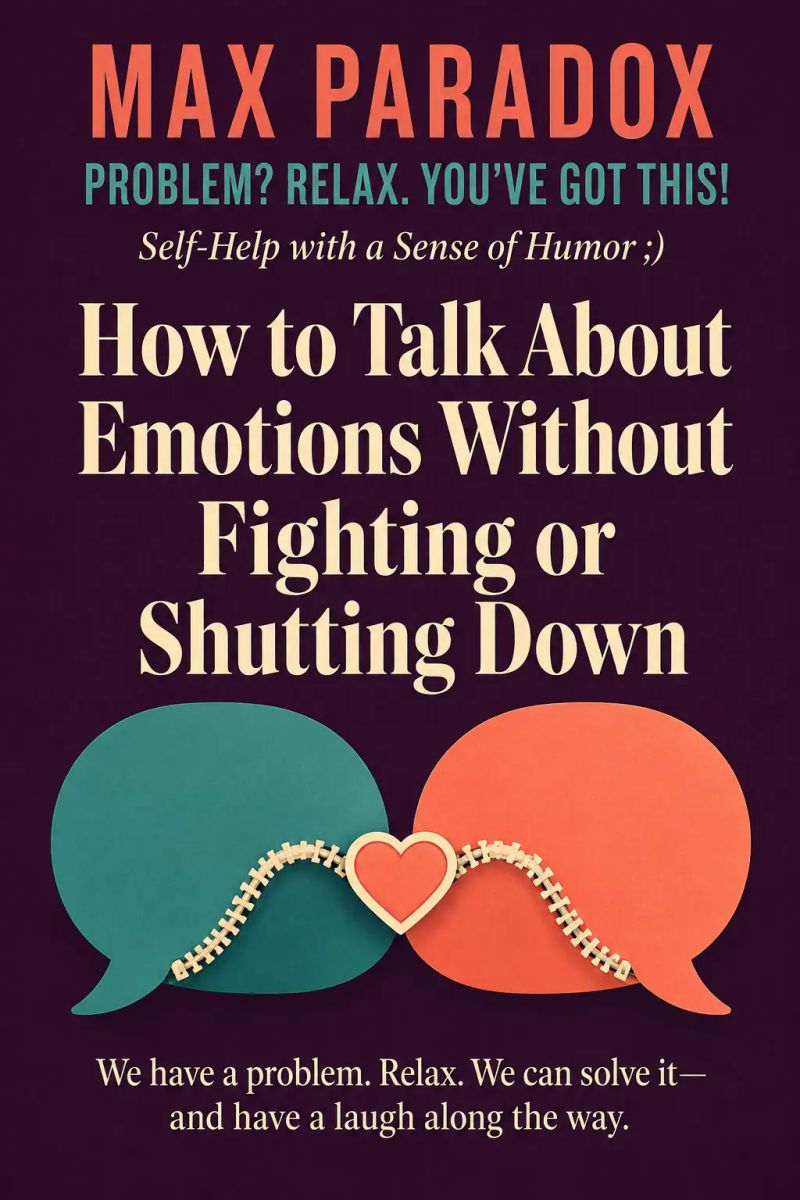
How to Talk About Emotions Without Fighting or Shutting Down
By Max Paradox


Length7h 11m
About this audiobook
You try to explain how you feel.
Five minutes later, you are arguing about your tone, something that happened six months ago, whether the word always was technically accurate, and - somehow - the dishwasher.
Or maybe you do the opposite. You shut down. You say "I'm fine," disappear emotionally, and spend the next three hours having an excellent version of the conversation entirely inside your own head.
How to Talk About Emotions Without Fighting or Shutting Down is a practical, funny guide to saying what matters without turning every difficult conversation into a courtroom, a hostage negotiation, or a three-day silence.
Max Paradox breaks emotional communication down into simple, usable skills for normal people who get tired, defensive, angry, anxious, overwhelmed, and occasionally develop flawless arguments twenty minutes after the conversation ends.
Inside, you'll learn how to:
describe what happened without turning your interpretation into an accusation;
recognize when defensiveness, shutdown, anger, or old reactions are taking over;
ask for reassurance, space, support, attention, or change without expecting mind reading;
listen without immediately fixing, correcting, or preparing your defense;
make clear requests instead of vague complaints;
use pauses without making them feel like abandonment;
repair a conversation after you interrupt, attack, misread, or say something badly;
communicate boundaries without cruelty;
deal with repeated conversations that never seem to get anywhere;
stop storing small frustrations until a wet towel becomes responsible for every unresolved problem since 2022;
create simple communication rules that still work when everybody is tired;
recognize when better wording will help - and when the real problem is behavior, incompatibility, or unwillingness to engage.
This is not a guide to becoming endlessly calm, emotionally perfect, or capable of discussing childhood wounds at 11:47 p.m. while assembling furniture.
It is a guide to doing the next useful thing.
Sometimes that means saying, "I'm hurt."
Sometimes it means asking, "What did you mean?"
Sometimes it means listening.
Sometimes it means taking twenty minutes and actually coming back.
And sometimes it means realizing that the conversation is not failing because you need a better synonym.
Practical, direct, and full of painfully recognizable moments, this book helps you communicate emotions in a way another human being can actually receive - without losing your voice, losing your temper, or emotionally logging off.
Because the goal is not to win the conversation.
The goal is to leave it understanding each other better than when you entered.
Preferably without bringing the dishwasher into it.
This publication was prepared with the assistance of tools that support the creative process, including artificial intelligence-based solutions. The final concept, structure, and editing belong to the author.
Audiobook details
Rating★★★★★ 4.8 (11)
Includes Amazon
GenreSelf-Help
Length7 hrs 11 mins
Narrated byListen with 1,000+ voices
FormateBook with Audio
Publish dateSep 15, 2026
LanguageEnglish
Table of contents
1INTRO
2Chapter 1 - Why a Feeling Turns Into a Fight
3Chapter 2 - A Feeling Is Not an Accusation
4Chapter 3 - Why You Go Blank at the Worst Possible Moment
5Chapter 4 - Stop Trying to Win the Conversation
Mostrar todos os capítulosVer menos
6Chapter 5 - Stop Expecting Mind Reading
7Chapter 6 - Stop Saving Everything for the Explosion
8Chapter 7 - Your Defense Can Wait
9Chapter 8 - Not Every Feeling Needs to Be Fixed
10Chapter 9 - Start Without Starting a War
11Chapter 10 - The Conversation Map
12Chapter 11 - Listen for What Is Under the Words
13Chapter 12 - Say the Hard Thing Without Becoming Cruel
14Chapter 13 - Repair the Conversation While It Is Still Happening
15Chapter 14 - Ask for What You Need Without Turning It Into a Demand
16Chapter 15 - What to Do When the Conversation Keeps Failing
17Chapter 16 - When You Are Too Tired to Communicate Beautifully
18Chapter 17 - When Old Reactions Take Over
19Chapter 18 - Catch the Pattern Before It Comes Back
20Chapter 19 - Build Rules Before You Need Them
21Chapter 20 - You Do Not Need Perfect Conversations

My Parents Believe Everything They See on Facebook - How to Talk About Fakes, AI, and “A Friend Sent It” Without Starting a Family WarMax Paradox7h 49m$7.70 · $0.00

They Live Among Us - Aliens, Humans, and the Beautiful Disaster of Planet EarthMax Paradox2h 45m$7.70 · $0.00

How to Help Your Teen Quit VapingMax Paradox6h 49m$7.70 · $0.00

Nie umiem być sam - Jak polubić własne towarzystwo bez prowadzenia ze sobą dziwnych rozmówMax Paradox5h 9m$7.70 · $0.00
Even My Hobby Became a Project - How to Do Something for Fun Without a Growth Plan or Monetization StrategyMax Paradox6h 9m$7.70 · $0.00

Jest sobota, a ja już boję się poniedziałku: Jak odzyskać weekend od własnej pracyMax Paradox5h 33m$7.70 · $0.00

Everyone Is an Expert Now - How the Internet Replaced Knowledge with ConfidenceMax Paradox1h 46m$7.70 · $0.00

Zarabiam więcej, a i tak czuję się biedniejszy: Jak odnaleźć się w świecie, w którym wszystko kosztuje absurdalne pieniądzeMax Paradox5h 46m$7.70 · $0.00
I'm Trying to Optimize My Entire Life - How to Stop Measuring Your Sleep, Steps, Water, Productivity, and Self-WorthMax Paradox7h 26m$7.70 · $0.00

How to Avoid Online Scams and Protect Your MoneyMax Paradox8h 20m$7.70 · $0.00
How to Cope with Loneliness and Reconnect with PeopleMax Paradox7h 27m$7.70 · $0.00

I Can't Get Along with My Coworkers - How to Survive Eight Hours a Day with People You Would Never Have ChosenMax Paradox6h 37m$7.70 · $0.00
I Argue with People I'll Never Meet - How to Stop Donating Your Evenings to Internet CommentsMax Paradox6h 40m$7.70 · $0.00

Teściowie wchodzą nam na głowę - Jak postawić granice rodzinie, zanim zacznie wybierać wam zasłonyMax Paradox5h 49m$7.70 · $0.00

Brutalna prawda o LinkedIn Platforma, która mówi, kim jesteś, zanim zdążysz to zrobić samMax Paradox3h 54m$7.70 · $0.00

How to Move Through Grief and Find Life After LossMax Paradox7h 17m$7.70 · $0.00

Rodzice wciąż traktują mnie jak dziecko - Jak dorosnąć również podczas rodzinnego obiaduMax Paradox6h 10m$7.70 · $0.00
How to Get Your Energy and Motivation BackMax Paradox7h 45m$7.70 · $0.00

I'm Afraid I've Wasted My Life - How to Stop Taking Stock of Your Losses Before HalftimeMax Paradox7h 9m$7.70 · $0.00

Wszyscy mają lepiej ode mnie - Jak przestać porównywać swoje życie z cudzym highlightemMax Paradox4h 45m$7.70 · $0.00
Learning to PrayJames Martin13h 24m4.5 (3.4K)$33 · $0.00

Swayam Ki AwaazPrem Rawat8h 34m4.7 (1.1K)$26 · $0.00

Forever BoyKate Swenson9h 27m4.7 (5K)$29 · $0.00

You Are Worth ItKyle Carpenter, Don Yaeger8h 53m4.7 (4.8K)$29 · $0.00

The Happiest Man on EarthEddie Jaku3h 48m4.6 (178K)$7 · $0.00

Finding MeViola Davis9h 15m4.6 (256.4K)$29 · $0.00

Spiritual AnatomyDaaji Kamlesh D. Patel9h 47m4.7 (319)$29 · $0.00

The Dangerous Truth about Today’s MarijuanaLaura Stack CSP, MBA9h 57m4.7 (385)$20 · $0.00

The Gospel according to Spiritualism (Translated)Allan Kardec14h 39m4.6 (3.9K)$5.70 · $0.00

Birdie & HarlowTaylor Wolfe7h 50m4.6 (6.5K)$26 · $0.00

CrossroadsKaleb Dahlgren7h 56m4.6 (4.9K)$26 · $0.00

Life on the BridgeKaelynn Partlow5h 40m4.6 (1.1K)$24 · $0.00

Keep Your Love OnDanny Silk9h 4m4.6 (8.1K)$10 · $0.00

The Tao of Joy Every DayDerek Lin10h 24m4.6 (762)$20 · $0.00

UndividedVicky Beeching9h 2m4.6 (1.3K)$29 · $0.00

HE CAN WHO THINKS HE CAN & OTHER BOOKS ON SUCCESSOrison Swett Marden5h 54m4.6 (1.2K)$1.99 · $0.00
Level UpRob Dial7h 42m4.6 (3.3K)$26 · $0.00

Burn the HaystackJennie Young, PhD9h 30m4.6 (543)$29 · $0.00

ACRES OF DIAMONDS: Our Every-day Opportunities (Wisdom & Empowerment Series) (Annotated)Russell Conwell2h 26m4.6 (1K)$2 · $0.00

Good InsideBecky Kennedy9h 55m4.5 (59.3K)$29 · $0.00
You may also like

Grumpy Mom Takes a HolidayValerie Woerner6h 57m4.4 (2.7K)$20 · $0.00

How To Make Friends And Influence People & How To Stop Worrying And Start LivingDale Carnegie22h 56m4.4 (13.4K)$1 · $0.00
Stop Whining, Start LivingDr. Laura Schlessinger5h 16m4.2 (1.1K)$24 · $0.00

Target 100Liz Josefsberg7h 15m4.1 (944)$20 · $0.00

Find Your PathCarrie Underwood5h 46m3.9 (9.4K)$24 · $0.00
Good InsideBecky Kennedy9h 55m4.5 (59.3K)$29 · $0.00

Making SpaceThich Nhat Hanh53m4.2 (3.2K)$5

Meditations for Women Who Do Too Much - Revised EditionAnne Wilson Schaef8h 19m4.1 (1.8K)$26 · $0.00

Raising Your Spirited ChildMary Sheedy Kurcinka14h 8m4.3 (12.5K)$33 · $0.00

Self Mastery Through Conscious AutosuggestionÉmile Coué2h 28m4.1 (2.2K)$2 · $0.00

Overcome Emotional Eating and Stop Cravings: Understand the Causes of Binge Eating and Food Cravings, Successfully Combat Eating Disorders and Find Your Way to Your Desired Weight and Better HealthMario Waldecker1h 2m$10 · $0.00

Be Good To Yourself (Unabridged) (Annotated)Orison Swett Marden6h 34m4.6 (12)$1.99 · $0.00
The Communication MasterclassNathan Cole1h 34m$6.80 · $0.00

Clean Up Your LifeBjörn Mod2h 13m$11 · $0.00

Prayers & Promises for Busy MomsBroadStreet Publishing Group LLC1h 33m$10 · $0.00

Perfectionism Recovery PlanImad Muratspahic3h 43m$12 · $0.00
The Motivation Mastery Audio SeriesChris Widener7h 36m4.1 (19)$75

Men's Devotional For Christian DadsCarol W. Rogers5h 37m4.8 (15)$10

Even on Vacation, I’m Still in Charge of Everything - How to Share Trip Planning, Agree on Expectations, and Relax Without Becoming Your Family’s Full-Time Tour GuideMax Paradox2h 55m$7.70 · $0.00

The Fourth Trimester MarriageNora T. Calder1h 48m$2.30 · $0.00