
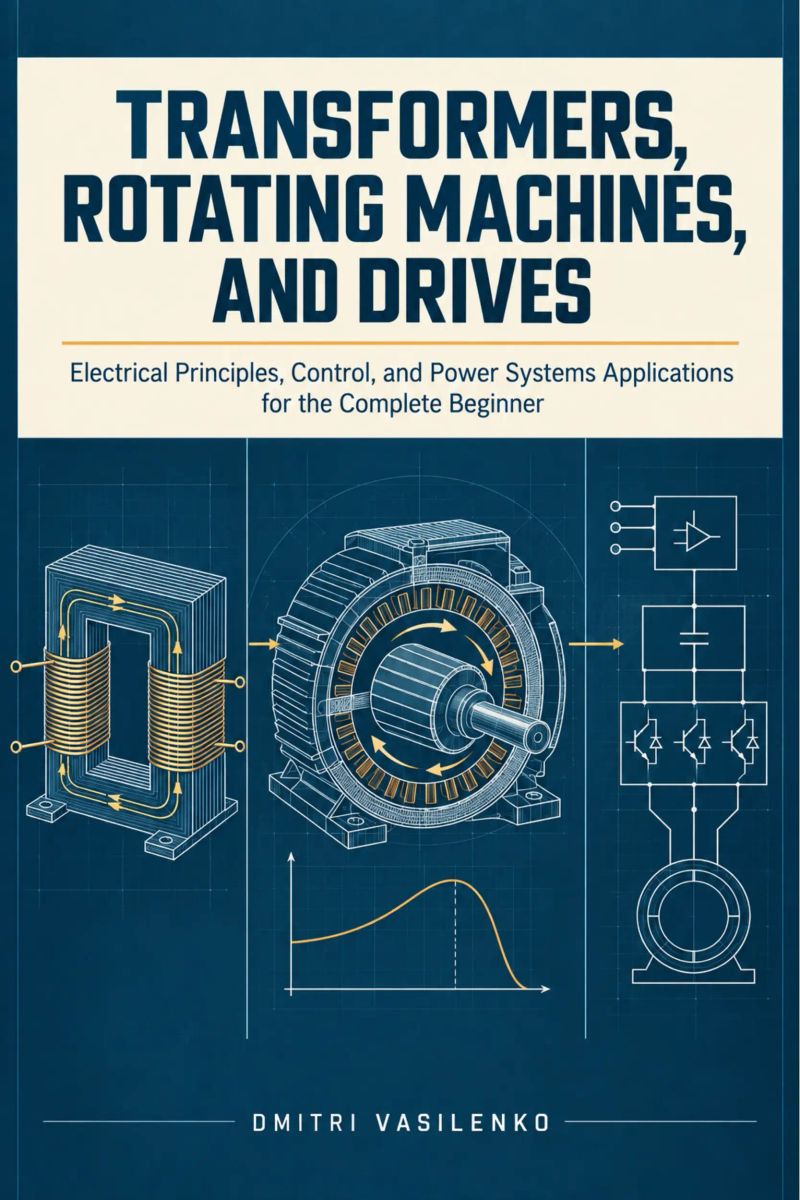
Transformers, Rotating Machines, and Drives
Electrical Principles, Control, and Power Systems Applications for the Complete BeginnerBy Dmitri Vasilenko


Length14h 11m
About this audiobook
A motor nameplate carries everything you need, once you know how to read it.
This book teaches machines from the magnetic circuit up so the numbers mean something. You work transformers from the ideal model through the equivalent circuit to open-circuit and short-circuit tests, regulation and efficiency, then three-phase connections, tap changers and parallel operation. Direct current machines, induction motors, single-phase and special types and synchronous machines each get their magnetic explanation, equivalent circuit and torque-speed behaviour before any application.
You learn across-the-line, wye-delta and soft starting, then variable frequency drive stages, volts-per-hertz and vector control and harmonic effects. Protection, insulation testing, vibration and thermography chapters connect theory to maintenance. Every chapter builds from first principles, with clear explanations and practical context, so you can move from basic electrical fundamentals to the behaviour of complete drive systems.
What you will learn:
• Electrical fundamentals for machines, including power, energy and circuit laws
• Magnetic circuits and core losses, and why they set the limits of machine performance
• Single-phase and three-phase transformers, including equivalent circuits, tests, regulation, efficiency, connections, tap changers and parallel operation
• Autotransformers and instrument transformers for measurement and protection
• Direct current machines: construction, equivalent circuit and torque-speed behaviour
• Three-phase induction motors, plus starting, testing and rating methods
• Single-phase and special machines for applications where three-phase is not available
• Synchronous machines, including their magnetic explanation and operating characteristics
• Variable frequency drives: stages, volts-per-hertz and vector control, and harmonic effects
• Protection, maintenance and testing, including insulation testing, vibration and thermography
• How machines behave inside complete power systems
For electrical technicians, apprentices, maintenance engineers and students meeting machines for the first time, this book provides a complete, beginner-friendly path from magnetic circuits to drives and power systems. If you want to understand what the nameplate really means and how to keep machines running, this is where to start.
Audiobook details
GenreTechnology
Length14 hrs 11 mins
Narrated byListen with 1,000+ voices
FormateBook with Audio
Publish dateSep 27, 2026
LanguageEnglish
Table of contents
1Transformers, Rotating Machines, and Drives
2Foreword
3Preface
4About This Book
5Important Safety Notice
Show all chaptersShow less
6Chapter 1: Electrical Fundamentals for Machines
71.1 Alternating Current Quantities and the Sine Wave
81.2 Phasors, Phase Angle and Complex Impedance
91.3 Real Power, Reactive Power and Power Factor
101.4 Three-Phase Connections and Per-Phase Analysis
111.5 Per-Unit Quantities and Nameplate Base Values
121.6 Measurement, Instrument Safety and Reading a Nameplate
13Chapter 2: Magnetic Circuits and Core Losses
142.1 Flux, Flux Density and Magnetomotive Force
152.2 Reluctance and the Magnetic Circuit Analogy
162.3 B-H Curves, Saturation and Air Gaps
172.4 Hysteresis Loss and Core Material
182.5 Eddy Current Loss and Lamination
192.6 Building and Testing a Magnetic Circuit
20Chapter 3: Single-Phase Transformers
213.1 The Ideal Transformer and Turns Ratio
223.2 The Real Transformer and Its Equivalent Circuit
233.3 The Open-Circuit Test
243.4 The Short-Circuit Test
253.5 Voltage Regulation
263.6 Efficiency and Loading
27Chapter 4: Three-Phase Transformers
284.1 Delta and Wye Connections and Their Ratios
294.2 Phase Displacement and Clock Notation
304.3 Tap Changers and Voltage Control
314.4 Parallel Operation
324.5 Inrush Current and Protection Coordination
334.6 Cooling Classes and Temperature Rise
34Chapter 5: Autotransformers and Instrument Transformers
355.1 Autotransformer Action and Sizing
365.2 Current Transformers and Burden
375.3 Voltage Transformers and Accuracy
385.4 Polarity, Marking and Connection Practice
39Chapter 6: Direct Current Machines
406.1 Construction, Commutation and Armature Reaction
416.2 The Machine Equations and Shunt, Series and Compound Characteristics
426.3 Starting Resistance and Protection
436.4 Speed Control and Braking
44Chapter 7: Three-Phase Induction Motors
457.1 The Rotating Magnetic Field and Synchronous Speed
467.2 The Equivalent Circuit and Rotor Referral
477.3 Power Flow and the Torque-Speed Characteristic
487.4 No-Load, Locked-Rotor and Load Behavior
49Chapter 8: Starting, Testing and Rating Induction Motors
508.1 Across-the-Line, Wye-Delta and Soft Starting

The Honey BusMeredith May9h 31m4.4 (16.6K)$25 · $0.00
Collected Writings of Nikola TeslaThomas Commerford Martin, Nikola Tesla19h 42m4.4 (2.8K)$1.99 · $0.00

Operation PedestalMax Hastings12h 29m4.4 (5.2K)$29 · $0.00

When the Heavens Went on SaleAshlee Vance18h 20m4.4 (3K)$40 · $0.00

Everybody Has a Podcast (Except You)Justin McElroy, Travis McElroy, Griffin McElroy5h 9m4.3 (2.3K)$24 · $0.00

Hands of TimeRebecca Struthers8h 8m4.4 (1.3K)$26 · $0.00

Never Lost AgainBill Kilday10h 1m4.4 (805)$29 · $0.00

How the Internet HappenedBrian McCullough13h 28m4.3 (2.7K)$23 · $0.00
Collected Writings of Nikola TeslaNikola Tesla, Thomas Commerford Martin21h 50m4.3 (1.7K)$1 · $0.00

Just AspireAjai Chowdhry9h 13m4.4 (260)$29 · $0.00

The Little Book of AliensAdam Frank8h 20m4.3 (1.3K)$26 · $0.00
The inventions, researches and writings of Nikola Tesla (Annotated)Thomas Commerford Martin16h 59m4.3 (1.3K)$2 · $0.00

KargilV.P. Malik15h 18m4.3 (2K)$24 · $0.00

Experiments with Alternating CurrentsNikola Tesla9h 16m4.3 (874)$1.99 · $0.00

Fire on the HorizonTom Shroder, John Konrad8h 23m4.3 (858)$26 · $0.00

The Smell of Kerosene (Annotated)National Aeronautics and Space Administration, Donald L. Mallick, Peter W. Merlin11h 32m4.3 (523)$2 · $0.00

The Boy Who Harnessed the WindWilliam Kamkwamba, Bryan Mealer10h 5m4.2 (78.9K)$29 · $0.00

Across the Airless WildsEarl Swift10h 8m4.3 (1.3K)$29 · $0.00

Console WarsBlake J. Harris20h 41m4.2 (13.7K)$46 · $0.00

Improvised Munitions HandbookU.S. Department of Defense4h 49m4.3 (1.6K)$0.99 · $0.00
You may also like

Der StruwwelpeterHeinrich Hoffmann2m4.0 (20.2K)$2.30
Volkswagen Transporters T4 Workshop ManualOwners Edition4m4.4 (42)$24 · $0.00

How to Play Chess (Annotated)Charlotte Boardman Rogers2h 43m4.1 (12)$2 · $0.00

Prelude in Cm (Chopin)Bill Brown Jr.30m$2

How to Make Money Flipping Houses - How to Find Undervalued Properties, Control Renovation Costs, and Sell at the Right PriceJACK FLIPWELL4h 31m$7.70 · $0.00

Raspberry Pi for Beginners Made SimpleWalter Hemsley4h 21m$13

Garmin Watch Made SimpleWalter Hemsley4h 17m$8

Samsung Galaxy for SeniorsWalter Hemsley3h 47m$7

The Senior-Friendly Guide to SpotifyWalter Hemsley3h 34m$5

Open Arms – Classical soloBill Brown Jr.45m$4
Thoughtful Engineering DecisionsDevin Marchetti11h 40m$45

Lookin' Out My Back DoorBill Brown Jr.1h 2m$10

Inglês Para Quem Ainda Não Sabe Tudo.William Mcpower2h 29m$9 · $0.00

Microsoft Planner Made SimpleRuth Callender4h 24m$8

Competitive Dynamics Of Air Transport In Brazil: 2008-2014Luiz Fernando Abel4h 55m$18 · $0.00

The Money Pit, Vol. 13Tom Kraeutler, Leslie Segrete9h 41m$20

What Even Is an APIFlorence Larkin7h$5 · $0.00

Up Around the BendBill Brown Jr.29m$2
Dimensional Modeling for Data WarehousesSofia Petrova15h 17m$75

Dear Hearts and Gentle PeopleBill Brown Jr.37m$4