
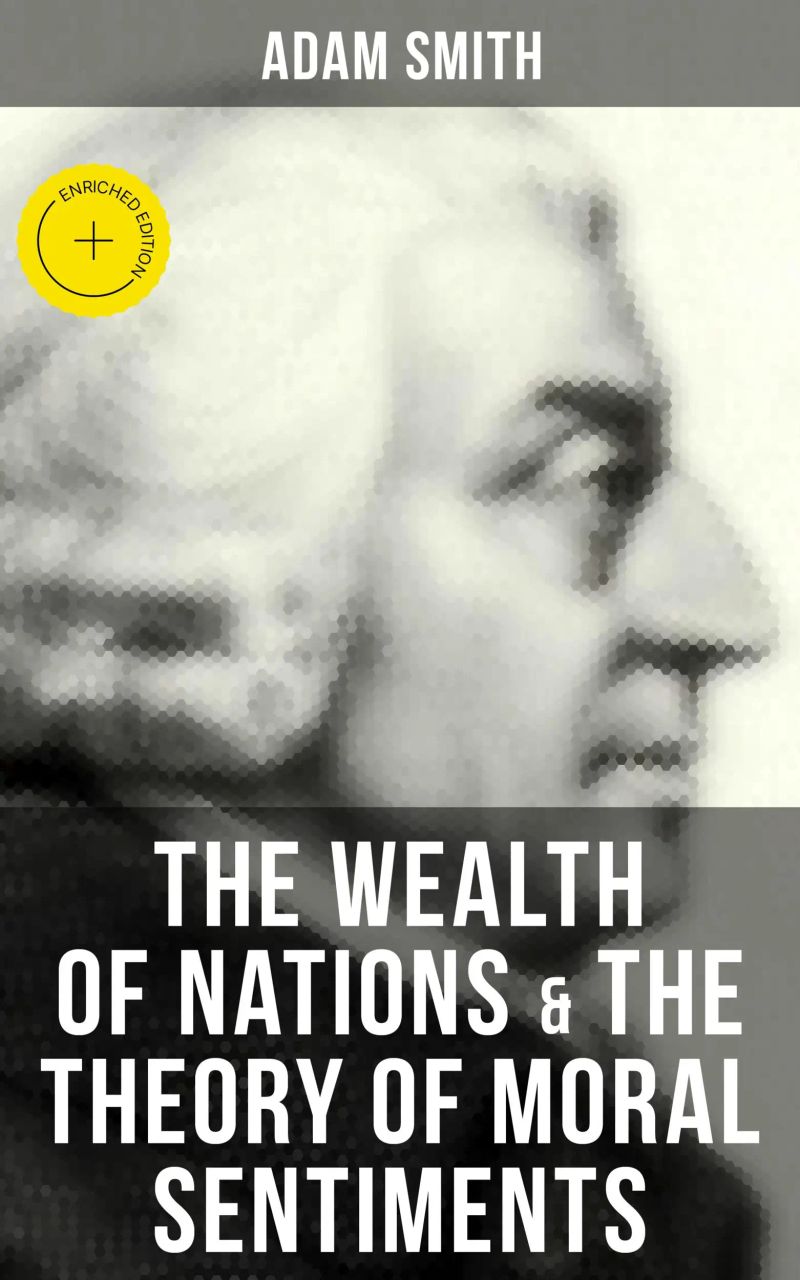
The Wealth of Nations & The Theory of Moral Sentiments
Enriched edition. Free Markets, Division of Labor, and Moral Sympathy in Political EconomyBy Adam Smith


Length59h 19m
About this audiobook
Adam Smith's 'The Wealth of Nations & The Theory of Moral Sentiments' is a groundbreaking work that delves into the realms of economics and ethics. In 'The Wealth of Nations,' Smith explores the principles of free-market capitalism and the division of labor, laying the foundation for modern economics. His detailed analysis of the market system and its implications on wealth generation makes this book a seminal piece in economic literature. In parallel, 'The Theory of Moral Sentiments' delves into the ethical foundations of human behavior, examining the role of sympathy and moral judgments in society. Smith's elegant prose and astute observations make these texts not only informative but also a pleasure to read, setting a standard for economic and philosophical discourse. The juxtaposition of these two works showcases Smith's deep understanding of human nature and the interconnectedness of economic and moral principles. This dual exploration provides invaluable insights into the complexities of society and the individual's place within it. I highly recommend this book to readers interested in the intersection of economics and ethics, as well as those seeking a comprehensive understanding of Adam Smith's seminal contributions to Western thought.
In this enriched edition, we have carefully created added value for your reading experience:
- A comprehensive Introduction outlines these selected works' unifying features, themes, or stylistic evolutions.
- The Author Biography highlights personal milestones and literary influences that shape the entire body of writing.
- A Historical Context section situates the works in their broader era—social currents, cultural trends, and key events that underpin their creation.
- A concise Synopsis (Selection) offers an accessible overview of the included texts, helping readers navigate plotlines and main ideas without revealing critical twists.
- A unified Analysis examines recurring motifs and stylistic hallmarks across the collection, tying the stories together while spotlighting the different work's strengths.
- Reflection questions inspire deeper contemplation of the author's overarching message, inviting readers to draw connections among different texts and relate them to modern contexts.
- Lastly, our hand‐picked Memorable Quotes distill pivotal lines and turning points, serving as touchstones for the collection's central themes.
Audiobook details
Rating★★★★ 4.2 (4K)
Includes Goodreads, Amazon, LibraryThing, StoryGraph
GenreBusiness and Economics
Length59 hrs 19 mins
Narrated byListen with 1,000+ voices
FormateBook with Audio
Publish dateDec 6, 2017
LanguageEnglish
Table of contents
1The Scarlet Letter & A Scarlet Stigma (Illustrated Edition)
2Introduction
3Author Biography
4Historical Context
5Synopsis (Selection)
Show all chaptersShow less
6The Invisible Hand of the Market: The Theory of Moral Sentiments
7PART I (pt. 1)
8PART I (pt. 2)
9PART II
10PART III (pt. 1)
11PART III (pt. 2)
12PART IV
13PART V
14PART VI (pt. 1)
15PART VI (pt. 2)
16PART VII (pt. 1)
17PART VII (pt. 2)
18The Wealth of Nations
19Introduction and plan of the work
20Part 1 Of the Causes of Improvement in the productive Powers of Labour, and of the Order according to which its Produce is naturally distributed among the different Ranks of the People
21Chapter 1 Of the Division of Labour
22Chapter 2 Of the Principle which gives Occasion to the Division of Labour
23Chapter 3 That the Division of Labour is limited by the Extent of the Market
24Chapter 4 Of the Origin and Use of Money
25Chapter 6 Of the component Parts of the Price of Commodities
26Chapter 7 Of the natural and market Price of Commodities
27Chapter 8 Of the Wages of Labour
28Chapter 9 Of the Profits of Stock
29Chapter 10 Of Wages and Profit in the different Employments of Labour and Stock
30Chapter 11 Of the Rent of Land
313. Third Period
32Part 2 Of the Nature, Accumulation, and Employment of Stock
33Part 3 Of the different Progress of Opulence in different Nations
34Chapter 3 Of the Accumulation of Capital, or of productive and unproductive Labour
35Chapter 4 Of Stock lent at Interest
36Chapter 5 Of the different Employment of Capitals
37Chapter 1 Of the Natural Progress of Opulence
38Chapter 2 Of the Discouragement of Agriculture in the ancient State of Europe after the Fall of the Roman Empire
39Chapter 3 Of the Rise and Progress of Cities and Towns, after the Fall of the Roman Empire
40Chapter 4 How the Commerce of the Towns contributed to the Improvement of the Country
41Part 4 Of Systems of political Economy
42Chapter 2 Of Restraints upon the Importation from foreign Countries of such Goods as can be produced at Home
43Chapter 1 Of the Principle of the commercial, or mercantile System
44Chapter 2 Of Restraints upon the Importation from foreign Countries of such Goods as can be produced at Home
45Chapter 4 Of Drawbacks
46Chapter 5 Of Bounties
47Chapter 6 Of Treaties of Commerce
48Chapter 7 Of Colonies
493. Of the Advantages which Europe has derived from the Discovery of America, and from that of a Passage to the East Indies by the Cape of Good Hope
50Chapter 8 Conclusion of the Mercantile System
The Wealth of NationsAdam Smith30h 50m4.1 (130.7K)$20 · $0.00

The Wealth of Nations (Annotated)Adam Smith42h 48m4.2 (35.4K)$2 · $0.00

Analytic Summary of The Wealth of NationsAdam Smith31m$7 · $0.00

Analytic Summary of The Wealth of NationsAdam Smith22m$7 · $0.00

The Essays of Adam SmithAdam Smith20h 38m4.2 (24)$1 · $0.00

An Inquiry Into the Nature and Causes of the Wealth of NationsAdam Smith, M. Garnier35h 14m4.3 (124.3K)$2 · $0.00

An Inquiry into the Nature and Causes of the Wealth of NationsAdam Smith43h 7m4.1 (120.2K)$2 · $0.00

The Invisible Hand of the Market: The Theory of Moral Sentiments + The Wealth of NationsAdam Smith59h 8m4.2 (1.6K)$2 · $0.00

Der Wohlstand der Nationen (Zusammengefasste Ausgabe)Adam Smith9h 3m$2

The Invisible Hand of the Market: The Theory of Moral Sentiments + The Wealth of Nations (2 Pioneering Studies of Capitalism) (Annotated)Adam Smith59h 21m4.0 (81)$1.99 · $0.00

Masterworks That Defined the Utilitarian Tradition – 4 Classic Moral Philosophy TextsAdam Smith, David Hume, Jeremy Bentham, Henry Sidgwick54h 31m$2

Der Wohlstand der NationenAdam Smith43h 37m4.1 (38.1K)$2 · $0.00

500 citações de grandes filósofos do século 18Adam Smith, Denis Diderot, Georg Christoph Lichtenberg, Nicolas de Chamfort, Pierre Augustin Caron de Beaumarchais2h 2m$8 · $0.00

600 citaten van de grote schrijvers uit de 18e eeuwAdam Smith, Charles de Montesquieu, Denis Diderot, Georg Christoph Lichtenberg, Jean-Jacques Rousseau, Pierre-Augustin Caron de Beaumarchais, Charles Montesquieu2h 55m$8 · $0.00

600 citat från 1700-talets stora författareAdam Smith, Charles de Montesquieu, Denis Diderot, Georg Christoph Lichtenberg, Jean-Jacques Rousseau, Pierre-Augustin Caron de Beaumarchais2h 35m$8 · $0.00

500 citazioni dei grandi filosofi del XVIII secoloAdam Smith, Denis Diderot, Georg Christoph Lichtenberg, Nicolas de Chamfort, Pierre Augustin Caron de Beaumarchais2h 17m$8 · $0.00

500 citat från 1700-talets stora filosoferAdam Smith, Denis Diderot, Georg Christoph Lichtenberg, Nicolas de Chamfort, Pierre Augustin Caron de Beaumarchais2h 12m$8 · $0.00

The Money GameAdam Smith7h 42m4.1 (2.1K)$15 · $0.00

600 Zitate von den großen Schriftstellern des 18. JahrhundertsAdam Smith, Charles de Montesquieu, Denis Diderot, Georg Christoph Lichtenberg, Jean-Jacques Rousseau, Pierre-Augustin Caron de Beaumarchais3h 25m$8 · $0.00

Never Split the DifferenceChris Voss, Tahl Raz8h 7m4.4 (277.7K)$26 · $0.00

The Intelligent Investor Rev Ed.Benjamin Graham17h 48m4.3 (191.5K)$40 · $0.00

The Hard Thing About Hard ThingsBen Horowitz7h 57m4.2 (134.3K)$26 · $0.00

Boundaries for LeadersHenry Cloud7h 36m4.3 (3.6K)$26 · $0.00

Poor Charlie’s AlmanackGrover Gardener, Charles T. Munger13h 9m4.5 (24.7K)$18 · $0.00

The Ambuja StoryNarotam Sekhsaria13h 59m4.5 (830)$33 · $0.00

The Secret Door to SuccessFlorence Scovel Shinn2h 25m4.5 (2.1K)$1.20 · $0.00

This Is Going to HurtAdam Kay5h 47m4.4 (444.7K)$24 · $0.00

Big TrustShadé Zahrai, Fayçal Sekkouah8h 36m4.6 (406)$26 · $0.00

The Intelligent Investor Third EditionBenjamin Graham, Jason Zweig20h4.4 (156.6K)$46 · $0.00

Bottle of LiesKatherine Eban14h 25m4.4 (12K)$33 · $0.00

The Antiracist Business BookTrudi Lebrón6h 10m4.6 (275)$17 · $0.00

The FormulaJoshua Robinson, Jonathan Clegg10h 41m4.4 (6.9K)$29 · $0.00

Let Them LeadJohn U. Bacon7h 10m4.5 (1.4K)$24 · $0.00

Secrets of the Millionaire MindT. Harv Eker5h 11m4.4 (301.4K)$24 · $0.00

The Person You Mean to BeDolly Chugh9h 6m4.4 (7.2K)$29 · $0.00

BoundlessNick Kostov, Sean McLain9h 17m4.5 (1.1K)$29 · $0.00

Everyday DharmaSuneel Gupta5h 2m4.5 (761)$20 · $0.00

Let's Talk Mutual FundsMonika Halan7h 5m4.4 (2.4K)$16 · $0.00

Secret PowerDwight Lyman Moody3h 7m4.4 (1.4K)$1.20 · $0.00
You may also like

On the SoulAristotle3h 25m4.1 (8K)$1.20 · $0.00

The Expression of the Emotions in Man and Animals (Annotated)Charles Darwin9h 27m4.1 (13.5K)$1.99 · $0.00

The Stones of VeniceJohn Ruskin49h 48m4.1 (3.4K)$1.99 · $0.00
An Enquiry Concerning the Principles of MoralsDavid Hume4h 1m4.1 (7.1K)Free

The Hidden Habits of GeniusCraig Wright10h 7m4.0 (2.3K)$29 · $0.00

The Descent of Man, and Selection in Relation to SexCharles Darwin28h 1m4.1 (6.4K)$1 · $0.00

The Essential Writings of Ralph Waldo EmersonRalph Waldo Emerson10h 1m4.4 (6.5K)$12 · $0.00

The Critique of Judgement Part IImmanuel Kant5h 48m4.1 (1.2K)$4.70 · $0.00

The Critique of JudgmentImmanuel Kant16h 24m4.1 (11.7K)$2 · $0.00

The Lives of a CellLewis Thomas4h 12m4.3 (14.8K)$15

Why Do Men Fall Asleep After SexMark Leyner, Billy Goldberg6h 32m3.7 (2.2K)$24 · $0.00
SapiensYuval Noah Harari15h 18m4.3 (1.4M) · 1211$33 · $0.00

Some We Love, Some We Hate, Some We EatHal Herzog12h 24m4.1 (5.2K)$29 · $0.00

Leonardo da Vinci: Thoughts on Art & LifeLeonardo da Vinci6h 48m4.1 (1.5K)$1.99 · $0.00

The Hand Phrenologically ConsideredAnonymous1h 35m$2 · $0.00

Scientific and Evolutionary Foundations of Morality – 4 Classic Moral StudiesAlexander Bain, William Kingdon Clifford, Thomas Huxley, W. R. Sorley29h 21m$2
The Greatest Works of John DeweyJohn Dewey168h 56m4.5 (18)$1.99 · $0.00

Beauty of the BeastJohn Bascom1h 44m$15 · $0.00

The Last HarvestJohn Burroughs6h 24m$1 · $0.00

From sketch-book and diaryElizabeth Butler4h 24m$2 · $0.00