
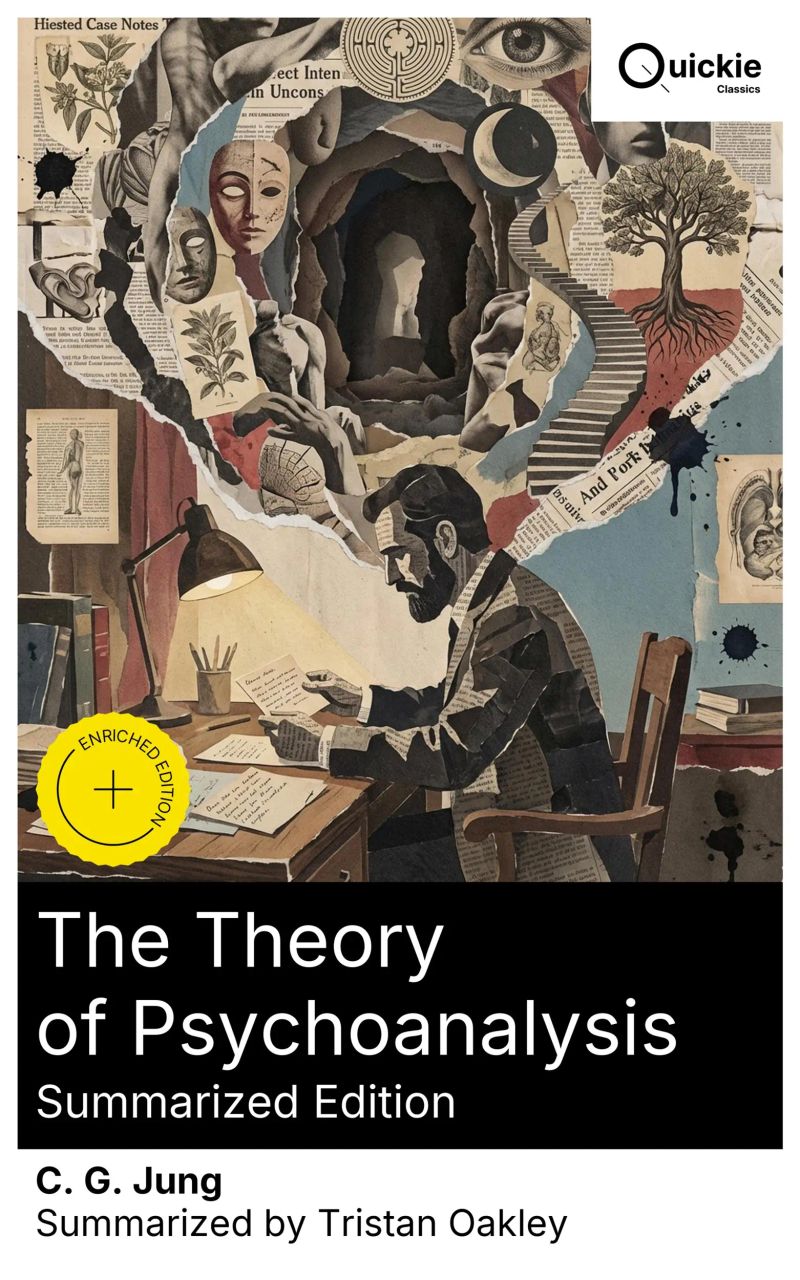
The Theory of Psychoanalysis (Summarized Edition)
Enriched edition. Analytical psychology, the collective unconscious, and dream interpretation in a seminal exploration of archetypal symbolismBy C. G. Jung


Length2h 46m
About this audiobook
In The Theory of Psychoanalysis, C. G. Jung condenses the foundations of psychoanalysis at a watershed moment before his break with Freud. Using case materials from the Burgholzli and his word-association studies, he examines neurosis, complexes, dreams, and transference. Respecting Freudian insights into sexuality, he already recasts libido as a general psychic energy and reads symptoms symbolically across culture and myth. The prose is didactic yet exploratory, shaped by its origin as public lectures. A psychiatrist trained under Eugen Bleuler, Jung worked at the Burgholzli Clinic, where he identified autonomous complexes through pioneering association tests. His collaboration and tensions with Freud, alongside wide reading in religion, mythology, and anthropology, informed this synthesis. The immediate impetus was his 1912 Fordham lectures, presenting psychoanalysis to an academic audience while marking emerging departures. Scholars, clinicians, and historically minded readers will value this concise bridge from classical Freudian doctrine to analytical psychology. It offers clear concepts, illustrative clinical vignettes, and a vantage on Jung's transition from medical psychopathology to cultural psychology. As an entry point, it prepares readers for later work on symbols, libido, and individuation.
Quickie Classics summarizes timeless works with precision, preserving the author's voice and keeping the prose clear, fast, and readable—distilled, never diluted. Enriched Edition extras: Introduction · Synopsis · Historical Context · Author Biography · Brief Analysis · 4 Reflection Q&As · Editorial Footnotes.
Audiobook details
Rating★★★★ 3.9 (245)
Includes Goodreads
GenrePsychology
Length2 hrs 46 mins
Narrated byListen with 1,000+ voices
FormateBook with Audio
Publish dateApr 3, 2026
LanguageEnglish
Table of contents
1Introduction
5Author Biography
2Introduction
6The Theory of Psychoanalysis
3Synopsis
7Analysis
4Historical Context
8Reflection
More from C. G. Jung
What to Make of a LifeJim Collins13h 31m4.4 (794)$33 · $0.00

Invisible StormJason Kander6h 48m4.7 (3.2K)$24 · $0.00

I Am The StormJanice Dean9h4.6 (1.5K)$8 · $0.00

On Democracies and Death CultsDouglas Murray10h 38m4.6 (6.5K)$29 · $0.00

TerraformPropaganda5h 39m4.7 (594)$24 · $0.00

Southern Horrors: Lynch Law in All Its Phases (Annotated)Ida B. Wells-Barnett2h 44m4.6 (1.3K)$2 · $0.00

Hour of the HeartIrvin D. Yalom, Benjamin Yalom8h 19m4.6 (2.3K)$26 · $0.00

Braving the TruthRachel Held Evans11h 31m4.7 (359)$29 · $0.00
Level UpRob Dial7h 42m4.6 (3.3K)$26 · $0.00

As a JewSarah Hurwitz8h 36m4.6 (1.2K)$26 · $0.00

Saint Joan (Annotated)George Bernard Shaw6h 20m4.6 (1.2K)$1.20 · $0.00

Burn the HaystackJennie Young, PhD9h 30m4.6 (543)$29 · $0.00

Woman and the New Race (Annotated)Margaret Sanger6h 30m4.6 (1K)$1.99 · $0.00

Good InsideBecky Kennedy9h 55m4.5 (59.3K)$29 · $0.00
The Mis-Education of the NegroCarter Godwin Woodson5h 4m4.5 (29.4K)$1.20 · $0.00

Du Bois: EssaysW.E.B. Du Bois6h 22m4.6 (1.5K)$1 · $0.00

The North American Indian (Illustrated Edition)Edward S. Curtis, Frederick Webb Hodge5h 59m4.6 (1.4K)$2 · $0.00

Valley of the BirdtailAndrew Stobo Sniderman, Douglas Sanderson10h 1m4.6 (2.4K)$29 · $0.00
Lies My Therapist Told MeGreg E. Gifford9h 3m4.6 (503)$29 · $0.00

Disturbed in Their NestsAlephonsion Deng, Judy A. Bernstein11h 22m4.6 (595)$23 · $0.00
You may also like

Dream Psychology: Psychoanalysis for BeginnersSigmund Freud6h 47m3.9 (5.3K)$1 · $0.00
On dreamsSigmund Freud2h 26m3.9 (3.7K)$1 · $0.00
A General Introduction to PsychoanalysisSigmund Freud17h 20m4.0 (16.6K)$1.20 · $0.00

PSYCHOANALYSIS FOR BEGINNERS: A General Introduction to Psychoanalysis & Dream Psychology (Annotated)Sigmund Freud24h 53m3.7 (4.5K)$2 · $0.00

A General Introduction to Psychoanalysis & Dream Psychology (Psychoanalysis for Beginners)Sigmund Freud24h 49m4.0 (15K)$1.99 · $0.00
The Collected Works of Sigmund FreudSigmund Freud112h 46m4.5 (2.7K)$2 · $0.00

The Law and The PromiseNeville Goddard3h 43m4.5 (1.2K)$4.70 · $0.00
The Collected Works of Sigmund FreudSigmund Freud92h 26m4.4 (2.2K)$1 · $0.00

PSYCHOANALYSIS FOR BEGINNERS: A General Introduction to Psychoanalysis & Dream Psychology (Annotated)Sigmund Freud24h 49m4.0 (19.4K)$1.99 · $0.00

Boundaries of the Soul, Revised and UpdatedJune Singer18h 39m4.2 (1.1K)$30 · $0.00
A general introduction to psychoanalysisSIGMUND FREUD17h 18m4.0 (18.9K)$3.50 · $0.00

Calm: The Magic of SleepMichael Acton Smith3h 17m4.0 (399)$18 · $0.00

A general introduction to psychoanalysisSIGMUND FREUD17h 18m4.0 (16.6K)$4.10 · $0.00

Psychoanalasys For BeginnersSigmund Freud24h 35m3.7 (5.7K)$2 · $0.00

The Origin and Development of PsychoanalysisSigmund Freud1h 58m4.0 (1.4K)$15

Feeling Is The SecretNeville Goddard44m4.5 (10.2K)$2 · $0.00
The Interpretation of DreamsSigmund Freud23h 38m4.0 (132.1K)$2 · $0.00

The Collected Works of Sigmund Freud: Psychoanalytic Studies, Theoretical Essays & ArticlesSigmund Freud92h 24m$1 · $0.00
Assim Falou SigmundJosé De Marqui0m$6 · $0.00
The Collected Works of Sigmund Freud: Psychoanalytic Studies, Theoretical Essays & Articles (Annotated)Sigmund Freud92h 40m$2 · $0.00