
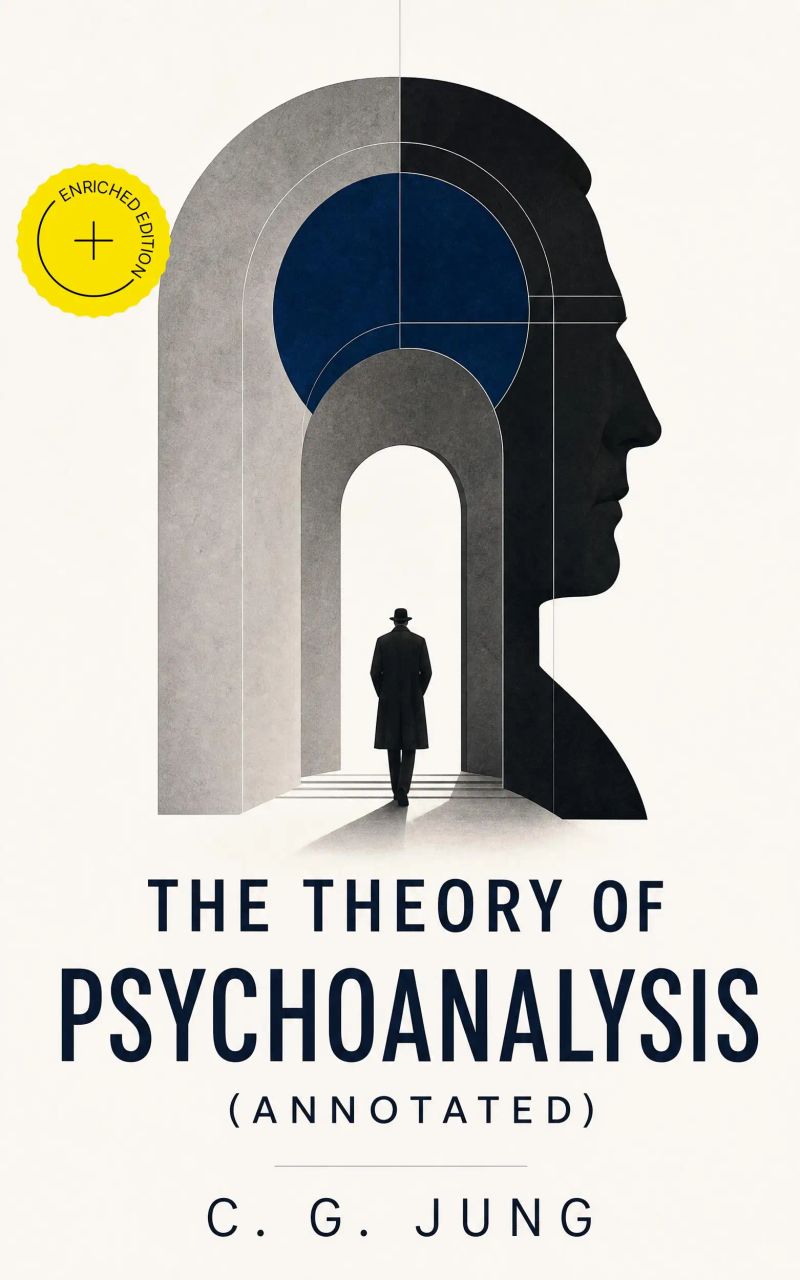
The Theory of Psychoanalysis (Annotated)
Enriched Edition. Lectures on Libido, Dreams, Neurosis, and the Origins of Analytical PsychologyBy C. G. Jung

Length7h 20m
About this audiobook
In The Theory of Psychoanalysis, C. G. Jung presents a lucid and consequential account of the principles, methods, and disputes that shaped early depth psychology. Originally delivered as lectures, the work combines clinical exposition with theoretical argument, clarifying concepts such as repression, libido, dreams, neurosis, and symbolic formation. Its style is disciplined yet exploratory, poised between medical science and humanistic interpretation. Historically, the book stands at the pivotal moment when Jung was both inheriting and revising Freud's psychoanalytic framework, expanding psychic life beyond sexuality toward broader symbolic and cultural meanings. Jung, a Swiss psychiatrist trained at the Burghölzli clinic in Zurich, brought to psychoanalysis an unusually wide intellectual range: psychiatry, mythology, religion, anthropology, and philosophy all informed his thought. His collaboration with Freud gave him intimate knowledge of orthodox psychoanalysis, while his clinical encounters and independent temperament led him to question its limits. This book reflects that transitional period, revealing the foundations of the analytical psychology he would later develop. Readers interested in the origins of modern psychotherapy will find this volume indispensable. It is especially recommended for students of psychology, intellectual history, and literature who wish to understand how psychoanalysis became a theory of meaning as well as a theory of illness.
This enriched edition has been carefully crafted to add value to your reading experience.
- A succinct Introduction situates the work's timeless appeal and themes.
- The Synopsis outlines the central plot, highlighting key developments without spoiling critical twists.
- A detailed Historical Context immerses you in the era's events and influences that shaped the writing.
- An Author Biography reveals milestones in the author's life, illuminating the personal insights behind the text.
- A thorough Analysis dissects symbols, motifs, and character arcs to unearth underlying meanings.
- Reflection questions prompt you to engage personally with the work's messages, connecting them to modern life.
- Hand‐picked Memorable Quotes shine a spotlight on moments of literary brilliance.
- Interactive footnotes clarify unusual references, historical allusions, and archaic phrases for an effortless, more informed read.
Audiobook details
Rating★★★★ 3.9 (452)
Includes Goodreads, Amazon, LibraryThing
GenrePsychology
Length7 hrs 20 mins
Narrated byListen with 1,000+ voices
FormateBook with Audio
Publish dateDec 9, 2023
LanguageEnglish
Table of contents
1The Theory of Psychoanalysis (Annotated)
2Introduction
3Synopsis
4Historical Context
5Author Biography
Show all chaptersShow less
6INTRODUCTION
7CHAPTER I Consideration of Early Hypotheses
8A Change in the Theory of Psychoanalysis
9The Traumatic Theory
10The Traumatic Theory Criticized
11The Conception of “Repression”
12The Theory of Sexual Trauma in Childhood
13Theory of Sexual Trauma Abandoned
14The Predisposition for the Trauma
15The Sexual Element in the Trauma
16The Infantile Sexual Phantasy
17CHAPTER II The Infantile Sexuality
18Objections to the Sexual Hypothesis
19The Conception of Sexuality
20The “Sexuality” of the Suckling
21The Polymorphic Perverse Sexuality of Infancy
22The Sexual Components as Energic Manifestations
23CHAPTER III The Conception of Libido
24The Energic Theory of Libido
25The Conception of Unconscious Phantasy
26The Sexual Terminology
27The Three Phases of Life
28The Sexual Definition of Libido Must be Abandoned
29The Problem of Libido in Dementia Præcox
30The Genetic Conception of Libido
31CHAPTER IV The Etiological Significance of the Infantile Sexuality
32The Infantile Sexual Etiology Criticized
33The Traumatic Theory—A False Way
34Retardation of the Emotional Development
35Introversion
36The Complex of the Parents
37Infantile Mental Attitude
38Unconscious Phantasy
39CHAPTER V The Unconscious
40CHAPTER VI The Dream
41The Method of Dream Analysis
42CHAPTER VII The Content of the Unconscious
43The Problems of the Incest-Complex
44CHAPTER VIII The Etiology of the Neuroses
45The Regression of Libido
46The Infantile Amnesia Criticized
47The Latent Sexual Period Criticized
48Further Remarks on the Etiology of Neurosis
49The Etiological Significance of the Actual Present
50The Etiological Significance of Failure of Adaptation
More from C. G. Jung
What to Make of a LifeJim Collins13h 31m4.4 (794)$33 · $0.00

Matters of the HeartJacinta Nampijinpa Price9h 35m4.8 (359)$29 · $0.00

Black AF HistoryMichael Harriot15h 43m4.7 (14.6K)$33 · $0.00

Bad Fat Black GirlSesali Bowen6h 32m4.7 (2.8K)$24 · $0.00

Invisible StormJason Kander6h 48m4.7 (3.2K)$24 · $0.00

I Am The StormJanice Dean9h4.6 (1.5K)$8 · $0.00

On Democracies and Death CultsDouglas Murray10h 38m4.6 (6.5K)$29 · $0.00

TerraformPropaganda5h 39m4.7 (594)$24 · $0.00

Southern Horrors: Lynch Law in All Its Phases (Annotated)Ida B. Wells-Barnett2h 44m4.6 (1.3K)$2 · $0.00

Hour of the HeartIrvin D. Yalom, Benjamin Yalom8h 19m4.6 (2.3K)$26 · $0.00

Braving the TruthRachel Held Evans11h 31m4.7 (359)$29 · $0.00
Level UpRob Dial7h 42m4.6 (3.3K)$26 · $0.00

As a JewSarah Hurwitz8h 36m4.6 (1.2K)$26 · $0.00

Saint Joan (Annotated)George Bernard Shaw6h 20m4.6 (1.2K)$1.20 · $0.00

Burn the HaystackJennie Young, PhD9h 30m4.6 (543)$29 · $0.00

Woman and the New Race (Annotated)Margaret Sanger6h 30m4.6 (1K)$0.99 · $0.00

Good InsideBecky Kennedy9h 55m4.5 (59.3K)$29 · $0.00
The Mis-Education of the NegroCarter Godwin Woodson5h 4m4.5 (29.4K)$1.20 · $0.00

Du Bois: EssaysW.E.B. Du Bois6h 22m4.6 (1.5K)$1 · $0.00

The North American Indian (Illustrated Edition)Edward S. Curtis, Frederick Webb Hodge5h 59m4.6 (1.4K)$2 · $0.00
You may also like

A General Introduction to Psychoanalysis & Dream Psychology (Psychoanalysis for Beginners)Sigmund Freud24h 49m4.0 (15K)$1.99 · $0.00

Totem and TabooSIGMUND FREUD6h 19m4.0 (19.3K)$3.50 · $0.00
The Interpretation of DreamsSigmund Freud23h 38m4.0 (132.1K)$2 · $0.00
The Collected Works of Sigmund FreudSigmund Freud92h 34m4.3 (722)$1.99 · $0.00
A General Introduction to PsychoanalysisSigmund Freud17h 20m4.0 (16.6K)$1.20 · $0.00
Totem and TabooSigmund Freud6h 19m4.0 (28.6K)$3.50 · $0.00

Psychology of The Unconscious (Annotated)Carl Gustav Jung22h 3m4.2 (3.1K)$2 · $0.00
On dreamsSigmund Freud2h 26m3.9 (3.7K)$1 · $0.00
Care of the SoulThomas Moore3h 3m4.2 (22.8K)$18 · $0.00
PSYCHOANALYSIS FOR BEGINNERS: A General Introduction to Psychoanalysis & Dream Psychology (Annotated)Sigmund Freud24h 53m3.7 (4.5K)$2 · $0.00

STEPHEN HEROJames Joyce32h 39m3.9 (1.6K)$2.99 · $0.00
A general introduction to psychoanalysisSIGMUND FREUD17h 18m4.0 (18.9K)$3.50 · $0.00

H. P. LOVECRAFT Ultimate Collection: Novellas, Short Stories, Poetry & Essays (Annotated)H. P. Lovecraft12h 28m4.6 (2.3K)$2 · $0.00
The UnconsciousSigmund Freud, H. W. Chase40h 2m4.1 (2.9K)$1.99 · $0.00

Dream Psychology: Psychoanalysis for BeginnersSigmund Freud6h 47m3.9 (5.3K)$1 · $0.00

Psychoanalasys For BeginnersSigmund Freud24h 35m3.7 (5.7K)$2 · $0.00

Boundaries of the Soul, Revised and UpdatedJune Singer18h 39m4.2 (1.1K)$30 · $0.00

Leonardo da VinciSigmund Freud2h 41m3.7 (2.6K)$1.20 · $0.00

Stephen Hero (Annotated)James Joyce33h 39m3.9 (1.5K)$1.99 · $0.00

Palmistry for AllCheiro4h 20m3.9 (1.5K)Free